
Accenture Case Interview: Strategy vs Consulting, Group Format, and Prep Plan (2026)
Accenture case interviews differ from MBB: group cases, Potentia for Strategy, and digital focus. Full breakdown, worked example, and prep plan for 2026.
On this page
The Accenture case interview in 2026 differs from MBB interviews in three ways: the case content carries a heavy digital layer (cloud migration ROI, AI implementation, transformation roadmaps rather than pure-strategy prompts), Accenture Strategy candidates may face the Potentia problem-solving interview, and group case interviews with 4-6 candidates are a signature format most other firms skip. Components vary by role and region, some Strategy processes include Potentia-style problem solving, some Consulting processes include digital-transformation cases, so confirm the exact format, timing, and participant count from your invitation; Accenture does not publish one comparable acceptance rate. Candidate perception of the process is unusually positive: according to Management Consulted's analysis of Glassdoor data, Accenture interviews carry a 68.3% positive rating and 89% of respondents rated the interview a fair assessment of their skills, among the highest scores in the industry.
This guide breaks down exactly what Accenture's process looks like, where it diverges from MBB, and how to build a prep plan that actually targets the right skills.
Accenture Strategy vs Accenture Consulting: Two Different Interviews
Most candidates apply to Accenture without distinguishing between its two main consulting tracks. That's a mistake: they have meaningfully different interview formats.
Accenture Strategy targets the same market as McKinsey, BCG, and Bain: high-stakes, board-level strategic questions for large corporations and governments. It recruits primarily from target MBA programs and top undergraduate institutions. The case interview at Accenture Strategy is more rigorous, and the track uses the Potentia interview as its signature assessment.
Accenture Consulting (often called Technology & Strategy Consulting) covers a broader mandate: implementation, operations, digital transformation, and technology advisory. Cases follow a more standard consulting format with a pronounced digital orientation. This track recruits both MBAs and undergrads at scale.
If you're unsure which track you're applying to, check your recruiter confirmation email. The interview invitation usually names the specific business unit.
Practice Accenture-style digital cases with AI feedback
Road to Offer's AI case coach gives you live feedback on structure, hypothesis quality, and communication across profitability, growth, market entry, and digital transformation cases.
The Potentia Interview (Accenture Strategy Only)
The Potentia is the interview that makes Accenture Strategy distinctive. Here's how it works:
- You receive a short paragraph (typically 2-4 sentences) describing a broad business topic or scenario
- You have 5 minutes to read, analyze, and structure your initial thoughts
- You present your thinking to the interviewer for roughly 10-15 minutes
- The interviewer then probes with follow-up questions for the remainder of the session (45-60 minutes total)
What makes it unusual: there is no quantitative analysis and no correct answer. According to MConsultingPrep's Accenture preparation guide, assessors evaluate how creatively and logically you explore a complex business problem under pressure. They're testing whether you can generate multiple angles on an ambiguous topic, prioritize them quickly, and communicate your reasoning clearly.
A sample prompt might be: "Digital health companies are expanding into primary care. What are the key strategic considerations?"
In 5 minutes, a strong candidate would:
- Identify 3-4 lenses (consumer demand, competitive dynamics, regulatory, technology capability)
- Establish a hypothesis about which lens matters most
- Prepare 2-3 provocative observations that show original thinking
The Potentia is not about structure for structure's sake. It rewards candidates who can form a genuine point of view quickly, not just enumerate categories.
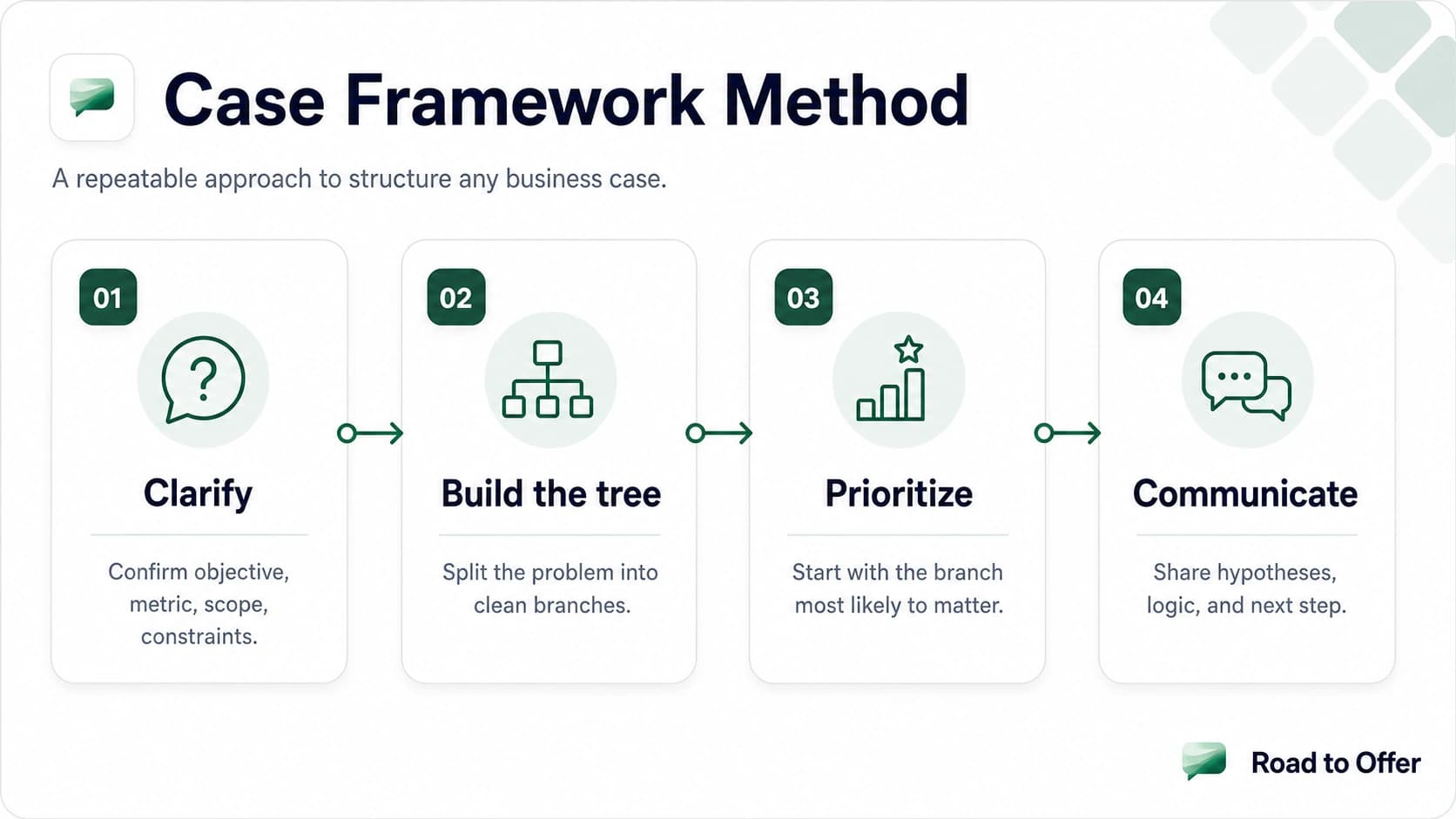
Learn the case method
One dense lesson, each step linked to the drill that trains it.
Standard Case Interview Format at Accenture
Beyond Accenture Strategy's Potentia, both tracks use traditional case interviews. Accenture's official Case Workbook identifies three main case formats:
Type 1: The Great Unknown
Minimal context, often just one or two sentences. Your job is to ask targeted clarifying questions to define the problem, then structure your analysis from scratch.
Example prompt: "Our client is a European retail bank experiencing margin pressure. What would you investigate?"
This format tests your ability to define a problem before solving it, a skill that separates good candidates from great ones. Candidates who rush to a framework without clarifying which business, which margins, and which time horizon are flagged immediately.
Type 2: The Parade of Facts
You receive a rich briefing document (sometimes 3-4 pages with charts, financials, and market data). The challenge is synthesis, not structure. You need to identify what's actually relevant and build a coherent narrative from a lot of noise.
Strong candidates move through data by forming a hypothesis first, then testing it against the data. Weak candidates try to analyze every data point and lose the thread.
Type 3: The Back of the Envelope
Market sizing and estimation questions. According to IGotAnOffer's Accenture case guide, these appear frequently at Accenture compared to MBB where structured cases dominate.
Example: "How many cybersecurity consultants does the U.S. need to hire over the next five years?"
Accenture also mixes interviewer-led and candidate-led formats within the same session. In interviewer-led cases, you respond to a scripted sequence of questions. In candidate-led cases, you propose what to investigate and drive every step. Both require different default behaviors: in interviewer-led cases, be concise and responsive; in candidate-led cases, be proactive about naming your next analytical move.

Profitability · medium
Practice for Accenture in a real case interview
Matched to this Accenture guide: a live energy profitability case with an AI interviewer. Free, scored on every step.
Practice this next: Run a market sizing drill before your next Accenture mock so the estimate becomes a timed rep, not passive reading.
How should you align your Accenture resume and cover letter before this interview?
Match the documents to the exact Accenture role, market, and invitation. The resume should prove how you translated a problem into delivery, while the letter explains why that role is the right context for the evidence.
- Before: Supported a digital project.
- After: Mapped the user handoff, compared failure points, and proposed a workflow adopted by the project sponsor.
Check that the resume proof, letter motivation, and case story describe the same role. Then rehearse the revised line as a short project explanation. Recruiters read the documents together: the resume proves the work, and the letter explains why it matters for this Accenture role. The Accenture cover letter guide owns the full letter structure, and the Accenture resume guide shows how to evidence delivery the way Accenture screens for it.
Make the application evidence consistent
Upload the resume for a Road to Offer graded report, not an Accenture hiring score.
Revise one line, rehearse the matching story, and bring that evidence into the next case practice rep.
The Group Case Interview: Accenture's Key Differentiator
Most MBB-focused candidates have never practiced a group case. That's a gap that costs Accenture candidates offers.
Group cases at Accenture involve 4-6 candidates working through a consulting problem together, typically under 45-60 minutes. According to PrepLounge's Accenture forum, the format usually works like this:
- Individual reading time (10 minutes): Each candidate receives a package of case materials, sometimes identical information and sometimes different pieces of the puzzle
- Group discussion (20-30 minutes): The team works collectively to structure the problem, share insights, and develop a recommendation
- Group presentation (10-15 minutes): The team presents to assessors, who may ask follow-up questions
Assessors evaluate two dimensions simultaneously: your individual analytical contribution AND how you work within the team. Scoring criteria typically include:
- Clarity of contribution: Do your points advance the group's thinking, or do you just agree with others?
- Collaboration without dominance: Do you build on others' ideas and invite quieter members to speak?
- Course correction: If the group heads in the wrong direction, can you redirect tactfully?
- Communication under pressure: Do you stay organized and concise when time is short?
For a full breakdown of group case strategies, see our guide on group case interview preparation, which covers participation frameworks, how to manage dominant teammates, and timing tactics.
Build group case skills before your Accenture interview
Practice structured thinking, synthesis under pressure, and collaborative case-solving with our AI coach, designed for both solo and group case formats.
The Digital Lens: What Makes Accenture Cases Different
If you've only practiced cases from MBB case books, you're missing Accenture's most distinctive case content. Accenture's core revenue comes from digital transformation, cloud services, and technology advisory, and that shows in its cases.
According to My Consulting Offer's Accenture prep guide, common digital case themes include:
- Cloud migration strategy: Should a manufacturer migrate its ERP to the cloud, and if so, how should it prioritize workloads?
- AI/automation ROI: A financial services client wants to automate back-office operations. What's the business case, and what are the implementation risks?
- Digital transformation roadmap: A legacy retailer is losing ground to digitally native competitors. What's a realistic 3-year transformation plan?
- Data strategy: A healthcare system wants to build a patient data platform. What governance, build-vs-buy, and monetization questions must it answer first?
These cases reward candidates who understand technology not just as a cost lever but as a strategic asset. You don't need to be a software engineer, but you do need to think fluently about concepts like build vs buy, platform economics, implementation sequencing, and change management.
Worked Digital Transformation Case Example
Prompt: "Your client is a $3B specialty chemicals company that processes most of its supply chain manually. A competitor just announced an AI-powered procurement system that reportedly cuts procurement costs by 18%. The CEO wants to know: should we build a similar system, and what would it cost?"
Framework applied:
What scored here: Immediate quantification of the opportunity, a structured build/buy/partner analysis, and a phased recommendation that de-risks the full implementation rather than committing to $40M upfront.
That fast decomposition (procurement base, savings rate, payback window) is the kind of live arithmetic Accenture cases reward. Run it yourself:
This type of case doesn't appear in classic MBB case books. Practicing with technology-flavored profitability and strategy cases is non-negotiable for Accenture prep.
Practice this next: Try a free digital-flavored case and push your recommendation to include implementation sequencing, not just the strategic answer.
The Behavioral Interview: Accenture's Core Values in Practice
Accenture places heavier behavioral emphasis than most consulting firms, using a structured behavioral interview as a standalone assessment, not just a quick warm-up before the case.
Accenture assesses candidates against six stated core values:
- Client Value Creation: delivering measurable business impact
- One Global Network: collaboration across geographies and functions
- Respect for the Individual: valuing diverse perspectives
- Best People: continuous learning and excellence
- Integrity: honesty and accountability
- Stewardship: long-term, responsible thinking
According to Hacking the Case Interview, the most commonly probed competencies are:
- Adaptability: "Describe a time you had to adopt a new system or process that replaced your existing approach."
- Collaboration under conflict: "Tell me about a time you managed a difficult stakeholder relationship."
- Learning agility: "Give me an example of when you had to master an unfamiliar skill quickly."
- Resilience: "Describe a time you failed and what you did differently next."
Each story should run 90-120 seconds using the STAR structure: set the Situation (15 sec), define your Task (10 sec), describe your Actions (60 sec), state the Result with a specific metric (20 sec). Results without numbers get downgraded. "The project went well" is much weaker than "we reduced onboarding time by 40% over 6 months."
For building a full story bank and calibrating STAR structure, start with the Accenture behavioral interview guide, then use the broader behavioral interview for consulting guide for cross-firm calibration.
How Accenture Compares to MBB
For candidates interviewing at multiple firms simultaneously, here's where preparation overlaps and where it diverges:
The overlap is real: structured thinking, hypothesis-led analysis, clean communication, and MECE frameworks transfer directly. What doesn't transfer: ignoring the group dynamic, skipping digital case types, and treating the Potentia like a standard case with numbers. Accenture's online assessment stage, a mix of cognitive and situational scenario tests, also has no clean MBB equivalent, so build that screen into your prep timeline.
According to Management Consulted's Accenture guide, Glassdoor data shows Accenture interviews carry a 68.3% positive rating and 89% of respondents felt the interview was a fair assessment of their skills, among the highest perception scores in the consulting industry.
Common Mistakes in Accenture Case Interviews
Mistake 1: Preparing only for 1-on-1 cases. Group cases require a completely different behavioral register. If you've never practiced with 5 people in the room, your first time should not be your actual interview.
Mistake 2: Treating the Potentia like a regular case. Candidates who spend 4 minutes building a MECE framework and 1 minute analyzing it miss the point. The Potentia rewards provocative hypotheses and original angles, not exhaustive categorization.
Mistake 3: Skipping digital case content. A cloud migration ROI analysis, an AI build-vs-buy decision, or a digital transformation sequencing problem will appear in most Accenture interviews. If your case library doesn't include these, you're underprepared.
Mistake 4: Generic behavioral stories. Stories that don't reference specific outcomes, specific stakeholders, or specific constraints feel fabricated. Accenture's behavioral assessors are looking for operational texture: real details that prove the story actually happened.
Mistake 5: Under-synthesizing in group cases. When time runs short in a group case, the candidate who says "let me summarize where we've landed: we believe X because of Y and Z, and our recommendation is W" consistently scores highest. Synthesis at pressure points is what assessors note.
For a full breakdown of timing, communication, and structure errors that tank candidates across firm types, see the case interview tips and common mistakes guide.
Accenture Case Interview Prep Plan
Build your prep around Accenture's three differentiators: the Potentia, group cases, and digital content.
Execution checklist
Identify your track (Strategy vs Consulting). Potentia prep is irrelevant for Consulting; skipping it is catastrophic for Strategy
Practice 10 solo cases in 2 weeks. Build baseline comfort with case structure and math before adding complexity
Practice 3 Potentia sessions (Strategy track only). Use business articles as prompts; time yourself; record and review
Practice 2 group cases with 4+ people. Group dynamics cannot be simulated alone; recruit classmates or use an online prep community
Build a digital case mini-library. Practice 3-5 cases with cloud, AI, or transformation angles; use MIT Sloan Management Review for scenarios
Prepare 5 behavioral stories mapped to Accenture's 6 core values. Each story should fit at least 2 values; prepare a results metric for each
Run 1 full mock with a timer on all sections. Stamina matters; a 3-hour Accenture assessment day requires rehearsed pacing
For a full week-by-week timeline across all preparation stages, the consulting interview prep timeline guide includes a 6-week plan that maps directly to Accenture's assessment structure.
Related Guides for Accenture Preparation
Accenture's process touches multiple preparation domains. These articles cover the specific skills you'll need:
- Group Case Interview Guide: Full breakdown of group case dynamics, participation strategies, and how to score in a competitive group setting
- Case Interview Frameworks: Complete Guide: The core frameworks (profitability, market entry, growth) that anchor most Accenture cases
- Deloitte case interview guide: The closest Big 4 peer for transformation and implementation-focused case work
- PwC case interview guide: Another Big 4 peer with a similar digital and advisory focus
- Capgemini Invent case interview guide: Capgemini's digital innovation arm and a direct competitor for Accenture's transformation work
- KPMG case interview guide: Big 4 peer for candidates comparing consulting tracks across the large professional services firms
- Case Interview Fit Questions: Behavioral question bank with answer templates calibrated for consulting firm interviews
- Market Sizing Step by Step: Back-of-the-envelope estimation is disproportionately common at Accenture; build this skill before your interview
- Written Case Interview Guide: Accenture occasionally uses written case formats in final rounds; the synthesis and slide-structure skills overlap directly
Interactive Drills
Find out where you stand before your Accenture interview
Start a free case and get scored across structure, analysis, communication, and digital case fluency, with feedback on the gaps most Accenture candidates miss.
Sources and Further Reading (checked June 17, 2026)
- Accenture careers and interviewing: accenture.com/us-en/careers
- Accenture behavioral interview prep (official Accenture blog): accenture.com/ca-en/blogs/blogs-careers/how-to-prepare-for-a-behavioral-interview
- Accenture FY19 Case Interview Workbook (official PDF): accenture.com, Case Workbook PDF
- IGotAnOffer Accenture case interview guide: igotanoffer.com/blogs/mckinsey-case-interview-blog/accenture-case-interview
- Management Consulted Accenture case interview: managementconsulted.com/accenture-case-interview
- MConsultingPrep Accenture case study guide: mconsultingprep.com/accenture-case-study-interview
- My Consulting Offer Accenture interview guide: myconsultingoffer.org/case-study-interview-prep/accenture-case-interview
- Hacking the Case Interview, Accenture business analyst guide: hackingthecaseinterview.com/pages/accenture-business-analyst-interview
- PrepLounge Accenture group case preparation: preplounge.com/consulting-forum/how-to-prepare-for-a-group-case-interview-at-accenture-21902
- Glassdoor Accenture interview reviews: glassdoor.com/Interview/Accenture-Interview-Questions-E4138.htm
Frequently asked questions
Resources and related guides
- Practice for Accenture in a real case interviewPractice
- Browse all free resourcesResource hub
- PwC Case Interview Guide 2026: Strategy&, Format, and Full Prep PlanFirm Specific · Mar 15, 2026
- Roland Berger Case Interview Guide: Process, Group Case & Sample Case (2026)Firm Specific · Mar 15, 2026
- McKinsey vs BCG: 10 Real Differences (2026 Guide)Firm Specific · May 1, 2026
- Top Automotive Consulting Firms in 2026: Rankings and Candidate GuideFirm Specific · Jun 1, 2026