
Consulting Behavioral Interview: STAR + 20 Questions
Prepare consulting behavioral and cultural-fit interviews with STAR, 20 adaptable prompts, sample answers, and firm-specific official guidance.
Your first interview question
Get your full coached feedback now. Continue the interview free after sign-up.

On this page
A consulting behavioral interview asks for evidence of how you have led, collaborated, influenced, decided, learned, and handled setbacks. Cultural-fit questions are part of that evidence: they test whether your demonstrated working behaviors and motivation align with the role and firm, not whether your personality matches the interviewer.
The format varies. McKinsey publishes guidance for its Personal Experience Interview; BCG and Bain publish their own interview guidance. Use those current pages and your invitation as the authority rather than assuming one timing, weight, or question sequence applies everywhere.
How Consulting Firms Weight Behavioral Interviews
Behavioral format and decision weight vary by firm, role, office, and interview stage. The useful comparison is what the current official guidance says each process tests.
Format also varies by stage: some firms screen behavioral answers first through a recorded HireVue video interview, where you answer fit questions to a camera with no interviewer to react to.
The implication is simple: prepare the behavioral evidence with the same care as the case. Do not assume it is merely a tiebreaker or that a strong case automatically overrides weak experience evidence.
For firm-specific consulting fit prep, use the new guides for Oliver Wyman, EY-Parthenon, Strategy&, Kearney, Roland Berger, L.E.K., and Simon-Kucher.
The STAR Method
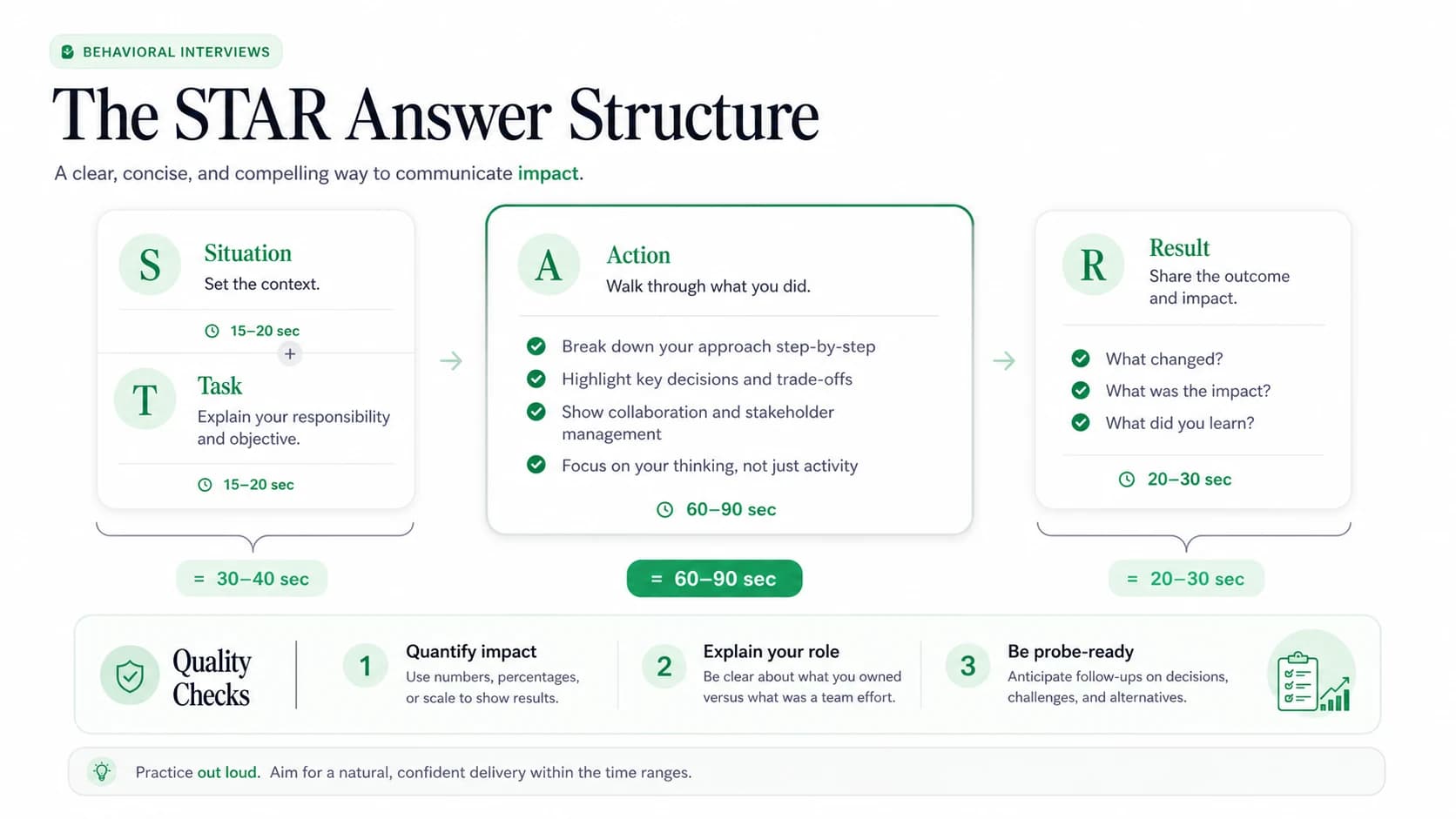
STAR is a useful framework for behavioral answers: Situation, Task, Action, Result. It is a tool for clarity, not a script every firm requires. Use it when it helps the interviewer follow the evidence.
STAR Framework
- 01
Situation. Set only the context needed to understand the stakes
- 02
Task. State your responsibility, constraint, or decision
- 03
Action. Explain what you specifically did and why
- 04
Result. State the outcome, evidence, and what you learned
Timing
A useful opening answer is concise enough to leave room for follow-up and detailed enough to establish your actions. Adjust to the question and interviewer rather than forcing a stopwatch formula.
Assessment-led firms can probe this differently from MBB. If your process mentions Korn Ferry or a structured talent screen, pair this guide with the Korn Ferry case interview guide.
- Situation + Task: concise context and your responsibility.
- Action: the largest share, focused on your decisions and behavior.
- Result: the outcome, evidence, limits, and reflection.
Common STAR Mistakes
- Too much situation, too little action. Spending 2 minutes setting the scene and 30 seconds on what you did. The interviewer cares about your actions, not the backstory.
- Vague actions. "I worked with the team to find a solution" tells the interviewer nothing. What specifically did you do? What did you say?
- Team results claimed as individual. "We grew revenue by 30%" doesn't tell the interviewer your contribution. What was your specific role in that outcome?
- No learning or reflection. The best answers end with a genuine insight: "If I did this again, I'd involve the finance team earlier. That's something I've applied since." Recording yourself and watching back is the fastest way to catch these habits, including how body language and presence affect the interviewer's perception even in behavioral sections.
What does cultural fit mean in consulting?
In a defensible interview process, cultural fit is evidence about work behavior and motivation. It should not mean similarity to the interviewer. The useful questions are whether you can collaborate, challenge ideas constructively, learn from feedback, handle ambiguity, communicate with clients, and explain why this role and firm make sense for you.
Useful cultural-fit prompts include:
- Tell me about a team norm you improved.
- Describe a time you disagreed with a leader and how you handled it.
- What feedback was difficult to accept, and what changed afterward?
- Tell me about a situation where the ethical or client-safe choice was not the easiest one.
- Which part of this firm's work is most relevant to your next learning goal, and why?
For “Why this firm?”, avoid generic prestige, people, and impact claims. Build the answer from three pieces: a specific capability or office strength, evidence gathered from official material or conversations, and a credible link to work you have done or want to learn.
Top 20 Consulting Behavioral Interview Questions
These 20 prompts cover common evidence categories. They are practice questions, not a claim that every firm asks the same list.
Leadership
- Tell me about a time you led a team through a difficult situation.
- Describe a time you had to lead without formal authority.
- Tell me about a situation where you had to make an unpopular decision.
- Describe a time you had to delegate effectively under tight deadlines.
Teamwork and Collaboration
- Tell me about a time you had to work with someone who was difficult.
- Describe a situation where you had to resolve a conflict within a team.
- Tell me about a time you had to adapt your communication style for a different audience.
- Describe a team project where someone wasn't pulling their weight. How did you handle it?
Influence and Persuasion
- Tell me about a time you convinced someone to change their mind.
- Describe a situation where you had to sell an idea to a skeptical audience.
- Tell me about a time you had to negotiate a compromise.
- Describe a time you influenced a decision without having the final say.
Problem-Solving and Initiative
- Tell me about a time you identified and solved a problem before anyone else noticed it.
- Describe a situation where you had to make a decision with incomplete information.
- Tell me about a time your initial approach failed and you had to pivot.
- Describe a time you went beyond your normal responsibilities to achieve a result.
Failure and Learning
- Tell me about your biggest professional failure and what you learned.
- Describe a time you received tough feedback. How did you respond?
- Tell me about a goal you didn't achieve. What happened?
Motivation and Fit
- Why consulting? Why this firm?
Interactive Drills: Behavioral Practice
Interactive drill set. Write an answer before revealing the worked solution, then continue into Road to Offer for scored practice and AI feedback.
Learn the behavioral method
STAR that survives probing, linked to the live AI interviewer.
Four fictional composite sample answers
The examples below are fictional composites written to demonstrate structure. Replace every detail with evidence from your own experience. Do not copy the names, numbers, or outcomes.
Sample 1: Leadership Under Pressure
Question: "Tell me about a time you led a team through a difficult situation."
Situation: "Three weeks before a student case competition, our faculty adviser became unavailable and a sponsor withdrew."
Task: "As club president, I had to decide whether we could deliver a credible event with less time and money."
Action: "I separated the must-haves from the extras, recruited a replacement adviser, approached local employers with a one-page sponsorship proposal, and rebuilt the event budget around a smaller venue and simpler catering. I gave each workstream one owner and reviewed risks every two days."
Result: "We delivered the event on schedule and within the revised budget. The useful lesson was not simply that the event survived; it was that I learned to define the non-negotiable outcome before asking the team to solve the constraints."
Sample 2: Influencing Without Authority
Question: "Tell me about a time you convinced someone to change their mind."
Situation: "During a product internship, an engineering leader favored building an internal CRM while the team also carried a large customer-feature backlog."
Task: "I needed to test the build decision and present the tradeoff without pretending I owned it."
Action: "I mapped the required features, compared credible off-the-shelf options, and estimated the engineering capacity each path would consume. In the discussion I led with the decision criteria and asked which tradeoff mattered most rather than declaring the original plan wrong."
Result: "The leader selected an external option after validating security and integration requirements. I learned that influence came from making the decision easier to inspect, not from having the strongest opinion in the room."
Sample 3: Failure and Learning
Question: "Tell me about your biggest professional failure and what you learned."
Situation: "Early in my career, I led a short market-research project and misunderstood the client's desired output."
Task: "I owned the analysis, client communication, and final deliverable."
Action: "I had started detailed analysis without confirming the outline. When the first review exposed the mismatch, I owned it, agreed on a new decision-led structure, cut work that did not support the decision, and set two interim reviews so the client could correct direction earlier."
Result: "We delivered the revised output, but the work was less polished than it could have been. Since then I confirm the decision, outline, and example output before deep analysis, and I can explain one later project where that checkpoint prevented the same mistake."
Sample 4: Drive
Question: "Tell me about a time you achieved a significant result through personal initiative."
Situation: "During graduate school, I noticed that students relied on scattered anecdotes about recruiting formats and outcomes."
Task: "No one had assigned the problem, so I first needed to confirm that students and career services would use a structured resource."
Action: "I interviewed students and career advisers, designed an anonymous survey with clear consent language, and built a searchable resource that separated official process information from candidate reports. I tested the first version with a small group before expanding it."
Result: "Career services adopted the resource for the next recruiting cycle and assigned an owner to maintain it. I learned that initiative is more credible when you validate the need, protect sensitive data, and build a handoff rather than stopping at the first launch."
Prepare the case evidence too
When your process includes a live case, practice explaining the structure, data, math, and recommendation out loud.
Firm-Specific Behavioral Differences
McKinsey PEI
McKinsey's official interviewing guide describes its current Personal Experience Interview themes and preparation expectations. Read that page close to your interview because names and process details can change. Prepare detailed examples rather than memorized summaries.
Preparation implication: map at least one detailed, truthful example to every theme named in the current official guidance. Avoid forcing a generic leadership story into a learning or connection question. For a question bank organized by theme, see the McKinsey PEI questions guide.
Deep dive: McKinsey PEI Guide
BCG Fit Questions
BCG's behavioral interview preparation page describes experience and capabilities as evidence against role-relevant values and competencies, not a generic personality match. The placement and length of those questions can vary by process.
Preparation implication: Follow the current invitation for the sequence. Prepare both behavioral evidence and analytical case skills because a BCG process can assess both, but do not assume they always appear inside one interview.
Bain Behavioral Interview
Bain's official interviewing page explains that interviews can ask candidates to describe past experiences, sometimes in the context of a consultant skill. Use the current role guidance rather than assuming a fixed dedicated session.
Preparation implication: include collaboration evidence and be precise about your contribution without claiming the team's result as your work alone.
More detail: Bain Case Interview Guide
Deloitte Behavioral Interview
Deloitte formats vary by role and region. The process may include competency, motivation, case, group, or other exercises, so follow the current posting and invitation.
Preparation implication: make the motivation answer specific to the role, practice, and office rather than relying on a universal script.
Stress-Testing Your Stories
Build a compact story bank that collectively covers leadership, teamwork, influence, initiative, resilience, motivation, and self-awareness; the best consulting behavioral interview resources can help you find additional practice material. The selection matters less than the depth. One story can support several questions when you change the emphasis without changing the facts.
For every story, prepare for follow-up such as:
- What specifically did you say/do?
- How did the other person react?
- Why did you choose that approach?
- What would you do differently?
- How has this experience changed your approach since?
If you cannot answer these cleanly, gather the missing facts or choose a different story.
Next Steps
- McKinsey PEI deep dive: McKinsey PEI Guide with current themes and full sample answers
- McKinsey PEI question bank: McKinsey PEI questions guide with 30+ practice prompts by dimension
- Fit questions across all firms: Case interview fit questions with 30 questions and worked examples
- STAR method for consulting: STAR method for consulting interviews with MBB-specific upgrades
- Why consulting: Why consulting answer guide for the motivation framework
- What motivates you: What motivates you for the dedicated motivation-question answer structure
- Leadership stories: Leadership story examples for scenario shapes and STAR templates
- Bain behavioral specifics: Bain Case Interview Guide with role-aware behavioral preparation
- Overall prep strategy: Consulting Interview Prep Timeline for a complete study plan
- Practice case interviews: How to Practice Case Interviews for session structure
Sources and Further Reading (checked June 17, 2026)
- McKinsey interview preparation and PEI dimensions: mckinsey.com/careers/interviewing
- BCG behavioral interview preparation guide: careers.bcg.com/blogarticle/how-to-prepare-for-a-behavioral-interview
- BCG interview process overview: careers.bcg.com/global/en/interview-process
- Bain experience interview and behavioral prep: bain.com/careers/hiring-process/interviewing
- DDI STAR method origin and behavioral interviewing: ddi.com/solutions/behavioral-interviewing/star-method
- IGotAnOffer McKinsey PEI questions and guide: igotanoffer.com/blogs/mckinsey-case-interview-blog/mckinsey-pei-how-to-impress-your-interviewer
- PrepLounge personal fit interview basics: preplounge.com/en/case-interview-basics/personal-fit-interview
Frequently asked questions
Resources and related guides
- Practice a real behavioral interviewPractice
- Browse all free resourcesResource hub
- Consulting Fit Interview Questions: 30 Examples + AnswersGetting Started · Mar 1, 2026
- Best Case Interview Books 2026: Ranked, Scored, and What to SkipGetting Started · Mar 20, 2026
- Tell Me About a Time You Managed Multiple Priorities: AnswerGetting Started · Jul 1, 2026
- ChatGPT Interview Preparation Guide (Prompts + Workflow) 2026Getting Started · May 1, 2026