
Guidehouse Case Interview 2026: Process, Cases, and Clearance
Ace the Guidehouse case interview with proven prep strategies, sample cases, behavioral tips, and a 30-day study plan for government consulting roles.
On this page
The Guidehouse case interview in 2026 tests candidate-led business cases with a public sector, healthcare, financial services, energy, infrastructure, or national security angle. Guidehouse formed in 2018 from PwC's public sector practice and expanded its scale and capabilities through a $1.1B acquisition of Navigant in 2019, which is why its cases lean toward government operations, healthcare compliance, and defense program management rather than the market-entry or PE-style cases MBB firms favor. Cases are typically candidate-led and run 30-40 minutes across four recurring types: federal ops, healthcare compliance, defense program management, and financial risk. Expect the process to vary by role: a campus consultant interview may look different from a cleared defense, technology, or experienced-hire role, and prior security clearance (Secret or TS/SCI) is a meaningful differentiator for Defense and Intelligence roles. Treat recruiter instructions and the live job posting as the source of truth, then prepare for structured problem solving, behavioral stories, and mission-driven client context.
Build Your Case Interview Foundation
Practice 100+ structured case prompts with instant AI feedback, covering government, healthcare, and commercial cases.
Guidehouse at a Glance
Guidehouse sits in a distinct category: it is neither a pure commercial strategy firm (like McKinsey or BCG) nor a pure government IT shop (like Leidos or SAIC). It occupies the advisory middle ground, helping agencies improve operations, manage risk, and comply with regulations, while also serving commercial healthcare and financial services clients.
The Veritas Capital ownership matters for your prep: Guidehouse is run like a commercial business targeting efficiency and growth, which means even government cases will have an ROI or cost-reduction angle.
The Guidehouse Interview Process: All Rounds Explained
Candidate reports commonly describe 2–3 rounds, but Guidehouse's process varies by role, practice, office, and clearance needs. Use the recruiter email and job posting as the source of truth.
Round 1: Recruiter Screen (30 minutes, phone) A standard fit call covering your resume, why consulting, and why Guidehouse. Expect questions about your interest in public sector work. This round does not include a case.
Round 2: Case + Behavioral Interviews (2–3 interviews, 45–60 min each) This is the substantive round. You will typically face:
- One or two behavioral interviews using the STAR method
- One candidate-led case interview running 30–40 minutes
- Possible written component or 48-hour take-home case for some roles
Round 3: Partner/Managing Director Final (senior and lateral roles) For experienced hire and managing consultant roles, a final round with a partner or managing director may occur. This round is heavily behavioral with a focus on client management and leadership judgment.
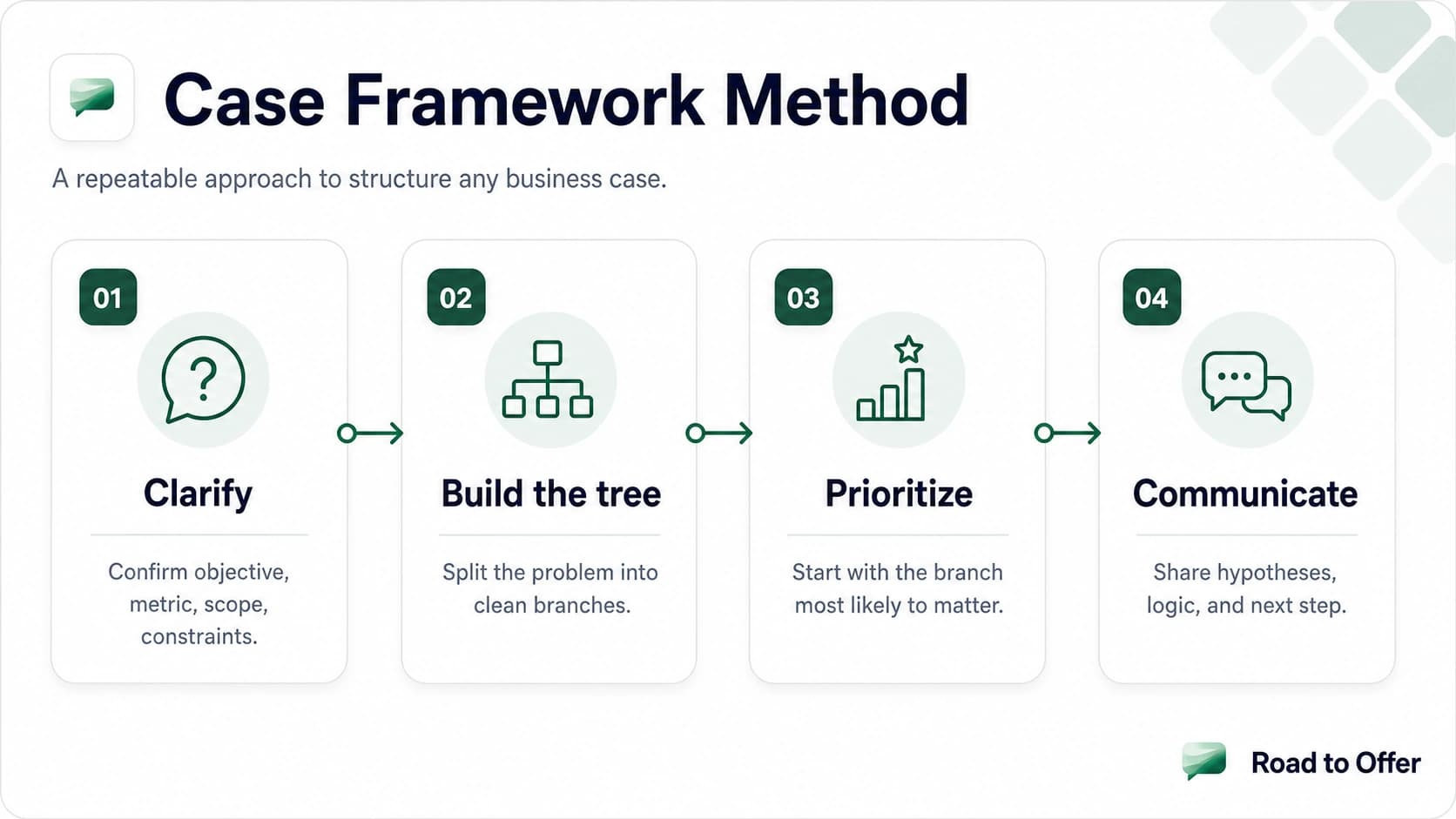
Learn the case method
One dense lesson, each step linked to the drill that trains it.
Guidehouse Case Interview Format: What to Expect
Guidehouse cases are candidate-led, meaning you control the structure, questions, and pace. This differs from interviewer-led formats (common at McKinsey) where the interviewer directs each step.
Typical case structure (30–40 minutes)
- Problem statement (3–5 min): Interviewer presents a scenario, often a federal agency or healthcare client facing a challenge
- Clarifying questions (2–3 min): Ask about the client's goal, timeline, and constraints
- Framework (3–5 min): Structure your approach. Problem tree or issue tree is preferred.
- Analysis (15–20 min): Work through each branch, request data, do math, synthesize
- Recommendation (3–5 min): Clear, concise, data-backed conclusion
Format variants candidates report
Not every Guidehouse interview is the standard live case. Two exercise variants appear in recent candidate reports for some roles:
- Excel-based exercise: you receive a spreadsheet dataset to clean, analyze, and summarize in a consulting-style output. CaseBasix's Guidehouse guide (updated August 20, 2026) reports it for some specialized or technical roles, and Hacking the Case Interview lists it as one of Guidehouse's three case formats alongside live cases and take-homes.
- Prepare-then-present: a technical round built around material you made in advance. One 2026 candidate report on Wall Street Oasis describes presenting a 15-minute slide deck built from data sent 48 hours before the session.
If your invitation mentions data analysis or a technical round, ask the recruiter whether it is a live case, an Excel exercise, or a prepared presentation, since the prep for each is different. The live candidate-led case remains the most common format for consulting roles.
Four Common Guidehouse Case Types
1. Government Operations & Efficiency Federal agencies asked to cut costs or improve service delivery. Common prompts: a federal agency needs to reduce administrative overhead by 20%, or a state Medicaid office wants to decrease claims processing time.
The mechanics, diagnosing where service broke down and rebuilding a staffing and process plan to recover it, transfer directly from a commercial operations turnaround. Practice one so the candidate-led diagnostic feels routine.

Operations · hard
Practice for Guidehouse in a real case interview
Matched to this Guidehouse guide: a live travel operations case with an AI interviewer. Free, scored on every step.
2. Healthcare Compliance & Cost Hospital systems, payers, or CMS clients dealing with regulatory compliance, billing optimization, or care model restructuring.
3. Defense Program Management DoD programs over budget or behind schedule. You may be asked to diagnose the root cause and recommend a corrective action plan.
4. Financial Services Risk Banks or insurance companies needing risk framework improvement, regulatory response plans, or AML (anti-money laundering) program overhauls.
More fast, multi-step arithmetic drills in the same style Guidehouse expects you to run live:
Practice Guidehouse-style case math from the Road to Offer drill engine. Answer a real prompt and get AI-scored feedback. Free accounts include 5 drills per day for the first 3 days after signup.
How should you align your Guidehouse resume and cover letter before this interview?
Match the documents to the exact public-sector, healthcare, defense, technology, or other role named in the posting. Verify any clearance, citizenship, or assessment requirement and protect restricted details.
- Before: Supported a government project.
- After: Mapped the approval handoff, identified the delayed decision point, and prepared options for the authorized stakeholder review.
Check that the line is releasable and that the role requirements come from the current invitation. Recruiters read the resume and cover letter together: the resume proves delivery, while the letter explains role and mission fit. Rehearse the same evidence without adding protected context.
Review the evidence at the confidentiality boundary
Drop the resume here for an independent graded report on what the cleared work can show without detail. Road to Offer's score, not a Guidehouse screen.
By uploading, you agree to resume analysis and report storage until you delete it. See the privacy policy.
Revise one safe line, rehearse the matching story, and use it in the next role-specific case rep.
Security Clearance: The Guidehouse Differentiator
Unlike McKinsey, BCG, or Bain, Guidehouse actively recruits for cleared consulting roles at multiple classification levels. This is a meaningful differentiator in your application strategy.
For campus recruits, most entry-level positions do not require a pre-existing clearance but will sponsor eligible candidates. You must be a U.S. citizen and able to pass a background investigation. Having a prior clearance (from ROTC, internships, or military service) is a significant differentiator. Mention it explicitly in your application and interviews.
For roles requiring clearance, interviewers will often ask about your background, international exposure, and financial history as part of assessing clearance eligibility. These are not traditional fit questions. Answer factually and directly.

Operations · hard
Practice a real public sector operations case
Matched to this Guidehouse guide: a public sector operations case, guided step by step. Free.
Behavioral Questions: Guidehouse's Mission-Driven Culture
Guidehouse emphasizes public sector mission alignment. Your behavioral stories need to reflect more than commercial impact. They should demonstrate that you understand and care about serving agencies and the public they represent.
High-frequency behavioral questions at Guidehouse
- "Tell me about a time you navigated ambiguity on a complex project."
- "Describe a situation where you had to influence a stakeholder who didn't initially agree with your recommendation."
- "Give me an example of a time you worked within a heavily regulated or compliance-driven environment."
- "Why Guidehouse specifically, versus a commercial consulting firm?"
- "Tell me about a time you contributed to a team achieving a mission-critical goal."
STAR answers for Guidehouse: what good looks like
Guidehouse vs. Booz Allen Hamilton vs. Accenture Federal
These three firms are frequently compared by candidates targeting the public sector consulting market.
Booz Allen Hamilton places less emphasis on structured case interviews than Guidehouse. Its process is primarily behavioral (hackingthecaseinterview.com). If you are debating between the two, you should prepare case interviews specifically for Guidehouse.
Accenture Federal Services overlaps significantly with Guidehouse in DoD and DHS work, but Accenture has a larger technology implementation footprint, while Guidehouse leans more toward advisory and financial management.
30-Day Guidehouse Prep Plan
Execution checklist
Days 1–5: Case fundamentals. Review MECE structuring, issue trees, and profitability frameworks.. Guidehouse cases require solid structural thinking even if math is lighter than MBB
Days 6–10: Government case specialization. Study federal budget structure, OMB, program management frameworks.. Government context is tested implicitly; knowing how agencies work speeds your analysis
Days 11–15: Practice 6 full cases (2 per topic: government ops, healthcare compliance, financial risk). Volume builds pattern recognition across the most relevant Guidehouse-style case types; use Road to Offer drills when you need fast feedback on structure and synthesis
Days 16–20: Behavioral story bank. Write and rehearse 6 STAR stories with mission-driven framing.. Behavioral rounds at Guidehouse are weighted heavily; preparation here has high ROI
Days 21–25: Mock interviews with feedback. At least 2 full-length mock cases with a partner.. Candidate-led format requires practice communicating your thought process out loud
Days 26–28: Firm research. Read Guidehouse practice area pages, recent press releases, and government contract awards.. Interviewers expect you to know which practice you are applying to and why
Days 29–30: Final review. Refine your 'Why Guidehouse' answer and logistics prep.. Last-mile polish on your opening and closing answers prevents avoidable misses
Interactive drill set. Write an answer before revealing the worked solution, then continue into Road to Offer for scored practice and AI feedback.
Preparing for the Written or Take-Home Component
Some Guidehouse roles (particularly in financial advisory and healthcare) include a written case or take-home component. Candidates are typically given a dataset or scenario and 24–48 hours to produce a structured presentation or memo.
Format tips:
- Lead with a single clear recommendation on page 1 (no build-up)
- Use 3 supporting arguments, each with quantitative backing
- Include a risks/limitations section, as government clients always want to know what could go wrong
- Keep slides to 8–12 or memos to 3–4 pages; longer is not better
Common mistakes:
- Spending 40+ hours on a 48-hour case (scope creep)
- Not checking math in exhibits, as errors signal poor attention to detail
- Using commercial consulting jargon (e.g., "synergy capture") for government clients who use different terminology
Related Prep Resources
If you are preparing for Guidehouse, these related guides will round out your preparation:
- Booz Allen Hamilton Case Interview Guide: closest peer firm comparison
- West Monroe Partners Case Interview: another US mid-market digital and operations advisory firm
- Top healthcare consulting firms: how Guidehouse's federal and commercial health work compares with MBB health practices, Big 4 health arms, and health-IT employers
- Case Interview Frameworks: Complete Guide: build the structural foundation
- Behavioral Interview for Consulting: STAR method and story bank
- Government & Healthcare Case Types: What to Know: sector-specific case prep
- Written Case Interview Guide: prep for the take-home component
- Case Interview Communication Tips: candidate-led format requires strong verbal clarity
Get Ready for Your Guidehouse Interview
Use a guided prep path to tighten your structure, math, and communication before Guidehouse-style interviews.
Sources (checked June 17, 2026; additions September 15, 2026)
- Guidehouse official: About Guidehouse
- Navigant/Guidehouse Interview Formats, CaseBasix (updated August 20, 2026)
- Guidehouse Interview Reports, Wall Street Oasis
- Guidehouse official: Careers
- Guidehouse Interview Questions, Glassdoor
- Guidehouse (Navigant) Consulting Interview Guide, Hacking the Case Interview
- Guidehouse Firm Overview & Salary Data, Management Consulted
- Guidehouse Completes $1.1B Acquisition of Navigant, Consulting.us
- Booz Allen Hamilton Case Interview Guide, Hacking the Case Interview
- Public Sector Consulting Case Interview Guide, Hacking the Case Interview
- Guidehouse Jobs & Security Clearance Roles, ClearanceJobs
- Navigant/Guidehouse Profile, CaseInterview.com
Frequently asked questions
Resources and related guides
- Practice for Guidehouse in a real case interviewPractice
- Browse all free resourcesResource hub
- AlixPartners Careers 2026: Turnaround Salary and Interview GuideFirm Specific · Sep 11, 2026
- Alvarez and Marsal Careers 2026: Restructuring Salary and Interview GuideFirm Specific · Sep 11, 2026
- Analysis Group Case Interview: Process, Question Types, and How to Prepare (2026)Firm Specific · Mar 25, 2026
- Capital One Case Interview Guide (2026): Format, Examples & Prep StrategyFirm Specific · Mar 15, 2026