
Tell Me About Yourself Consulting Interview: How to Answer
Tell me about yourself in a consulting interview is answered with a 60 to 90 second story (our recommendation, since no firm publishes a length): what you do now, two proof points, why consulting, why this firm. Pick one through-line and stop so the interviewer can probe. Below are a template, illustrative drafts and a cut list.
Your first interview question

For the wider fit context, read the behavioral interview consulting guide after this page.
How do you answer tell me about yourself in a consulting interview?
To answer tell me about yourself in a consulting interview, use four parts: who you are now, two proof points, why consulting, and why this firm. Treat it like a case opening: you are not saying everything, you are showing you can choose what matters.
- Now. One sentence on what you do or study and the thread running through it.
- Proof. Two experiences that show problem solving, leadership or client impact, each with what you did and what changed.
- Why consulting. The kind of problem you want more of, in your words.
- Why this firm. One connection that follows from your story: a practice, an industry, a conversation.
A fill-in version:
My background is in [field or role], and the thread through it is [theme]. The two experiences that shaped it were [proof 1] and [proof 2], because they required me to [consulting skill]. I realized I am most energized by [type of problem], which is why I am drawn to consulting and to [firm or practice connection].
Pick the through-line first by asking one question: what is the one quality that should make this interviewer want me on a team? Everything that does not support it gets cut. The same spine also works in a consulting coffee chat, in a softer tone.
How long should a consulting tell me about yourself answer be?
A consulting tell me about yourself answer should run 60 to 90 seconds, which is our recommendation, because no firm publishes a length. At a normal speaking pace that is roughly 150 to 225 words (a rule of thumb, not a firm requirement).
That fits how our other guides treat the opener: about a minute in the consulting interview questions bank, and a short pitch before the deeper story in the BCG fit interview guide. Our advice: stay under two minutes. A fit interview is a conversation, so leave room for follow-ups on the experiences you raised.
Practice your opening answer out loud
Run a short behavioral practice session and get feedback on whether your story is clear, specific, and interview-ready.
Practice your intro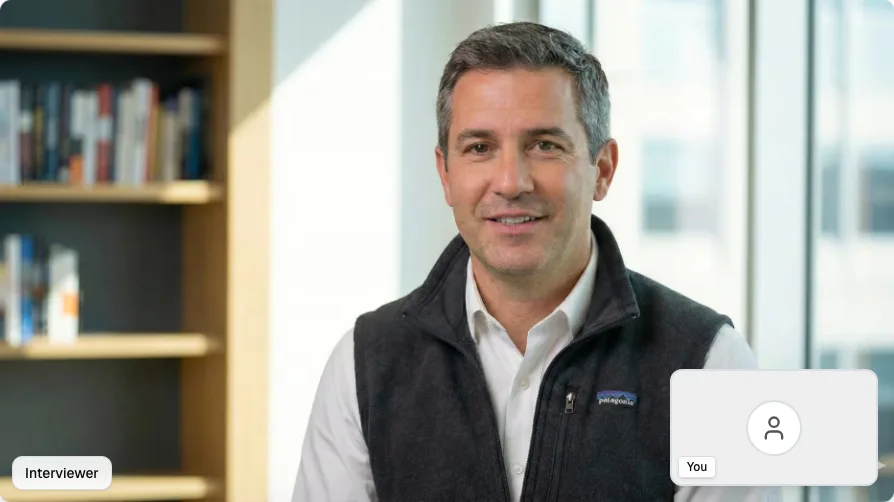
What should I say when an interviewer asks me about myself?
When an interviewer asks you about yourself, talk about your professional story and leave out everything that does not prove you can do the job. Use these rules:
- One skill per experience. If you mention three experiences, let each prove a different thing, for example problem solving, then communication, then leadership. Two skills in one story blur both.
- Order. Start with now, then go back only as far as the proof requires. If you prefer chronological order, keep it short and end on the present.
- Numbers. Add a result only when it is true and you can defend it in a follow-up.
- Hobbies and personal facts. Include one only if it supports the through-line. Skip your hometown and childhood.
- The close. End on a forward step, such as consulting, not on a list.
Before rehearsing, test each proof point: could you answer three follow-ups about your role, the conflict and the decision? If not, choose a stronger experience. Your story bank for leadership examples and the STAR method help here.
What does a tell me about yourself answer look like for your background?
A tell me about yourself answer follows the same four parts for every background and swaps in your own proof. The drafts below are illustrative templates with placeholders, not real achievements. Use only experiences that are yours: McKinsey's interviewing page lists "exaggerating or creating achievements that aren't yours" as not allowed (checked November 2026).
Undergraduate
"I am studying [major], and what I keep coming back to is [theme, such as turning analysis into a decision]. In [student group or internship], I [what you did] and [result you can defend]. In [second experience], I [what you did with a team]. That is why consulting is the next step: I want to keep solving [type of problem] with a team. I am especially interested in [firm connection]."
MBA or career switcher
"I started in [function], where I [responsibility] and saw how hard it is to turn [strategy or analysis] into [outcome]. The work I enjoyed most was [diagnosing, aligning stakeholders, planning], for example [project]. Business school widened that from [functional lens] to a general management lens. Consulting lets me apply that across [industries or client situations], which is why I am interested in [firm or practice]."
PhD candidate
"I am finishing a PhD in [field]. The part I enjoy most is not [technical detail] but [deciding what to test first with limited time, or explaining a result to a non-expert partner]. In [project], I [what you decided and what changed]. I want to do that kind of prioritizing across more problems than one thesis allows, which is why I am applying to consulting."
Experienced hire
"My background is [technical or finance field], and the work I have enjoyed most sits between [analysis] and [business decision]. In [project], I [what you did], which led to [result you can defend]. In [second project], I [stakeholder or leadership example]. I want to work on problems where the output is a decision, which is why consulting and [practice or industry] fit."
Keep the structure, replace every bracket with your own facts, and say it the way you speak.
Is tell me about yourself the same as walk me through your resume?
Tell me about yourself and walk me through your resume are close enough that one prepared answer covers both. The difference is emphasis.
In both cases the trap is reading the resume aloud: the interviewer already has it. What they cannot see on the page is why the experiences add up to consulting, so that is the part your answer has to supply. If your firm's next step is a deeper story, such as the McKinsey Personal Experience Interview or the BCG fit interview, keep this opener short and save the detail for those questions.
Do McKinsey, BCG and Bain ask tell me about yourself?
On the pages we checked, McKinsey, BCG and Bain list no "tell me about yourself" question or model answer, so prepare the opener and confirm the format with your recruiter. What each firm says on its own pages (checked November 2026):
One BCG nuance: a 2022 BCG careers blog post by a recruiting specialist in the Dubai office says that in a behavioral-style interview "You won't get asked questions like 'tell me about yourself'" (BCG blog, checked November 2026). That is one office and one format, so treat it as a reason to expect behavioral questions and still prepare the opener. Our BCG behavioral interview questions and Bain fit interview guide cover each format, and MBB behavioral interview styles compares them.
University career centers describe it as a standard opener. Yale's Office of Career Strategy says you are likely to be asked it at the start of a job or internship interview, Harvard's career services lists it first among general introduction questions, and UC Berkeley publishes a worksheet for it (all checked November 2026).
Why do consulting interviewers ask tell me about yourself?
Consulting interviewers ask tell me about yourself because your answer shows how you synthesize facts, choose what matters and communicate a point. That is close to the daily consulting task: take a lot of information, structure it, make it useful to someone else.
Our recommendation is one core opener for every firm, changing only the last sentence, the firm bridge, so a BCG tell me about yourself answer differs from another firm's only there. A consulting answer differs from a generic job-interview introduction. A generic answer lists school, activities and interests. A consulting answer says why those facts matter for advisory work. The interviewer is listening for clarity, relevance, motivation and self-awareness. The prompt can appear in a recruiter screen, a fit conversation or before a case; the consulting interview process guide places it in the full sequence, and why consulting is the question that usually follows.
What mistakes make a tell me about yourself answer sound junior?
The mistakes that make a tell me about yourself answer sound junior are reciting the resume, opening with trivia, using prestige language, over-polishing and ignoring the firm.
- Reciting the resume. Weak: "I went to this school, joined this club, did this internship." Stronger: "My background centers on analytical problem solving in team settings, first in coursework, then in a strategy internship."
- Opening with personal trivia. Hometown and childhood rarely help unless they explain a professional thread.
- Prestige language. Weak: "I want consulting because it is fast paced and works with top clients." Stronger: "The projects I enjoyed most required me to structure ambiguous problems and turn analysis into recommendations."
- Over-polishing. A perfect script can sound less credible than a clear answer in natural phrasing. Practice should make you more precise, not more theatrical.
- No firm link. An answer that fits any employer is unfinished. Add a firm-specific reason only if it follows from real evidence.












Prep plans for McKinsey, BCG, Bain, Deloitte, Accenture, EY-Parthenon, Kearney, Oliver Wyman, Roland Berger, L.E.K., OC&C, Strategy&, Simon-Kucher, Arthur D. Little, Capital One and your target firm. Choose your firm in the plan builder.
Get your prep plan
A week-by-week schedule built around your target firm and interview date.


How do you practice a tell me about yourself answer?
Practice your tell me about yourself answer in three passes: draft the spine, say it out loud, then pressure-test the follow-ups. Write the four parts, say them without reading, record once, and cut filler and any sentence that does not help the interviewer see your fit.
Next, get feedback from a peer, mentor or mock interviewer. MIT's career office, for one, offers mock interviews with constructive feedback (checked November 2026); a live behavioral practice session does the same on demand and shows which claims need a stronger example. Then use the fit bank in consulting fit interview questions.
Your opener should also set up the case: structure, prioritization and clean communication. The table lists three real cases from the case library to run after the fit portion. Median times come from completed voice runs between June 25 and September 22, 2026, and count runs, not people.
| Case (style, industry) | Quant difficulty | Qualitative difficulty | The math you run | Median time |
|---|---|---|---|---|
GreenBite Snacks Profitability Reset (McKinsey, packaged snacks). 6 (2 with math), 2 exhibits. | medium | easy | Channel decline share, partial EBITDA recovery | 16 min, 56 voice runs |
UrbanBrew Coffee Margin Case (BCG, coffee chain). 6 (2 with math), 2 exhibits. | medium | easy | Category gross margin, EBITDA recovery | 16 min, 117 voice runs |
Meridian Electronics (Bain, consumer electronics). 9 (5 with math), 3 exhibits. | medium | medium | Synergies as spend times savings rate | 21 min, 14 voice runs |

The case styles match the three firms in the table above. Once your opener is ready, the case interview prep guide connects it to the rest of your preparation. Your first full case is free when you create an account.
Practice the rest of the fit interview
After your opening answer is sharp, rehearse the behavioral follow-ups that usually come next.
Start free practiceSources and Further Reading (checked November 2026)
- McKinsey - Getting ready for your interviews
- BCG - Interview process
- BCG - How to Prepare for a Behavioral Interview (Oct 18, 2022)
- Bain & Company - Interviewing
- Harvard FAS Mignone Center for Career Success - Interviewing
- Yale Office of Career Strategy - Interview Preparation
- UC Berkeley Career Engagement - Interview Preparation
- MIT Career Advising and Professional Development - Interviewing
Frequently asked questions
Let your favorite AI make the case
Ask ChatGPT, Claude, or Perplexity whether Road to Offer is worth it. We're confident you'll like the answer.
No affiliation with ChatGPT, Claude, or Perplexity
Resources and related guides
- Practice a real behavioral interviewPractice
- Browse all free resourcesResource hub
- Leadership Story Examples for Consulting InterviewsFundamentals · Jun 3, 2026
- Accenture Salary Guide 2026 - Pay by Level and Career PathFundamentals · May 20, 2026
- Case Interview Prep for Non-Business Majors: A 2026 PlanFundamentals · Jun 3, 2026