
Bain Fit and Behavioral Interview Guide: Questions, Dimensions & Model Answers (2026)
How Bain scores the fit and behavioral interview in 2026: the four dimensions, a complete backward-looking and forward-looking question bank with model STAR answers, a story-mapping table, and the red flags that sink strong candidates.
Your first interview question
Get your full coached feedback now. Continue the interview free after sign-up.
On this page
The Bain fit and behavioral interview is a scored, standalone component of Bain's 2026 recruiting loop, weighted alongside the case, the written case, and (in some offices) a group exercise. According to StrategyCase, roughly 1 in 100 applicants clear Bain's full interview process, so the behavioral round is a real filter, not a warm-up. Bain interviewers run two kinds of questions: classic backward-looking stories about what you actually did, and forward-looking "how would you handle this" scenarios that older guides ignore. The fit portion itself is short, MConsultingPrep puts a typical consulting fit segment at 10 to 15 minutes, so every answer has to be structured and tight. Bain scores you on decision-making quality, ownership, teamwork, and learning. This guide gives you the full question bank for both halves, model STAR answers mapped to each dimension, a story-mapping table, and the red flags that sink otherwise-strong candidates.
Where the Behavioral Interview Sits in Bain's Process
Bain runs a multi-part interview loop, and the fit and behavioral component is a deliberate, scored part of it, not filler around the case. MConsultingPrep notes that candidates typically face 4 to 6 interviews across the full process, and a behavioral segment shows up inside most of them, usually 10 to 15 minutes before or after the case. Some offices and rounds also add a written case (StrategyCase describes the written format as roughly 30 minutes of planning and analysis, 10 minutes drafting the output, and 30 minutes presenting and defending it) and occasionally a group exercise.
The point to internalize: behavioral signal can be as decisive as case performance. Two candidates who both crack the case are separated by how they answer "tell me about a time you led through a difficult situation." Bain is hiring people who will sit in front of clients, so the fit interview is where they test whether you are someone a partner trusts in the room. For the other half of the loop, the case mechanics are covered in our Bain case interview guide.
The Four Dimensions Bain Likely Scores For
Bain's behavioral evaluation is not a vibe check, but it is not a published rubric either. Bain does not release an official behavioral scorecard, so treat the four dimensions below as a synthesis of what prep coverage consistently converges on, not a leaked checklist. Knowing them still lets you aim every story at what is most likely being measured. The four that recur across Bain prep coverage are:
MConsultingPrep maps Bain's fit screen to a similar trio: leadership, achievement and drive, and analytical problem-solving. The two framings overlap. Leadership and drive live inside ownership and decision-making; analytical problem-solving shows up in how you reasoned through a decision. The practical move is to make sure every story you prepare clearly demonstrates at least two of these dimensions, so you are never caught with an answer that lands flat against the thing the interviewer is grading.
Bain's Backward-Looking vs Forward-Looking Split
This is the part many guides underplay. Bain does not only ask about your past; the fit interview tends to pair two distinct question types:
- Backward-looking (classic PEI): "Tell me about a time you..." These probe real, lived experience. They are where STAR storytelling and your prepared story bank do the work.
- Forward-looking (hypothetical scenarios): "How would you handle a client who resists your recommendation?" "How would you motivate a report who has checked out?" "What would you do if an unexpected roadblock hit two days before a deliverable?" These test judgment in real time, not memory.
The forward-looking half is what trips candidates who over-prepared scripts. You cannot memorize an answer to a scenario you have not seen, and that is the point. As experienced coaches put it, there is no reliably likely question at this level: everything is unlikely, so adaptability beats memorization. If you walk in with eight rehearsed monologues and nothing else, a single "how would you..." question can unravel the impression you built.
The Complete Bain Behavioral Question Bank
Below is the two-column bank: the backward-looking PEI question and the forward-looking scenario for each of Bain's four dimensions. Prepare for both columns, not just the left one.
Other backward-looking prompts that show up at Bain: leading a team through a difficult situation, influencing a decision without formal authority, and a time you took ownership of a problem that was not technically yours. Map each of these to one of the four dimensions before your interview so you know which story you will reach for.
Model answer: a backward-looking question (STAR)
Question: "Tell me about a time you led a team through a difficult situation." (Dimension: decision-making quality + ownership)
- Situation: As the operations lead for my university's 600-person career fair, I found out ten days before the event that our main venue had double-booked us, and we had no backup space.
- Task: I had to relocate the entire fair without losing the 40 employer sponsors who had already paid and printed their materials.
- Action: Instead of escalating and stalling, I split my five-person committee into two tracks: two people cold-called every alternative space on and off campus while I renegotiated with the original venue for a smaller overflow room as a fallback. When a nearby conference center came back as workable, I rebuilt the floor plan that night and sent all 40 sponsors a one-page change notice the next morning, before the rumor mill could start.
- Result: We moved the fair with only two sponsors dropping out instead of the dozen we feared, attendance held at roughly 550, and the conference center became our default venue the following year.
- Reflection: I learned that in a logistics crisis the first job is to control the information, not just the plan. Telling sponsors before they heard a rumor is what kept their trust, and I now over-communicate the moment a plan breaks.
Notice the structure: it states the decision, explains the reasoning, gives a measurable outcome, and ends with a lesson. That is exactly the answer-first shape Bain rewards.
Model answer: a forward-looking question (reason out loud)
Question: "A client resists a recommendation you are confident is correct. How would you handle it?" (Dimension: teamwork and collaboration + decision-making)
A strong answer is structured, not a single sentence: "First I would clarify whether the resistance is about the analysis or the implementation, because they need different responses. If it is the analysis, I would walk back through the data and pressure-test my own assumptions in front of them, since being confidently wrong is worse than being slow. If it is implementation, the recommendation may be right but the path is, so I would co-design a phased version with the client team that captures most of the value with less disruption. Throughout, I would treat their pushback as information, not an obstacle, and I would escalate to my manager before the relationship is damaged rather than after." That answer shows judgment, collaboration, and humility in one pass.
How to Answer: STAR and Answer-First Storytelling
Bain rewards concise, structured delivery and penalizes rambling. The reliable shape:
- State the decision or headline first. Open with the outcome or the call you made, then back into the story. Interviewers should know in the first sentence where you are going.
- Walk the STAR spine. Situation and task briefly, action in detail, result with a number wherever one exists.
- Show the reasoning, not just the actions. Bain scores decision quality, so say why you chose, not only what you did.
- End with reflection. One specific, applied lesson signals the learning dimension and lands the answer.
Keep a single story under two minutes. If you cannot tell it in that window, it is not refined yet. Bain's interviewers are listening for a clear protagonist (you), a real decision, and a measurable result. For a deeper comparison of how this differs from McKinsey's highly structured Personal Experience Interview, read our McKinsey PEI guide; the structures rhyme, but McKinsey drills one story far deeper while Bain ranges across more dimensions.
Build Your Story Bank: The Mapping Table
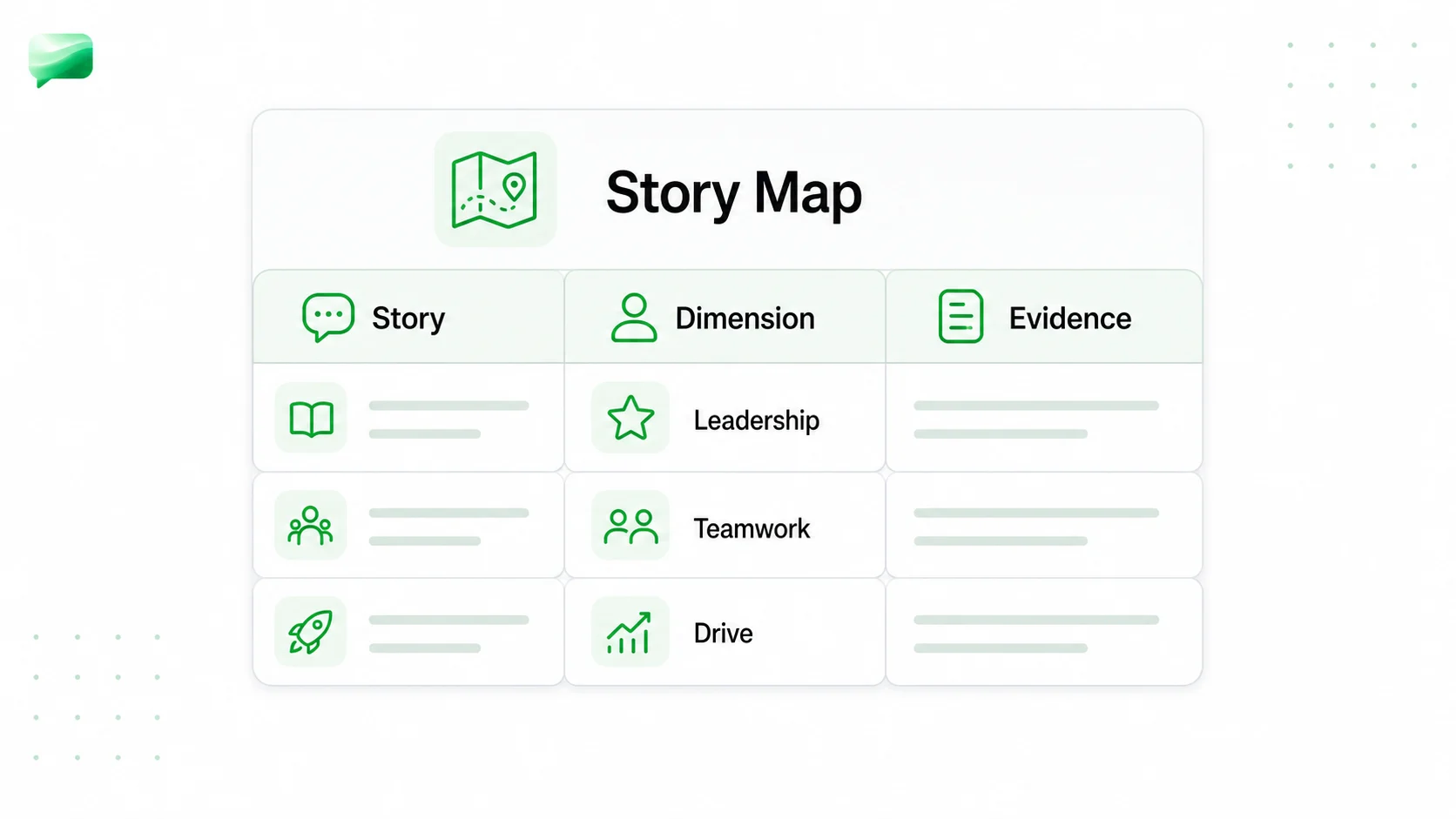
The biggest efficiency unlock is preparing a small set of flexible stories and mapping each to multiple dimensions, so one experience can answer several questions. MConsultingPrep recommends 3 to 5 stories, ideally 3 to 4 detailed and well-rounded ones; broader guidance pushes 5 to 6 if you have the range. Aim to cover all four dimensions at least twice.
Here is the artifact to leave this article with. Fill it in with your own experiences:
Each story should be tagged for at least two dimensions. When a question lands, you choose the story whose strongest tag matches what the interviewer is grading. That is how you avoid the dreaded "I do not have an example for that" freeze.
Handling Forward-Looking Scenario Questions
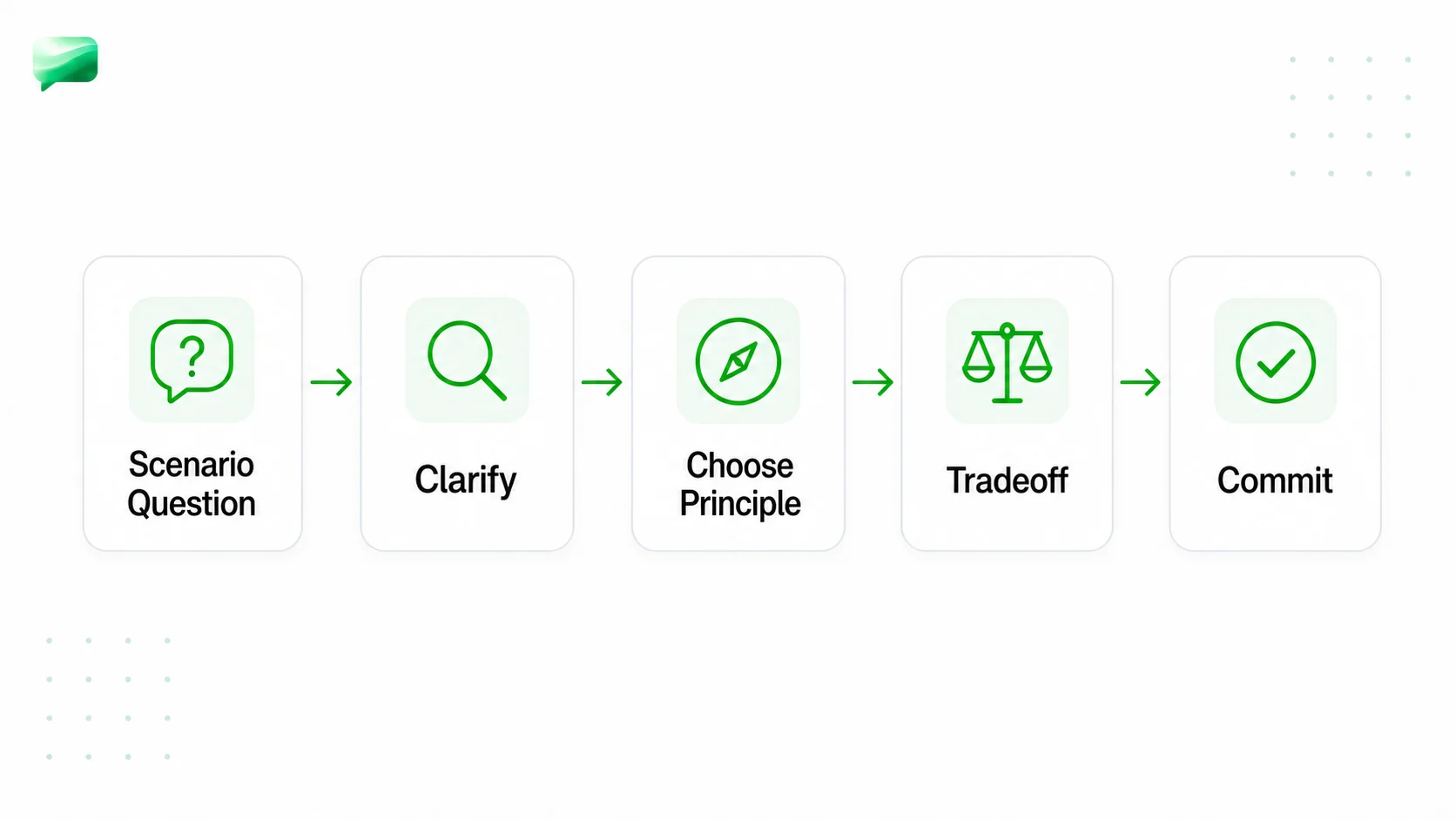
Forward-looking questions reward adaptability, and you cannot script them. The way to prepare is to practice the process, not the answers:
- Clarify first. Restate the scenario and ask one sharp question if the prompt is ambiguous. This buys thinking time and shows you do not jump to conclusions.
- Name your priorities out loud. "My first priority is protecting the client relationship, my second is getting the analysis right." This is the behavioral equivalent of laying out a framework.
- Walk the approach step by step. Two or three concrete moves, in order, with the reasoning attached.
- Address the obvious risk. End by naming what could go wrong with your approach and how you would watch for it.
Because there is no predictable question, the candidates who do best are the ones who treat every hypothetical as a chance to show judgment, not to recite a memorized line. Practicing aloud (with a partner, a coach, or an AI drill) is the only way this gets fluent.
Red Flags and Common Mistakes
Bain interviewers debrief on a shortlist of recurring tells. These are the ones that quietly cost offers:
- Stories that fit any firm. An answer tuned for a McKinsey PEI or a generic behavioral round usually underplays the ownership-and-results angle Bain weights most. Re-aim the story at Bain, do not paste it across.
- An outcome with no number behind it. A story that ends on "the project was a success" leaves the interviewer nothing to grade. Anchor it to a metric or a concrete before-and-after, or it reads as inflated.
- Stopping before the lesson. Cutting the reflection forfeits the learning dimension outright. Close every story with what you now do differently because of it.
- A story that overstays its window. Past roughly two minutes, the signal flips from "structured" to "cannot prioritize," the exact opposite of the consultant read.
- Freezing on forward-looking questions. Treating a hypothetical as a trivia question instead of a reasoning exercise. Walk it like a mini-case: clarify, prioritize, approach, risk.
- A thin "Why Bain?" Generic culture praise signals you skipped the research, on the one question that exists to test exactly that.
"Why Bain?" and Motivation Questions
Bain will ask why Bain specifically, and "the culture and the people are amazing" is the answer every interviewer has heard a thousand times. Credible answers connect a researched, specific reason to your own goals: Bain's results-and-ownership culture, a practice area you genuinely care about, the way associates are developed and staffed, or a concrete interaction you had during recruiting that told you something real. Research the firm the way you would research a case: read its work, talk to people who are there, and have a point of view. For a fuller breakdown of how to build that answer, see our why Bain guide. Motivation questions are scored for authenticity and homework, so specificity is the entire game.
Your Prep Timeline and Practice Method
StrategyCase recommends a six-to-eight-week preparation runway for Bain interviews, and the fit component deserves a real share of it, not the last weekend.
Execution checklist
Weeks 1 to 2: Build the story bank. Draft 5 to 6 stories, write each in STAR form, and fill in the dimension-mapping table so every story covers at least two of Bain's four dimensions.
Weeks 3 to 4: Refine and time. Cut each story to under two minutes, lead with the decision, and add a measurable result plus a one-line reflection. Practice aloud, never silently re-reading scripts.
Week 5: Forward-looking scenarios. Drill the hypothetical column: client resistance, motivating a report, unexpected roadblocks. Practice the clarify-prioritize-approach-risk structure until it is automatic.
Week 6: Mock interviews. Run full mocks that mix backward and forward questions back to back, with feedback on structure, specificity, and reflection. Record yourself or use AI feedback to catch rambling.
Weeks 7 to 8 (if available): Integrate with the case. Simulate full interview blocks (fit segment plus case) so your behavioral answers stay sharp when you are already tired from casing.
The method that matters most is practicing delivery out loud rather than reading scripts. Reading produces stories that sound rehearsed; speaking produces stories that sound like you. Use mock interviews, a practice partner, or an AI coach to get reps, and prioritize the forward-looking questions that you cannot rehearse in advance.
Sources and Further Reading (checked June 26, 2026)
- StrategyCase, Bain case interview format (selectivity, written-case timing, prep timeline)
- MConsultingPrep, McKinsey PEI vs BCG and Bain fit interviews (fit timing, number of interviews, story count)
- Day One Careers, mastering the consulting behavioral interview (MBB selectivity context, McKinsey-specific): https://blog.dayone.careers/mastering-the-consulting-behavioral-interview-key-questions-and-answers/
Frequently asked questions
Resources and related guides
- Practice a real behavioral interviewPractice
- Browse all free resourcesResource hub
- BCG Fit and Behavioral Interview Guide: The 3 Whys, Question Buckets & Sample Answers (2026)Firm Specific · Jun 28, 2026
- BCG vs Bain: 10 Real Differences (2026 Guide)Firm Specific · May 1, 2026
- Bain Behavioral Interview Questions With Complete Worked AnswersFirm Specific · Jul 18, 2026
- Bain TestGorilla Assessment: Format, Sections & PrepFirm Specific · May 1, 2026