
Consulting Interview Questions: 25 With Answers (2026)
Consulting interview questions come in four kinds: fit questions about why you want consulting and this firm, behavioral questions about what you did in the past, case questions that test how you solve a business problem, and the questions you ask at the end. Most rounds mix the first three in one conversation.
This guide covers the 25 most common questions by type, a model answer for each, and how to practice them out loud.
What are the most common consulting interview questions?
The 25 questions below cover what candidates hear most often, in the order they usually come up. The firms do not publish one list, so treat this as a map of question types, not a script. BCG's interview process page says its interviews explore your experience, skills and motivation, and that client-facing roles add a case interview. Bain's interviewing page says it gives every candidate for a role the same questions, to reduce bias.
Most candidates meet these questions inside one process: a resume screen, often an online test, then a first and a final round that mix fit, behavioral and case questions. Click a stage to see what it tests and the practice that matches it, or jump to that part of this guide.
From application to consulting offer
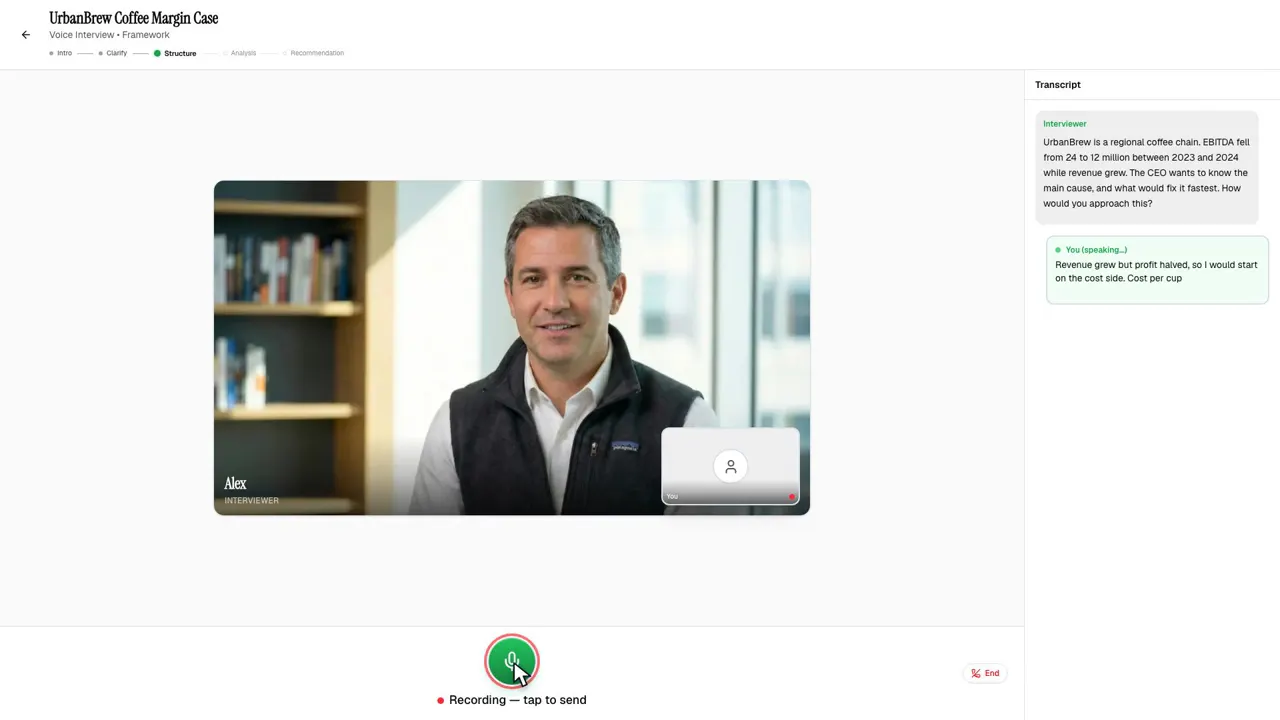

Pass the resume screen
One page of quantified results; firms screen on academics, impact and leadership before anyone asks you a question. Drop your resume for a consulting-screen grade.
Opening resume uploader...
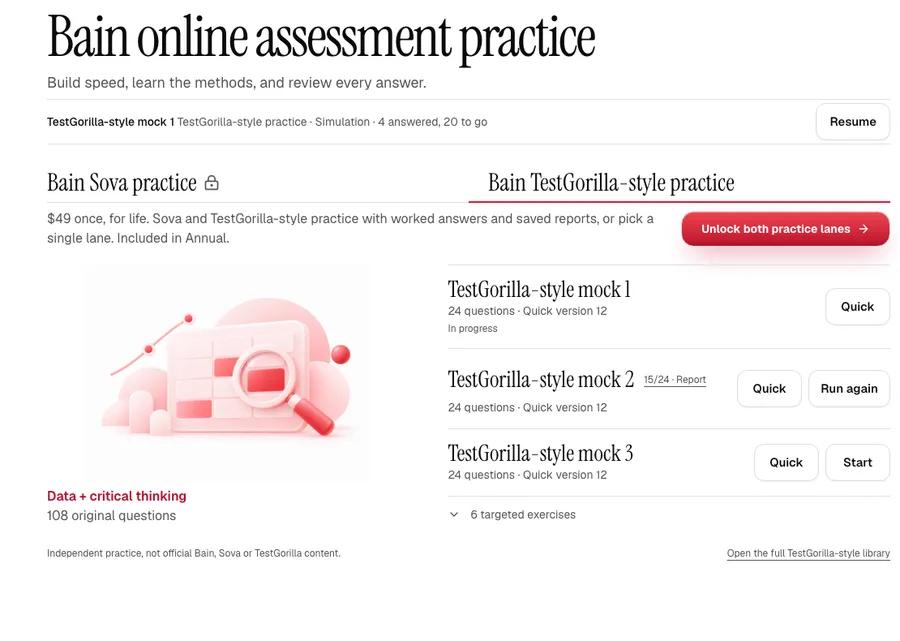
Firms that use an online test send it before the first interview. You can take a timed run of each one on the free assessment simulators, and the consulting interview process guide covers each stage in more detail.
Online test
some firms
- McKinsey Solve, BCG Casey, Bain Sova or TestGorilla
- Taken before the first interview
Your invitation names the test
First round
consultants
- Fit or behavioral questions (1 to 14)
- One case (15 to 21)
- Your own questions at the end (22 to 25)
Final round
senior consultants or partners
- The same mix, with more weight on judgment and your stories
- Formats vary by firm and office
The firm's own interview page is the authority
The answers below are short models on fictional candidates. Use their shape, then fill it with your own facts.
What fit questions do consulting interviewers ask?
Fit questions ask why you want consulting, why this firm and who you are, and they open most rounds. Bain's interviewing page says it looks for people who can explain why they want to join that firm specifically, so a generic answer costs you here. The full bank of 30 is in our guide to consulting fit interview questions, and you can say your answers out loud to an AI interviewer in behavioral interview practice.
1. Tell me about yourself.
Model answer: "I studied economics, then spent two years in operations at a regional grocer, where I rebuilt the store ordering model and cut waste in our produce category. That project is why I am here: I liked finding the problem in the data more than running the fix, and consulting is that work every week. Outside work I coach a youth chess club."
Keep it to about a minute, end on why you are in the room, and let the interviewer pick what to probe. Our tell me about yourself guide has templates by background.
2. Why consulting?
Model answer: "Two reasons. First, I learn fastest on short, hard problems, and my best year was the one where I moved between three projects. Second, I want to see how many industries make decisions before I choose one. A consultant I worked with on our pricing review showed me what that looks like, and I want that pace."
Give two reasons that are true of you, with one moment that proves each. More examples by background are in our why consulting answer guide.
3. Why this firm?
Model answer: "I spoke with two of your consultants about their first projects, and both described being given a piece of the problem to own in week one. That matches how I work best. I also read your recent work on grocery supply chains, which is the space I know, and I would like to start where I can add something early."
Name people you spoke to and work you read. Anything you could say about every firm will not count.
4. Walk me through your resume.
Model answer: "I will go in order and flag the decision at each step. I chose economics because I liked pricing problems, took the operations role because it put me close to real data, and led the ordering project because nobody owned it. Each step moved me closer to problem solving as the job itself."
Give each step one sentence and the decision behind it. The management consulting resume guide covers what the page itself should show, and the free consulting resume grader scores yours against a consulting screen.
5. Where do you see yourself in five years?
Model answer: "Leading workstreams on client projects and having found the one or two industries I want to go deep in. I do not know yet which ones, and that is part of why I want to start in consulting."
6. What is your biggest weakness?
Model answer: "I used to hold work until it was perfect. On the ordering project I shared a rough model a week late and learned that an early draft would have saved two rounds of rework. Now I share a first version within two days and say what is still rough."
Pick a real weakness, show the moment you noticed it and what you do now.
What behavioral questions come up in consulting interviews?
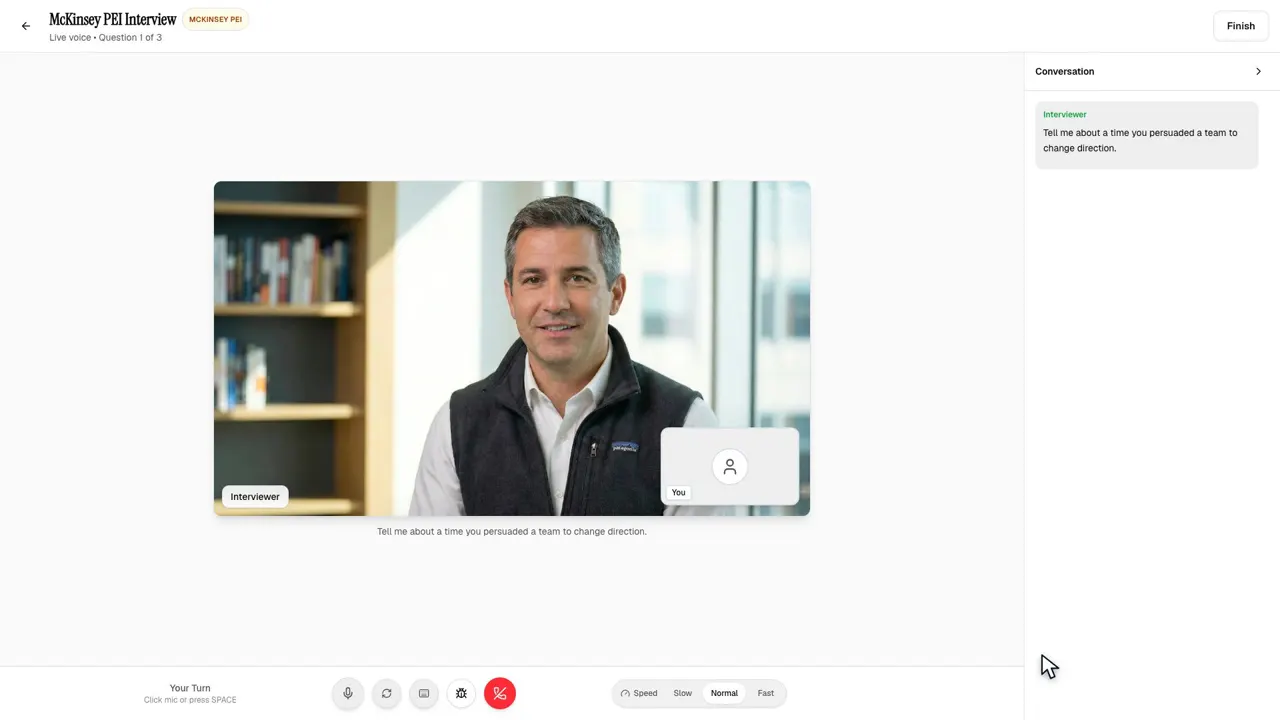
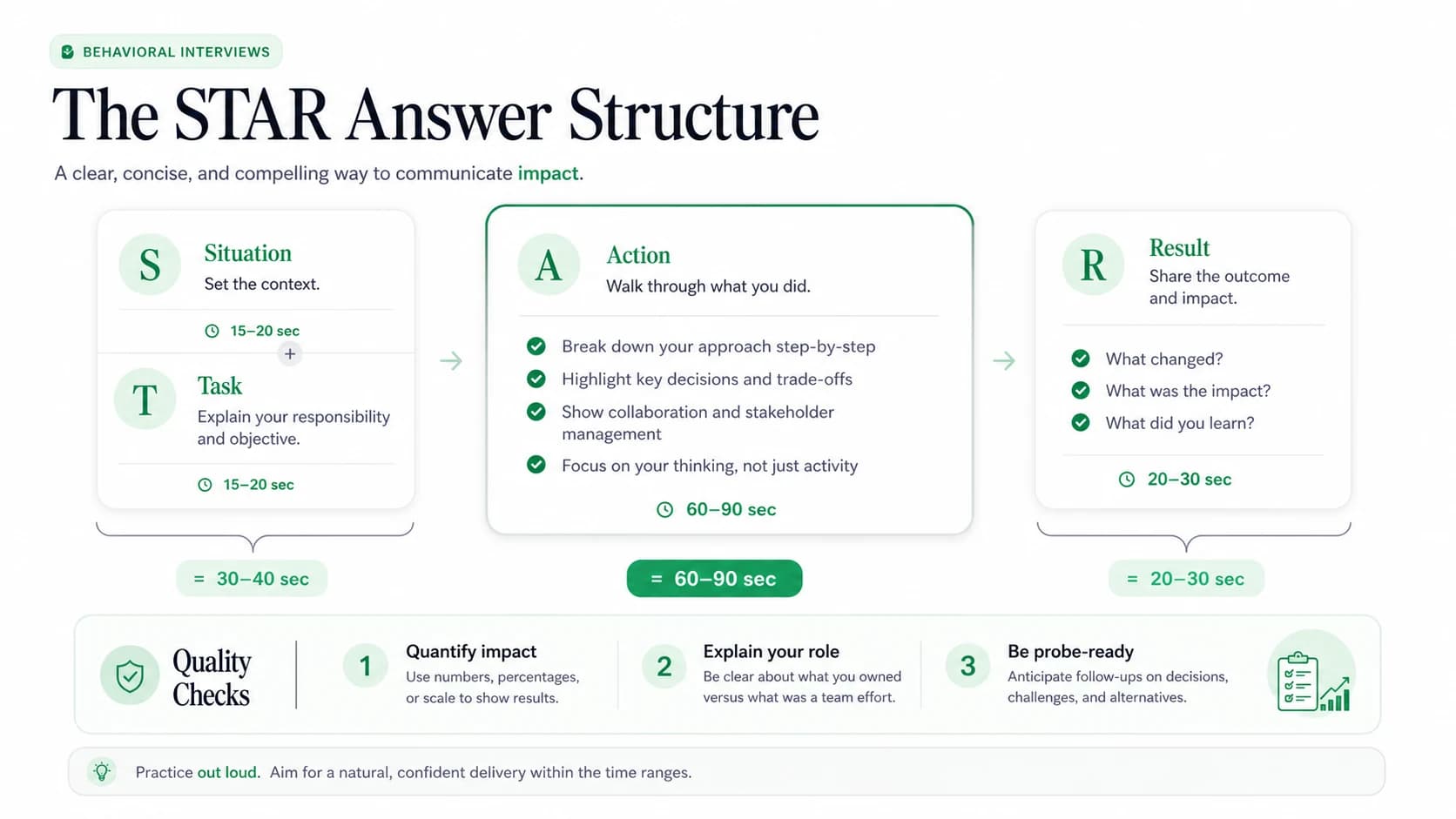
Behavioral questions ask for one past example that proves a skill: leadership, influence, failure, conflict or drive. BCG's behavioral interview guide and McKinsey's interviewing page, which describes its Personal Experience Interview, are the authorities for those firms. Answer each one with the STAR method for consulting interviews (situation, task, action, result) and spend most of the time on your own actions. The method and 20 more prompts are in our guide to consulting behavioral interview questions; for McKinsey's format, read the McKinsey PEI guide.
7. Tell me about a time you led a team.
Model answer: "Our student consulting project was two weeks behind with four weeks left. I split the work by person instead of by section, set a daily 15-minute check-in, and took the hardest analysis myself. We delivered on time, and the client used our pricing model for the next season."
8. Tell me about a time you persuaded someone without authority.
Model answer: "Our store managers did not trust the new ordering model. Instead of pushing it, I ran it side by side with their own orders for one store for three weeks and shared the waste numbers each Friday. After the third week, two more managers asked to join."
9. Tell me about a time you failed.
Model answer: "I launched a weekly sales report that nobody read, because I never asked the managers what they needed. I scrapped it, interviewed four of them and rebuilt it around the two numbers they checked every morning. The lesson I still use: ask the user before building."
10. Describe a conflict with a teammate.
Model answer: "A teammate wanted to present every scenario; I wanted one recommendation. I asked what worried him, and it was being caught out by a question. We agreed on one recommendation up front with the other scenarios in the backup slides. The client asked about one of them, and he answered it."
11. Tell me about a time you worked under a tight deadline.
Model answer: "A supplier issue gave us 48 hours to re-plan a holiday order. I listed what had to be right (top 50 products) and what could be rough (the rest), assigned owners and checked in twice a day. We placed the order with three hours to spare."
12. Tell me about a time you solved a problem with incomplete information.
Model answer: "We had no data on why one store's waste doubled. I wrote three hypotheses, picked the cheapest to test first (delivery timing), and checked a week of delivery logs. It was a late truck, which we moved, and waste came back down within a month."
13. Tell me about a time you received tough feedback.
Model answer: "My manager said my updates buried the answer. I started opening every email with the decision I needed, in one line. Response times on my requests dropped from days to hours."
14. What achievement are you most proud of?
Model answer: "Rebuilding the ordering model, because nobody asked me to. I saw the waste numbers, built a first version on weekends and earned the pilot by showing results. It is the clearest example of how I like to work."
Practice one behavioral answer out loud
Answer a leadership, failure or influence question by voice and get follow-up probes on where your evidence is still vague.
Practice a behavioral answer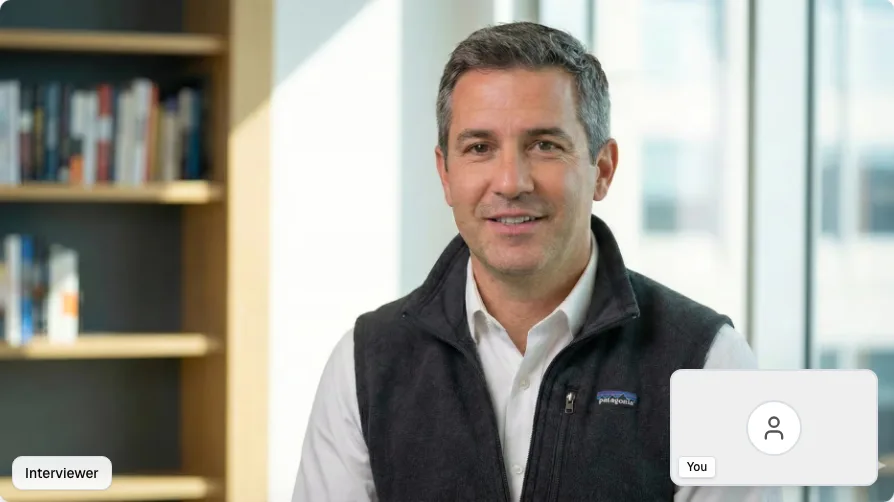
What case interview questions do consulting firms ask?
Case questions walk through one business problem: clarify it, structure it, estimate or calculate, read a chart, brainstorm and recommend. Bain's interviewing page describes the case as a test of logical, structured thinking where there is not always one right answer. Each step has a typical question; the detailed version, with worked solutions, is our guide to case interview questions and answers.
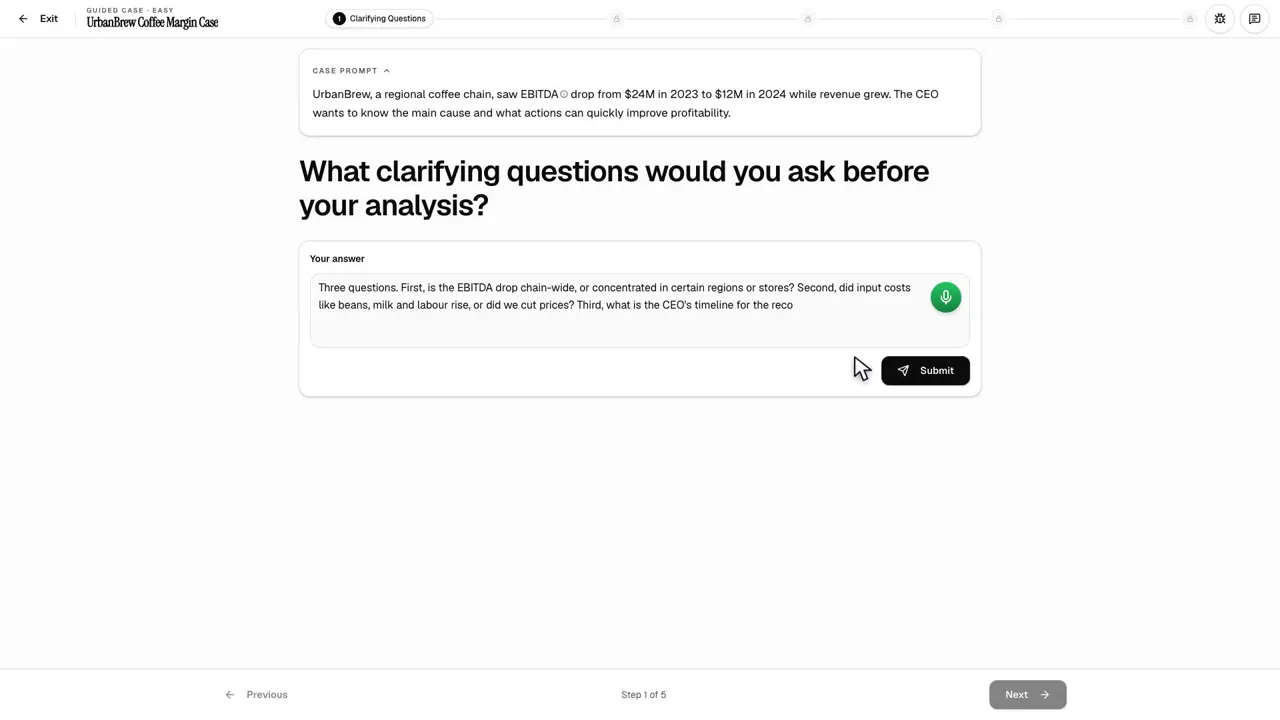
The table below lists four real cases from the case library that use the steps in questions 15 to 21. An AI interviewer runs each one out loud, shows each exhibit when you reach it and scores the debrief. Median times come from completed runs between June 25 and September 22, 2026, and count runs, not people.
| Case (style, industry) | Quant difficulty | Qualitative difficulty | The math you run | Median time |
|---|---|---|---|---|
UrbanBrew Coffee Margin Case (BCG, coffee chain). 6 (2 with math), 2 exhibits. | medium | easy | Category gross margin, EBITDA recovery | 16 min, 117 voice runs |
MedSuite Technologies Hospital Software Pricing (McKinsey, hospital software). 8 (3 with math), 2 exhibits. | medium | medium | Revenue at each price point, tiered pricing | 20 min, 18 voice runs |
Meridian Electronics (Bain, consumer electronics). 9 (5 with math), 3 exhibits. | medium | medium | Synergies as spend times savings rate | 21 min, 14 voice runs |
Electro Chargers City Entry (BCG, EV infrastructure). 7 (2 with math), 3 exhibits. | medium | medium | Vehicle base projection, station investment | 23 min, 24 voice runs |


UrbanBrew is the closest to the coffee chain example in question 16. Electro Chargers is adapted from the Wharton consulting club casebook; the other three were written for Road to Offer, and none is a firm's own material. Your first full case is free when you create an account.
15. What questions would you ask before you start?
Model answer: "Before I structure this, I would like to confirm three things: what the client means by success here (profit, revenue or share), the time frame, and whether anything is off the table, such as closing stores."
Ask two or three questions that change your structure, then stop. The free case method lesson walks through clarifying, structuring and closing in order:
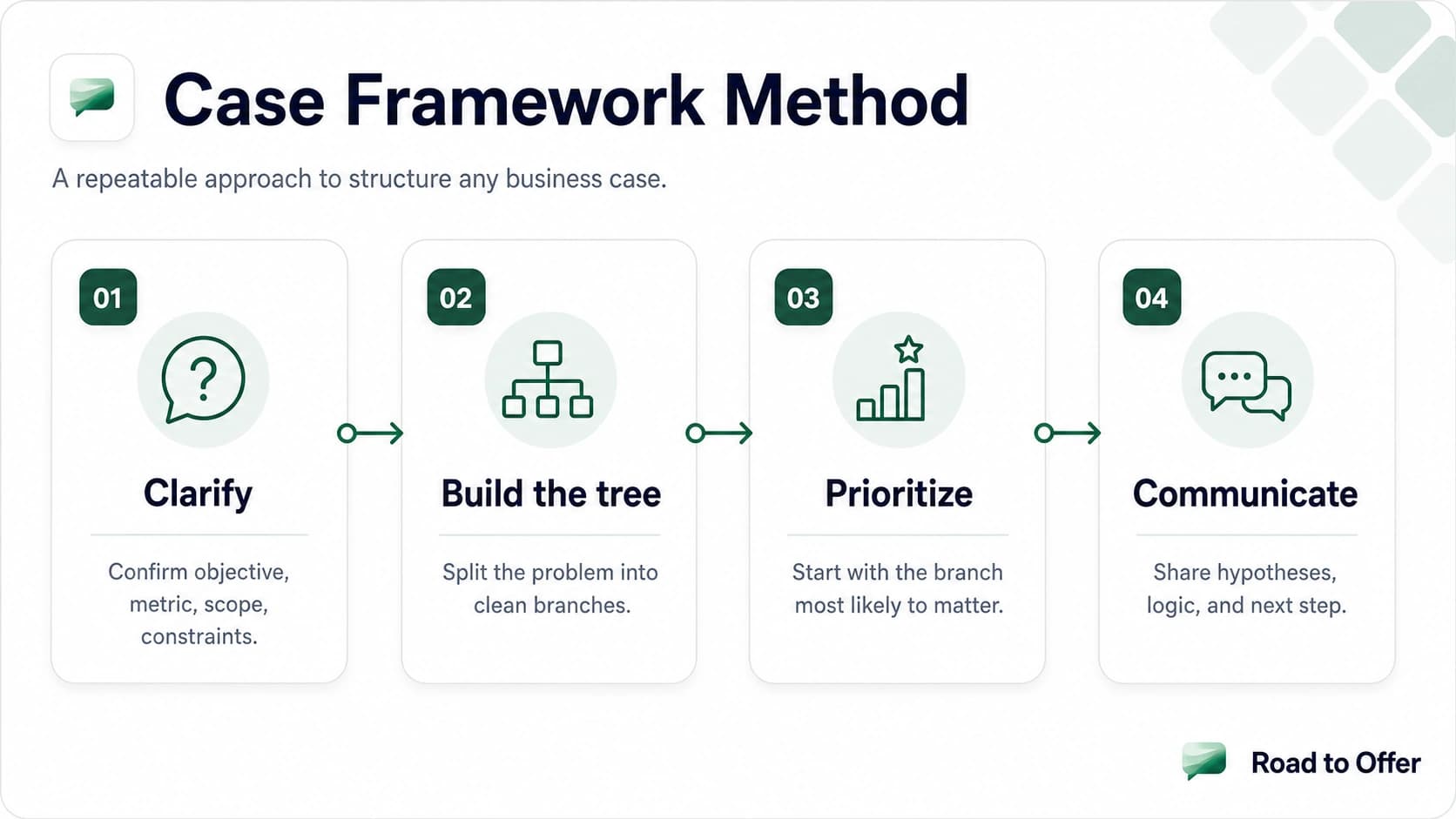
Learn the case method
One dense lesson, each step linked to the drill that trains it.
16. How would you approach this problem?
Model answer, for "A coffee chain's profit fell 20% in a year": "I would split profit into revenue and costs. On revenue: number of stores, customers per store and spend per customer. On costs: fixed costs like rent and staff, and variable costs like beans and milk. I would start with costs, since you mentioned new suppliers this year."
State your structure, say where you will start and why, then let the interviewer steer.
17. How many electric scooters are rented in a city each day?
Model answer, on made-up numbers: "Take a city of 1 million people. About half are between 18 and 45, so 500,000. If 5% of them ride on a typical day, that is 25,000 riders, and at 1.5 rides each, about 37,500 rentals a day. I would sanity-check that against the size of the fleet."
State each assumption out loud and round to easy numbers. More practice is in our market sizing questions bank.
18. What is the break-even volume?
Model answer, on made-up numbers: "Fixed costs are $200,000 a year and each unit earns $40 after variable costs, so break-even is 200,000 divided by 40, which is 5,000 units. Last year they sold 4,200, so they are about 800 short."
Say the formula before the numbers, and say what the result means for the client. Five more worked versions are in our break-even analysis case interview guide.
19. What does this chart tell you?
Model answer: "The headline is that online sales grew every quarter while store sales were flat, so all the growth came from online. The one surprise is the dip in the third quarter, which I would ask about before drawing a conclusion."
Lead with the headline, then the detail, then what you would ask next.
20. What could explain the drop in customers?
Model answer: "I see three groups of causes: our own changes (prices, menu, opening hours), competitors (a new chain nearby, a delivery app), and the market (fewer office workers downtown). I would check our own changes first because they are the easiest to fix."
Group your ideas instead of listing them, so the interviewer sees the structure.
21. What would you recommend?
Model answer: "The client should renegotiate its bean contract, because the new supplier explains most of the profit drop. That should recover about three quarters of the lost profit within a year. The risk is quality complaints, so I would test the change in ten stores first."
Answer first, then the two strongest reasons, the risk and the next step. The case interview synthesis guide has a 60-second template.
To put questions 15 to 21 together, run one full case out loud with an AI interviewer:
Start a free case interview
Don't know how to case yet? Learn how to case
What questions should you ask the interviewer?
Ask one or two questions you cannot answer from the firm's website, about the work, the team or the interviewer's own experience. BCG's interview process page quotes a consultant who says the questions you ask at the end helped them judge their own fit. More examples by round are in our guide to questions to ask your consulting interviewer.
22. What did your first project teach you?
It invites a real story and shows you care about how people learn on the job.
23. How are new consultants staffed on their first projects?
It shows you are thinking about the actual work, and the answer tells you a lot about the firm.
24. What surprised you most after joining?
It is open enough that interviewers tend to answer honestly, which gives you material for "why this firm" later.
25. What separates consultants who do well in their first year?
You hear what the firm values, in the interviewer's words.
How do you practice consulting interview questions?
Practice consulting interview questions out loud, in the same mix the interview uses: a few fit and behavioral answers, then a case. Reading answers builds recognition; saying them builds the delivery the interviewer actually hears.
- Build a story bank. Write five to eight real examples that each show a different skill (leadership, influence, failure, conflict, drive). Most behavioral questions above can be answered from that bank.
- Rehearse fit answers on a timer. Record "tell me about yourself", "why consulting" and "why this firm", then cut anything that does not support the point.
- Drill the case steps separately. Structure, estimates, math and charts each improve faster on their own than inside a full case. Road to Offer's drill bank covers each step, and a free account includes 5 drills a day for your first 3 days.
- Run full cases. A full case puts the steps together under time pressure. Your first full case is free when you create an account, and you can run it by voice. With no partner, follow the plan in how to practice case interviews alone.
A plan built around your target firm and interview date puts these reps in order:













Prep plans for McKinsey, BCG, Bain, Deloitte, Accenture, EY-Parthenon, Kearney, Oliver Wyman, Roland Berger, L.E.K., OC&C, Strategy&, Simon-Kucher, Arthur D. Little, Capital One and your target firm. Choose your firm in the plan builder.
Get your prep plan
A week-by-week schedule built around your target firm and interview date.
Sources (checked November 7, 2026)
- BCG, interview process: careers.bcg.com/global/en/interview-process
- BCG, how to prepare for a behavioral interview: careers.bcg.com/global/en/blogarticle/how-to-prepare-for-a-behavioral-interview
- Bain & Company, interviewing: bain.com/careers/hiring-process/interviewing
- McKinsey & Company, interviewing: mckinsey.com/careers/interviewing (the page did not load for us on November 7, 2026; it is linked as the authority for McKinsey's format)
- DDI, the STAR method: ddi.com/solutions/behavioral-interviewing/star-method
Frequently asked questions
Resources and related guides
- Practice a real case interviewPractice
- Browse all free resourcesResource hub
- Consulting Behavioral Interview: STAR + 20 QuestionsGetting Started · Feb 19, 2026
- Best Case Interview Books 2026: Ranked, Scored, and What to SkipGetting Started · Mar 20, 2026
- Consulting Fit Interview Questions: 30 Examples + AnswersGetting Started · Mar 1, 2026
- ChatGPT Interview Preparation Guide (Prompts + Workflow) 2026Getting Started · May 1, 2026