
Consulting Fit Interview Questions: 30 Examples + Answers
Scan 30 consulting fit interview questions by signal, see concise answer guidance, and study one leadership example under follow-up probing.
On this page
Consulting fit questions ask for evidence of motivation, leadership, influence, teamwork, resilience, and learning. Use this page as the question bank: choose the signal you need to practice, answer one question with a real example, then test whether your action and result survive follow-up questions. For the method itself, use the behavioral interview guide or McKinsey PEI guide.
Which fit question should you practice first?
Why Fit Questions Can Make or Break Your Offer
McKinsey's official interviewing page asks candidates to prepare detailed examples for Connection, Leadership, Drive, and Growth. BCG and Bain likewise publish behavioral or experience guidance, but none of those pages establishes a single cross-firm score weight or timing rule. If your process includes fit, treat it as real evidence, not filler around the case.
The reason is straightforward: consulting firms hire people who will be effective in client-facing roles, not just people who can solve structured problems. A candidate who delivers strong cases but gives vague, unconvincing answers about their leadership experience or can't articulate why they want to be a consultant signals a gap that no amount of analytical skill can fill.
The McKinsey PEI Guide covers PEI dimensions in depth, and the McKinsey PEI questions guide offers a full practice question bank organized by dimension. The behavioral interview guide for consulting covers the broader behavioral landscape. This article focuses specifically on the questions you will face and how to structure answers that hold up under pressure.
Where can you learn the answer method?
This page owns the question bank. The behavioral interview guide, STAR method guide, and McKinsey PEI guide own the deeper method and firm-specific probing.
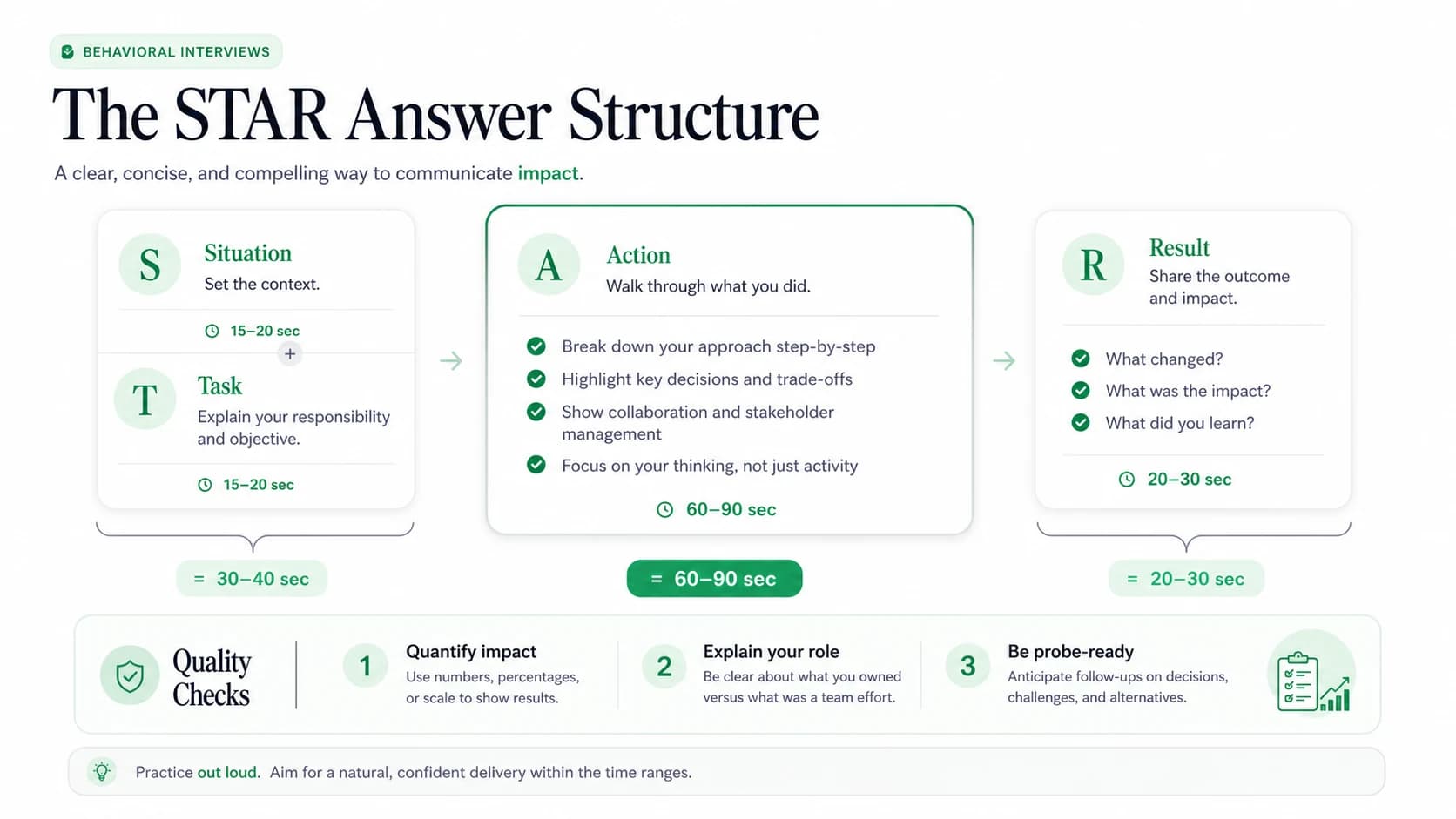
Learn the behavioral method
STAR that survives probing, linked to the live AI interviewer.
A compact answer structure: SCAIR
The STAR method is widely taught for behavioral answers. For consulting-specific STAR upgrades and full worked examples, see our STAR method for consulting interviews guide. SCAIR adds an explicit complication and reflection so follow-up questions can examine judgment, trade-offs, and learning rather than a scripted chronology.
Use the Situation-Complication-Action-Impact-Reflection (SCAIR) structure, which builds on STAR by explicitly separating what made the situation genuinely hard (Complication) and adding what you learned (Reflection):
- Situation: Set the scene briefly. What was the context, and what were you responsible for?
- Complication: What was the specific challenge, obstacle, or conflict? What made the obvious path unavailable?
- Action: What did you specifically decide and do? What alternatives did you consider, and why did you choose this approach?
- Impact: What happened as a result? Quantify the outcome where the evidence supports it.
- Reflection: What did you learn, and what would you do differently?
The Complication and Action sections should make your judgment visible. Keep enough context for the listener to understand the stakes, then spend the detail on what you personally decided, did, and learned.
Building Your Story Bank
Before diving into the 30 questions, build a story bank broad enough to cover the signals named in your confirmed process. A strong leadership story may also show influence, initiative, or risk-taking when the underlying event genuinely supports that angle.
How to build your bank:
- List your strongest recent experiences: professional, academic, or extracurricular. Include successes, setbacks, conflicts, and changed decisions.
- For each experience, identify which question categories it can cover. A story about leading a product launch under a tight deadline might work for leadership (Q1), working with limited resources (Q19), and taking a risk (Q20). Most strong stories cover 3-4 categories.
- Test each story for depth. You should know the people involved, alternatives considered, evidence available, outcome, and what you would do differently.
- Check coverage against the current process. For McKinsey, use the dimensions on its current official interviewing page. For BCG, Bain, or another firm, use the current role guidance and invitation rather than importing McKinsey's structure.
- Stress-test each story with follow-ups. Ask why you made the decision, what the other people believed, what alternative you rejected, what you would have done if the plan failed, and what changed afterward.
Free live AI interview
Pressure-test one fit story
Run a behavioral practice session and get follow-up probes on whether your story has enough ownership, judgment, and result detail.
Practice a fit story
If your target list includes Big Four or strategy-arm interviews, use the firm-specific behavioral guides for KPMG, PwC, EY, EY-Parthenon, Strategy&, and Monitor Deloitte.
What are 30 consulting fit interview questions?
Each question below includes what the interviewer is actually assessing, what a weak answer looks like, and what makes a strong answer. For the three questions expanded below (leadership, failure, and why consulting), full answer frameworks follow.
Category 1: Leadership (McKinsey PEI: Leadership, formerly Inclusive Leadership)
McKinsey's official guidance on the Leadership dimension (formerly Inclusive Leadership) is available on the McKinsey careers interviewing page.
1. Tell me about a time you led a team through a difficult situation.
What they assess: Whether you can diagnose team dysfunction, make hard calls under pressure, and drive to a result. Treat it as one possible Leadership prompt, not a guaranteed opener.
Weak answer: A vague story about "motivating the team" with no specifics about what went wrong, what you personally decided, or what the outcome was.
Strong answer: Name the specific difficulty, the decision you made and why you chose it over alternatives, and a supported outcome. Keep the context concise and give the most detail to your own actions rather than what "we" did.
Full answer framework for Question 1: See the worked example below in "Full Worked Example: A Leadership Story Under Probing."
2. Describe a situation where you had to lead without formal authority.
What they assess: Influence skills. Consulting is fundamentally about leading without authority: you are an advisor, not a manager. This question tests whether you can move people without positional power.
Weak answer: "I convinced my teammates to follow my plan." No specifics about resistance or how you navigated it.
Strong answer: Show the specific resistance you faced, the tactic you used (data, framing, coalition-building, demonstrating the approach first), and why that tactic worked with that particular audience.
3. Give me an example of a time you had to build consensus among people who disagreed.
What they assess: Collaborative problem-solving. Can you navigate competing interests without steamrolling or caving?
Weak answer: "I listened to everyone and found a compromise." This is process description, not a story.
Strong answer: Name the specific disagreement, identify why each side held their position (they usually have legitimate reasons), and explain how you found a solution that addressed the core concern of each party, not just a middle ground.
4. Tell me about a time a team you led underperformed. What did you do?
What they assess: Accountability and diagnostic ability. Do you blame the team, or do you own the outcome and fix the root cause?
Weak answer: Blaming team members or external circumstances. "The timeline was too aggressive."
Strong answer: Own what you could have done differently as the leader. "I realized I had assigned tasks based on availability, not skill. I restructured the work allocation based on each person's strength, which required a difficult conversation with one team member about being reassigned."
5. Describe a situation where you had to make an unpopular decision as a leader.
What they assess: Conviction and judgment. The key is naming who was unhappy and why you held the position anyway. Generic "tough but necessary" framing fails here.
Weak answer: A decision everyone eventually agreed with. That was not actually unpopular.
Strong answer: Name the specific pushback, explain your reasoning despite opposition, and show the result. The strongest answers acknowledge what you sacrificed (team morale, a relationship, short-term results) in service of the right long-term call.
6. Tell me about a time you had to delegate a critical task to someone you weren't sure could handle it.
What they assess: Judgment about people and risk management. Can you set someone up for success while having a contingency plan?
Weak answer: "I delegated and it worked out fine." No specifics about why you were unsure or how you managed the risk.
Strong answer: Explain what made the person a risk (experience level, track record on similar work), what support structure you put in place (check-ins, milestones, a backup plan), and what happened. If they succeeded, name what you learned about delegation. If they struggled, explain how you intervened.
7. Give me an example of a time you developed or mentored someone on your team.
What they assess: Investment in others. This maps directly to the Leadership dimension, can you make others better? For scenario shapes and a STAR template specific to leadership questions, see leadership story examples.
Weak answer: Generic mentoring ("I coached them through the project"). No specifics about what skill gap you identified or how you closed it.
Strong answer: Identify a specific skill gap, explain the intervention (not just "I gave them feedback" but what the feedback was and how you delivered it), and show a measurable improvement in their performance.
Category 2: Connection (McKinsey PEI: formerly Personal Impact)
8. Tell me about a time you influenced a senior stakeholder who initially disagreed with you.
What they assess: Upward influence. This is core to consulting: you will regularly tell senior clients things they do not want to hear.
Weak answer: "I presented the data and they agreed." This skips the hard part: how you handled their initial resistance.
Strong answer: Name the stakeholder's initial position and why they held it (usually legitimate concerns: risk, cost, politics). Show how you reframed the issue in terms they cared about. The best answers show you understood their objection before you countered it.
9. Describe a situation where you changed someone's mind using only your persuasion skills.
What they assess: Pure influence without data or authority as a crutch. Can you construct an argument that shifts someone's thinking?
Weak answer: A situation where you had data on your side and the other person was simply wrong. That is not persuasion; that is correction.
Strong answer: A situation with genuine ambiguity where reasonable people could disagree. Show the specific framing, analogy, or logic chain you used.
10. Give me an example of a time your analysis changed the direction of a project.
What they assess: Analytical impact. Did your work product actually change a decision, or was it just a deliverable that went into a drawer?
Weak answer: "I built a financial model and the team used it." No specifics about what insight the model revealed or what decision changed.
Strong answer: "My analysis showed that the highest-margin customer segment was also the one with the highest churn. That shifted the team's priority from acquisition to retention, which was a 180-degree change in strategy."
11. Tell me about a time you communicated a complex idea to a non-technical audience.
What they assess: Communication adaptability. Consultants present to C-suite executives who are not experts in the analysis methodology.
Weak answer: "I simplified it." How? What did you cut? What analogy did you use?
Strong answer: Name the audience, the complexity, and the specific communication technique (analogy, visual, progressive disclosure). Show that the audience acted on your communication, which proves it worked.
12. Describe a situation where you had to manage up to get a decision made.
What they assess: Can you move a senior person to action without overstepping? This is a daily consulting skill.
Weak answer: "I escalated the issue." Escalation is a last resort, not a strategy.
Strong answer: Show how you framed the decision for your manager/executive by reducing their cognitive load, presenting options with a clear recommendation, and creating urgency without manufacturing crisis.
13. Give me an example of a time you used data to shift an organization's direction.
What they assess: Whether you can translate analysis into organizational action. This is the consulting value chain: data to insight to action.
Weak answer: An analysis that impressed your boss. Impact means the organization actually changed behavior.
Strong answer: Name the organizational belief you challenged, the data that contradicted it, how you presented the data (not just what it showed, but how you made it persuasive), and the resulting change.
Category 3: Drive (McKinsey PEI: formerly Entrepreneurial Drive)
14. Tell me about a time you identified and seized an opportunity others had overlooked.
What they assess: Pattern recognition and initiative. Can you see something others missed and act on it without being told?
Weak answer: An opportunity that was obvious in retrospect. "I suggested we sell online" is not entrepreneurial.
Strong answer: Explain specifically what made the opportunity non-obvious (why others missed it), what data or observation led you to see it, and what you did to capture it, not just identify it.
15. Describe a situation where you built something from scratch with limited resources.
What they assess: Resourcefulness and tolerance for ambiguity. Early consulting engagements often have incomplete data and unclear scope.
Weak answer: A project where you had a clear brief and just executed it.
Strong answer: Show how constraints forced creative solutions. "I did not have budget for market research, so I built a proxy dataset from publicly available import/export records and LinkedIn headcount data."
16. Give me an example of a time you took initiative well beyond your defined role.
What they assess: Drive and scope expansion. Consultants regularly identify problems outside their workstream and raise them.
Weak answer: "I worked extra hours." That is effort, not initiative.
Strong answer: Name something you did that was genuinely outside your job description: you identified a problem no one asked you to look at, built a solution, and delivered it.
17. Tell me about a time you failed at something and what you did next.
What a useful answer can show: Self-awareness, resilience, and learning. Own the failure without letting it consume the answer.
Weak answer: A "failure" that is actually a humble brag ("I worked too hard and burned out"). Or a failure where you blame circumstances.
Strong answer: Name a genuine failure where you made a wrong decision or lacked a skill. Own it specifically. Then show what you changed as a result, going beyond "I learned to communicate better" to something like "I now run a pre-mortem exercise before every major deliverable because this failure taught me I was not stress-testing my own assumptions."
Full answer framework for Question 17: Start with the specific decision or action that failed. Name the consequence and who was affected. Explain what you did immediately to mitigate the damage, then spend meaningful detail on the structural change you made to prevent recurrence. End with evidence that the change worked. The useful signal is your ownership, recovery, and learning process, not a fixed answer allocation.
18. Describe a project you drove from conception to completion.
What they assess: End-to-end ownership. Can you conceive, plan, execute, and deliver?
Weak answer: A project where you inherited the plan and executed it.
Strong answer: Show how you identified the need, scoped the work, made tradeoff decisions along the way, and delivered a measurable result.
19. Tell me about a time you had to accomplish a significant goal with minimal resources.
What they assess: Resourcefulness, a close variant of Question 15. The nuance is "significant goal": they want to see that the stakes were real.
Weak answer: A small-stakes project with limited resources. If nothing important was at risk, the constraint does not matter.
Strong answer: Show a high-stakes goal where the resource constraint forced you to prioritize ruthlessly. What did you choose NOT to do, and why?
Category 4: Growth (McKinsey PEI: formerly Courageous Change)
20. Tell me about a time you took a significant professional risk.
What they assess: Risk tolerance and judgment. They are not looking for recklessness; they want to see calculated risk-taking where you weighed downside against upside.
Weak answer: A risk that had no real downside. "I applied for a stretch role" is not risky if the worst outcome is staying in your current role.
Strong answer: Name what you stood to lose (reputation, money, a relationship, your job), why you decided the risk was worth it, and what happened. The best answers show you had a contingency plan.
21. Describe a situation where you challenged the status quo in your organization.
What they assess: Willingness to push against inertia. Consultants are hired to change things, and this question tests whether you are comfortable with that role.
Weak answer: Suggesting a minor process improvement that everyone agreed with.
Strong answer: Name the entrenched practice you challenged, why it existed (it usually has historical reasons), what resistance you faced, and how you built support for the change.
22. Give me an example of a time you delivered difficult feedback to someone more senior than you.
What they assess: Courage and tact. In consulting, you will tell partners and client executives that their strategy is wrong. This question tests whether you can do that without being fired or ignored.
Weak answer: "I told my boss about a typo in their presentation." That is not difficult feedback.
Strong answer: Show feedback that the senior person did not want to hear, how you chose the right moment and framing, and what happened. The strongest answers show the relationship survived or improved.
23. Tell me about a time you made a decision that went against conventional wisdom.
What they assess: Independent thinking. Can you form your own view when the consensus is wrong?
Weak answer: A decision that turned out well without explaining why you believed the consensus was wrong.
Strong answer: Name the conventional wisdom, explain the specific evidence or reasoning that led you to disagree, and show the result. Interviewers respect the reasoning even if the outcome was mixed.
24. Describe a situation where you had to push back on a client, manager, or stakeholder.
What they assess: Professional courage combined with relationship management. Can you say no without burning bridges?
Weak answer: Passive pushback ("I expressed my concerns"). Did you actually change the outcome?
Strong answer: Name the request, why you believed it was wrong, how you pushed back (with what evidence or framing), and the result. Show that you preserved the relationship.
Category 5: Why Consulting and Why This Firm
25. Why consulting, and why now?
What they assess: Motivation clarity and self-awareness. This is the most important question in Category 5. See the dedicated section below for a full framework.
Weak answer: "I want to be challenged intellectually." Everyone says this, and it applies to dozens of careers.
Strong answer: A specific trigger experience, a specific capability gap your current role cannot fill, and a specific reason consulting fills that gap better than alternatives (PE, corporate strategy, tech).
Full answer framework for Question 25: See "How to Answer 'Why Consulting?'" below.
26. Why McKinsey (or BCG, or Bain) specifically?
What they assess: Whether you have done real research or are applying to every firm with the same generic answer.
Weak answer: "Your reputation for excellence" or "Your people are the best." Every firm says this about themselves.
Strong answer: Reference a specific practice area, a published case study, a conversation with a current consultant, or a structural difference. "BCG's digital transformation practice published work on AI adoption in industrial clients, which is exactly the problem set I have been working on and want to go deeper in" is specific. "McKinsey has the best people" is not.
27. What do you think the day-to-day of consulting actually looks like, and why does that appeal to you?
What a useful answer can show: Whether you have researched the work closely enough to make a deliberate choice. Workload, travel, team dynamics, and client exposure vary by practice, office, project, and role.
Weak answer: "Working on important strategy projects with smart people."
Strong answer: Explain the conditions you verified for the target role and why they fit you. For example: "I spoke with consultants in this office and learned that junior team members combine detailed analysis with client communication. That mix fits the evidence I have from my current role and the capability I want to build next."
28. What would you do if you don't get into consulting?
What a useful answer can show: Whether consulting is a deliberate choice rather than a default. A credible alternative helps you explain the trade-off without pretending to know how one interviewer will interpret it.
Weak answer: "I would keep trying until I get in." This signals desperation, not fit.
Strong answer: Name a specific alternative that shares some characteristics with consulting (corporate strategy, PE, a startup) and explain what consulting offers that the alternative does not.
29. Where do you see yourself in five years?
What a useful answer can show: Career intentionality and whether your near-term goals plausibly fit the role. Do not invent loyalty or promise a tenure you cannot know.
Weak answer: A destination with no credible link to the near-term role, or a promise to remain at one firm when you cannot know that future.
Strong answer: Show a path that plausibly runs through consulting. "In five years, I want to be leading client engagements in the healthcare space. I have seen how BCG's healthcare practice has shaped delivery system reform, and I want to be deep enough in that domain to drive those recommendations myself."
30. What is a business problem you have been thinking about recently?
What they assess: Intellectual curiosity and business judgment. Can you think about business problems when no one is asking you to?
Weak answer: A generic topic ("AI is changing everything") with no specific angle or analysis.
Strong answer: A specific business problem with your own hypothesis about what is driving it. "I have been thinking about why grocery delivery companies cannot achieve profitability despite high customer demand. My hypothesis is that the unit economics fail because average basket size is too low to cover last-mile delivery cost, and the fix is either increasing basket minimums or bundling delivery with a subscription that changes purchasing behavior."
Fictional Worked Example: A Leadership Story Under Probing
Let me walk through how to build a strong answer to Question 1, "Tell me about a time you led a team through a difficult situation," and then show how it could hold up under detailed follow-up probing.
The initial answer (using SCAIR):
Situation: "I was leading a 6-person team delivering a regulatory compliance system for a financial services client. We were two weeks from the launch deadline."
Complication: "Our lead developer identified a critical architectural flaw. The data validation module couldn't handle edge cases in the client's legacy data format, which we had never been given access to test against. Fixing it properly would take three weeks, but the client had regulatory deadlines tied to our launch that created real legal exposure if we slipped. Asking for an extension was not viable, and shipping with the flaw was not viable either."
Action: "I convened the technical team for a two-hour decomposition session. We identified that 85% of the client's data fell into patterns our system handled correctly. The 15% of problematic edge cases were concentrated in inactive legacy accounts. I proposed a phased launch: go live with the validated data set and quarantine the legacy accounts for a manual review process while we fixed the architecture in parallel.
Then I had to sell it internally. The client's compliance officer initially refused because her instinct was that 'partial' meant 'non-compliant.' I spent two hours walking her through the regulatory language with our legal team, and we identified that the quarantine approach actually satisfied the regulation because the problematic accounts represented less than the threshold of portfolio exposure the rule targeted."
Impact: "We launched on time. The legacy account fix was completed 11 days later. The client wrote us a reference letter specifically citing our crisis management."
Reflection: "I had relied too heavily on the client's assurances that their data was standardized. I now build data validation checkpoints earlier in every implementation timeline."
Now, here is how a probing interviewer could follow up:
Follow-up 1: "You mentioned a two-hour decomposition session. How did you structure that session?"
Strong answer: "I split it into three phases. First 30 minutes: the developer who found the flaw presented the technical details so everyone had the same understanding. Next 60 minutes: we mapped every data pattern in the client's system against our validation rules to find the actual failure rate. Final 30 minutes: we brainstormed solutions and I pushed for options that preserved the deadline rather than assuming an extension."
Follow-up 2: "Why did you lead the compliance conversation yourself rather than having your legal team handle it?"
Strong answer: "Our legal team understood the regulatory language but didn't understand the technical architecture. The compliance officer's concern was essentially technical: she needed to know that quarantined data couldn't create reporting gaps. I was the only person who could bridge both sides of that conversation."
Follow-up 3: "What did you do about the developer who missed this issue during the design phase?"
Strong answer: "We had a private conversation after the crisis was resolved. The root cause was that our requirements document listed the client's data as 'standardized format' based on what the client told us, and he had designed to that spec. The failure was a process gap in how we validated client-provided assumptions, not a competence issue. We added a requirement verification step to our project methodology."
Follow-up 4: "What would you have done if the compliance officer still refused after your two-hour session?"
Strong answer: "I had a fallback. If she refused the phased approach, I was prepared to propose a 72-hour emergency audit of just the edge case accounts, which our data showed would cover about 60% of the legacy issues and might bring us below any reasonable threshold. But I also knew that escalating to her manager was available as a last resort, and I had already briefed our account lead on that possibility."
This is a fictional composite built to demonstrate answer depth. In a real interview, use only facts from an event you lived through and make sure each follow-up can be answered without inventing details.
Free live AI interview
Try one answer and receive follow-up probes
Practice a leadership, influence, failure, or motivation answer and review where ownership, judgment, or evidence is still vague.
Practice a behavioral answerHow to Answer "Why Consulting?"
This question trips up more candidates than almost any behavioral question. The bad versions are instantly recognizable:
- "I want to be challenged intellectually." (Everyone says this.)
- "I want to help companies solve important problems." (Vague and generic.)
- "I have always been passionate about strategy." (Meaningless without specifics.)
The problem with these answers is that they apply equally to investment banking, private equity, corporate strategy, or a dozen other careers. If your answer doesn't specifically describe consulting, it's not specific enough.
A strong "why consulting" answer has three components (for a full framework with firm-specific examples, see the why consulting answer guide):
1. A specific trigger. An experience that showed you what consulting work actually produces. Not "I liked strategy" but "I watched a consulting team restructure our operations unit and realized the work I was doing in finance was always downstream of the decisions they were making upstream."
2. A specific gap. Something you cannot get in your current role that consulting provides. Not "more challenge" but "I have optimized the same process three different ways and I need a context where the problem set rotates every few months and I'm constantly building new expertise."
3. A specific firm fit. Why McKinsey, BCG, or Bain specifically, grounded in something real. Research their practice areas, read published case studies, talk to current consultants. "Your healthcare practice's work on delivery system reform" beats "your reputation for excellence." For firm-specific angles, see the McKinsey Case Interview Guide.
Fictional Composite Answers for Common Questions
Beyond the leadership example above, these fictional composites demonstrate the SCAIR structure. Their companies, figures, and outcomes are illustrative. Replace every detail with truthful evidence from your own experience.
For McKinsey: IGotAnOffer's McKinsey PEI guide recommends multiple stories per PEI dimension. Treat that as third-party prep advice, not an official quota. McKinsey's official page is the source for the current dimensions; your invitation determines the actual round structure.
For BCG and Bain: Use each firm's current official guidance and your invitation to confirm the behavioral format. Third-party reports can suggest question shapes, but they do not establish a universal duration, story quota, or rule against reusing an experience when a different truthful dimension is relevant.
"Tell me about a time you influenced a senior stakeholder who initially disagreed with you." (Q8)
Situation: "I was a product analyst at a fintech company. Our VP of Engineering wanted to build a custom analytics platform in-house. The estimated cost was $2M over 18 months."
Complication: "I had spent two weeks evaluating vendor options and believed a third-party platform could achieve 90% of the functionality at $400K over 6 months. But the VP had strong technical convictions about in-house solutions, and he had been burned by a vendor integration failure two years earlier. His objection was not irrational; it was grounded in real experience."
Action: "I did not lead with my recommendation. I first asked him to walk me through what went wrong with the previous vendor, and I documented every failure point. Then I built a comparison framework that scored both options on his specific failure points: API reliability, data ownership, migration risk, and support responsiveness. The in-house option scored higher on data ownership and customization. The vendor option scored higher on time-to-value, total cost, and, critically, on the three failure points from his previous experience, because the vendor I was recommending had contractual SLAs on exactly those items. I presented the comparison privately before the team meeting so he could process it without an audience."
Impact: "He approved the vendor option. The platform launched in 5 months at $380K. Two years later it was still in use, and the VP specifically referenced the evaluation framework I built as a model for future build-vs-buy decisions."
Reflection: "I learned that influence starts with understanding why someone holds their position, not just why they are wrong."
"Tell me about a time you failed and what you did next." (Q17: Full Worked Answer)
Situation: "I was leading a market expansion analysis for my team's product. We were evaluating entry into the Southeast Asian market."
Complication: "I recommended we launch in Indonesia first based on market size data, and my manager approved a $200K pilot budget. Within 8 weeks, we discovered that our payment integration would not work with the dominant Indonesian digital payment systems, which I had not researched. The pilot stalled. We had spent $120K and had zero customers."
Action: "I immediately flagged the issue to my manager rather than trying to solve it quietly. I proposed two paths: invest an additional $80K to build the payment integration (12-week delay), or pivot the pilot to Vietnam where our existing payment infrastructure worked. I built a 48-hour analysis comparing the two options on market size, competition, and implementation speed. Vietnam was 40% smaller but had 6-month faster time-to-revenue. I recommended Vietnam and took accountability for the original recommendation error."
Impact: "We pivoted to Vietnam, launched in 10 weeks, and acquired 2,000 customers in the first quarter. The original $200K budget absorbed the sunk cost. We eventually entered Indonesia 14 months later with proper payment infrastructure."
Reflection: "I now run what I call an 'infrastructure audit' before any market recommendation, mapping not just demand but whether our technical stack actually works in that market. I missed it because I was focused on the strategic case and treated implementation as someone else's problem."
"What is your greatest strength?" (additional practice question)
Do not answer this with a personality trait ("I am a hard worker"). Answer with a demonstrated capability:
"My strongest skill is translating quantitative analysis into a recommendation that non-technical stakeholders act on. In my last role, I built three analyses that directly changed executive decisions: a pricing model that shifted our enterprise pricing from flat-rate to usage-based, a retention analysis that redirected $1.5M of marketing spend from acquisition to existing customers, and a competitor analysis that led to our first product partnership. In each case, the analytical work was necessary but not sufficient. The impact came from presenting it in a way that made the decision obvious."
"What is your greatest weakness?" (additional practice question)
Name a real weakness, show you are aware of its impact, and describe the specific system you have built to manage it:
"I tend to over-invest in the analysis phase and under-invest in socializing findings with stakeholders before formal presentations. Early in my career, I delivered a market sizing that was analytically rigorous but surprised my team because they had not seen any interim work. The recommendation was good, but the lack of early buy-in meant it took three additional meetings to get approval. I now share a rough 'direction of travel' memo at the 50% analysis mark with anyone who will be in the final decision. This catches misalignment early and builds support before the formal presentation."
"Describe a time you worked on a team to solve a difficult problem." (Variant of Q3)
Situation: "I was part of a 4-person cross-functional team (two engineers, one designer, one product person) tasked with reducing checkout abandonment by 15% within one quarter."
Complication: "The engineers believed the fix was performance-related (page load speed). The designer believed it was UX friction (too many form fields). We had 12 weeks, a fixed engineering sprint allocation, and could not do both."
Action: "I proposed we spend the first week running a data analysis to determine which hypothesis had more support before committing resources. I pulled funnel data showing that 70% of abandonment happened at the payment information step, not during page load. The load times were within industry benchmarks. This shifted the engineers' position: the data was clear that UX, not performance, was the bottleneck. We then collaborated on a streamlined checkout that reduced form fields from 14 to 7, with the engineers building a saved-payment-method feature that eliminated the most friction-heavy step for returning users."
Impact: "Checkout abandonment dropped 22% in 10 weeks, exceeding the 15% target. The saved-payment feature became the highest-NPS product change that quarter."
Reflection: "The key was using data to resolve the disagreement before it became a political fight. If I had just argued for UX changes, the engineers would have felt overruled. Letting the data drive the prioritization preserved the team dynamic."
How Many Stories Do You Need?
Build enough distinct stories to cover the dimensions and interview components confirmed for your process. Every story should be adaptable to multiple question types; a strong leadership story can also prove influence or teamwork by emphasizing different decisions. See the behavioral interview guide for the full story-bank method.
Prefer stories that are recent and relevant enough for you to recall your decisions, alternatives, stakeholders, and results truthfully. Undergraduate candidates can use strong extracurricular, academic, volunteer, or part-time examples. If important details are no longer reliable, choose a different story rather than filling gaps from memory.
Preparing for Firm-Specific Fit
McKinsey asks candidates to share detailed personal examples across its current dimensions. Prepare one or more honest examples for each relevant dimension and practice follow-ups on choices, alternatives, stakeholders, impact, and reflection. Do not infer a fixed duration or probe count from third-party reports.
BCG publishes behavioral-interview guidance that emphasizes authentic examples and preparing around the role. Use BCG's current guidance and your invitation to select examples that show your actual decisions, collaboration, learning, and motivation.
Bain describes experience interviews as a chance to discuss your background, goals, and fit with the role. Use Bain's current interviewing page and your invitation to confirm the format, then prepare truthful examples with clear personal actions and reflection.
You can practice fit answers with our AI interviewer, which simulates the probing style consulting firms use. The AI asks follow-up questions that test the depth of your story, then provides structured feedback on specificity, impact language, and story coherence.
Free live AI interview
Practice your fit stories with AI probing
Our AI interviewer asks follow-up questions so you can identify where ownership, judgment, evidence, or reflection becomes unclear.
Practice fit answersSources and Further Reading (checked July 20, 2026)
- McKinsey PEI dimensions and interview preparation: mckinsey.com/careers/interviewing
- BCG behavioral interview preparation guide: careers.bcg.com/blogarticle/how-to-prepare-for-a-behavioral-interview
- BCG interview process and fit assessment format: careers.bcg.com/global/en/interview-process
- Bain experience interview and hiring process: bain.com/careers/hiring-process/interviewing
- DDI STAR method origin (behavioral interviewing system, introduced 1970s): ddi.com/solutions/behavioral-interviewing/star-method
- IGotAnOffer McKinsey PEI guide with example questions: igotanoffer.com/blogs/mckinsey-case-interview-blog/mckinsey-pei-how-to-impress-your-interviewer
- PrepLounge personal fit interview guide: preplounge.com/en/case-interview-basics/personal-fit-interview
Frequently asked questions
Resources and related guides
- Practice a real behavioral interviewPractice
- Browse all free resourcesResource hub
- Consulting Behavioral Interview: STAR + 20 QuestionsGetting Started · Feb 19, 2026
- Tell Me About a Time You Managed Multiple Priorities: AnswerGetting Started · Jul 1, 2026
- Best Case Interview Books 2026: Ranked, Scored, and What to SkipGetting Started · Mar 20, 2026