
Consulting Interview Process: Stages, Timeline, and Format
A practical guide to the consulting interview process, including the main stages, timeline, and what firms test at each step.
On this page
The consulting interview process usually has four core stages: application, assessment, interviews, and offer. The exact format changes by firm and office, but the same pattern shows up again and again: firms screen for baseline credentials first, then test problem solving, communication, and fit through a mix of cases, behavioral interviews, and office-specific assessments. This guide explains what happens at each stage and how to prepare for it.
Stage 1: Application and Resume Screen
Most candidates are filtered at the application stage before interviews begin. Screeners look for a clean resume, strong evidence of impact, and a background that fits the office and role. The exact bar varies by firm, office, and candidate profile, but strong academics, quantified experience, and clear communication matter everywhere.
Referrals can help a strong application get a closer look, especially when the office is reviewing a large batch of candidates at once. A good referral is not a substitute for a solid resume, but it often increases the chance that your application gets real attention.
Stage 2: Online Assessments
Many firms add a digital assessment or screening step after the application review. These screens are designed to see how you reason, not whether you memorized frameworks, so the best prep is targeted format practice, not generic business reading.
Drill the timed arithmetic these screens actually test from the Road to Offer drill engine. Answer a real prompt and get AI-scored feedback. Free accounts include 5 drills per day for the first 3 days after signup.
McKinsey uses Solve, Bain may use office-specific digital assessments such as SOVA or related tests, and BCG's process varies by office but typically combines fit, case, and team-oriented evaluation. BCG's screen is the easiest one to rehearse before it counts, because the chatbot format is reproducible: try the BCG Casey simulator and see whether your reasoning survives without an interviewer to read.
Stage 3: First-Round Interviews
First-round interviews usually include two case interviews plus behavioral questions. Cases typically run for 30 to 45 minutes and test structure, quantitative reasoning, and synthesis.
The critical format difference: McKinsey uses interviewer-led cases where the interviewer controls the agenda. BCG and Bain use candidate-led cases where you drive the structure. Practicing only one format is a common failure mode.
Stage 4: Final-Round Interviews
The final round usually features two to four interviews with Partners or Senior Partners. Final-round cases are more conversational and less scripted. According to RocketBlocks, Partners probe deeper, go off-script, and test how candidates handle pushback.
Behavioral depth usually increases in the final round. According to CaseCoach, everyone in the final round can case. The differentiator is whether Partners want you on their team at a client site.
- McKinsey: 2-4 interviews; PEI goes deeper; AI interview pilot in select offices
- BCG: 2-3 "Partner round" interviews; open-ended strategic cases
- Bain: 2-3 interviews; one heavily behavioral (30+ min of fit questions)
Stage 5: Offer Decision and Next Steps
Offer decisions usually come within a few business days after the final round, though some offices move faster than others. Outcomes are usually offer, waitlist, or rejection. Most firms allow reapplication after a waiting period, but the exact policy varies.
If you are also evaluating compensation by firm and role, use our consulting salary guide for that separately. It is a different research question from how the interview process works.
How MBB Differs from Big 4 and Tier 2
MBB, Big 4, and Tier 2 firms share the same basic structure but diverge on case format, behavioral emphasis, and unique components. MBB firms use candidate-led cases (except McKinsey's interviewer-led format). Big 4 firms like Deloitte add group case interviews and written cases. EY-Parthenon includes a written case analysis component.
Case interview styles also vary: Oliver Wyman mirrors MBB's candidate-led format, while Accenture uses interviewer-led formats. Firms like Korn Ferry run a structured process closer to MBB than many candidates expect.
How to Prepare for Each Stage
Optimal preparation varies by stage and timeline. For a complete weekly schedule, see our consulting interview prep timeline. Application prep starts 3-6 months before deadlines with your resume, networking via informational interviews, and your why consulting narrative.
Assessment prep is format-specific and relatively compact: 5-10 hours on the exact test your target firm uses. Case interview prep is the core investment: learn frameworks, build mental math speed, and prepare 4-6 behavioral stories using the STAR method. Final-round prep shifts emphasis toward synthesis quality, insight delivery, polishing behavioral stories for partner-level conversations, and reviewing practical details like interview dress code.
Common Mistakes at Each Stage
The most common overall failure is under-preparing for cases. Most candidates need repeated reps, feedback, and firm-specific practice before they feel genuinely ready for first round.
The consulting interview prep timeline maps what to do first and what to practise each week.
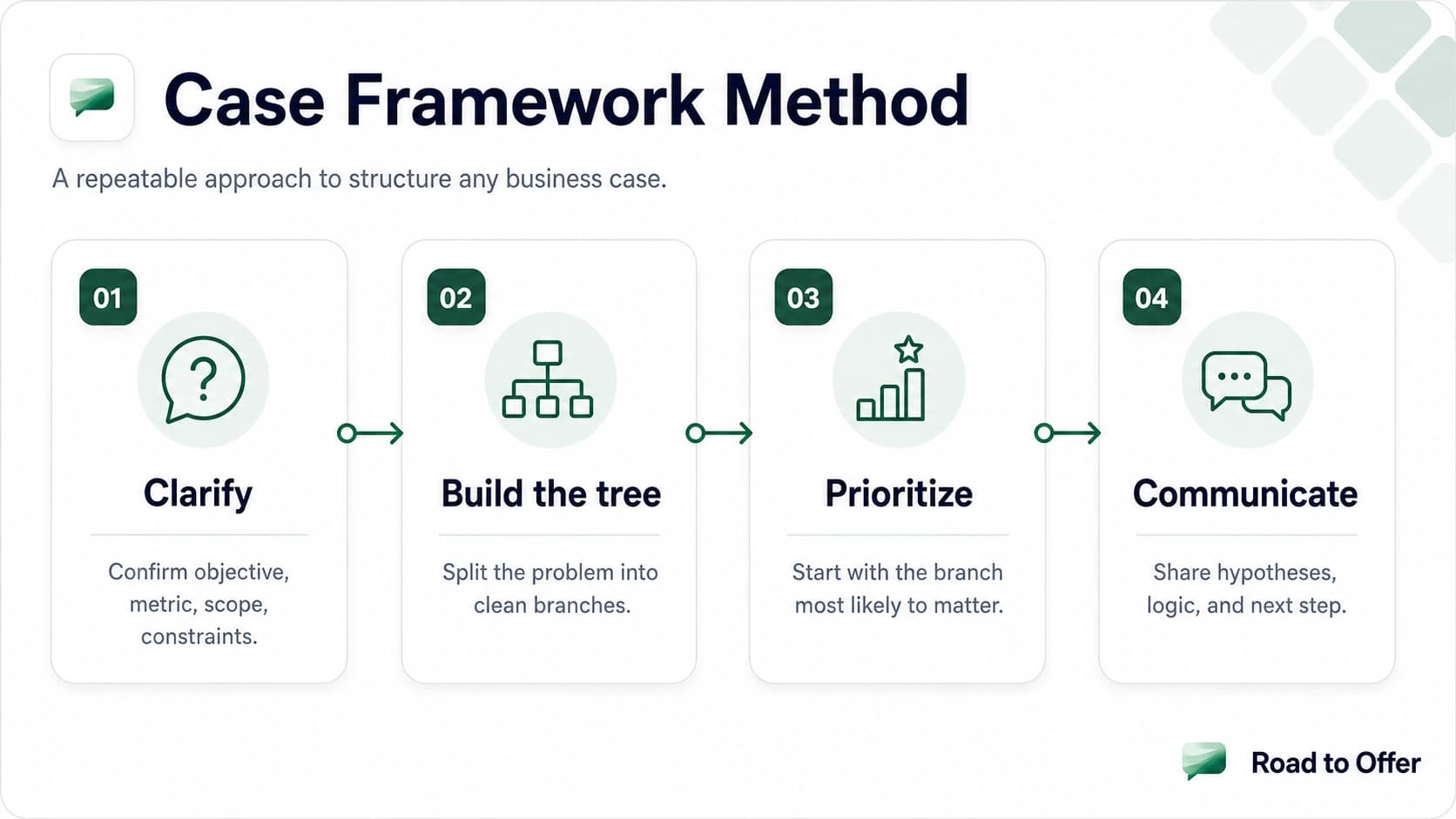
Learn the case method
One dense lesson, each step linked to the drill that trains it.
Related Guides
- Case Interview Prep Guide: Where to Start
- Consulting Interview Prep Timeline: 4 Plans
- What Is a Case Interview?
- First Round vs Final Round Consulting Interview
- McKinsey Case Interview Guide
- BCG Case Interview Guide
- Behavioral Interview Guide for Consulting
Sources (checked June 17, 2026)
- McKinsey interview prep: mckinsey.com/careers/interviewing/getting-ready-for-your-interviews
- McKinsey Solve FAQ: mckinsey.com/~/media/mckinsey/careers redesign/interviewing/main/solve-faqs-2024.pdf
- BCG interview process: careers.bcg.com/global/en/blogarticle/consulting-interview-process-what-to-expect
- Bain hiring process: bain.com/careers/hiring-process/
- Bain interviewing guidance: bain.com/careers/hiring-process/interviewing/
- Bain digital assessment: bain.com/careers/hiring-process/digital-assessment/
Frequently asked questions
Resources and related guides
- Run a real case interviewPractice
- Browse all free resourcesResource hub
- Best Case Interview Books 2026: Ranked, Scored, and What to SkipGetting Started · Mar 20, 2026
- Consulting Firms in Germany: Candidate Map by Specialty, Office, and Interview (2026)Getting Started · Aug 13, 2026
- Free Consulting Toolkit BundleGetting Started · Jun 4, 2026