
PwC Case Interview Guide 2026: Strategy&, Format, and Full Prep Plan
Complete PwC case interview guide 2026: Strategy& vs PwC Consulting, the round-by-round process, what interviewers score, and a step-by-step prep plan.
On this page
PwC case interviews in 2026 run through two distinct doors, Strategy& and PwC Advisory or Consulting, so the first prep decision is figuring out which one your invitation is testing, not memorizing one generic PwC case format. Strategy& is PwC's pure strategy arm, competing directly with McKinsey, BCG, and Bain for corporate-strategy and M&A mandates, and it publishes its own case-prep guidance on strategyand.pwc.com. PwC Advisory and Consulting interviews run a mixed format instead: candidate-led and interviewer-led cases, written exercises, group cases, and sometimes an online cognitive assessment, depending on role and office.
This guide covers the full PwC interview process from first screen to offer, how Strategy& differs from PwC Consulting, where PwC diverges from McKinsey, BCG, and Bain, one compact worked example, the digital/tech consulting track, and a complete prep plan, so verify your role, office, and service line against the current invitation before choosing a format. For eight fully solved cases, use the PwC and Strategy& practice cases page. If you're also targeting MBB firms, pair this with our McKinsey case interview guide and BCG case interview guide.
For service-line fit and Big Four behavioral prep, pair this with the PwC behavioral interview questions guide.
PwC Strategy& vs PwC Consulting: The Critical Distinction
Most candidates treat "PwC" as a single entity. It isn't. The two arms recruit separately, pay differently, and offer different types of work.
Turn the PwC role split into a transformation structure
Choose the route first, then build a tailored structure with implementation trade-offs.
Strategy& (Formerly Booz & Company)
PwC acquired Booz & Company in 2014 and rebranded it Strategy&. It is PwC's pure strategy consulting arm, the equivalent of McKinsey, BCG, or Bain within the PwC network. Strategy& serves C-suite clients on corporate strategy, M&A, market entry, and organizational transformation. It competes directly with MBB for senior-level strategy mandates.
Interview characteristics:
- Candidate-led case format: you drive structure, questions, and recommendation
- Strategy-focused cases: make-vs-buy, new product introduction, market entry, M&A
- Strong behavioral emphasis (PwC wants to rule out candidates treating Strategy& as a safety school)
- 2 interview rounds total
Culture and work: More concentrated strategy work, less implementation. Strategy& teams are typically leaner than MBB teams. Hours are demanding but generally below McKinsey norms.
PwC Consulting (Management, Technology, Risk)
PwC's broader consulting practice covers management consulting, technology consulting, and risk advisory. Work includes ERP implementations (SAP, Oracle, Microsoft), digital transformation programs, operations improvement, financial risk, and regulatory compliance.
Interview characteristics:
- Mix of candidate-led, written, and group case formats
- More operational case topics: profitability, cost reduction, market sizing, digital strategy
- Online cognitive assessment required for most roles
- Up to 3 interview rounds, with potential group case component
Culture and work: Broader client exposure, more implementation-heavy projects, generally better work-life balance than Strategy&. The technology consulting practice has grown rapidly with AI and ERP mandates.
Compensation
Compensation varies by level, location, practice, and current role posting. Use the posting's published band or recruiter-provided range.
The Full Interview Process
Strategy& Interview Process
Strategy& round count, timing, interviewer seniority, and case/behavioral split vary by role and office. Confirm each from your invitation.
PwC Consulting Interview Process
Online Assessment (Round 1 pre-screen):
- Cognitive skills test covering English comprehension, quantitative reasoning, and logical reasoning
- Not timed as a single block; individual sections are timed separately
- Results determine whether you advance to a recruiter screen
Recruiter Screen (Round 1b):
- 30-minute phone or video call
- Behavioral questions only (tell me about yourself, why PwC, leadership examples)
- No case component
Round 2 Interviews:
- Two interviews: one case + one behavioral/fit
- Case format is candidate-led; topics are more operational than Strategy&
- Conducted by Manager-level consultants
Final Round:
- Three to five interviews depending on the practice
- May include a written case exercise or individual presentation; some routes send the materials in advance, so confirm timing from your invitation
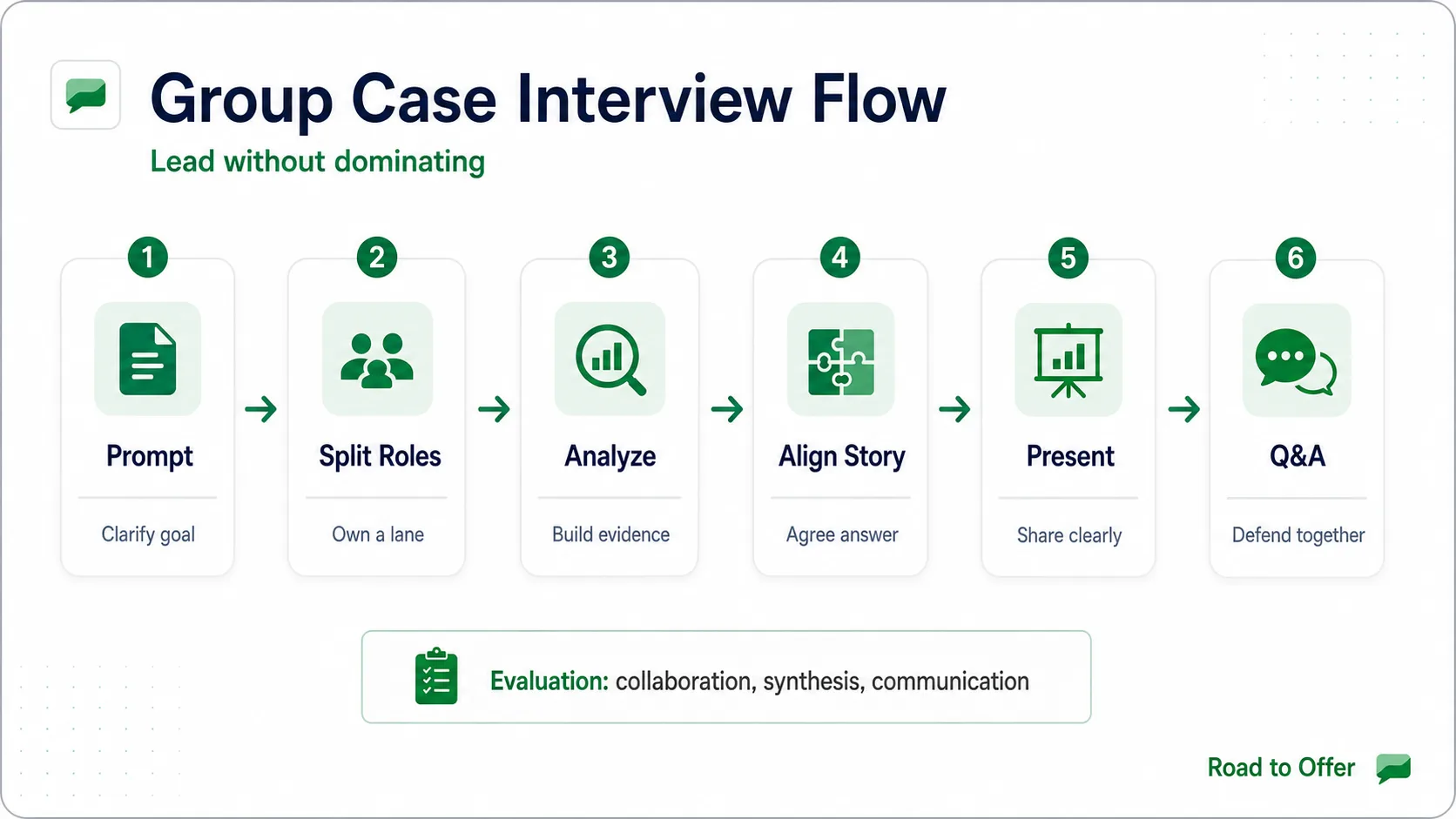
- May include a group case (3 to 6 candidates, collaborative 20 to 30 minute exercise)
- Mix of behavioral and technical questions for technology consulting roles
For a deep dive on written case formats, see our written case interview guide. For group cases, see the group case interview guide.
Round-by-Round at a Glance
Not every route includes every step. Use this table to map your invitation, then prepare only for the steps it names.
The case interview length and format come from PwC's advisory case prep page, where the interviewer expects you to break the problem down, ask clarifying questions, and work basic numbers out loud. The screen, group case, written case and final interview steps are candidate-reported and vary by route, so confirm timing and materials from your invitation.
How PwC Case Interviews Differ From MBB
Understanding where PwC diverges from McKinsey, BCG, and Bain is essential for targeted prep.
Case Format Comparison
PwC Strategy& vs. PwC Consulting
PwC vs. MBB
The Three Key Differences
1. Behavioral interviews carry more weight at PwC. MBB firms weigh case performance heavily; behavioral is secondary. At PwC (especially Strategy&) the fit interview can eliminate you even if your case performance is strong. PwC interviewers are specifically checking that you genuinely want to work there and aren't just using it as an MBB fallback.
2. PwC uses group cases; MBB doesn't. PwC Consulting's final round may include a group case where 3 to 6 candidates work together on a problem. MBB firms do not use this format. The group case evaluates collaboration, leadership, and the ability to advance a discussion rather than dominate it.
3. PwC case problems are often narrower. MBB cases often ask you to define the problem before solving it. PwC cases typically hand you a more defined problem statement. This makes them slightly more tractable but also means you must go deeper into quantitative analysis rather than spending time scoping.
For comparison with another Big 4 firm, see our Deloitte case interview guide.
How should you align your PwC resume and cover letter before this interview?
Scope the documents to PwC consulting or Strategy& only where the current role does so. Show client problem solving and implementation without naming an assessment vendor or path that has not been verified.
- Before: Supported a client analysis.
- After: Compared the operating options, summarized the tradeoff, and prepared the recommendation used in the sponsor review.
Check that the role, market, and current invitation support the application story. Recruiters read the resume and cover letter together: the resume proves the work, while the letter explains why PwC or Strategy&. Use the existing PwC cover letter guide for the full letter job.
Keep the parent and strategy-arm evidence distinct
Upload the resume for a Road to Offer graded report, not a PwC screen.
Revise one role-specific line, rehearse the matching story, and bring it into the next case rep.
PwC's Digital and Technology Consulting Track
PwC Technology Consulting has become one of the fastest-growing practice areas, driven by SAP and Oracle ERP mandates, AI implementation projects, cybersecurity advisory, and digital transformation programs.
What the Technology Track Looks Like
Technology Consulting interviews add a technical layer on top of standard case preparation:
Technical screen (phone/video):
- Computer Science fundamentals: object-oriented programming, database management, computer networks, operating systems
- Data Structures and Algorithms (DSA) for more technical roles
- Questions about SQL, data modeling, or cloud platforms for data/analytics roles
Case component:
- Technology-focused case topics: post-merger IT integration, ERP selection and rollout, digital transformation ROI, cybersecurity risk quantification
- Questions about how to evaluate build-vs-buy for enterprise software
- Data interpretation exercises with dashboards or system output data
Behavioral emphasis:
- STAR-format answers with emphasis on navigating ambiguity and stakeholder management
- Technical communication: explaining complex systems to non-technical audiences
- Example: "Tell me about a time you had to translate a technical recommendation into a business case"
What PwC's AI Practice Means for Interview Prep
PwC has heavily invested in AI and generative AI consulting as a growth area. Candidates for strategy and technology roles should expect case prompts involving:
- AI adoption ROI: cost of implementation vs. productivity gains
- Data readiness assessments for AI deployment
- Change management for automation initiatives
- AI ethics and regulatory risk (especially EU AI Act compliance)
You don't need to be an AI engineer, but you should be able to frame an AI implementation decision as a business case with quantified assumptions.
Worked Example: Airline Beverage Profitability Case
Prompt: "A regional airline is considering adding alcoholic beverages to its in-flight menu on short-haul routes. Should it do it?"
This is one compact PwC-style profitability case: a defined problem, operational scope, and a clear need for numbers. Every figure below is an illustrative assumption you would state out loud, not airline data. For eight fully solved cases across Strategy& and PwC Consulting formats, including a regional bank digital transformation payback, work through the PwC and Strategy& practice cases.
For the structure, split revenue into passengers x uptake x spend, costs into product, crew training, licensing, and insurance, and strategic fit into competitors, brand, and crew workload. Ask whether the interviewer wants you to go deeper anywhere before you quantify.
Revenue: 50 aircraft x 10 flights a day = 500 flights. 500 flights x 120 passengers x 15% uptake x $10 average spend = $90,000 a day, or about $32.9M a year.
Costs: product at 40% of revenue (about $13.1M), a $2M crew training cost spread over 3 years (about $0.7M), an insurance uplift ($0.5M), and licensing (about $0.05M) total about $14.4M a year.
Net: about $18.5M incremental profit a year, roughly a 56% margin on beverage revenue.
PwC's case prep page says you may be asked to estimate figures or do quick calculations, with no advanced math required, so practise this arithmetic as mental math and confirm the calculator policy from your invitation.
Recommendation: "Proceed, starting with a pilot on the highest-traffic routes. On these assumptions the menu adds about $18.5M a year in incremental profit. The risks to monitor are liability incidents and cabin crew workload."
PwC Behavioral Interview: What They're Actually Testing
PwC's behavioral interview carries more weight than at most MBB firms. For Strategy&, the behavioral round is partly a "reverse filter": interviewers are checking you're genuinely interested in PwC, not just using it as a backup.
The Five Behavioral Themes PwC Tests
1. Leadership and influence without authority
"Tell me about a time you led a team without formal authority."
2. Client/stakeholder management
"Describe a situation where you had to manage a difficult client or stakeholder."
3. Analytical problem-solving under pressure
"Walk me through a time you had to make a decision with incomplete data."
4. Adaptability and ambiguity
"Tell me about a time when your initial approach didn't work and how you adapted."
5. Why PwC / Why Strategy& (weighted heavily)
"Why PwC over MBB?" or "What specifically draws you to Strategy& rather than McKinsey?"
Prepare a crisp, specific answer to the "why PwC" question. Vague answers ("I love the collaborative culture") fail this check. Research specific PwC deals, practice groups, or initiatives and reference them by name.
For more on structuring behavioral answers, see our case interview fit questions guide.
PwC Case Interview Scoring
PwC's advisory case prep page names five things interviewers listen for. Use them as your self-scoring checklist:
The same page tells candidates to ask clarifying questions, practise sample cases out loud with a timer, sharpen mental math, and think out loud when stuck. It also states that cases are not testing for a single right answer and that AI or GenAI is not permitted during the assessment and interview process.
For a full breakdown of how candidates are scored across these dimensions, see our case interview scoring rubric guide.
Case Frameworks Most Useful for PwC
PwC cases frequently test three core framework types. Master these before anything else.
1. Profitability Framework
Use when: Revenue or margin has declined, or you're evaluating whether a new initiative is financially viable.
Structure: Revenue (Volume × Price) − Costs (Fixed + Variable) = Profit. Identify which driver changed, then drill down.
This is the most common PwC Consulting case type. See our detailed profitability framework guide.
2. Market Entry Framework
Use when: A client is considering entering a new market, launching a new product, or expanding geographically.
Structure: market attractiveness, then company capabilities, then entry strategy, then the financial case.
3. Cost-Benefit / Investment Case
Use when: A client is evaluating a major capital investment, technology project, or operational change.
Structure: total cost (one-time + recurring), then total benefit (revenue uplift + cost savings), then break-even timeline, then risk factors.
A technology platform migration, weighing the one-time spend against maintenance savings and new revenue, is the classic PwC Technology Consulting version of this framework.
For a full library of frameworks, see our case interview frameworks complete guide.
Knowing the three frameworks is not what gets scored. Interviewers listen for a structure built from the case details, and a generic template reads as memorized. Build one structure in the case below and get it graded, then check whether your issue tree stayed specific to the client.

Operations · medium
Practice for PwC in a real case interview
Matched to this PwC guide: a live manufacturing operations case with an AI interviewer. Free, scored on every step.
Quantitative Skills: What PwC Tests
Even if a calculator is permitted, practice handling:
- Percentages and margins: "Revenue is $200M with a 15% net margin. Costs increase by $5M. What's the new margin?"
- Breakeven: "Fixed costs are $2M. Variable cost is $40 per unit. Price is $60. How many units to break even?"
- Market sizing: "Estimate the size of the market for online banking apps in Germany."
- Growth rates: "Revenue grew from $80M to $100M. What was the percentage growth?"
Practice mental math drills daily. Aim for fluency on 2-digit multiplication and percentage calculations within 10 to 15 seconds.
For structured practice, see our market sizing step-by-step guide and mental math for case interviews guide.
Practice this next: Run a free math drill before your next full case so mental arithmetic does not become the bottleneck.
PwC Case Interview Prep Plan
Week-by-Week Schedule
Total prep time: 6 weeks, 60 to 80 hours for a competitive result.
Accelerated track (3 weeks): Compress by focusing on: profitability framework only (Week 1), 3 solo cases + 3 partner cases (Week 2), 2 mock interviews + behavioral polish (Week 3). Achievable if you already have case interview experience.
Priority Resource Order
- PwC's official case prep page: pwc.com careers/advisory case study prep, start here for format and example
- Strategy&'s official business case prep page: strategyand.pwc.com
- Solo practice: Work through 8 to 10 cases from HackingTheCaseInterview or PrepLounge PwC-specific cases
- Partner practice: 4 to 6 live partner sessions using real PwC case types
- Road to Offer AI coaching: Practice with real-time feedback on structure, math, and synthesis, then use the recommended drill path before the next full mock
For a full timeline calibrated to your specific situation, see our consulting interview prep timeline guide.
Common PwC Case Interview Mistakes
1. Treating Strategy& as an MBB backup. Interviewers ask "why PwC?" specifically to screen out candidates using them as a safety school. Have a specific, researched answer.
2. Under-preparing for behavioral interviews. At PwC, behavioral interviews can eliminate otherwise strong candidates. Treat them as equally important as the case.
3. Skipping the online cognitive assessment at PwC Consulting. Many candidates don't practice for this screening step. A poor cognitive assessment result eliminates you before live interviews.
4. Using generic frameworks. PwC interviewers reward frameworks tailored to the specific problem. A generic issue tree is less impressive than a tight 3-bucket structure built from the case details.
5. Forgetting to synthesize. PwC interviewers specifically look for a clear recommendation. Don't leave the room with "it depends" as your conclusion.
Sources and Further Reading (checked June 17, 2026)
- PwC Advisory Case Study Prep, official guidance: https://www.pwc.com/us/en/careers/entry-level/advisory-case-study-prep.html
- Strategy& Business Case Prep, official page: https://www.strategyand.pwc.com/m1/en/careers/apply/business-case-prep.html
- PwC Strategy& Case Interview Complete Guide, HackingTheCaseInterview: https://www.hackingthecaseinterview.com/pages/pwc-strategyand-case-interview-prep
- The PwC Case Interview Strategy, MyConsultingOffer: https://www.myconsultingoffer.org/case-study-interview-prep/pwc-case-interview-strategy/
- PwC Strategy& Case Interview Free Guide, IGotAnOffer: https://igotanoffer.com/blogs/mckinsey-case-interview-blog/strategy-pwc-case-interview
- PwC Salaries 2025 to 2026, Glassdoor: https://www.glassdoor.com/Salary/PwC-Salaries-E8450.htm
- PwC Recruitment Rate Data, FinanceBand: https://financeband.com/what-is-pwc-recruitment-rate
- PwC Interview Prep Guide 2026, PrepLounge: https://www.preplounge.com/en/blog/consulting/firms/pwc
- MBB vs Big 4 Consulting Comparison, IGotAnOffer: https://igotanoffer.com/blogs/mckinsey-case-interview-blog/big4-mbb
Related Guides
- PwC and Strategy& practice cases: 8 worked examples to rehearse after this guide
- PwC Strategy& case interview guide: PwC's strategy arm uses a distinct integrated case format
- Deloitte Case Interview Guide: Big 4 competitor comparison and case format breakdown
- KPMG Case Interview Guide: Big 4 peer with a comparable behavioral-first format
- Written Case Interview Guide: Prep for PwC and Strategy& final round written formats
- Profitability Framework Guide: Deep dive on the most common PwC case type
- Group Case Interview Guide: How to lead, contribute, and stand out in PwC Consulting group cases
Frequently asked questions
Resources and related guides
- Practice for PwC in a real case interviewPractice
- Browse all free resourcesResource hub
- Accenture Case Interview: Strategy vs Consulting, Group Format, and Prep Plan (2026)Firm Specific · Mar 15, 2026
- Booz Allen Case Interview: Public-Sector Cases + PrepFirm Specific · Mar 15, 2026
- EY-Parthenon Case Interview 2026: Process, Rounds, Written CaseFirm Specific · Mar 7, 2026