
EY Online Assessment 2026: Tests, Job Simulation & How to Pass
A current, free guide to the EY online assessment: the aptitude tests, the situational/strengths questions, the EY Job Simulation, worked examples for each test type, the official rules, and a prep plan.
On this page
What should you verify about the EY online assessment?
EY's online assessment is an early, role- and country-dependent screen, so use the invitation and official local page to confirm which reasoning, situational, and job-simulation steps apply. EY's official US early-careers FAQ says most candidates finish that route's core skills assessment in about 20 minutes and must complete it within 24 hours of the invitation, as checked July 18, 2026. What this means for your prep: treat the invitation as the format contract, then use timed graph and exhibit reasoning drills only for the skills it names, not as an EY simulator.
Where the EY Online Assessment Sits in the Funnel
EY's recruiting sequence varies by route. Your process may include an online assessment, job simulation, assessment centre, or interviews in a different combination and order.
EY does not publish one cross-route screen-out rate or cut-off. Treat numerical accuracy, time management, situational judgement, and values alignment as separate preparation needs rather than assigning an unsupported probability to any stage.
The EY Aptitude Tests, Broken Down
Common prep formats include numerical reasoning, verbal reasoning, situational judgement, job simulation, and strengths-based questions. The mix is not universal; match your practice to your invitation.
Numerical reasoning
Numerical questions can test data interpretation: read a table or chart, then calculate a percentage change, ratio, share, or forecast. Use the invitation's question count, timing, and calculator policy rather than assuming one vendor format applies.
Verbal reasoning
Verbal reasoning uses the True / False / Cannot Say format against short business passages. The trap is answering from real-world knowledge instead of the passage. If the text does not state or directly support the statement, the answer is Cannot Say, even when the statement is plausible.
Logical and inductive reasoning
Logical or inductive reasoning shows a sequence of shapes or figures and asks you to identify the underlying rule, then pick what comes next. It rewards abstract pattern recognition rather than knowledge. This is the same skill that shows up in consulting screens generally, so if you are also preparing for other firms, the reasoning carries across (see how a Big Four sibling structures it in the PwC assessment test guide).
Worked Examples for Every Test Type
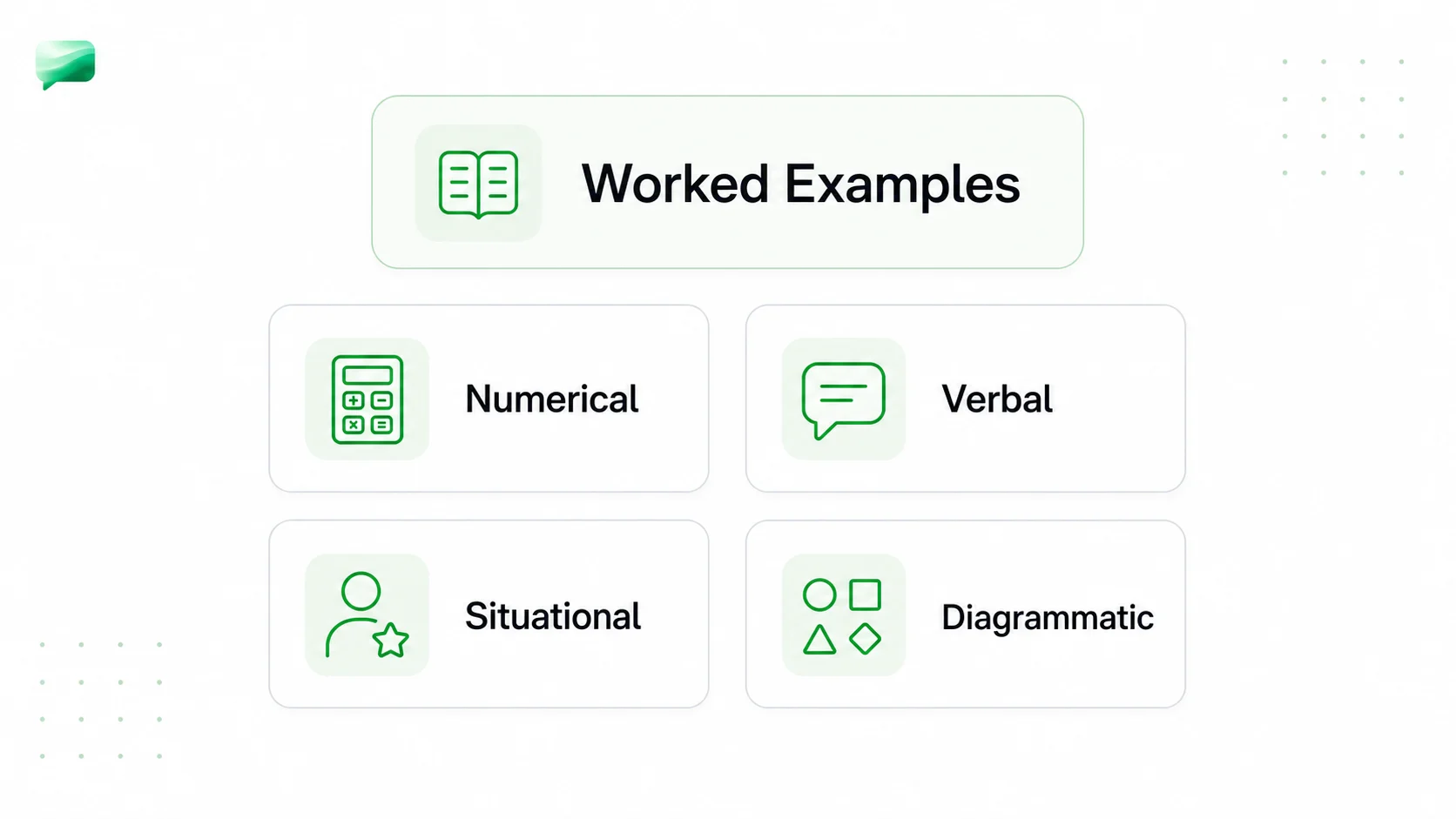
Most competitor pages paywall their practice questions. Here is a labelled worked example for each EY test type so this page doubles as a quick rep.
Worked example: numerical (data table)
Prompt. A retail client reports revenue by region (in millions), 2024 then 2025: North 120 then 138, South 90 then 99, East 200 then 210, West 75 then 90. Which region had the highest year-over-year growth rate?
Working. Compute each growth rate. North: 18 / 120 = 15%. South: 9 / 90 = 10%. East: 10 / 200 = 5%. West: 15 / 75 = 20%.
Answer. West, at 20%. The trap is anchoring on absolute change (North grew by 18, the biggest raw jump) instead of the percentage the question asked for. Always re-read whether the question wants absolute or relative change.
Get one case math answer scored from the Road to Offer drill engine. Answer a real prompt and get AI-scored feedback. Free accounts include 5 drills per day for the first 3 days after signup.
Worked example: verbal (True / False / Cannot Say)
Passage. "In 2025, EY's consulting division grew faster than its tax division. Both divisions hired graduates, though the firm did not disclose exact graduate numbers by division."
Statement. "EY hired more graduates into consulting than into tax in 2025."
Answer. Cannot Say. The passage confirms both divisions hired graduates but explicitly says the per-division numbers were not disclosed, so you cannot conclude which hired more. A statement that "consulting grew faster than tax" would be True, because the passage states it directly.
Worked example: logical (pattern sequence)
Prompt. A sequence of shapes: a triangle, then a square, then a pentagon, then a hexagon. Each shape is unshaded on odd positions and shaded on even positions. What is the fifth shape?
Working. Two rules run in parallel. Rule one: the number of sides increases by one each step (3, 4, 5, 6, so the next is 7). Rule two: shading alternates, and position five is odd, so it is unshaded.
Answer. An unshaded seven-sided shape (a heptagon). Inductive items almost always hide two simultaneous rules; isolate each one before predicting the next frame.
Worked example: situational judgement (ranked responses)
Scenario. You are on an EY audit team. The day before a client deadline, a teammate is clearly behind on their section and has not flagged it. What do you do?
- Most effective: Speak to the teammate directly, understand the blocker, and offer to take a defined piece of the work, then make sure the manager has visibility so the client commitment holds. (Shows teaming and integrity.)
- Reasonable: Flag the slippage to the manager early so the team can re-plan. (Protects the client, slightly weaker on teaming because you skipped the direct conversation.)
- Least effective: Say nothing because it is not your section, or quietly redo their work without telling anyone. (Fails both teaming and integrity, and creates risk.)
SJT items rarely have a single "correct" click. You are ranking responses, and the strongest ones combine doing the right thing for the client with collaborating openly rather than rescuing or blaming.
Situational Judgement, Strengths, and "What's Your Mindset"
Some EY routes include situational and strengths questions. If yours does, practice explaining how you would behave and what motivates you, within the format stated in the invitation.
The reliable way to answer is to map your responses to EY's five core values: integrity, respect, teaming, energy, and courage. That does not mean picking the answer that sounds most virtuous. It means picking the response you can defend with real evidence and that stays consistent across the whole questionnaire, because strengths assessments look for patterns, not single polished clicks.
Inside the EY Job Simulation
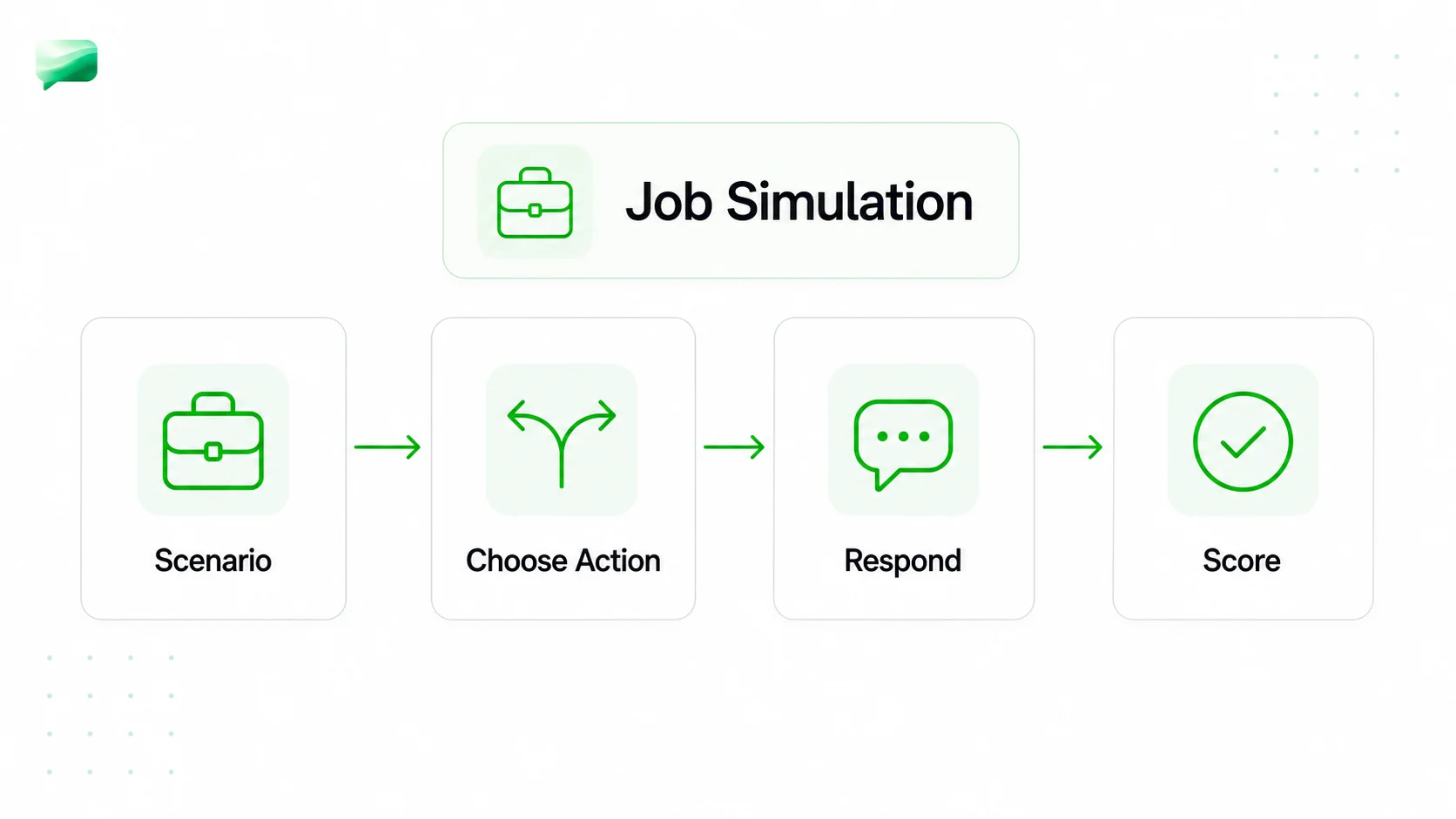
If your route includes an EY Job Simulation, expect work-style scenarios that may combine judgement, reasoning, and motivation. Follow the current invitation for sections, timing, and sitting requirements.
The six sections typically run along these lines:
- Your Thinking (how you approach problems)
- Making Connections (relating information and stakeholders)
- Solving Problems (short reasoning and analysis tasks)
- Developing Solutions (turning analysis into recommendations)
- Implementing Change (execution and follow-through judgement)
- Why EY (motivation and fit)
Because it blends situational judgement, light reasoning, and motivation in one timed sitting, treat it as a hybrid: bring your aptitude focus to the reasoning items and your values mapping to the judgement and motivation items. Some markets also add a short video interview after this stage; psychometric-success.com describes giving candidates two minutes to prepare and two minutes to record an answer, so rehearse speaking to a camera in tight windows.
Logistics and Rules Candidates Get Wrong
Most avoidable failures here are administrative, not intellectual. EY's official early-careers FAQ is the source of truth, and it settles several myths:
- The 24-hour window is real. The skills assessment must be completed within 24 hours of receiving the assessment email.
- It is short, not trivial. Most candidates finish in about 20 minutes, but you can usually pause and resume within the window.
- Emails arrive on a schedule. Assessment emails are sent Monday to Friday during business hours and typically arrive within 12 business hours of applying, so check spam if it is quiet.
- Results are not shared. EY confirms assessment results are not disclosed to candidates, so do not waste energy trying to reverse-engineer a hidden score.
- Responses stay valid for the cycle. Your responses remain valid for the duration of each recruitment cycle, which matters if you apply to more than one role.
One more flag worth knowing: for certain routes MConsultingPrep reports a separate written or accounting test of around 60 multiple-choice questions plus one essay in 90 minutes. That is role-specific, so confirm against your own invitation rather than assuming every applicant faces it.
How to Prepare: A Step-by-Step Plan
You cannot cram judgement, but you can absolutely train the aptitude tests that do most of the screening out.
Execution checklist
Step 1: Confirm your exact format. Read your invitation email and local careers page. They override any article. Note which tests you face, the timing, and whether a written/accounting test applies to your role.
Step 2: Drill numerical under a timer. This is the highest-leverage prep. Do timed data-table and chart sets at under one minute per question until the arithmetic stops being the bottleneck. A calculator is usually allowed, so practice with one.
Step 3: Train the verbal discipline. Practice True/False/Cannot Say sets and force yourself to answer only from the passage. Build the habit of choosing Cannot Say when the text does not directly support the statement.
Step 4: Pattern-spot for inductive items. Practice shape sequences and train yourself to isolate two simultaneous rules (count and shading, rotation and position) before predicting the next frame.
Step 5: Map five strong stories to EY's values. Prepare evidence-backed examples for integrity, respect, teaming, energy, and courage so your strengths, simulation, and any video answers stay consistent.
Step 6: Rehearse the job simulation flow. Run a full timed reasoning-plus-judgement sitting so the one-hour, one-sitting format and the camera-based questions do not surprise you.
Use the invite-to-skill method: 1. confirm the route, 2. list the modules named in the invitation, 3. time one matching practice set, 4. review accuracy and judgement separately.
Test-day tactics
On the day itself, set up a quiet space, a stable connection, and a single uninterrupted block so you can finish in one sitting. Do a quick computer and browser check before you open the unique link from your own invitation. Budget your time per question and do not stall on a hard numerical item; mark a best estimate and move on, because most aptitude tests do not penalize wrong answers, so a blank is the only guaranteed zero. Between sections, take three slow breaths and reset, since the verbal and inductive sections punish the rushed-momentum mistakes that carry over from a stressful numerical round.
SHL practice for EY: early access, and drills you can run today
The SHL simulator is still in build. Signing up free reserves your place and opens the timed math drills that train the numerical reasoning speed EY's SHL round tests.
What Comes After: The EY Experience Day
Later stages vary by route and may include an EY Experience Day, assessment centre, group exercise, case study, or interviews. Confirm the components, group size, and timing from your recruiter or invitation.
The case study is where consulting-style structuring shows up directly, and it is the one component you can practice like a real case interview. Lead with a clear structure, do the math out loud, and finish with a recommendation that names the action, the why, and the main risk.
If you are recruiting into EY's consulting or strategy side, the case bar rises, and our EY case interview guide walks through that format in detail.
Service-Line and Role Differences
EY hires across Consulting, Assurance, Tax, and Strategy and Transactions, and the assessment mix can differ across those routes.
- Consulting and Strategy. Expect the strongest emphasis on the case study and structured problem-solving at the assessment centre. The reasoning sections matter, but your case structure and synthesis become the differentiator. For the strategy arm specifically, the EY-Parthenon case interview guide covers the sharper, more strategy-led case bar.
- Assurance and Tax. These routes may add the role-specific written or accounting test (around 60 multiple-choice questions plus an essay in 90 minutes, per MConsultingPrep) and lean more on technical and behavioral fit than on consulting-style cases.
- Grad, intern, and experienced hire. Graduate and intern routes lean hardest on the standardized aptitude tests and the job simulation as a top-of-funnel filter. Experienced hires often face fewer standardized tests and more role-specific and interview-led assessment.
The constant across all of them is the early aptitude screen. Whatever service line you target, clearing the numerical, verbal, and inductive tests is the price of admission, and the values mapping is what carries you through the human stages.
If the current invitation names Job Simulation, use the EY Job Simulation preparation guide. It trains representative evidence-to-response skills while leaving current format, timing, provider, and recording rules to the official instructions.
Sources (checked June 26, 2026)
- EY official, Early Careers Assessment FAQs: https://www.ey.com/en_us/careers/early-careers-assessment-faqs
- MyConsultingOffer, EY Online Assessment: https://www.myconsultingoffer.org/case-study-interview-prep/ey-online-assessment/
- MConsultingPrep, EY Online Assessment: https://mconsultingprep.com/ey-online-assessment
- Practice Aptitude Tests, EY assessments profile: https://www.practiceaptitudetests.com/top-employer-profiles/ernst-young-assessments/
- psychometric-success.com, EY assessment test types: https://psychometric-success.com/aptitude-tests/test-types/ey-assessment
- GraduatesFirst, EY assessment tests: https://www.graduatesfirst.com/ey-assessment-tests
Frequently asked questions
Resources and related guides
- Start Quick MathPractice
- Browse all free resourcesResource hub
- Accenture Assessment Test 2026: Identify Your Route & PrepareFirm Specific · Jun 27, 2026
- BCG Pymetrics Assessment: 12 Games, Scoring, and Prep (2026)Firm Specific · May 1, 2026
- Deloitte Assessment Test and Job Simulation 2026: Format, Sections & PrepFirm Specific · Jun 27, 2026
- Oliver Wyman Online Test and Assessment 2026: Format, Scoring & PrepFirm Specific · Jun 28, 2026
- EY Job Simulation: Written Response Method and Worked ExamplesFirm Specific · Jul 18, 2026