
KPMG Online Assessment and Launch Pad 2026: Stages, Tests & Prep
A route-aware guide to the KPMG online assessment and Launch Pad in 2026: Transforming Small Businesses, Delivering Outcomes, the video interview, Launch Pad day, scoring, and how to prepare for the UK and US routes.
On this page
The KPMG online assessment and Launch Pad process in 2026 is a four-stage funnel: an online application, two immersive online assessments (Transforming Small Businesses, then Delivering Outcomes), an on-demand video interview, and a final in-person Launch Pad assessment day. According to GraduatesFirst, the first assessment, Transforming Small Businesses, runs about 90 minutes inside a 5-day completion window, and vendor estimates suggest 50 to 80 percent of candidates are cut at the online-assessment stage. This guide is route-aware because the UK and EU immersive process differs sharply from the US route, which leans on standalone aptitude tests plus an on-demand video. Below you will find one clean stage-by-stage timeline, a side-by-side of the two routes, a concrete Launch Pad walkthrough, the 1 to 5 scoring against KPMG's behavioural capabilities, and worked practice questions. Read your invitation email first, then use the breakdowns here to prepare for your actual route.
Where does each KPMG assessment stage sit in the funnel?
KPMG screens in sequence, but the UK and EU immersive route differs from the US standalone-test route. GraduatesFirst and AssessmentDay report that Transforming Small Businesses takes about 90 minutes inside a 5-day completion window, as checked June 26, 2026. Confirm your route first, then use timed graph and exhibit reasoning drills as adjacent practice rather than as a KPMG simulator.
KPMG screens in sequence, and most candidates are removed early. The online assessments are the heaviest filter. Per GraduatesFirst, vendor estimates put online-assessment rejection at 50 to 80 percent, with 60 to 80 percent cut on aptitude-test results where those apply. That makes the assessments, not the final interview, the stage most worth preparing for.
Sources: GraduatesFirst and AssessmentDay. The funnel mirrors the candidate's real journey, so the rest of this guide follows it stage by stage.
Use the route-first funnel method: 1. identify the regional route, 2. map the next required stage, 3. practice its reasoning or response format, 4. keep live-case preparation running in parallel.
Practice under real assessment pressure
KPMG buries its reasoning tests inside emails, voicemails, and reports. Run a free AI-scored case to sharpen the structured judgement those simulations grade.
UK and EU route vs US route: split them before you prepare
The single most common mistake is preparing for the wrong KPMG process. The immersive UK and EU route and the US route test different things, and most competitor pages blur them together. Use this table to confirm which one applies to you, then prepare only for that column.
Source for the US-route timings: MConsultingPrep. The immersive route folds reasoning into realistic work rather than asking standalone aptitude questions, which is why UK candidates describe it as feeling less like a test and more like a workday simulation.
KPMG online assessments explained: Transforming Small Businesses
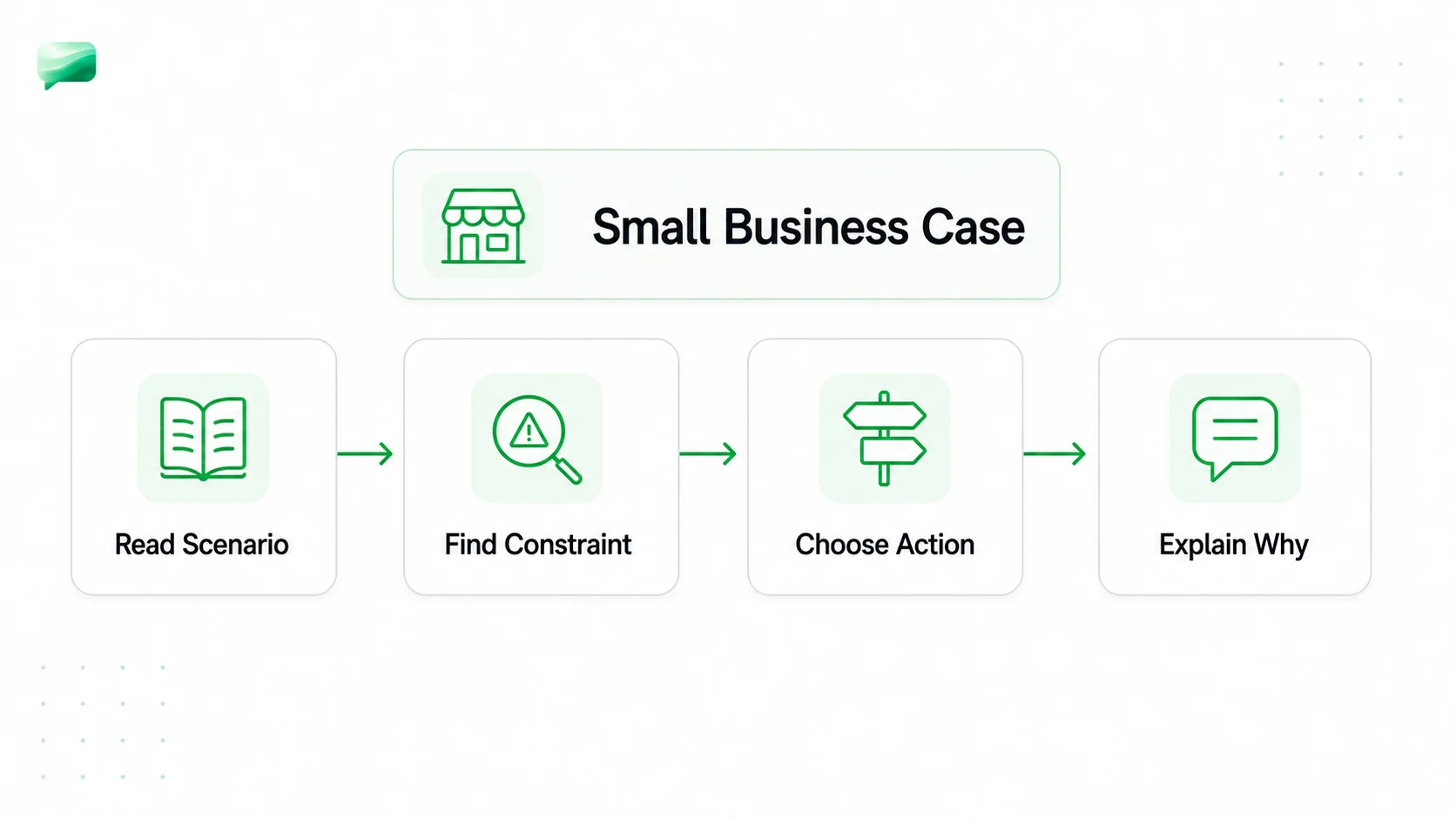
Transforming Small Businesses is the headline assessment on the immersive route. Per AssessmentDay and GraduatesFirst, it runs about 90 minutes on average inside a 5-day window and is built around three fictional businesses. You work through emails, voicemails, short videos, and reports, then respond to prompts the way a junior consultant or auditor would: prioritising tasks, interpreting data, and making judgement calls in context.
It is described as untimed in the sense that you have the 5-day window, but the realistic average is around 90 minutes, so block one quiet, uninterrupted session rather than starting and stopping. MConsultingPrep reports the scenario-based assessment presents roughly 12 to 20 work-based scenarios across that 90-minute experience.
The second immersive stage, Delivering Outcomes, adds around 40 questions per both GraduatesFirst and AssessmentDay. It continues the same realistic framing rather than switching to abstract puzzles.
What the scenarios actually test
Underneath the realistic packaging, KPMG is measuring the same reasoning skills standalone aptitude tests target, blended with situational judgement. Inside the scenarios you will face:
- Situational judgement: how you prioritise competing tasks, escalate issues, and handle client or team friction.
- Numerical reasoning: interpreting tables, charts, margins, and ratios drawn from the fictional businesses.
- Verbal reasoning: reading reports and emails, then drawing supportable conclusions rather than plausible-sounding guesses.
- Logical and inductive reasoning: spotting patterns and implications in the data you are given.
This is the key shift from KPMG's older standalone aptitude tests. Rather than a discrete numerical section followed by a discrete verbal section, the reasoning is nested in a workday context. The practical implication: practising raw aptitude drills still helps, but you also need to extract the right numbers and statements from messy, realistic source material before you can reason on them.
The Critical Thinker test and service-line knowledge tests
Some streams add a focused Critical Thinker test on top of the immersive assessments. Per MConsultingPrep and GraduatesFirst, the Critical Thinker section is roughly 30 minutes with around 10 numerical reasoning questions. It is short, but the questions are dense, so pace yourself rather than rushing the early items.
Certain service lines, particularly audit and tax, layer on a specialized knowledge test. MConsultingPrep reports this as roughly 25 questions over 25 to 30 minutes, checking baseline familiarity with the discipline you applied to. If you are applying to audit or tax, brush up on core concepts for that service line before you sit it; a general consulting prep routine will not cover the specialist content.
The KPMG on-demand video interview
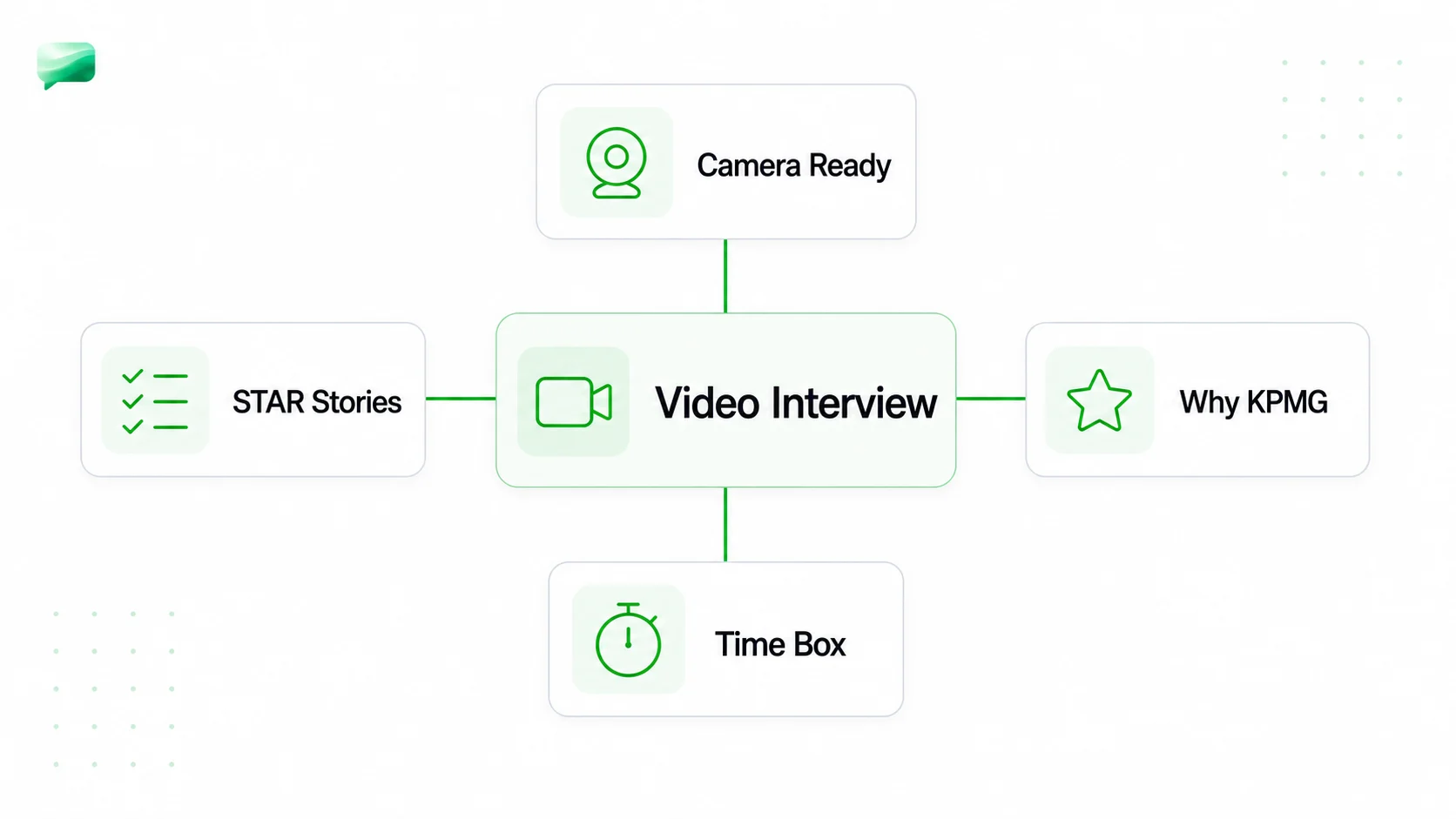
After the online assessments comes a pre-recorded video interview. Per AssessmentDay, it consists of four questions, with roughly 2 minutes to prepare and 2 minutes to record each answer. The questions map to strengths and behavioural competencies rather than technical knowledge.
Treat it like a behavioural interview you cannot interrupt. Most platforms allow no second take, so the format punishes rambling far more than a live conversation does. Prepare two or three crisp stories in advance, map them to KPMG's behavioural capabilities, and practice answering to a camera so the 2-minute window feels natural. The same story-driven preparation carries into Launch Pad, so the work compounds.
KPMG Launch Pad assessment day: a walkthrough
Launch Pad is KPMG's final stage, and recent cycles returned it to an in-person half-day after the earlier virtual version that competitors still describe. Per AssessmentDay, it runs as a half-day starting around 9 AM, and GraduatesFirst reports the component timings below.
There is a small vendor disagreement worth resolving: AssessmentDay describes group exercises of about 5 people with roughly 4 group tasks, while GraduatesFirst reports groups of 5 to 8. Plan for a group of around 5 to 8 and several short collaborative tasks, and you will be prepared either way.
The analytical exercise is where structure matters most. You receive case-style materials and have to organise a recommendation under time pressure, which is exactly the skill consulting case practice builds. For the partner interview, the bar is professional judgement and motivation, not memorised frameworks. If your structuring instinct is shaky, drill it before the day.
Interactive drill set. Write an answer before revealing the worked solution, then continue into Road to Offer for scored practice and AI feedback.
KPMG's values and behavioural capabilities: what scoring maps to
KPMG scores against its values and a set of behavioural capabilities, and understanding the framework lets you target your answers. The values are Integrity, Excellence, Courage, Together, and For Better. The behavioural capabilities assessors look for include career motivation, drives collaboration, and exercises professional judgement.
Assessors typically grade each capability on a 1 to 5 scale, where a 1 signals a clear gap and a 5 signals strong, evidence-backed behaviour. The practical takeaway is that vague enthusiasm scores low. An answer that says "I work well in teams" earns less than one that shows you mediated a disagreement, redistributed work, and hit a deadline. Frame the values as learnable behaviours you can evidence, not innate traits, and map each prepared story to one capability so you cover the framework across your answers.
Pass marks, rejection rates, and timelines
The numbers candidates most want are also the least officially published, so treat the figures below as third-party estimates. Per MConsultingPrep, the reported online-test cut-off sits around 75 to 80 percent, and KPMG often rejects more than 60 percent of candidates at the online-test stage. GraduatesFirst reports vendor estimates that 60 to 80 percent are rejected on aptitude-test results and 50 to 80 percent at the online-assessment stage overall.
On timing, AssessmentDay reports an overall decision timeline of roughly 2 to 6 weeks. Once an offer comes through, PrepLounge notes candidates typically have two working days to respond. PrepLounge also sizes the firm at around 276,000 professionals across 138 countries and territories, while GraduatesFirst cites roughly 270,000 employees across about 140 countries, which gives a sense of scale and why the early filters are so aggressive.
Stage-by-stage preparation playbook
Prepare in the order the funnel hits you, and practise each format under time pressure rather than just reading about it.
Online assessments. Drill numerical and verbal reasoning, but always extract the data from a realistic prompt first. A worked numerical example: a fictional cafe's revenue rose from 40,000 to 46,000 pounds while costs rose from 30,000 to 33,000. Margin moved from 25 percent to roughly 28.3 percent, so profitability improved despite higher costs, which is the conclusion the scenario wants you to reach and defend.
A worked verbal example: if a report states "the bakery launched online ordering in March and sales rose in April," the supportable conclusion is that sales rose after launch, not that the launch caused the rise. Answer from the text, flag correlation versus causation, and you will avoid the most common trap.
Video interview. Record yourself answering four behavioural prompts in 2-minute takes. Tighten anything that runs long.
Launch Pad. Practise structuring a recommendation from a short case packet in 30 minutes, and rehearse contributing to a group without dominating or disappearing. For the case-style analytical exercise, the McKinsey Solve guide is a useful comparison point on how immersive, scenario-based assessments are scored across firms.
SHL practice for KPMG: early access, and drills you can run today
We have not shipped the SHL simulator yet. A free account puts you first in line and opens the timed math drills that build the numerical reasoning speed KPMG's SHL stage rewards.
Eligibility and logistics
Per GraduatesFirst, typical UK eligibility is a 2:1 degree, five GCSEs at grade 5 (C) or above, and 112 to 120 UCAS points, and AssessmentDay similarly reports a minimum 2:1 degree. If you are unsuccessful, GraduatesFirst reports a reapplication window of roughly 6 to 12 months before you can try again.
Logistically, the immersive UK and EU route and the US aptitude-plus-video route are genuinely different products, so confirm your route from the invitation email and local careers page before you build a prep plan. If you are recruiting across the Big Four in the same cycle, the PwC assessment test guide covers a comparable region-split process, and the KPMG case interview guide goes deeper on the case-style reasoning that surfaces in the Launch Pad analytical exercise and partner interview.
If your current invitation names Launch Pad, use the KPMG Launch Pad preparation guide. That child uses conditional, invitation-first preparation and does not claim that Launch Pad applies to every role, country, or recruiting cycle.
Sources
- MConsultingPrep: KPMG Online Test (checked June 26, 2026)
- GraduatesFirst: KPMG job tests (checked June 26, 2026)
- AssessmentDay: KPMG application process (checked June 26, 2026)
- PrepLounge: KPMG firm overview (checked June 26, 2026)
Turn assessment prep into interview readiness
Launch Pad's analytical exercise and partner interview test the structured reasoning the simulations only sampled. Run a free AI-guided case to walk in fluent.
Frequently asked questions
Resources and related guides
- Rehearse a KPMG answer livePractice
- Browse all free resourcesResource hub
- KPMG Launch Pad: Conditional Preparation Guide and Worked TaskFirm Specific · Jul 18, 2026
- Accenture Assessment Test 2026: Identify Your Route & PrepareFirm Specific · Jun 27, 2026
- BCG Pymetrics Assessment: 12 Games, Scoring, and Prep (2026)Firm Specific · May 1, 2026