
KPMG Case Interview Guide: Format, Written Case, and Prep Strategy (2026)
KPMG case formats vary by role, service line, country, and office. Learn how to verify the process and prepare for live or written case work.
On this page
KPMG case prep is role-, country-, service-line-, and office-dependent, so start by identifying the process you were invited to, not by memorizing one universal round sequence. KPMG does not publish universal behavioral and case weights; confirm the current process with the recruiter and prepare every component named in your invitation.
For service-line fit prep, use the KPMG behavioral interview questions guide before your case mocks.
Use this selector before choosing a rep. If the invitation names a written case, practise a static prompt with a hypothesis, issue tree, math setup, and recommendation. If it names a live case, use a profitability or structure rep. Do not assume a timed document simulation unless KPMG supplied one.
What Is KPMG Strategy Consulting? The BearingPoint History
To understand KPMG's interview format, you need to understand its history. KPMG divested its consulting arm in 2002 (spun off as BearingPoint), leaving the firm without a major consulting capability for years. This created a structural gap that KPMG has been filling ever since by rebuilding its advisory and strategy practice from scratch.
The current practice sits within KPMG's broader advisory and consulting context. That makes the named role and service line more useful for preparation than a cross-firm prestige ranking.
This matters for interview prep in two ways:
- Behavioral evidence matters. Prepare values alignment, stakeholder skills, professional judgment, and ownership using the current role materials.
- Implementation can matter. For roles that name execution, change, transactions, or technology, connect the recommendation to operating trade-offs instead of stopping at the strategy.
KPMG Interview Format: Rounds, Behavioral Weight, and Timeline
KPMG Strategy round count and total timeline vary by office and role.
KPMG Strategy Interview Pipeline
- 01
Application + Resume Screen. Resume, cover letter, GPA/GMAT screen. Some offices add a Hirevue video screen.
- 02
Early Interviews. Behavioral or case discussions may apply; confirm timing and interviewer count.
- 03
Interview Day. Written or individual cases may apply; follow the invitation's format.
- 04
Later Interviews. A senior interview may apply depending on office and role.
- 05
Offer Decision. Timing varies; ask your recruiter.
Before any of these rounds, some offices add an online stage, so review the KPMG online assessment guide for the aptitude and situational tests to expect. Students looking to enter the pipeline earlier should weigh the KPMG internships guide and KPMG Embark Scholars, the firm's early-talent program for first- and second-year undergraduates.
KPMG does not publish universal behavioral-to-case weights. Use this unweighted preparation checklist instead:
Firm and stage formats differ, so use the McKinsey process guide or BCG format guide only for those firms. Do not transfer a fixed case-to-behavioral weighting to KPMG.
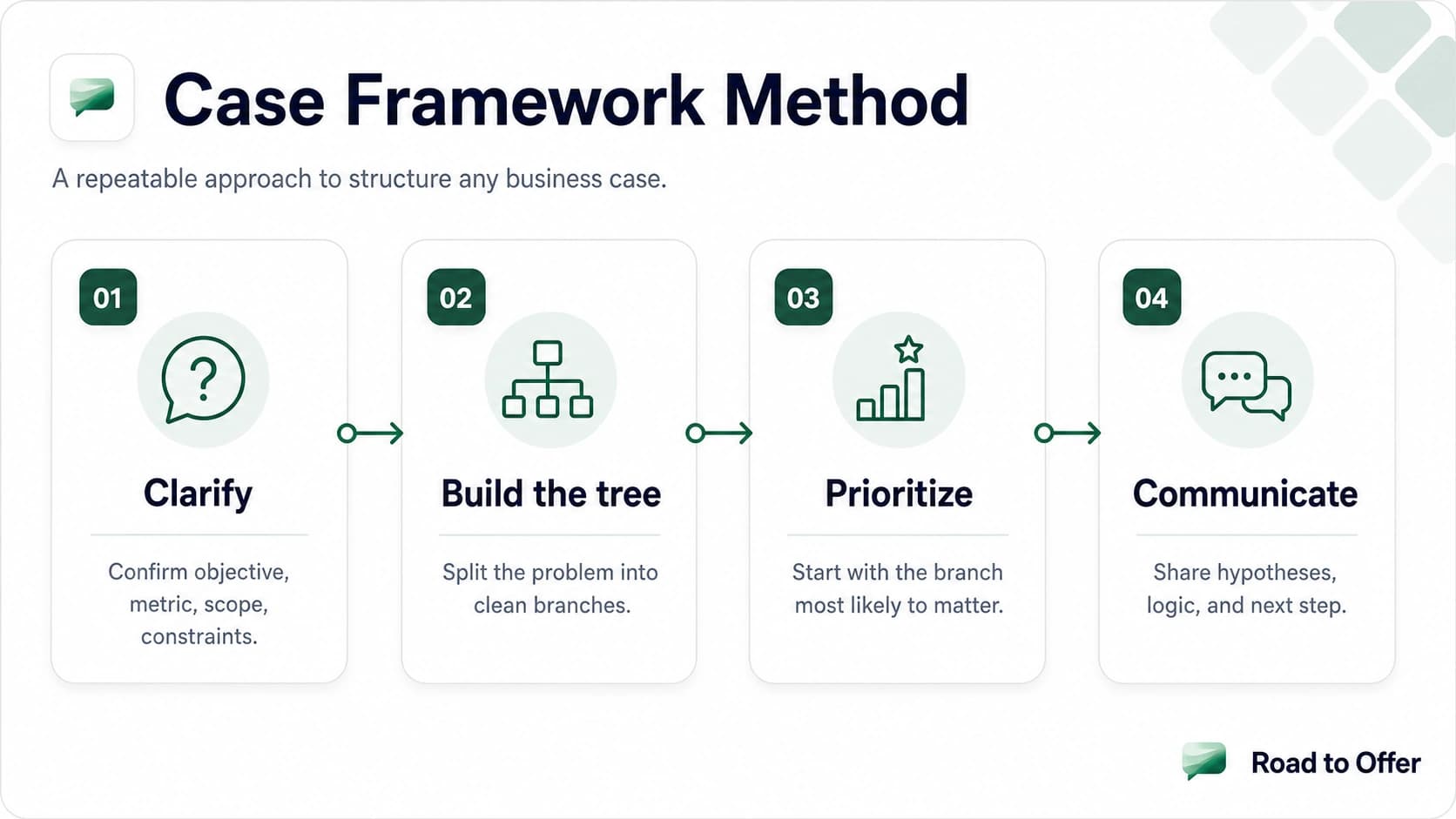
Learn the case method
One dense lesson, each step linked to the drill that trains it.
How should you align your KPMG resume and cover letter before this interview?
Scope the documents to the KPMG consulting role, business unit, and market named in the posting. Make client analysis and team delivery visible without assuming one assessment or cover-letter rule.
- Before: Prepared analysis for a client.
- After: Compared the operating options, summarized the risk tradeoff, and prepared the recommendation used in the sponsor review.
Check the current invitation before naming Launch Pad or another assessment path. Recruiters read the resume and letter together: the resume proves the work, while the letter explains why this KPMG role. Rehearse the revised line in the format the current guide and invitation require.
Keep the business-unit evidence specific
Upload the resume for an independent graded report, not an official KPMG evaluation.
Revise one role-specific line, rehearse the tradeoff, and use the evidence in the next case rep.
The Written Case Interview: What to Expect
KPMG's written case is the component most candidates underestimate because it doesn't map neatly to standard case interview prep. Here is the mechanics:
Static practice prompt: A client has lost four margin points while revenue remained flat. Write a one-sentence hypothesis, a three-branch issue tree, the first calculation you would request, and an answer-first recommendation with one implementation risk. This is a structure exercise, not a simulated KPMG document assessment.
Setup: If included, use the invitation's document packet, data, time limit, and requested recommendation format.
Delivery: Follow the stated presentation medium and timing, then prepare for questions on reasoning, alternative interpretations, and implementation considerations.
What's being evaluated:
- Speed of synthesis (can you identify the 2-3 key insights from a noisy dataset in under an hour?)
- Slide structure (is your recommendation well-organized and supported by evidence?)
- Communication clarity under pressure (can you explain a complex finding without jargon?)
- Handling pushback (do you defend your recommendation with data or cave immediately?)
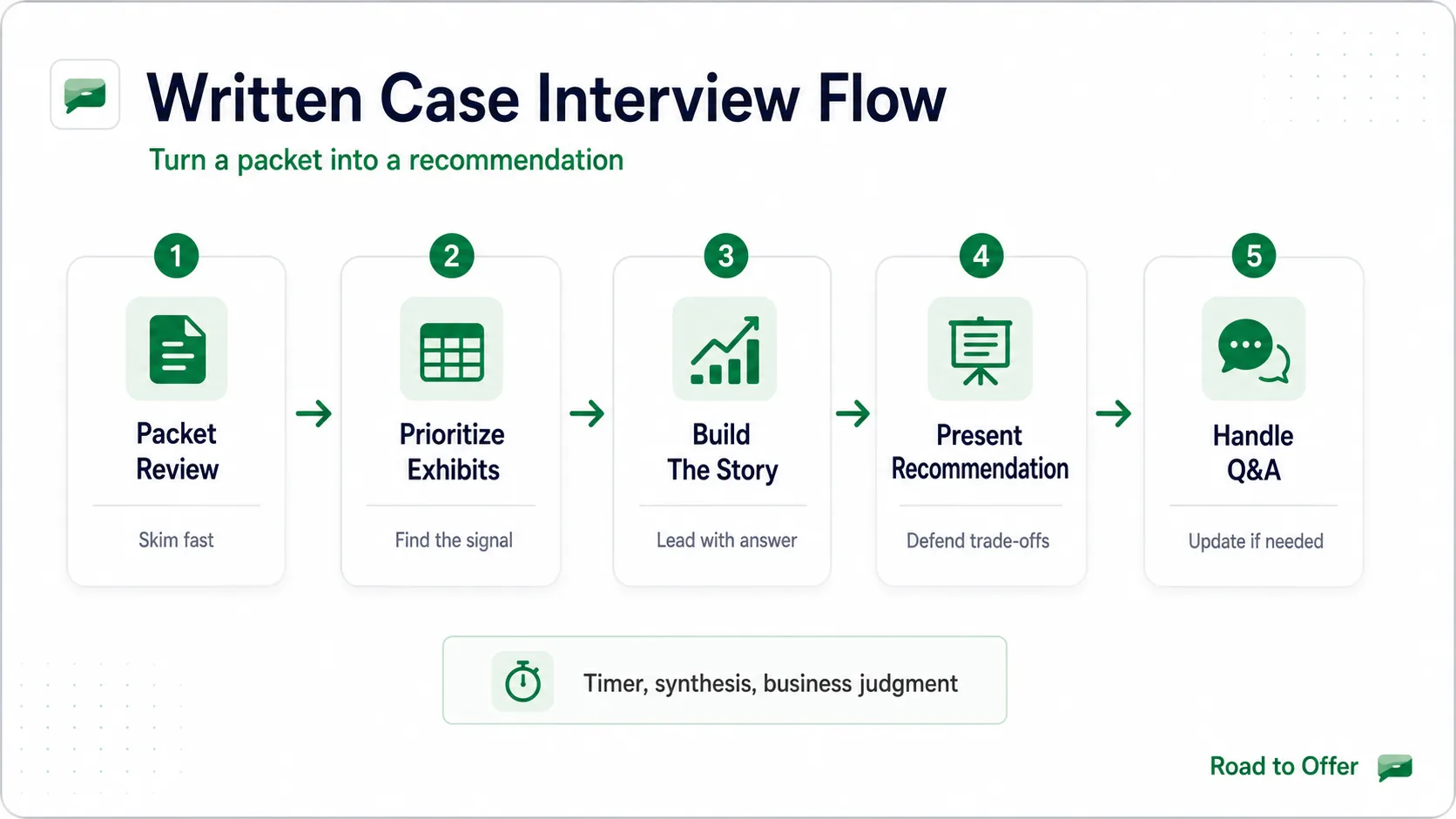
A written exercise can test synthesis and implementation thinking, but KPMG does not publish one universal purpose or rubric for it.
For more on this format, the written case interview guide covers document analysis techniques in detail.
KPMG Case Types and Frameworks That Work
KPMG cases are candidate-led. You drive the structure, ask clarifying questions, and present a recommendation. The firm uses three primary case archetypes:
1. Profitability Cases (Most Common)
A client's margin is declining. Diagnose whether it's a revenue or cost problem, identify the specific driver, and recommend a fix.
Standard approach: Revenue = Volume × Price, then segment by business line or geography. Cost = Fixed vs. Variable, then segment by cost category. For KPMG specifically, cases often have an implementation layer: not just "what's the problem" but "what should they do differently in operations."
See the profitability framework guide for a full walkthrough.
Practice this next: a candidate-led margin-recovery case where you diagnose whether the problem is revenue or cost, then add the operational fix KPMG cares about.
2. Market Entry Cases
Should a client enter a new market, geography, or product category? KPMG market entry cases frequently involve digital transformation angles or cross-border complexity, reflecting the firm's advisory work in those areas.
Structure: Market attractiveness (size, growth, margins, competition) → Fit with client capabilities → Entry strategy (organic build, acquisition, partnership) → Risk.
See the market entry framework guide for detailed approach.
Practice this next: Run a free market entry case after reviewing the market sizing step-by-step guide for the demand sizing layer.
3. M&A and Integration Cases
Should a client acquire a target, and if so, how should integration be managed? KPMG's transaction advisory practice means M&A cases are disproportionately common, especially post-merger integration questions.
Structure: Strategic rationale → Valuation and synergy sizing → Integration complexity and risk → Recommendation.
See the M&A case framework guide for the full framework.
Practice this next: Run a free M&A-style case and pressure-test the integration risk section out loud.
Frameworks to NOT over-rely on: Porter's Five Forces and the 4Ps appear occasionally but are secondary. KPMG interviewers respond best to issue tree-based structures that are clearly driven by the specific case prompt, not pre-fabricated frameworks dropped wholesale.
Behavioral and Fit Interview: KPMG's 5 Core Values
KPMG's behavioral interview is explicitly values-based. The five core values are:
Prepare 2-3 STAR-format stories (STAR method guide) for each value. KPMG interviewers often ask values questions directly ("Tell me about a time you demonstrated courage") rather than abstractly. The behavioral interview guide for consulting covers STAR preparation in detail.
Common KPMG behavioral questions:
- "Tell me about a time you delivered difficult feedback to a peer or superior."
- "Describe a situation where you had to work with someone whose values differed from your own."
- "Give me an example of when you pushed beyond what was asked of you on a project."
- "Tell me about a time your team faced a significant setback. What was your role in recovering?"
- "How do you make sure the work you produce reflects KPMG's commitment to excellence?"
Also prepare 3-4 strong answers to fit questions (consulting fit questions guide): "Why KPMG?" (vs. Monitor Deloitte, PwC Strategy&), "Why strategy consulting?", and "Where do you see yourself in five years?"
Worked Example: KPMG Profitability Case Walk-Through
Prompt: "Your client is a regional logistics company with 12 distribution centers across the US Midwest. Revenue has been flat at $240M for two years while operating margin has dropped from 14% to 9%. The CEO wants to understand what's driving the margin decline and what to do about it."
Opening structure:
"Before I dive in, let me clarify two things: is the flat revenue by choice (held pricing stable) or by market constraint? And is the margin decline affecting all 12 distribution centers or concentrated in certain ones?"
[Interviewer: Revenue is flat because of competitive pricing pressure in two markets. The margin decline is concentrated in four of the twelve centers.]
"Thanks. That's helpful. I want to frame this as: four specific centers have a profitability problem, and I need to determine whether it's a revenue problem in those markets or a cost problem at those facilities. Let me structure this as revenue versus cost.
Revenue side: Flat at $240M but pricing pressure in two markets. Average revenue per shipment or per distribution unit is probably declining. At 14% → 9% margin, that's a $12M swing on $240M revenue ($33.6M to $21.6M in operating profit).
The margin-swing arithmetic above is exactly the kind of fast, clean case math KPMG expects you to do live, including in the timed written case. Drill it until percentage-to-dollar conversions are automatic.
Calculate a logistics margin swing from the Road to Offer drill engine. Answer a real prompt and get AI-scored feedback. Free accounts include 5 drills per day for the first 3 days after signup.
Cost side: Fixed costs (labor, rent, equipment leases) are likely static while volume may have softened in those four centers. If volume per center dropped 10-15%, fixed cost absorption per unit rises, directly compressing margin.
My hypothesis: the four underperforming centers are in the competitive markets, with flat or declining volume and unchanged fixed cost base. The quick fix is either repricing (if market allows) or rightsizing the cost structure, likely consolidating headcount or renegotiating lease terms.
I'd want to look at: revenue per shipment by center, headcount and labor cost per center, and fixed vs. variable cost split for the four underperforming facilities."
[Interviewer: Good. The four centers have 8% lower revenue per shipment than the firm average and 15% higher labor cost per shipment. What do you recommend?]
"The combination of lower realized price and higher unit labor cost is a structural margin squeeze. I'd recommend two parallel actions: first, a labor productivity review at the four centers: if throughput per headcount is below the eight high-performing centers, there's a staffing optimization opportunity. Second, evaluate whether pricing in those two competitive markets can be partially recovered through service differentiation (faster delivery windows, guaranteed SLAs) or whether the better path is to accept the volume loss and exit the most unprofitable lanes.
My recommendation: pursue labor rightsizing first (faster payback, internal control) while piloting service-based repricing in the highest-volume lanes of the two competitive markets. Avoid across-the-board price increases in the contested markets without a service improvement to justify them."
This is the structure KPMG interviewers reward: clear segmentation, quantification of the problem, testable hypothesis, actionable recommendation.
KPMG vs. MBB vs. Big 4: Which Prep Approach Is Right?
If you are applying to both MBB and KPMG Strategy, run two separate prep tracks. MBB prep builds the analytical ceiling. KPMG prep requires additional behavioral depth and written case practice that MBB prep does not cover.
For broader Big 4 context, see the Deloitte guide, PwC guide, and Accenture guide.
4-Week KPMG Prep Plan
Execution checklist
Week 1: Foundation: frameworks + profitability cases. Build your core case structure before adding complexity. Run one Road to Offer baseline case, then master the standard frameworks KPMG is most likely to test.
Week 1: Behavioral story bank: 10 STAR stories mapped to KPMG's 5 values. Values-based behavioral questions are not optional prep at KPMG. Map each story to at least one of: Integrity, Excellence, Courage, Together, For Better.
Week 2: Market entry + M&A case practice (4-6 cases). KPMG's advisory focus makes these the second and third most common case types after profitability. Use Road to Offer guided cases to force the implementation trade-off after each recommendation.
Week 2: Written case simulation: timed document review (45 min) + 15 min presentation. Written case is the most-underestimated KPMG-specific component. Do at least 3 timed simulations before Round 2.
Week 3: Mixed case practice + behavioral mock interviews. Simulate a full KPMG interview day: one written case + one Road to Offer voice or guided case + 30 min behavioral. Build stamina for the full-day format.
Week 3: Why KPMG answer: research 3 specific KPMG initiatives, practices, or clients. Generic 'Big 4 strategy' answers fail at KPMG. Reference specific practice areas (e.g., KPMG Deal Advisory, Technology in Finance) or recent firm news.
Week 4: Full mock interviews + debrief. Focus on recommendation clarity and pushback handling. Use the Road to Offer debrief to pick the next structure, math, or synthesis drill instead of practicing evenly across everything.
Week 4: Review KPMG's published reports and thought leadership. Shows genuine interest and gives you material for 'Why KPMG' and fit conversations.
For the broader consulting interview prep timeline, see the 4-week prep timeline guide.
Common Mistakes in KPMG Interviews
Preparing only for cases. The single most common prep error for KPMG is treating it like an MBB interview with mostly case practice. KPMG's behavioral weight means a strong case performance can still result in a rejection if your values stories are thin.
Generic "Why KPMG" answers. Answers like "KPMG is a global firm with great clients" land poorly. Interviewers want to hear specific practice areas, named initiatives, or evidence that you understand where KPMG Strategy fits in the competitive landscape versus Deloitte and PwC.
Underestimating the written case. Most candidates have never done a timed document-review case before their KPMG interview. Three weeks of case framework practice does not prepare you for synthesizing a 15-page exhibit pack in 50 minutes.
Caving on pushback. KPMG interviewers test whether you will defend a data-supported position. Changing your recommendation immediately when challenged is interpreted as low confidence, not open-mindedness. Acknowledge the counterpoint, then explain why your recommendation still holds. Update only if the new information genuinely changes the analysis.
See the case interview tips and mistakes guide for a full breakdown of common candidate errors.
KPMG Interview Resources
For foundational case prep, the case interview frameworks complete guide and case interview examples library are the highest-ROI starting points. For behavioral prep, use the STAR method guide for consulting and the fit questions guide. Before the interview, the KPMG cover letter guide helps you tailor your application letter to KPMG's values and target practice.
If you are also interviewing at other Big 4 firms, the management consulting firms ranking guide provides positioning context for how KPMG compares to Deloitte, PwC, and Accenture in the strategy market. To place KPMG Strategy within the wider landscape of consulting firm types, from MBB to the Big 4 strategy arms, see the types of consulting firms overview. For candidates targeting the strategy arms specifically, see the EY case interview guide for KPMG's closest Big 4 peer in behavioral format, and the Monitor Deloitte case interview guide for the candidate-led strategy arm at Deloitte.
Sources and Further Reading (checked June 17, 2026)
- KPMG Global, FY2024 Revenue and Headcount: https://kpmg.com/xx/en/media/press-releases/2024/12/robust-growth-for-kpmg-as-global-revenues-rise-5-percent-to-us-dollar-38-point-4-billion.html
- Management Consulted, KPMG Interview Guide: https://managementconsulted.com/kpmg-interview/
- Hacking the Case Interview, KPMG Case Interviews: https://www.hackingthecaseinterview.com/pages/kpmg-case-interviews
- Glassdoor, KPMG Management Consultant Salary Data (2024-2025): https://www.glassdoor.com/Salary/KPMG-Management-Consultant-Salaries-E2867_D_KO5,26.htm
- KPMG Core Values, Official Statement: https://home.kpmg/xx/en/home/about/our-values.html
- BearingPoint History, Consulting Spinoff Context: https://www.bearingpoint.com/en/about-us/our-journey/
Frequently asked questions
Resources and related guides
- Practice for KPMG in a real case interviewPractice
- Browse all free resourcesResource hub
- Alvarez & Marsal Case Interview: Format, Restructuring, Prep (2026)Firm Specific · Mar 29, 2026
- Expedition EY: assessment format, practice plan, and consulting prepFirm Specific · May 22, 2026
- EY Case Interview: Choose Consulting, S&T or EY-ParthenonFirm Specific · Apr 8, 2026