
Bain Vector: What It Is and How the Interview Runs (2026)
Vector is the brand on Bain's digital and AI practice pages, but Bain hires into work areas like Analytics, Data & Research and Technology & Engineering. What Vector covers, who it hires, and how each loop runs.
On this page
Vector is the brand Bain & Company puts on its digital and technology consulting work, and it is still live. Bain serves its digital consulting pages under bain.com/vector-digital/, and the AI, Insights, and Solutions page underneath it uses the Vector Digital name directly. But there is a catch worth knowing before you spend a week preparing for the wrong thing: the top-level page is titled Digital Consulting Services and does not lead with the word Vector, and Bain's careers site does not list Vector as a career path at all. It lists work areas. So Vector is what the practice is called, and Analytics, Data & Research or Technology & Engineering is what you actually apply into.
That distinction matters more than it sounds. If you search Bain's job board for Vector you will find very little, conclude the practice is gone, and miss the roles. This guide covers what Vector actually contains, which work area each role family sits in, and what each interview loop looks like based on what Bain publishes about its own process. If you want a read on your consulting side before you go deep on the technical side, run a free graded case and see whether structure or synthesis is the thing holding you back.
Bain Vector at a Glance
Is Bain Vector Still a Real Thing?
Yes, with a qualifier that changes how you search for jobs.
The evidence on Bain's own site cuts both ways. The URL namespace is intact, the sub-practice page still says Vector Digital, and the content underneath is substantial rather than an archived stub. That is not what a retired brand looks like. Compare it to BCG Gamma, which genuinely stopped being a live brand when its people were folded into BCG X: the old name now redirects candidates elsewhere and BCG tells you to apply under the new one.
Bain has not done that. What Bain has done is quietly stop leading with Vector in the customer-facing headline, so the practice names carry the weight instead. Practically, treat Vector as a useful umbrella word for the work and treat AI, Insights, and Solutions and Enterprise Technology as the terms that will actually appear in a job title, a recruiter email, and an interview.

Growth · hard
Practice for Bain in a real case interview
Matched to this Bain guide: a live technology growth case with an AI interviewer. Free, scored on every step.
What Sits Inside Vector
Bain's digital consulting page reports 9,500+ projects, 1,500+ in-house team members, and 700+ ecosystem partners. Underneath that sit two named practices, and they hire differently enough that you should know which one you are talking to.
AI, Insights, and Solutions (AIS)
Bain's AIS page describes four integrated capability groups:
- Design and research, creating products and experiences aligned to user needs
- Engineering, building scalable software, data, and platform systems for analytics and AI
- Product management and innovation, taking omnichannel solutions from strategy to execution
- Data science and ML engineering, delivering the AI and insight generation itself
The page reports 200+ deep analytics academic and software experts, 1,500+ partnering analytics and software engineers, and 2,500+ projects completed to date. This is the closest analogue to BCG X on the model-building side, and the prep that transfers is data science case interview practice rather than a pure algorithms grind.
Enterprise Technology
Bain's Enterprise Technology page covers technology strategy and transformation, systems and architecture modernization, technology operating models and agile delivery, technology cost management, cybersecurity and resilience, IT delivery assurance, technology merger integration, and automation. It reports 300+ dedicated technology partners including former CIOs, roughly 2,000 technology due diligence assessments in the last five years, and 20+ strategic partnerships across AI, software, and cloud.
Read those numbers as a signal about the interview. A practice with 2,000 tech due diligence assessments behind it is going to ask commercial questions, not only architectural ones. If a posting says Enterprise Technology, expect architecture depth on top of a business conversation, which is the same profile BCG Platinion screens for at BCG.
How Vector Differs From Core Bain Consulting
The trap for technical candidates is assuming the case half does not apply to them. Bain's interviewing page says it is looking for candidates who can make logical assumptions, perform quick calculations, and build on others' ideas constructively. Those are case-interview behaviors, and none of them are things a strong model portfolio demonstrates on your behalf. The what is MBB consulting guide compares McKinsey, BCG, and Bain on work, office, role, development, people, and offer, and the case behaviors above carry into the technical loop.
Before you spend prep hours on the technical screen, get the business structuring rep in, because that is the half most technical candidates lose on.
Which Roles Does Bain Hire Into?
Bain's careers site organizes openings into work areas rather than practices. These are the ones that carry Vector work.
Inside Technology & Engineering, Bain names four integrated teams: AI, Insights, & Solutions (AIS), Enterprise Technology, NextGen Software Solutions ("discover, build and deliver new software with Bain's intellectual property"), and Technology Solutions Group (TSG), which is internal-facing tooling rather than client delivery. That last distinction is worth confirming with your recruiter before you prepare a client-case answer for an internal-platform role.
Live listings on those pages at the time of writing included full stack TypeScript engineering roles on AI products, Data Architect within Enterprise Technology, Enterprise Architect for Financial Services, and Lead, AI Engineering. The mix tells you Bain is hiring builders and architects, not only modelers.
How Does the Bain Vector Interview Loop Work?
Start from what Bain publishes, because the widely repeated round counts on prep sites are not something Bain states. Bain's interview prep page says you will have "several rounds of interviews" and that "each role has its own process designed to look for those unique skills and experiences." That sentence is the single most important thing on this page: there is no one Vector loop, and any guide that gives you a fixed number of rounds for a digital role at Bain is guessing.
What Bain does name, on its interviewing page, is the menu of interview types:
Your loop is a subset of that menu. A data scientist and an enterprise architect will not draw the same items. Confirm the actual sequence with your recruiter and your interview invitation rather than preparing against a generic MBB template.
Does the Bain online assessment apply?
Bain runs online screening assessments, and it describes them as covering "your preferences and proficiency." Two named screens show up in Bain's candidate-facing process depending on region and role: the behavioral-style SOVA assessment and the TestGorilla screen. Bain does not publish which one gates which digital role, so treat both guides as preparation you might need rather than a step you definitely face. The verification-first move is the same as above: ask, then prepare.
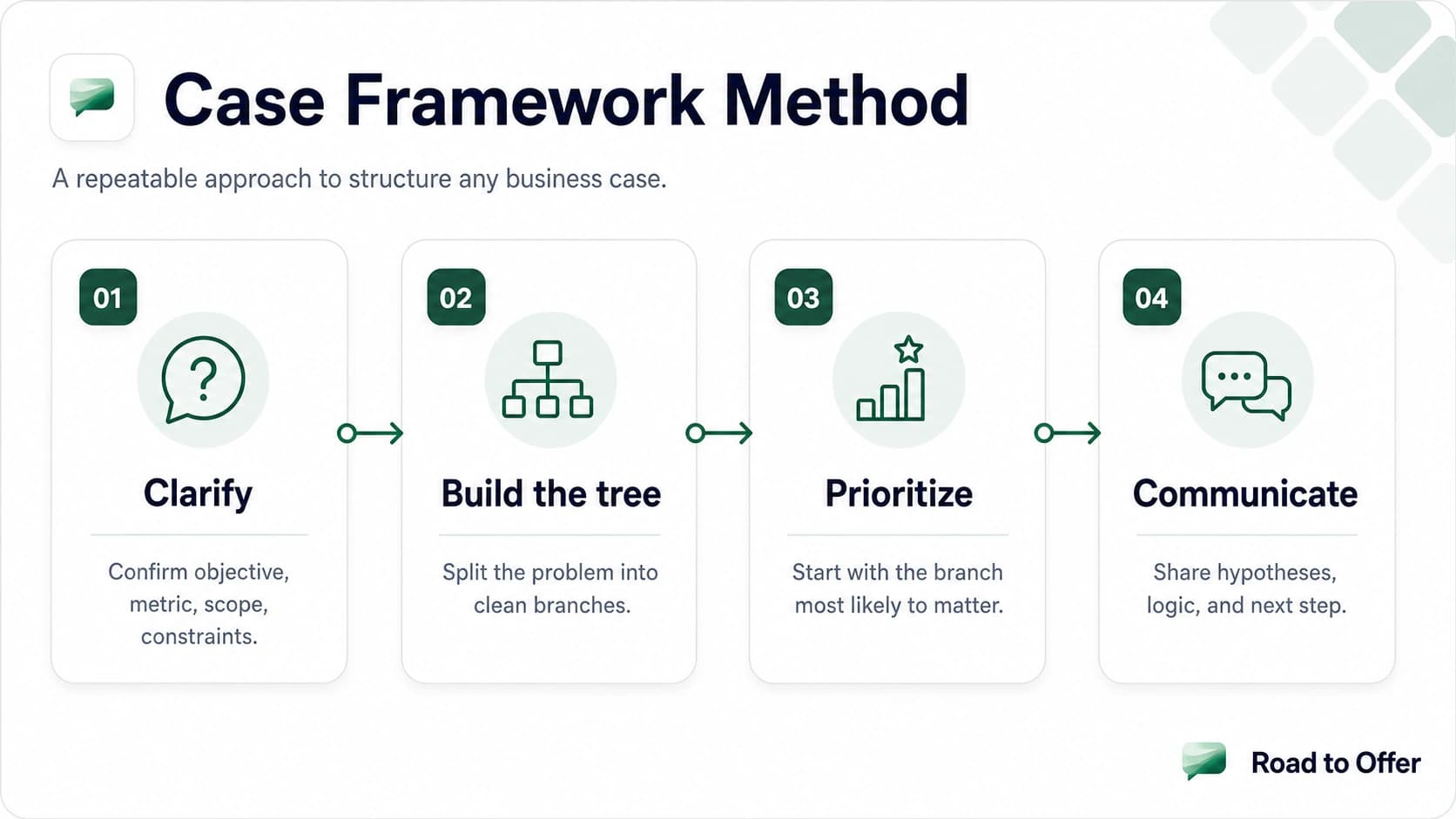
Learn the case method
One dense lesson, each step linked to the drill that trains it.
What does the technical case look like?
This is where the loop diverges most from a standard Bain case. A generalist Bain case asks what the client should do. A Vector case asks what should be built, whether the data supports it, and how you would know it worked.
The reliable shape, and the one Bain's own emphasis on logical assumptions and quick calculations rewards, runs like this:
- Anchor on the business objective first. Not "build a model." The commercial outcome the model exists to move, stated in one sentence.
- Convert it into a data problem. What is being predicted or optimized, over what horizon, on what unit of analysis, using which available features.
- Choose the first approach honestly. A simple, explainable baseline usually beats a sophisticated one when the client's data maturity and adoption reality do not support the sophisticated one. Say why.
- Define success and guardrails. The primary metric, plus the costs and failure modes the primary metric hides.
- Recommend a path. A pilot with a control, a read window, and a stated threshold for expanding.
Candidates who struggle either skip step one and start modeling, or never reach step three and stay abstract. The digital transformation case and technology case interview guides cover the business-side patterns behind both, and the case interview frameworks guide covers the structuring habit underneath.
The step that trips technical candidates hardest is step four, because it is arithmetic under pressure rather than modeling.
A worked example of the trade-off question
Below is the shape of question that separates a Vector-ready candidate from a strong modeler. Work each one before revealing the answer.
A full case gives you all five steps in sequence under time pressure, which the drills above deliberately do not. This one runs the capacity and economics reasoning a Vector engagement would.
Run a Bain profitability case before your Vector loop. How much cost synergy can a $22B electronics group pull from a $4.5B acquisition? Answer this Bain profitability case step in the article. Browse more practice cases in the case interview library
Reading Exhibits Like a Consultant, Not a Data Scientist
Bain's answer-first style means the exhibit conversation is not "describe this chart." It is "tell me the implication and what you would do." That reflex is trainable and it is the single highest-leverage habit for a technical candidate entering a consulting loop, because your instinct is to caveat and an interviewer's expectation is to conclude.
The case interview data interpretation guide covers the reading order, and the structured thinking guide covers what to do with the conclusion once you have it.
If cases are genuinely new to you because you came from a technical background, start with the method rather than more reps.
What About the Behavioral Round?
Bain says some roles include at least one behavioral interview where colleagues discuss your background and experience, and it asks candidates to connect their skills to the role and to Bain's operating principles. Technical candidates lose points here more often than they lose them on the model, usually by describing the system rather than their own decision inside it.
The stories that work are specific and end in a change you made: a project where the data was worse than promised, a disagreement with an engineer or a client stakeholder, a model you shipped that nobody adopted. The Bain fit interview guide covers the structure, and the Bain behavioral interview questions guide gives you the question set to rehearse against. Why Bain is worth writing out properly too, because "I want to do AI work" is not a Bain answer, it is a reason to work anywhere.
Rehearse out loud against follow-up probes rather than writing the stories down. A story that survives one "why did you do it that way?" is the one that survives the interview.
How Should Each Role Family Prepare?
Your split should follow the loop you actually face, not a generic case plan.
- Data science and analytics. Statistics and SQL fluency first, since a screen usually gates everything else. Then exhibit-to-decision practice with the chart drills, because the technical case rewards reading an exhibit and naming the implication more than it rewards a better model.
- Software and platform engineering. Your technical rounds are your own domain, but the client-facing conversation decides the offer. Rehearse explaining one architecture decision to a non-technical stakeholder in ninety seconds, and run structure drills so you can hold a business problem in a clean tree while you do it.
- Enterprise Technology and architecture. Add the commercial layer: technology cost, due diligence reasoning, and merger integration all appear in Bain's own capability list. The profitability framework is the underlying structure most of those conversations resolve into.
- Design and product. Metric definition and prioritization under a client constraint, plus a portfolio story that ends in adoption and business outcome rather than in a shipped screen. Market sizing drills are unexpectedly good practice for the "how big is this opportunity" question that follows a product pitch.
- Generalist consultant with AI exposure. Confirm first whether the role is actually a Vector practice role or a consulting role that partners with one. If it is consulting, the Bain case guide and Bain practice cases are your prep, not this page.
Across all five, the shared skill is closing: taking a messy input and stating a decision with a reason. The synthesis drills train exactly that, and the case interview synthesis guide covers the sentence structure behind it.
Applications and Timing
Bain organizes applications by work area rather than by practice, so the mechanical advice is short: pick the work area, read the practice name inside the posting, and tailor to that practice rather than to "Vector."
For the written materials, technical candidates lose points by writing in tool names instead of client impact. "Built an XGBoost pipeline in Airflow" tells a Bain reader nothing about whether anything changed. The Bain resume guide covers the format, the consulting resume guide covers the bullet structure, and the resume grader will tell you which of your bullets are tool descriptions rather than results. The Bain cover letter guide covers the letter, which matters more at Bain than at most firms.
If you are still deciding between a technical role at a consultancy and one in industry, the consulting vs tech comparison covers the trade-off honestly, and the Bain salary guide covers how Bain pays on the consulting side. Bain does not publish Vector compensation bands, and we are not going to invent them.
A Two-Week Prep Plan for a Vector Loop
Each step here wires to something you can actually do rather than advice to go practice.
Bain Vector prep sequence
Confirm the loop with your recruiter. Which screen, how many rounds, whether there is a take-home. Bain says each role has its own process, so ask instead of assuming.
Read the posting for the practice name. AIS, Enterprise Technology, NextGen Software Solutions, or TSG. Tailor everything to that practice, not to the word Vector.
Run a full graded case first. It tells you whether structure, math, or synthesis is your weak dimension before you spend hours on the wrong one.
Attack that one dimension with drills. Structure, case math, and charts each train a single skill in short reps.
Grind your technical domain separately. SQL and statistics for data roles, algorithms and system design for engineering roles. No case platform replaces this.
Rehearse three behavioral stories out loud. Use the Bain fit interview guide and answer follow-up probes, not just the opening question.
Send your resume through the resume grader. Rewrite every bullet that names a tool instead of a result.
Run one more timed case from the case library. In the last 48 hours, to rebuild the closing reflex before a final round.
Get your Bain prep plan
How Road to Offer Helps With a Vector Loop
Being straight about it: Road to Offer does not simulate a SQL screen or a coding assessment, and no case prep platform should claim it does. Grind that on your own. What Road to Offer covers is the consulting half of a Vector loop, which is the half technical candidates actually lose on, and it covers it with graded reps rather than reading. Live AI-graded cases score your structure, math, exhibit reading, and synthesis on every attempt. More than 600 drills let you attack one weak dimension at a time instead of running another full case. Learning Mode and the free courses carry the fundamentals if cases are new to you, and the resume grader catches technical work written in tool names instead of client impact.
Matched next steps for a Vector candidate:
- Free graded case practice for the business half of the technical case
- Chart and exhibit drills for the exhibit-to-decision habit
- Case library to run a full timed case before a final round
- Resume grader to turn model work into client impact language
- Quick math for the arithmetic speed the value-sizing questions demand
Related Guides
- BCG X case interview
- Data science case interview guide
- Bain SOVA test guide
- What is Bain & Company
- Bain internships
- Technology case interview
Sources (checked July 27, 2026)
Frequently asked questions
Resources and related guides
- Practice real Bain casesPractice
- Browse all free resourcesResource hub
- BCG X: Roles, Careers, Pay, and Interviews (2026)Firm Specific · Jun 29, 2026
- McKinsey QuantumBlack: Roles, Interviews, and Prep (2026)Firm Specific · Jul 27, 2026
- Bain Behavioral Interview Questions With Complete Worked AnswersFirm Specific · Jul 18, 2026
- Newton Europe Interview and Selection Day Guide (2026)Firm Specific · Aug 13, 2026