
McKinsey QuantumBlack: Roles, Interviews, and Prep (2026)
QuantumBlack is the AI arm of McKinsey & Company, acquired in 2015 out of Formula 1 analytics. What it does, which roles it hires, how its interview loop differs from a standard McKinsey loop, and how to prepare for each stage.
On this page
QuantumBlack is the AI arm of McKinsey & Company: the part of the firm whose deliverable is a working model, pipeline, or deployed AI system rather than a recommendation. Its own publication describes it as "a global community of technical and business experts" that uses AI on complex problems. McKinsey bought it in December 2015, when Consultancy.uk reported a London firm of around 45 people founded in 2009 with roots in Formula 1, where performance differences are, in co-founder Simon Williams's phrasing, "measured in milliseconds". Ten years on, QuantumBlack's own LinkedIn page lists a company size band of 1,001 to 5,000 employees. For a candidate, the practical consequence is that you are interviewing for a technical role inside a consulting firm, which means two bars, not one: the code and the model have to hold up, and so does the client conversation around them.
Before you spend a month on Python, get a read on the consulting half of the loop, because that is where technical candidates usually lose points. Run a free graded case and see whether structure or synthesis is the thing holding you back.
QuantumBlack at a Glance
What Does QuantumBlack Actually Do?
McKinsey's consulting business answers what the client should do. QuantumBlack exists because a growing share of those answers only pay off if somebody builds and ships the thing that produces them. A demand forecast that lives in a notebook changes nothing. A demand forecast wired into a replenishment system, monitored, and adopted by store managers changes the number.
That focus on production, not proof of concept, is visible in what McKinsey has bought. In January 2023 the firm announced its acquisition of Iguazio, a Tel Aviv MLOps platform, bringing more than 70 data and AI experts in. The announcement quotes QuantumBlack global co-leader Alexander Sukharevsky saying the combination "deepened the end-to-end offering", and co-leader Alex Singla describing the goal as being able to "speed up, scale and productionize AI implementations". Senior partner Ben Ellencweig said the firm analysed more than 1,000 AI companies worldwide before picking Iguazio.
Read that as an interview signal rather than corporate news. A firm that spends an acquisition on the deployment layer is going to ask you about the deployment layer. Candidates who stop their answer at model selection are answering half the question.
The skills mix on client teams is broad. When McKinsey opened QuantumBlack offices in Singapore and Tokyo in July 2019, Consultancy.asia described the unit as employing data scientists, engineers, machine learning specialists, and technical architects working alongside strategists, digital experts, industry specialists, and designers. That article counted nine QuantumBlack locations at the time, including London, Montreal, Chicago, Boston, Sao Paulo, Gurgaon, and Sydney. The office list has moved on since then, so treat it as history rather than a current map, and check the location on your own role listing.

Growth · hard
Practice for McKinsey in a real case interview
Matched to this McKinsey guide: a live technology growth case with an AI interviewer. Free, scored on every step.
How Does QuantumBlack Differ From Core McKinsey Consulting?
The two sit on the same engagements and get confused constantly, usually by candidates who prepare for the wrong loop.
If you are not sure which one your posting belongs to, the fastest tell is the role title. Business analyst and associate are consulting titles, and the McKinsey business analyst role and what an associate at McKinsey does guides describe those paths. Data scientist, data engineer, and AI engineer are QuantumBlack titles. If you want the firm-level picture that sits above both, start with the McKinsey firm overview and working at McKinsey.
BCG runs the same split with BCG X, its tech build and design unit, which absorbed the old BCG Gamma analytics group. If you are applying to both firms, the structural comparison in 10 differences between McKinsey and BCG saves you from assuming the loops mirror each other.
Which Roles Does QuantumBlack Hire?
The honest source here is the live listing rather than a prep-site summary. On July 27, 2026, LinkedIn's QuantumBlack job page showed 109 open roles worldwide, with these titles among them:
Two things generalise across all of them. First, the ladder is explicit: junior, roman-numeral levels, then senior. The level you apply at decides how much of the conversation is about your own past work versus a fresh problem, in the same way seniority shapes the consulting ladder described in the McKinsey hierarchy guide. Second, every one of these titles is client-facing. There is no back-office lane where you avoid explaining your work to somebody who does not write code.
Note what is not on that list. There were no titles on the listing for pure research scientists or for design roles at the time it was checked. Consultancy.asia's 2019 description mentioned designers working alongside QuantumBlack teams, so design work clearly touches the unit, but do not assume a design pipeline exists today without finding the posting yourself.
What Does QuantumBlack Pay?
McKinsey does not publish QuantumBlack compensation bands, so the honest source is self-reported data with all the caveats that carries. levels.fyi's McKinsey data scientist submissions show the following total compensation in the United States:
levels.fyi puts the US median for the role at $200K. These are voluntary submissions with small per-level samples, and they cover McKinsey's data scientist title rather than a QuantumBlack-specific band, so read them as a range rather than an offer. For how the consulting side pays by title, see the McKinsey salary guide and the McKinsey partner salary breakdown.
How Does the QuantumBlack Interview Loop Differ From a Standard McKinsey Loop?
Start with the honest caveat, because this is where prep content lies most often. McKinsey does not publish a QuantumBlack-specific interview map, and formats move by role, level, office, and year. Confirm the current sequence with your recruiter and with your invitation email. Everything below is what candidates have reported, and it is useful as a shape rather than a schedule.
The most detailed public account is a candidate write-up of a QuantumBlack data scientist loop that walks through six rounds plus an optional seventh:
The line worth writing on your hand comes from that account's description of the use case round: "Structure > Model complexity". The candidate reports being pushed hardest on decision-making logic rather than on algorithmic depth, which matches what the associate partner and partner rounds are scoring for.
That is the real difference from a standard McKinsey loop. A generalist candidate faces business cases and structured behavioural rounds, described in the McKinsey case interview guide. A QuantumBlack candidate faces those same conversations at the back of the loop, with a coding and modelling gate in front of them. The technical gate filters. The consulting conversation decides.
Which means the structuring skill everyone assumes is the consulting half is doing work in both halves. A use case that opens with "let me first understand what decision this model is supposed to change" is a structured answer, not a soft one.
If the structuring habit itself is new to you, the case interview frameworks guide covers how to build an issue tree that fits the problem instead of importing a template.
What Does the QuantumBlack Technical Case Actually Look Like?
This is the round that trips up both kinds of candidate: the modeller who never reaches the business, and the consultant who never reaches the data. The reported shape is a client scenario you carry from problem framing through to deployment and risk in about an hour. Here is that shape on a prompt type that recurs across AI delivery work.
Prompt: a national utility wants to cut unplanned outages on its distribution network using AI. Field crews currently schedule maintenance on fixed intervals. Design the approach and explain how you would know whether it worked.
- Anchor on the business objective first. The goal is not a model. It is fewer customer-minutes lost without sending crews on trips that were not needed. That trade-off between missed failures and wasted truck rolls is the entire case, and naming it in the first ninety seconds is what the interviewer is waiting for.
- Turn it into a data problem. Predict the probability that a given asset fails in the next thirty days, then convert that probability into an inspection priority list. Candidate features: asset age and type, load history, fault history, weather exposure, vegetation proximity, and prior maintenance records.
- Interrogate the data before the model. Which of those exist today, at what granularity, with what gaps? A senior interviewer will plant a data quality problem on purpose. Asking where the fault history comes from and how failures are labelled is a stronger move than proposing an architecture.
- Choose the first model honestly. A gradient boosted baseline on asset-level features usually beats jumping to deep learning when the engineering maturity and label volume do not support it. Explainability is what gets a field supervisor to follow the list.
- Define success and guardrails. Primary metric: customer-minutes lost, or unplanned outages avoided. Guardrails: crew hours consumed, false alarm rate, and the share of recommendations crews actually action.
- Recommend a path. Pilot on a defined set of regions against a matched control, read the difference over a stated window, and expand on a threshold you name up front rather than on a feeling.
The candidates who struggle skip step one, and the ones who plateau never reach step five. Notice how much of that sequence is arithmetic you have to do out loud while somebody watches. Size the prize, compare thresholds, separate the treatment effect from the trend.
The mental arithmetic in those four reps is the same arithmetic a business case demands, and it is the part technical candidates most often practise least. If you want the underlying speed, the case interview math practice guide and the mental shortcuts breakdown cover the specific habits, and free daily case math drills give you graded reps on them.
For the business-case half of the loop, run a full case in a technology context rather than another notebook exercise.
Run a McKinsey market entry case end to end. The chain must pick one of five regional Australian towns for its next multiplex. Answer this McKinsey market entry case step in the article. Browse more practice cases in the case interview library
Does the McKinsey PEI Apply at QuantumBlack?
The Personal Experience Interview is McKinsey's structured behavioural format, and the reported QuantumBlack loop puts two rounds with senior interviewers at the end of the process where that kind of conversation lives. The candidate account above describes an associate partner round on prioritisation, client disagreement, and delivered impact, and a partner round labelled a case but described as mostly behavioural. Whether your own rounds are formally called PEI is a question for your recruiter, not for a prep article.
Prepare as if they are, because the depth bar is the thing that catches technical candidates out. PEI answers are not two-minute anecdotes. They are one situation carried far enough that the interviewer can see what you personally decided, what it cost you, and what you would change. The McKinsey PEI guide covers the dimensions and the depth, the PEI questions page collects the prompts, and PEI practice walks through how to rehearse rather than memorise.
Stories that work for a technical candidate are specific and unflattering in the right places: a project where the data was materially worse than promised, a disagreement with an engineer or a client stakeholder about scope, a model you shipped that nobody used, and what you changed afterwards. The failure story is not a trap. It is the one where the interviewer can actually see your judgment. You can run a graded McKinsey PEI round and get scored on structure, specificity, and reflection before the real one.
Related to this, the why McKinsey question still comes up, and a technical candidate needs an answer that explains why this firm rather than a product company. "I want to work on hard AI problems" does not distinguish McKinsey from a dozen other employers.
Does QuantumBlack Use McKinsey Solve?
Solve is McKinsey's digital assessment, and the McKinsey Solve guide covers what it contains, including the Redrock study and Sea Wolf games. Whether it appears in a QuantumBlack loop is not something to assume in either direction, and the candidate account above describes a HackerRank technical assessment rather than Solve. Your invitation email is the only reliable answer. If Solve does appear, prepare it as its own workstream, because it tests something different from both the coding screen and the case.
How Should You Prepare, by Role Family?
Your prep split should follow the screen you actually face, not a generic case plan. Each step below wires to something you can practise today rather than something you can read about.
- Data scientist. Python, SQL, and statistics fluency first, since the assessment gates everything else and nothing downstream happens if you fail it. Then exhibit-to-decision practice, because the use case round rewards the person who reads a chart and names the implication over the person with the better model. Free daily chart and exhibit drills target that directly.
- Data engineer. Pipeline design, data quality, and the ability to explain a schema decision in business terms. Rehearse one architecture choice you made and defend it to somebody who does not write code, in ninety seconds, without jargon.
- AI or software engineer. Algorithms and system design carry the technical rounds, but the associate partner and partner conversations decide the offer. Practise the synthesis habit of leading with the answer, then the reasoning, which is the opposite of how most engineering write-ups are ordered.
- Consultant-titled technical roles. Confirm first whether the posting is QuantumBlack or a consulting role that collaborates with it. If it is consulting, generalist case prep and the McKinsey practice cases set are the right work, not this page.
The skill every one of these paths shares is turning an exhibit into a decision under time pressure. Run one live rep and see where you actually land.
If cases are genuinely new to you because you came from a technical background, do not start with drills. Start with the method, then drill the pieces.
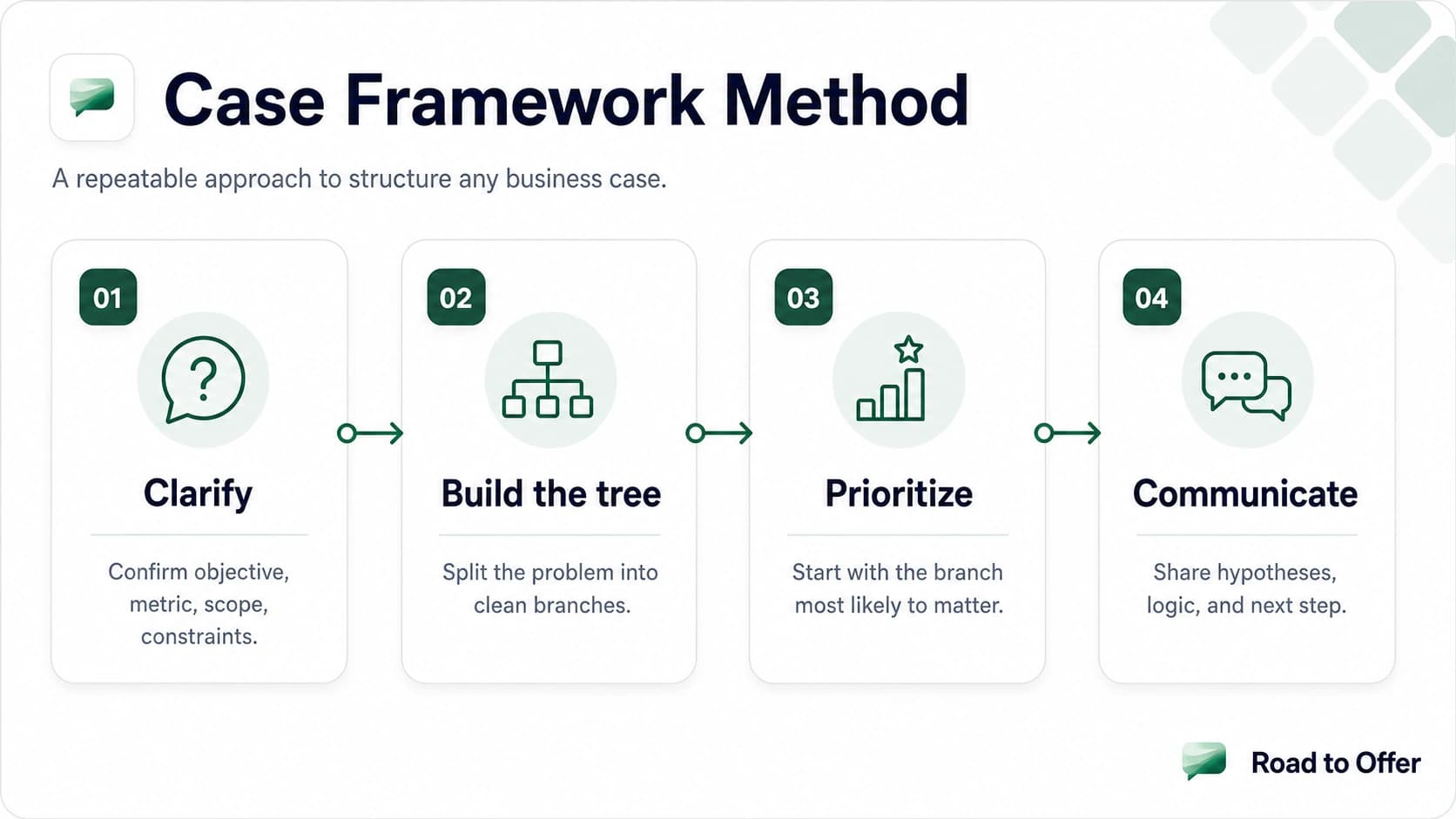
Learn the case method
One dense lesson, each step linked to the drill that trains it.
The case interview data interpretation guide covers the reading habits behind the exhibit work, and the data science case interview guide covers the technical case format across firms rather than at McKinsey specifically.
Applying: Timing and Materials
QuantumBlack roles are posted continuously rather than only on a campus cycle, but if you are coming through a university pipeline the McKinsey deadline page tracks the dates that matter, and the McKinsey internship guide covers the intern route.
The resume is where technical candidates lose the most avoidable ground. A bullet that reads "built an XGBoost model with 0.87 AUC" describes a tool. A bullet that reads "cut forecast error enough to release $2M of working capital, adopted by three regional teams" describes impact, and impact is what a consulting screen is trained to look for. The McKinsey resume guide covers the format, the McKinsey cover letter guide covers the letter, and the consulting resume grader scores what you have now and tells you which bullets are still written in tool names.
How Road to Offer Helps With a QuantumBlack Loop
Being straight about this: Road to Offer does not simulate the HackerRank coding assessment, and no prep platform should claim it does. Grind that on your own with Python, pandas, and a statistics refresher. What Road to Offer covers is the other half of the loop, the half technical candidates actually lose on, and it covers it with graded reps rather than reading.
Live AI-graded cases score your structure, math, exhibit reading, and synthesis on every attempt. More than 600 drills let you attack one weak dimension at a time instead of running another full case and hoping the weakness surfaces. Free courses and Learning Mode carry the fundamentals if cases are new to you. The behavioral simulator runs a graded fit round with follow-up probes, which is the closest thing to the associate partner and partner conversations. The resume grader catches model work written in tool names instead of client impact.
Matched next steps for a QuantumBlack candidate:
- Free graded case practice for the business half of the use case round
- Chart and exhibit drills for the exhibit-to-decision habit
- Structure drills for the framing move that opens the use case
- Graded McKinsey PEI round for the associate partner and partner rounds
- Resume grader to turn model work into client impact language
- Case library when you want a specific industry rather than a random case
Related Guides
- Data science case interview guide
- BCG X: roles, careers, pay, and interviews
- McKinsey competitors
- McKinsey Solve guide
Sources (checked July 27, 2026)
- About QuantumBlack, AI by McKinsey, its own publication
- McKinsey acquires data analytics firm QuantumBlack, Consultancy.uk
- QuantumBlack, AI by McKinsey company page, LinkedIn
- QuantumBlack, AI by McKinsey job listings, LinkedIn
- QuantumBlack, AI by McKinsey company profile, Forbes
- McKinsey launches QuantumBlack in Singapore and Tokyo, Consultancy.asia
- McKinsey & Company acquires Iguazio, official announcement, January 23, 2023
- McKinsey data scientist compensation, levels.fyi
- QuantumBlack data scientist interview experience, candidate write-up
Frequently asked questions
Resources and related guides
- Practice real McKinsey casesPractice
- Browse all free resourcesResource hub
- Bain Vector: What It Is and How the Interview Runs (2026)Firm Specific · Jul 27, 2026
- BCG X: Roles, Careers, Pay, and Interviews (2026)Firm Specific · Jun 29, 2026
- McKinsey vs BCG: 10 Real Differences (2026 Guide)Firm Specific · May 1, 2026