
Why Bain? How to Answer the Fit Question (2026 Sample Script)
A copy-paste-ready Why Bain answer plus the swap test, verified Bain facts (local staffing, PE practice, A Bainie never lets another Bainie fail), and the 3-element formula interviewers reward.
Your first interview question
Get your full coached feedback now. Continue the interview free after sign-up.
On this page
A strong "Why Bain?" answer in 2026 does one job: prove your motivation is specific to Bain and not transferable to any other firm. According to CaseBasix, the answer that lands runs about 60 to 90 seconds, roughly 150 to 200 words spoken aloud, and weaves three things together: a Bain-specific fact, a genuine personal connection, and a clear career goal. The fastest way to check whether yours is specific enough is the swap test: if you can replace "Bain" with "McKinsey" or "BCG" and it still works, it is too generic to score. The hooks that pass are Bain-only: the local staffing model, the market-leading Private Equity practice, the "A Bainie never lets another Bainie fail" ethos, and the Bain World Cup. Bain notes it was founded in 1973 and employs about 19,000 people across 67 cities in 40 countries, giving you concrete material to build on instead of prestige filler.
A 60 to 90 second "Why Bain?" answer you can adapt
Most guides hide the good example behind a signup or hand-wave the culture. Here is a full sample answer first, so you can see the shape before you build your own. Swap the bracketed parts for your real details.
Notice what that answer does. It opens with a reason tied to how Bain operates, anchors the culture claim to a real conversation rather than a quote, cites one verified result, and ends on a career goal that Bain is uniquely positioned to serve. Every sentence breaks if you swap in another firm name. That is the bar.
What interviewers are really testing
"Why Bain?" looks like a softball, but interviewers use it to probe four things at once: genuine motivation, firm-specific knowledge, mutual fit, and staying power in a high-stakes environment. A polished but generic answer fails all four, because it signals that you applied to every firm with the same letterhead swapped.
This question almost always sits inside the fit portion of the interview, not the case. If you want the full picture of where it lands in Bain's process and how the cases run alongside it, the Bain case interview guide maps the rounds. And because "Why Bain?" is really a sharper version of "Why consulting?", it helps to lock your broader motivation first using the Why consulting answer guide so the two answers reinforce each other instead of contradicting.
The swap test: the Bain-only proof points your answer must hit
The single most useful gimmick for fixing a weak answer is the swap test. Say your answer out loud, then mentally replace "Bain" with "McKinsey" or "BCG." If the sentence survives the swap, delete it. A passing "Why Bain?" answer collapses the instant you change the firm name, because it leans on facts only Bain can claim.
Here are the proof points worth building around, and why each one is swap-proof.
Execution checklist
Local staffing model. Bain staffs consultants on clients near their home office, so you build deep industry and client relationships and travel less than the fly-everywhere generalist model. McKinsey and BCG do not staff this way, so the claim breaks on swap.
Private Equity practice. Bain's PE practice is the acknowledged market leader. If your goal touches commercial due diligence or investing, this is a fact only Bain can claim at this scale.
A Bainie never lets another Bainie fail. The collaboration ethos is Bain's signature. Tie it to a real conversation with a Bainie, not a quote you read, so it reads as evidence rather than a slogan.
Bain World Cup. Roughly a quarter of the global firm flies in for the annual soccer tournament, which has run for 30 plus years per My Consulting Offer. That is concrete proof of camaraderie, not a vague great-culture claim.
Results focus and the 4-to-1 S&P number. Bain's publicly traded clients have outperformed the S&P 500 by four to one. It signals you did real homework and that you value measurable impact.
Culture: "A Bainie never lets another Bainie fail"
Bain's culture is its most repeated selling point, which is exactly why it is the easiest place to sound generic. The ethos most candidates cite is "A Bainie never lets another Bainie fail," shorthand for a collaborative, relatively flat, support-first environment. The camaraderie is real enough that, per My Consulting Offer, roughly 25% of the global firm attends the annual Bain World Cup soccer tournament, an event that has run for more than 30 years.
Consulting Bootcamp notes Bain has topped Glassdoor's Best Places to Work list, cited as a record seventh time. That is a usable credibility hook, but do not stop there. The fix for "I love the culture" is to attach the culture to something only you experienced: a coffee chat, an office tour, a case competition Bain ran on your campus.
The local staffing model and what it means for your career
Bain's local staffing model is one of the cleanest differentiators you can use. Instead of the generalist model where consultants fly anywhere for any project, Bain tends to staff people on clients near their home office. The practical consequences are real: deeper industry knowledge, longer-running client relationships, and a travel and lifestyle profile that many candidates prefer.
If your honest motivation includes wanting roots in one city, repeat exposure to an industry, or relationships that outlast a single engagement, the local staffing model is the fact to name. It is true, it is Bain-specific, and it survives the swap test cleanly.
Results and the Private Equity practice: Bain-only proof
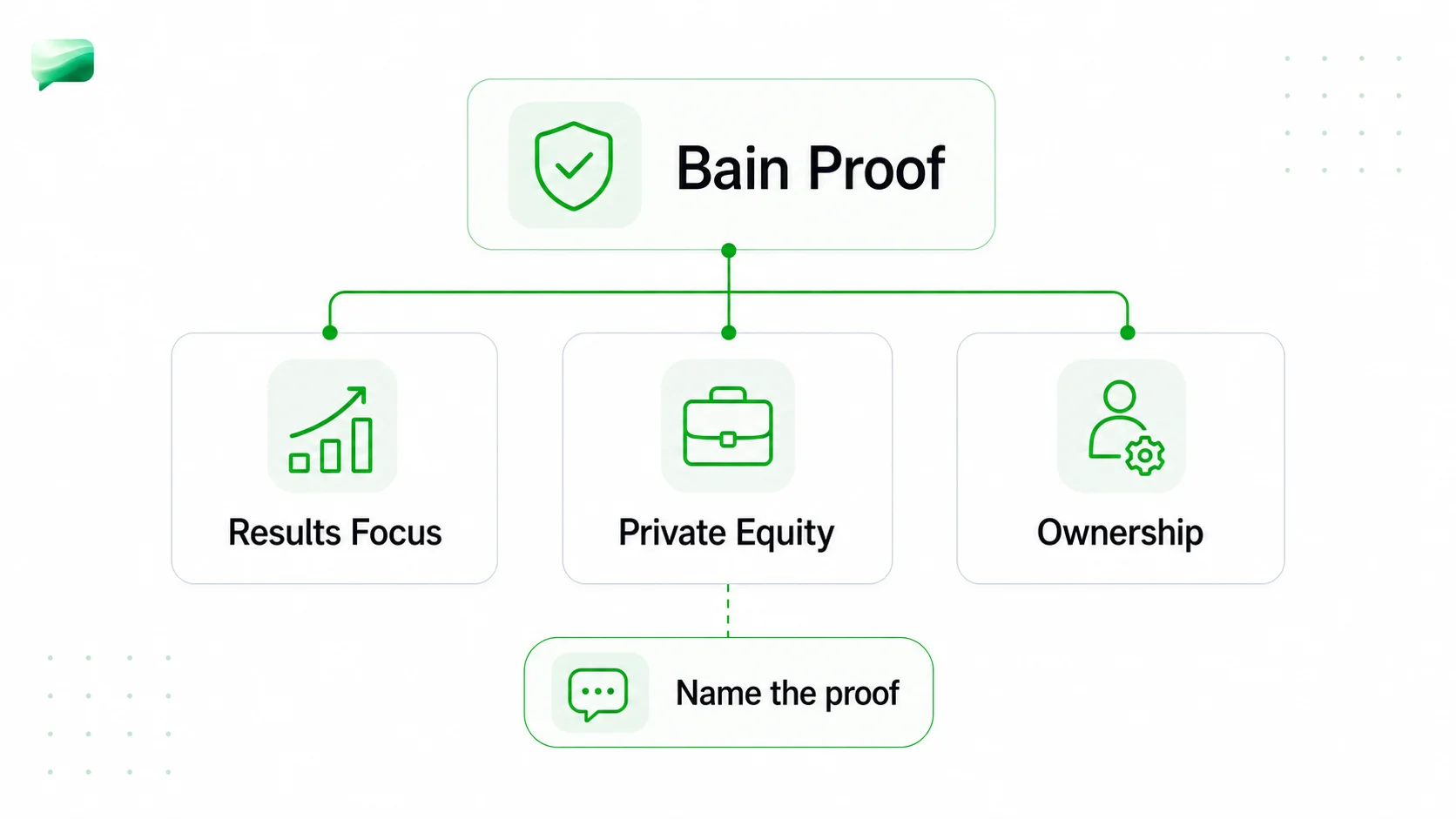
Bain markets itself as relentlessly results-driven, and the firm gives you numbers to back it. Per My Consulting Offer, Bain's publicly traded clients have outperformed the S&P 500 by four to one. On scale, Bain reports working with more than two-thirds of the Global 500 and over 9,000 companies worldwide, and it has committed to delivering $2 billion in pro bono consulting by 2035.
The standout, though, is the Private Equity practice. It is widely regarded as the market leader, and it is the proof point to lean on if your goal involves investing, diligence, or transaction work. Bain was founded in the 1970s by Bill Bain, a former Boston Consulting Group executive, and the firm has built its results-and-PE reputation steadily since. That heritage gives you a concrete, defensible angle most candidates never use.
Mentorship, feedback, and the promotion track
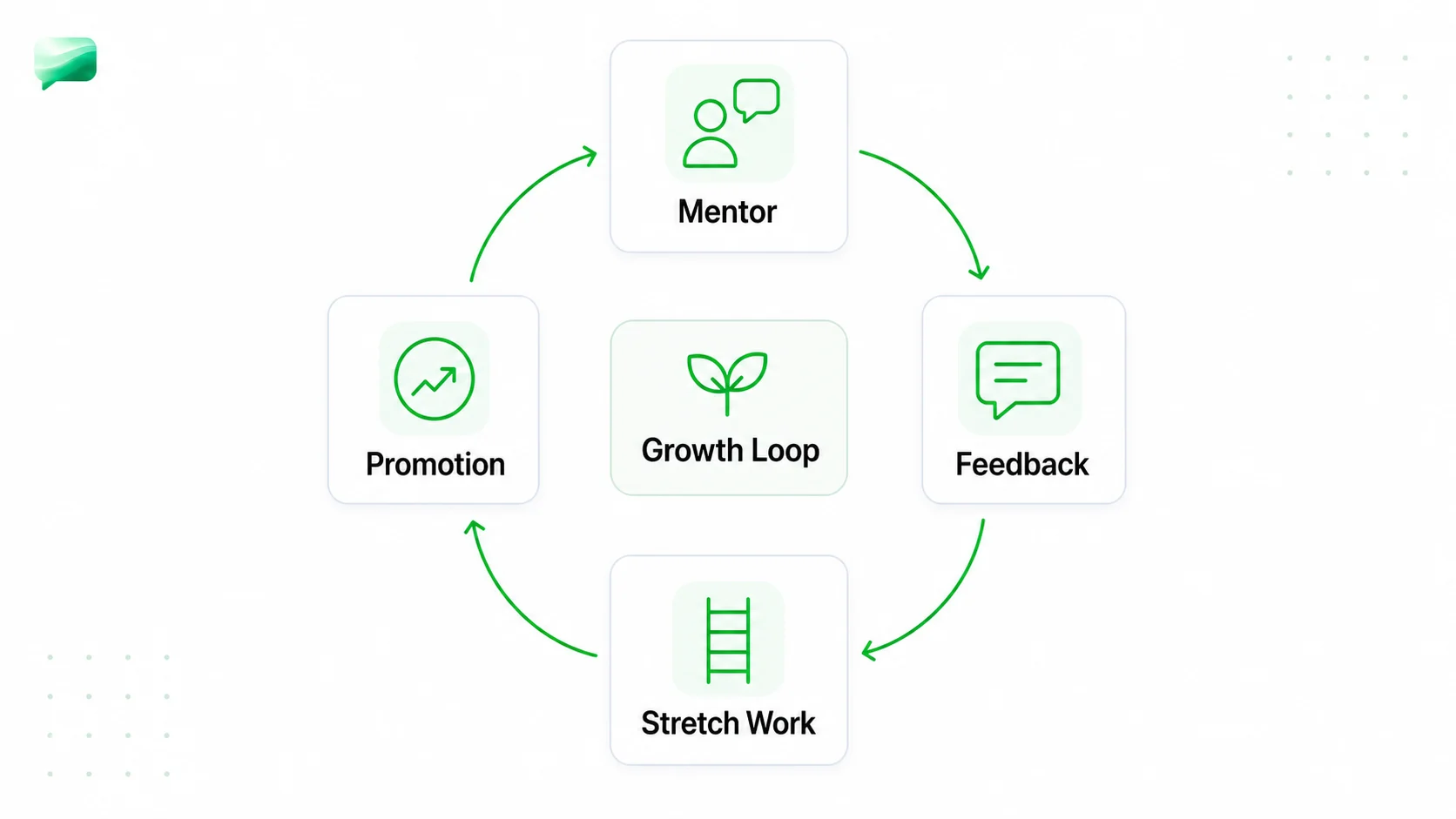
Staying power is part of what "Why Bain?" tests, so referencing career personalization and development reads as mature. Bain runs structured mentorship, 360-degree feedback, and global training programs roughly every 18 months, per My Consulting Offer. The case-team pyramid also creates a clear promotion track, and the same source reports that about 90% of Associate Consultants and Consultants are promoted after the two-year mark, with the majority choosing to stay.
If part of your motivation is genuinely about growth and personalized career paths, say so and back it with one of these facts. Just keep it secondary. Development matters to every firm, so it cannot carry the answer alone, but it deepens a fit narrative that already has a Bain-specific spine.
The 3-element formula and how to deliver it
The winning answer is not a list of facts. It is a logical flow built from three elements:
- A Bain-specific fact (local staffing, the PE practice, the World Cup, the results numbers).
- A personal connection (a conversation, an experience, a value the fact maps to).
- A career goal that Bain is uniquely positioned to serve.
Sequence them so each one sets up the next: fact, then why that fact matters to you, then where it takes you. Keep the whole thing to 60 to 90 seconds and roughly 150 to 200 words. Deliver it conversationally and structured, but not over-rehearsed. The personal half is where most candidates underinvest, and it is the half that proves mutual fit rather than one-way admiration. For the behavioral stories that surround this answer, the McKinsey PEI guide is a useful contrast, because Bain weights fit a touch more loosely than McKinsey's rigid PEI structure, which gives you room to be more natural.
Weak vs. strong: the same answer, fixed
Seeing the transformation makes the lesson concrete.
The left column works for any firm, which is the problem. The right column dies on swap, which is the point.
Common mistakes to avoid
1. Leaning on prestige. "Bain is one of the best firms in the world" tells the interviewer nothing they do not already know, and it signals you chose the brand, not the firm.
2. Quoting the Bain website. Reciting mission statements or the slogan verbatim reads as a skim, not research. Use the idea, attach your own evidence.
3. Vague buzzwords. "Collaborative, impactful, world-class" are filler. Replace each adjective with a fact or a story.
4. Over-rehearsing. A word-perfect recitation sounds robotic and breaks under a follow-up question. Know your three elements cold, then speak naturally.
5. Forgetting the personal half. A wall of Bain facts with no personal connection answers "what is Bain" instead of "why you and Bain." The mutual-fit half is mandatory.
Practice your delivery, not just your script
Reading a great answer and delivering one under pressure are different skills. The follow-up ("tell me more about that conversation") is where memorized answers fall apart. The fix is reps: say your answer out loud, get feedback on whether it actually passes the swap test, and tighten it until it lands in 90 seconds without sounding scripted. That rehearsal loop, not another article, is what moves the needle in the final week.
Sources
- Bain & Company, About (checked June 26, 2026)
- My Consulting Offer, Why Bain guide (checked June 26, 2026)
- CaseBasix, Why Bain (checked June 26, 2026)
- Consulting Bootcamp, How to answer Why Bain in 2026 (checked June 26, 2026)
Frequently asked questions
Resources and related guides
- Practice real Bain casesPractice
- Browse all free resourcesResource hub
- Why BCG? How to Answer the Fit Question (2026 Structure, Swap Test & Sample)Getting Started · Jun 27, 2026
- Why McKinsey? How to Answer the Fit Question (Sourced Differentiators + Sample Answers) (2026)Getting Started · Jun 27, 2026
- Tell Me About a Time You Failed: Consulting AnswerGetting Started · Jun 30, 2026
- What Motivates You? Consulting Interview AnswerGetting Started · Jun 30, 2026