



Red Rock
Save $20
$49
$29one-time
- Ten Red Rock simulations
- Fourteen connected responses per run
- Scored debrief on every response
Practice
Learn
Assessments
Road to Offer is independent and not affiliated with or endorsed by McKinsey. This is original practice content built from publicly available information about the assessment format, not a copy of the live assessment. Formats change between offices and recruiting cycles.
New to Redrock? Read the McKinsey Redrock Study guide and the full McKinsey Solve guide.
One full simulation, start to finish: the Study and all six Cases on one 35-minute clock, scored when you submit. The free practice is a shorter edition of Simulation 1. The scenario, exhibits and numbers are original Road to Offer content, not an official McKinsey case.
| Free | A short edition of Simulation 1 (Calderas Mining: should the miner fund an electric-haul rollout?): warm-up, Investigation, budget allocation and two Cases, five steps worth eight points, about 12 minutes in Simulation mode. One per account; your score shows and the full worked review opens with a one-time unlock or a plan. The ten full simulations are in paid packs. |
|---|---|
| Clock | 35 minutes in Simulation mode, with a warning at the halfway point. Learning mode is untimed and lets you repair one answer. |
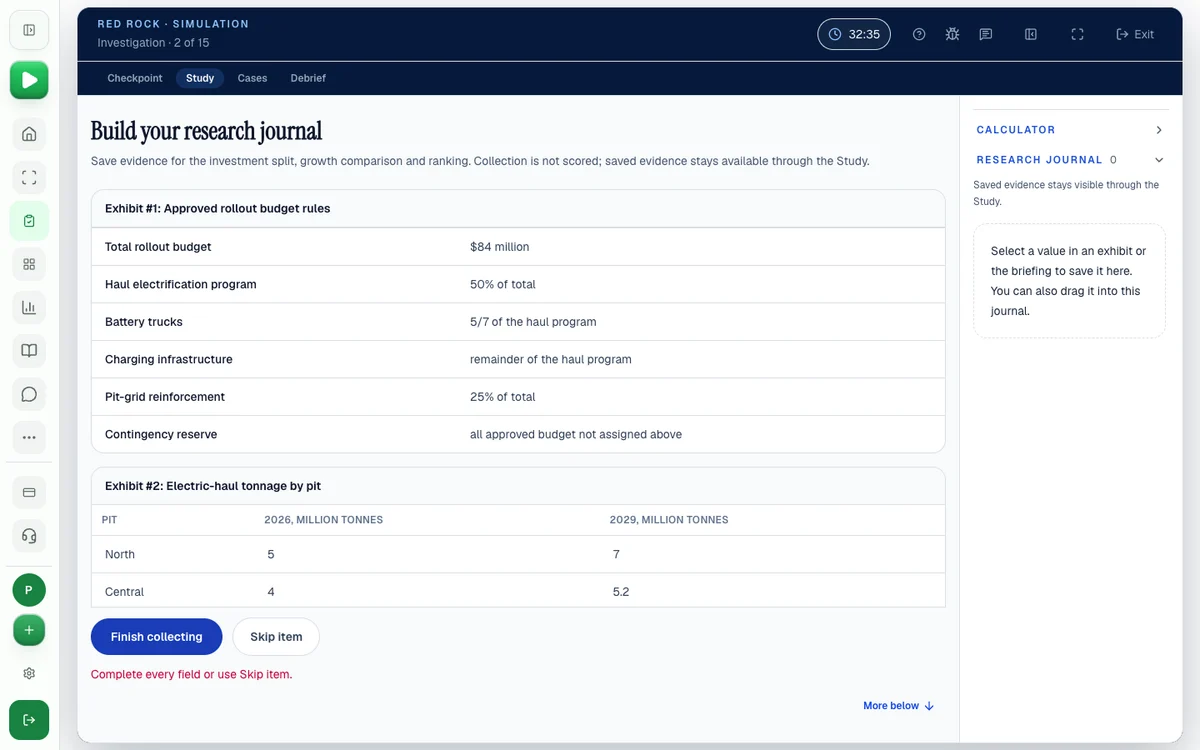
| Study: Investigation | Read the briefing and exhibits, then save the values you will need to a research journal. Saving evidence is not scored. |
| Study: Analysis | Three calculations: split an $84 million budget across four categories, compare tonnage growth from 2026 to 2029, and rank pits by average annual growth. |
| Study: Report | Complete the written board memo, choose the chart that fits the question, then build that chart from your numbers. |
| Six Cases | Standalone questions on new data: choose the evidence a plan needs, a supplier percentage share, the hub with the highest certified share, mean versus median delay, a complement probability and a budget reallocation ratio. |
| Tools | Research journal and an on-screen calculator, available through the Study. |
| Scoring | 13 scored decisions worth 36 points in total. |
| Your result | Your points, where you lost them by stage, your strongest and weakest step, and every answer next to the worked solution. A practice percentile appears once enough runs of the same simulation exist. |
| Library | Ten full Red Rock simulations in total, from easier foundation scenarios to real-difficulty ones. |
The quick version: Red Rock is the McKinsey Solve case study module. Candidates report roughly 35 minutes across sequential phases, interpreting exhibits, calculating with a built-in calculator, and submitting numerical and written outputs. McKinsey has not published a detailed official breakdown, and details vary by cycle.
Ten simulations, $29 once. One free practice per account, about 12 minutes.
Some exhibit figures are shares of other shares; save what you need.
Compute and commit each response, then work the standalone cases.
Your answer beside the worked one, then three runs to fix it.
Finish 5 of 10 Sea Wolf and 5 of 10 Red Rock simulations first.
The calculation in a Red Rock phase is usually something a competent candidate could do untimed without error. What breaks people is everything around it: a unit line buried in an exhibit footnote, a fixed cost that does not scale with volume, a journal full of true facts that have nothing to do with the question. The assessment is testing whether you read carefully under time pressure and whether you notice which information actually changes the answer. That is the same skill that separates a clean case interview from one where the candidate confidently computes the wrong thing.
You get the client objective, a briefing, and exhibits. The research journal is where you save the facts you think matter: some change the calculation and some are context, and telling them apart is the skill. The built-in calculator handles the arithmetic, so you are testing your reasoning rather than your mental math. Then enter each response in the stated unit. The first step runs here free; a free account keeps your answer and continues the same attempt through Investigation, budget allocation and two Cases in the app. Free Simulation runs one advisory clock of about 12 minutes and shows the free first-step result and explanation, then holds later verdicts for the final report. Matching game, Solve pack or included Annual Pro access unlocks untimed Learning with feedback and a repair after each response. The full simulations in the paid packs run the whole Study, Investigation, Analysis and Report, then six independent Cases. The examples below teach the method using original practice material, not official questions.
Three original teaching examples. Try each before reading the approach; they are not recorded user answers or a measurement of how often candidates make these mistakes.
Reconcile units before computing anything. When an exhibit's unit differs from the rate's unit, convert explicitly and write the converted figure down rather than holding it in your head.
Your answer is wrong by a factor of a thousand and looks plausible.
Fixed costs still hit profit; they just do not scale. Compute the variable saving across total volume, then subtract the fixed charge once.
Yes. Gross saving minus the fixed charge is the answer the client asked for.
Read the requested unit last, before you submit, and convert. Assessments that state a unit mark on it.
Enter 6,230. Divide dollars by 1,000 when the requested unit is thousands of dollars.
Use this order: objective, evidence, relationship, calculation, implication. The same disciplined setup that structure drills build for frameworks applies to a data study.
Steps 4 and 5 are where most points go. These original examples use invented numbers, not the free simulation's.
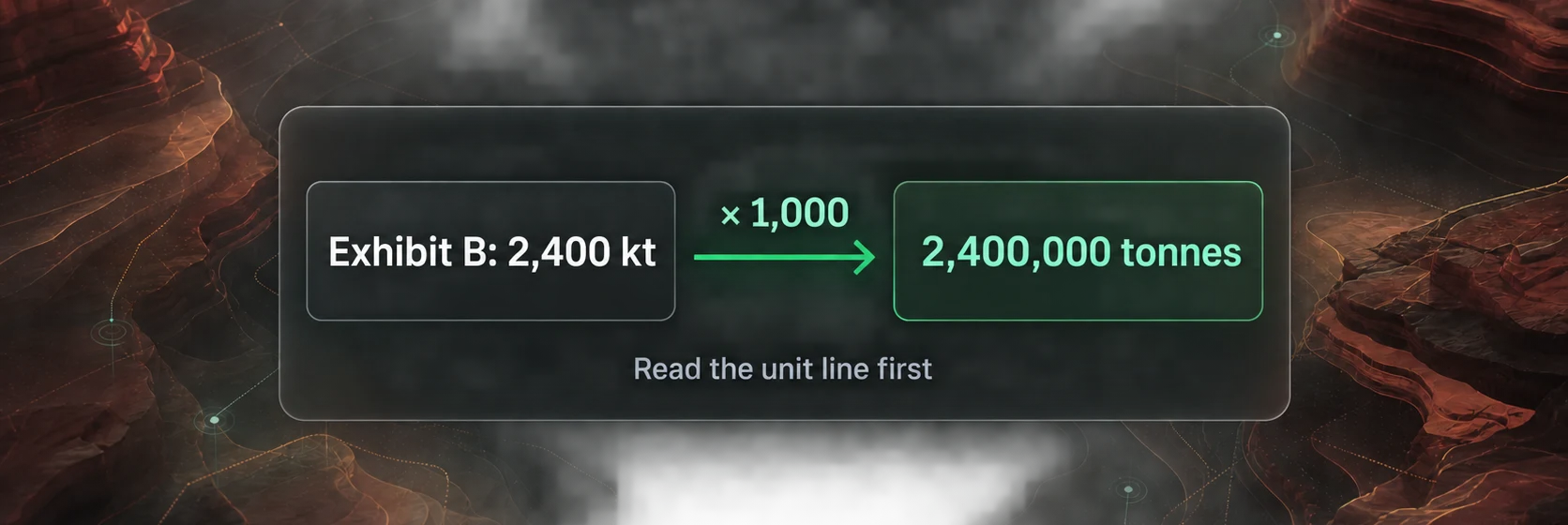
Units. An exhibit lists 2,400 kt of ore while every cost is per tonne. Convert first: 2,400 kt × 1,000 = 2,400,000 tonnes. Missing the footnote leaves an answer that is out by a factor of 1,000 and still looks plausible.
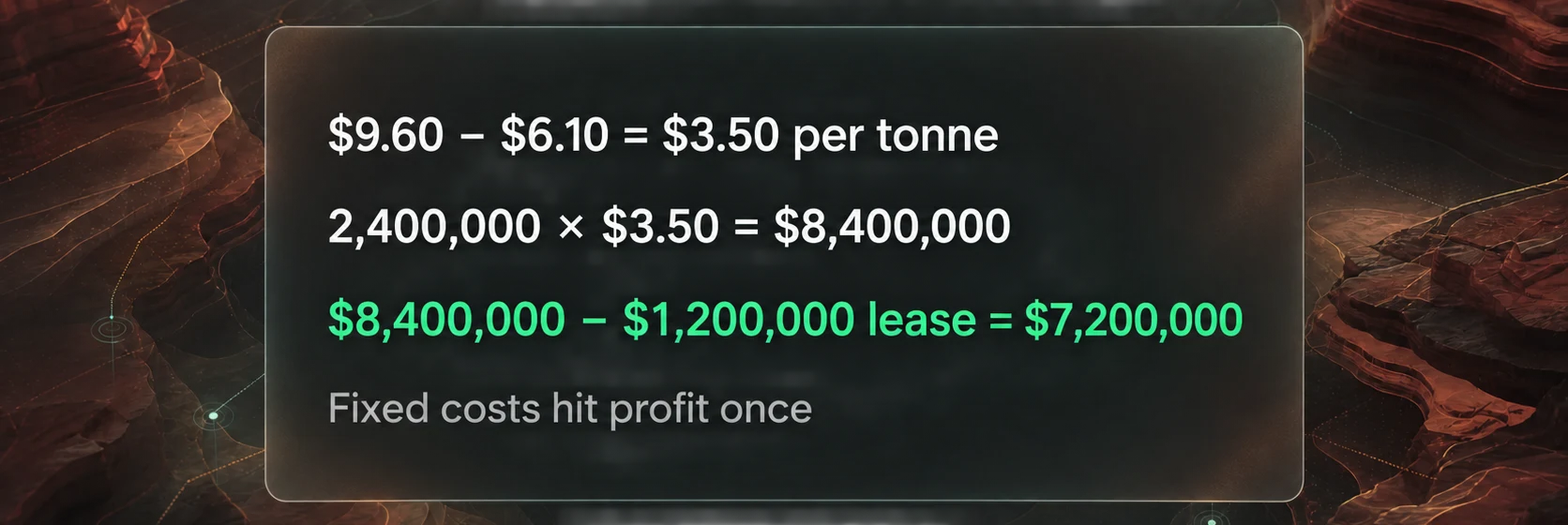
Fixed costs. A new supplier saves $9.60 − $6.10 = $3.50 per tonne across 2,400,000 tonnes, or $8,400,000 a year, but adds a $1,200,000 annual lease. The lease is subtracted once: $8,400,000 − $1,200,000 = $7,200,000.
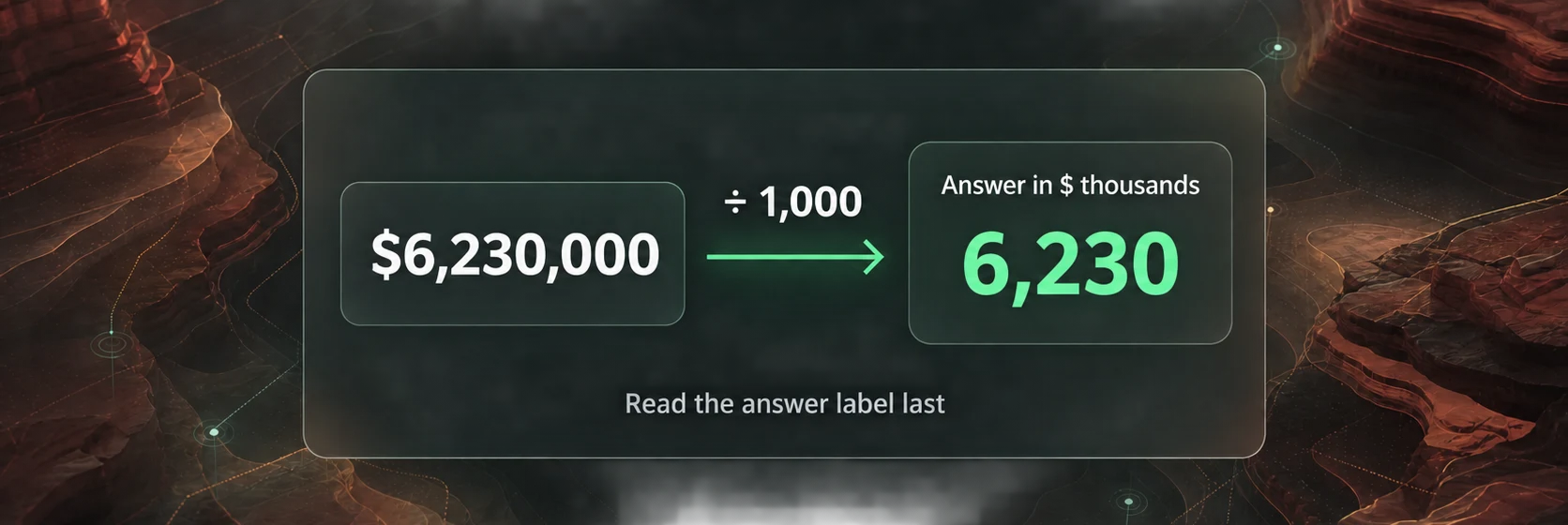
Answer units. The question asks for thousands of dollars and your calculation gives $6,230,000. Enter 6,230, because $6,230,000 ÷ 1,000 = 6,230.
You do not need advanced mathematics. You need reliable setup, clean units, and enough pacing discipline to avoid spending several minutes rescuing one avoidable mistake. Timed case interview math practice and short math drills build that reliability.
Spread the number work across mental math for case interviews and quick case interview math tips so each day targets a different weakness.
McKinsey says Solve is a gamified assessment of problem-solving ability and that performance is considered with the rest of the application. Its official guidance also prohibits recording, screenshots, outside tools, and assistance during the live assessment. Practice beforehand; do the real assessment alone.
Trace the error backwards instead of repeating the final calculation. Start with the submitted unit, then inspect the equation, the evidence saved to the journal, and finally the original objective. This reverse order finds the first broken link quickly.
A good debrief ends with one changed behavior. "Be more careful" is not observable. "Write the denominator beside every percentage before calculating" is.
The complete Redrock Study guide covers reported format details and more worked math. The McKinsey Solve guide explains how Redrock, Sea Wolf, and SFL fit together — if your invitation includes those tasks, Road to Offer offers a free run of each, with additional simulations in paid packs.
McKinsey and Solve are trademarks of McKinsey & Company. Road to Offer is independent and is not endorsed by McKinsey.

Turn your result into one focused practice rep: the response you missed, worked through, and the next run that fixes it.