
L.E.K. Case Interview Examples: 9 Practice Cases and Market Sizing Walkthroughs (2026)
Nine L.E.K. case interview examples with worked solutions, including L.E.K.'s three official published cases decoded, market sizing openers, and commercial due diligence prompts in the sectors L.E.K. actually staffs.
On this page
L.E.K. Consulting runs candidate-led case interviews across 27 offices and roughly 2,300 employees, and it publishes exactly three case examples on its own careers site with no answers attached: an aircraft brainteaser, a brewery profit-volatility case, and a pharmaceutical market sizing and pricing case. Two of those three require an estimate, which tells you what the firm weights. L.E.K.'s official application page says the process "differs slightly by region" and includes "a mixture of experiential and case interviews (both quantitative and strategic cases are possible)". Candidate reports describe two 30-minute cases in round one and a written case of about 60 minutes in the final round.
The failure mode specific to this firm is not weak structure. It is treating the opening estimate as a warm-up. At L.E.K. the number you build in the first eight minutes becomes the denominator for everything after it: the pricing decision, the investment recommendation, the go or no-go. Candidates who rush the sizing to "get to the real case" spend the rest of the interview defending a figure they never pressure-tested. This page works nine cases end to end, starting with L.E.K.'s own three, and ends each one in a decision rather than a framework.
What a good L.E.K. practice example has to show
Most published L.E.K. material stops at the prompt. That is useful for exposure and useless for calibration, because you never learn whether your estimate chain or your recommendation would have survived. A practice case earns its place only if it carries five things.
Use the same loop on every case below: state the decision, build the first tree, ask for the highest-value evidence, then close with a recommendation that has a number attached to it. If you want the format and process detail rather than the material, the L.E.K. case interview guide covers rounds, timings and what the invitation controls.
How L.E.K. cases differ from MBB and other tier-2 firms
L.E.K. is not "BCG with fewer offices". Its case mix reflects its book of business, which is heavily weighted toward commercial due diligence, life sciences and consumer, and that shows up in the questions.
What this means for your practice mix. If you have only run generalist profitability cases, you will feel the gap in two places: sector vocabulary and estimate discipline. Fix the first with the life sciences consulting case interview guide and the private equity due diligence framework. Fix the second by getting an estimate graded rather than self-marked, because the part you cannot assess alone is whether your driver chain would have survived a challenge.
Size a market the way an L.E.K. opener demands from the Road to Offer drill engine. Answer a real prompt and get AI-scored feedback. Free accounts include 5 drills per day for the first 3 days after signup.
The five question types inside an L.E.K. case
An L.E.K. case is a sequence of separately scored asks, and each one is rehearsable on its own before you ever sit a full case.
L.E.K.'s published in-case guidance maps almost one to one onto that list. Its seven tips tell candidates to take time and restate the facts, gather thoughts before speaking, stick to the approach, ask clarifying questions, formulate hypotheses aloud, "come up with an answer" while showing willingness to rethink, and be yourself. Read together, that is a request for a candidate who commits and then updates, not one who hedges until the interviewer decides for them.
L.E.K.'s three official case examples, decoded
These are the only cases L.E.K. publishes, and it deliberately gives approach questions instead of answers. Work each prompt cold before reading the solution.
Official case 1: the aircraft brainteaser
L.E.K.'s prompt. Airplanes take off from JFK and LAX every hour on the hour, continuously, flying identical New York to Los Angeles routes. The flight takes five hours. You leave New York at 12:00 PM EST. How many airplanes flying the opposite route will you pass on the way?
The trap. Most candidates answer five, counting only the aircraft that depart LAX during their flight. That ignores every plane already airborne when you take off.
Worked approach. Work in one time zone and put every departure on a single clock. You are in the air from 12:00 to 17:00 EST.
- An eastbound plane that left LAX at 07:00 EST lands at JFK at 12:00 EST, exactly as you take off. That is the earliest one you encounter.
- An eastbound plane that leaves LAX at 17:00 EST departs exactly as you land. That is the last one you encounter.
- Every hourly departure between those two endpoints is in the air at some point during your flight: 07:00, 08:00, and so on through 17:00.
- That is 11 aircraft. If the interviewer wants only planes you pass mid-air, exclude the two endpoint encounters and answer 9.
What is actually being scored. Not the number. It is whether you convert to a single clock before counting, whether you name the endpoints explicitly, and whether you volunteer the 9 versus 11 boundary condition instead of being caught by it. For more of this format, see the consulting brain teasers guide.
Official case 2: Brewery Profits
L.E.K.'s prompt. Two competing brewers, Cheapo Beer Company and Bourgeois Beer, Inc., have reported similar revenues over five years with steady growth. Cheapo is the "All-American Beer" staple at tailgate parties. Bourgeois markets itself as brewed fresh from mountain water. Cheapo's profits have grown at a moderate, consistent rate. Bourgeois's profits have fluctuated significantly. Why the difference, and as CEO of Bourgeois, what would you do about it?
The structure that works. Revenue is similar and steady for both, so the volatility is not a demand story. That collapses the tree fast. Profit volatility with stable revenue has three possible homes: input cost exposure, operating leverage (the fixed versus variable cost split), and discretionary spend that is lumpy year to year, mainly marketing and promotion. Say that out loud, then ask for the cost structure.
Worked math (case assumptions, stated as such). Assume both brewers sit at $500M revenue.
- Cheapo: contribution margin 40%, fixed costs $80M. Operating profit = ($500M x 0.40) − $80M = $120M.
- Bourgeois: contribution margin 55% (premium pricing), fixed costs $170M (own brewery, spring water sourcing, glass packaging). Operating profit = ($500M x 0.55) − $170M = $105M.
- Now flex revenue down 5%. Cheapo loses $25M x 0.40 = $10M, an 8.3% profit hit. Bourgeois loses $25M x 0.55 = $13.75M, a 13.1% profit hit on a smaller base.
Add the input exposure. If Bourgeois buys $120M of ingredients and packaging on the spot market and those prices swing 15% year to year, that alone is a ±$18M profit swing, roughly 17% of operating profit, before volume moves at all.
Recommendation with numbers attached. Two levers, in order. First, hedge or forward-contract about 70% of the input basket: residual exposure falls from ±$18M to roughly ±$5.4M. Second, convert fixed capacity to variable by contract-brewing peak volume instead of building for the peak, which lowers the fixed base and shrinks the operating-leverage amplifier. Smoothing marketing spend across quarters is a third-order fix, worth naming and not leading with. Risk to flag: hedging locks you out of input price declines, so the case for it is variance reduction, not expected profit.
That decomposition is the profitability framework applied to volatility rather than level, and it is the single most reusable move in the L.E.K. set. The part candidates get wrong is the structure, not the arithmetic: they list cost categories instead of naming the three mechanisms that can produce volatility under stable revenue.
Build a candidate-led structure and get it scored from the Road to Offer drill engine. Answer a real prompt and get AI-scored feedback. Free accounts include 5 drills per day for the first 3 days after signup.
Official case 3: Large Pharma Co., the baldness cure
L.E.K.'s prompt. A large pharmaceutical client has developed a pill, IPP2, that regrows hair to age-15 thickness within three months and must be taken daily to maintain it. Estimate the size of the market for this drug and describe how you would price it.
This is the case that tells you the most about L.E.K., because the estimate is not the answer. It is the input to the pricing decision, and a wrong denominator makes every price you propose indefensible.
Worked approach, top down. Every number below is a case assumption you should state aloud, not a researched figure. The interviewer is buying the chain.
- Start with US adults: assume roughly 260 million, split about evenly, so 130 million men and 130 million women.
- Prevalence of noticeable pattern hair loss: assume 40% of adult men across all ages, giving 52 million, and 20% of adult women, giving 26 million. Total pool: 78 million.
- Not everyone with hair loss wants a daily pill. Screen for cosmetic priority, tolerance for a chronic medication, and ability to pay a cash price: assume 25%, giving roughly 19.5 million willing patients.
- Adoption is gated by awareness, prescriber access and switching from existing routines. Assume the drug captures 20% of the willing pool at steady state: 3.9 million patients.
- Pricing. This is cosmetic, so assume no insurance reimbursement and a cash-pay decision. Anchor between the two existing options: daily generic therapies run tens of dollars a month, surgical restoration runs several thousand dollars once. A daily pill with a visible three-month result sits closer to the surgical value, so price at $100 per month, or $1,200 a year, and validate with willingness-to-pay research before launch.
- Revenue: 3.9 million x $1,200 = roughly $4.7 billion a year at steady state.
Sanity check. 3.9 million patients is 5% of the 78 million pool and about 3% of adult men. For a cash-pay cosmetic therapy that is a plausible ceiling, not a conservative floor, so flag it as the assumption most worth testing. If the interviewer pushes the capture rate to 10% of the willing pool, revenue halves to $2.3 billion, and that sensitivity is the answer worth volunteering.
How to close it. Price on value, not cost, because the marginal cost of a pill is irrelevant to what a cosmetic buyer will pay. Recommend a single cash price with an annual prepay discount to lift retention, since revenue depends entirely on daily adherence over years rather than a one-time purchase. Name adherence as the primary risk and the first thing you would measure after launch. If your estimate chain felt loose here, the method is in market sizing step by step, and the practice inventory is in the best market sizing practice resources.
The arithmetic in the pricing half is where candidates slip, because it is easy until the interviewer flexes one assumption and asks for the new number out loud.
Rep the multi-step arithmetic these cases run on from the Road to Offer drill engine. Answer a real prompt and get AI-scored feedback. Free accounts include 5 drills per day for the first 3 days after signup.
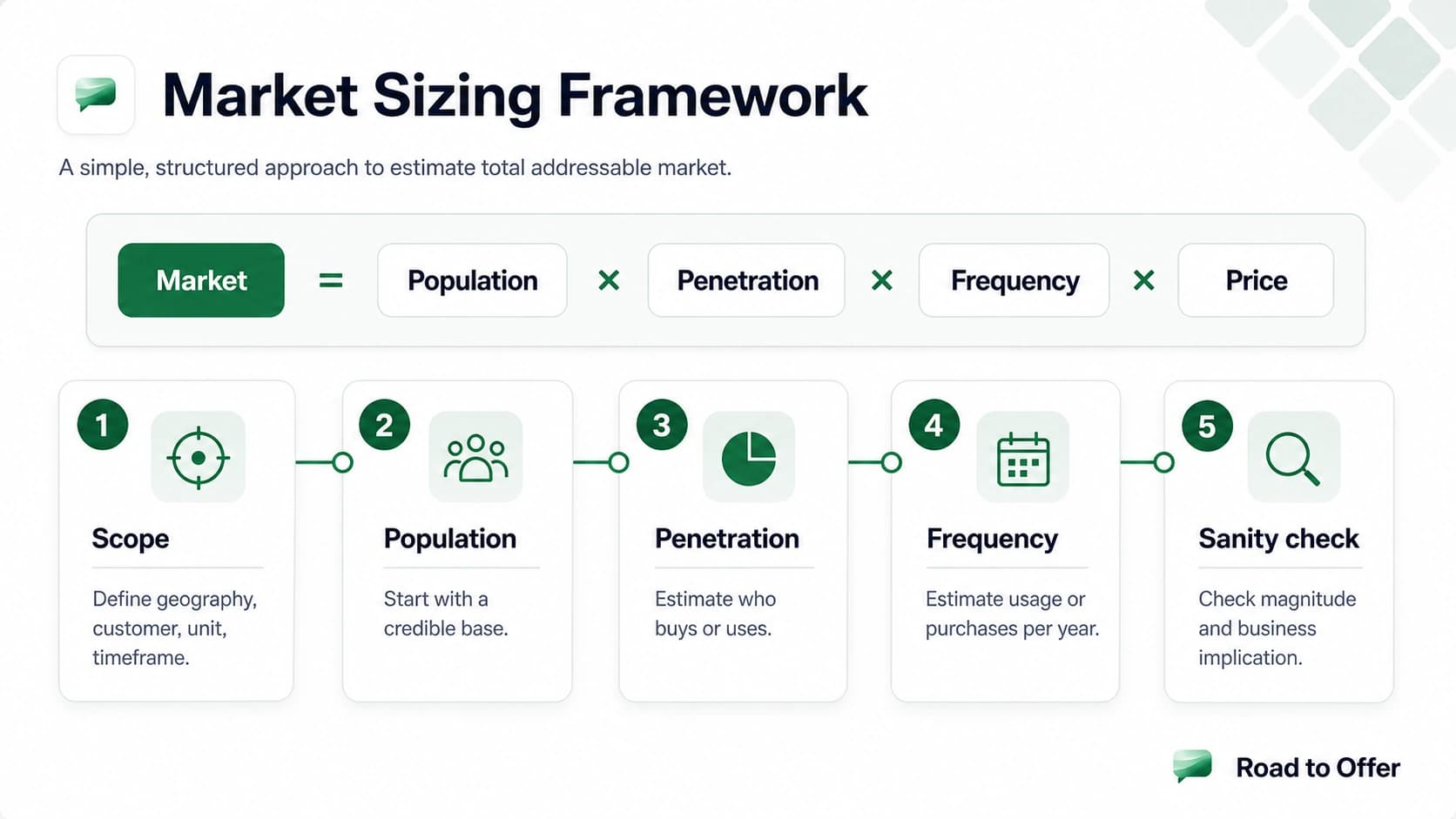
Learn market sizing
Segmentation, anchors, sanity checks, then scored reps.
Six more L.E.K.-style practice cases with worked solutions
These are written in the sectors L.E.K. actually staffs. Read the prompt, cover the solution, and give yourself two minutes to structure before you look.
Case 4: Commercial due diligence on a veterinary clinic roll-up
Prompt. A mid-market private equity fund is considering a $240M acquisition of a 60-clinic veterinary group. The platform grew revenue 14% last year. Should the fund proceed, and what would change your answer?
Structure. Three testable branches: is the market growth real and durable, is the platform's growth organic or acquired, and does the roll-up thesis have anything left to buy.
Worked approach.
- Decompose the 14%. If 9 points came from four clinics acquired mid-year and 5 points from same-clinic growth, the platform is buying growth, not producing it. Ask for same-clinic revenue growth as your first exhibit; it is the single number that decides this case.
- Test same-clinic growth quality. Split it into visits and revenue per visit. If visits are flat and revenue per visit is up 5%, growth is pricing, and pricing has a ceiling in a discretionary spend category.
- Test the roll-up runway. At 60 clinics with an average purchase price of 8x EBITDA and a platform valued at 14x, the arbitrage is real but only while targets exist. Ask how many independent clinics remain in the platform's geographies and whether competing consolidators are bidding the multiple up.
- Size the return. If EBITDA is $30M (a 12.5% margin on $240M of revenue at an 8x entry) and the fund can add 20 clinics at 8x with $1.5M EBITDA each, that is $30M of acquired EBITDA for $240M of capital, revalued at the platform multiple.
Recommendation. Proceed only if same-clinic growth is above 4% on visits rather than price, and if at least 40 acquirable clinics remain within the existing footprint. Otherwise the fund is paying a platform multiple for an arbitrage that closes before exit. Principal risk: veterinary labour supply, which caps how fast acquired clinics can be integrated.
This is the archetype L.E.K. sells more of than any other. The transferable skill is running the growth decomposition before touching valuation, and it rehearses cleanly on a real private equity growth case.
 Bain
BainGrowth · hard
Run a live private equity growth case
Same skill as Case 4 in an L.E.K.-style diligence: decompose growth into its real drivers, test whether the thesis survives the numbers, then commit to a recommendation and get scored on it.
Case 5: Life sciences in-licensing decision
Prompt. A mid-cap biopharma company can in-license a Phase 3 asset for $150M upfront plus $300M in milestones. Peak annual sales are projected at $600M. Should they take it?
Structure. Probability of approval, commercial realism of the peak sales figure, and whether the client can actually sell it with the salesforce they have.
Worked approach.
- Risk-adjust first. If Phase 3 assets in this indication approve at roughly 60%, the $600M peak becomes a $360M expected peak before you discount anything.
- Build the revenue shape, not just the peak. Assume a four-year ramp to peak, seven years at peak, then a patent cliff. Ten years of contribution at a 30% net margin on the risk-adjusted number is roughly $1.0B undiscounted, and materially less after discounting at a biotech cost of capital.
- Compare with the cost. $150M upfront is spent regardless of outcome. Milestones are contingent, so weight them by the same 60% and by the sales thresholds attached to them.
- Ask the question that decides it: does the client already call on the prescribers this drug needs? If yes, the incremental commercial cost is close to zero and the deal works at these terms. If no, add the cost of a new specialty salesforce and the deal likely does not.
Recommendation. Take it only if the target prescriber overlap with the existing portfolio exceeds roughly 60%, and negotiate more of the $300M into approval-contingent milestones rather than upfront. The sensitivity worth naming is probability of approval: at 45% instead of 60%, the deal stops clearing its cost of capital. Sector concepts behind this case are in the life sciences consulting case interview guide.
Case 6: MedTech sizing opener into a pricing decision
Prompt. Before we discuss strategy, how many hip replacement procedures are performed in the United States each year? Our client makes hip implants and is considering a premium-priced ceramic bearing.
Worked approach, top down. Again, these are stated assumptions.
- US population 330 million. The at-risk group is adults 65 and older: assume 17%, so 56 million.
- Assume roughly 0.6% of that group receives a hip replacement in a given year: 336,000 procedures. Add younger patients from trauma and early-onset arthritis at about 25% of that figure: roughly 420,000 procedures a year.
- Client share at 20% gives 84,000 implants. If the premium bearing carries a $1,200 price uplift and converts 30% of the client's volume, that is 25,200 units x $1,200 = $30M of incremental revenue.
How the sizing decides the strategy. $30M of uplift against a development and regulatory cost of, say, $45M means the product needs three years to pay back before competitive response. If instead the conversion rate is 60% because surgeons in this segment default to premium bearings, payback halves and the decision flips. So the strategic question is not "is the market big" but "what fraction of surgeons choose the bearing rather than the hospital procurement team", and that is the exhibit to request.
 McKinsey
Market entry · medium
Run a live medtech market-entry case
Same skill as Case 6: size the segment, set the price corridor, and commit to an entry recommendation, scored live.
Case 7: Industrials profitability, specialty coatings
Prompt. A specialty coatings manufacturer has grown revenue 9% over two years while operating margin fell from 16% to 11%. The CEO wants to know why.
Structure. Mix, price, and cost-to-serve. Not the generic revenue-minus-cost tree, because the case has already told you revenue is up.
Worked approach.
- Ask for revenue and margin by product line. If aerospace coatings at a 28% margin were flat while general industrial coatings at a 7% margin grew 30%, the margin decline is mix, and the growth is the problem rather than the cure.
- Quantify it. Assume revenue moved from $400M to $436M, with general industrial rising from $120M to $156M. Blended margin at the old mix would have been about 15.7%; at the new mix, roughly 12.9%. Mix explains most of the five-point fall, and the residual is real cost inflation.
- Chase the residual. Raw material index up 8% with pricing up only 3% means the client is absorbing input inflation on annual contracts with no pass-through clause.
Recommendation. Reprice or exit the lowest-margin general industrial accounts, add raw-material pass-through clauses at contract renewal, and reset the sales incentive from revenue to gross margin dollars. Quantify the ask: recovering three of the five lost points on $436M is roughly $13M of operating profit. See the profitability framework for the underlying tree.
Case 8: Consumer growth, subscription pet food
Prompt. A direct-to-consumer fresh pet food brand at 180,000 subscribers wants to reach 500,000 in three years. What is the path, and what does it cost?
Worked approach.
- Net adds needed: 320,000 over 36 months. But churn eats gross adds first. At 3.5% monthly churn on an average base of 300,000, the brand loses roughly 10,500 subscribers a month, or 378,000 over the period.
- So gross acquisitions required are roughly 320,000 + 378,000 = 698,000. At a blended acquisition cost of $70, that is $49M of spend.
- Now flex churn. At 2.5% monthly, losses fall to about 270,000 and gross adds to 590,000, saving roughly $7.6M at the same acquisition cost. Retention is a cheaper lever than acquisition here, and the math proves it rather than asserting it.
- Check unit economics before recommending spend. At $75 monthly revenue and a 35% contribution margin, a subscriber contributes $26 a month, so a $70 acquisition cost pays back in under three months. The spend is justified as long as churn does not rise with channel scale.
Recommendation. Fix retention first, then scale acquisition into the channels that hold payback under four months. Name the risk plainly: blended acquisition cost usually rises as you scale paid channels, so the $49M figure is a floor. The same reasoning pattern appears in the growth strategy cases guide.
 Bain
BainGrowth · easy
Run a live food growth case
Same skill as Case 8: pick the growth lever, work the unit economics, and defend the plan out loud.
Case 9: Market entry, airport foodservice concession
Prompt. A restaurant group is bidding for a five-year foodservice concession at a regional airport with 6 million annual passengers. What should they bid?
Worked approach.
- Convert passengers to customers. 6 million passengers, assume 55% are departing and pass the concession area, and 25% of those buy: 6M x 0.55 x 0.25 = 825,000 transactions.
- Revenue at a $14 average ticket: $11.6M a year.
- Costs: food at 30%, labour at 28%, and airport rent typically charged as a percentage of sales, say 15%. That leaves 27%, or $3.1M, before fixed overhead and the build-out.
- Build-out of $4M amortised over five years is $800K a year, leaving roughly $2.3M of annual operating profit, or $11.5M across the term.
- The bid ceiling is what remains after a required return. If the group needs a 20% return on the $4M invested, the maximum incremental guaranteed payment is well below the $2.3M annual profit line.
Recommendation. Bid with a revenue-share structure rather than a fixed guarantee, because passenger volume is the risk you cannot control and a fixed minimum transfers that risk to you for free. Flag the assumption most likely to be wrong: the 25% purchase rate, which swings the whole case. The underlying tree is the market entry framework, adapted to a bid rather than a build.
The L.E.K. written case
Candidate reports consistently describe a written exercise in the final round: a pack of slides with text, charts and tables, roughly 60 minutes to work through it, then a short deck and a presentation followed by questions. The volume is deliberately more than you can read.
What it actually tests. Triage and headline writing, not exhaustive analysis. You will not read every page. The scored behaviour is deciding in the first five minutes which three or four questions the pack is really asking, then reading only the pages that answer them.
How to prepare for it.
- Write slide headlines as conclusions, not labels. "Enterprise churn drove 70% of the revenue decline" beats "Revenue analysis".
- Build the deck backwards from your recommendation, then cut anything that does not support it.
- Rehearse the 60-minute clock with a real data pack. The written case interview guide and the consulting assessment centre written case playbook both give timed drills for this.
- Practise saying the answer first. In the presentation, the recommendation goes in the first sentence, then the support.
The skill that carries the written case is compression: turning a page of analysis into one defensible sentence. That is a separately scoreable move and worth a graded rep before the round.
Compress an analysis into one defensible answer from the Road to Offer drill engine. Answer a real prompt and get AI-scored feedback. Free accounts include 5 drills per day for the first 3 days after signup.
Self-diagnostic: are you practising like an L.E.K. candidate?
Work through these after the nine cases above. Each maps to something L.E.K. asks for explicitly in its own interview guidance.
- Did you state your assumptions out loud before calculating? L.E.K.'s first published tip is to restate facts and state assumptions. An estimate delivered without its assumptions cannot be challenged, which means it cannot be scored.
- Did your estimate carry through to the decision? In Case 3 and Case 6, the sizing sets the denominator for pricing. If your recommendation would have been the same at half the market size, you did not use the number.
- Did you commit? L.E.K. asks candidates to "come up with an answer" while remaining willing to rethink. Hedging until the interviewer decides reads as the opposite of both halves.
- Did you name the assumption most likely to be wrong? Volunteering the sensitivity is the single fastest way to look like someone who has done diligence work.
- Did you speak the sector's language? In a life sciences or MedTech case, terms like probability of approval, prescriber overlap and site of care are table stakes rather than bonus points.
For fit and experiential rounds, which run alongside the cases rather than after them, use the L.E.K. behavioral interview questions guide, and rehearse those answers on the behavioral practice simulator rather than in your head. Before the round opens, run your CV through the consulting resume grader, since L.E.K. screens applications before any of this matters.
L.E.K.'s official practice resources
Work the firm's own material first, because it is the only material that is definitionally on-format.
- The interview preparation page. L.E.K.'s interview preparation page carries all three published cases plus the seven in-case tips. Treat the "Approaching the Case Interview" questions under each case as the actual exercise: they are the questions your interviewer is scoring you against.
- The application page. L.E.K.'s apply page states the process differs by region and level, and that candidates may apply to only one global office per year. Confirm your own sequence from your invitation rather than from any guide, including this one.
- The firm's insights library. L.E.K.'s published insights are organised by the exact sectors its cases come from. Reading two or three in the sector you are interviewing for is the cheapest sector-vocabulary win available.
- Its own numbers. L.E.K.'s about page reports 27 offices, 200 or more partners, 2,300 or more employees and 2,000 or more cases annually, which is useful material for a specific "why L.E.K." answer rather than a generic one.
Once the official material is exhausted, the constraint stops being reading and starts being reps under pressure. Pick candidate-led estimation, profitability and diligence prompts from the case library and run them out loud.
How to use these nine cases
Do not read them a second time. Run the loop below on each one, and convert every failure into a specific rep rather than another pass through the material.
How to run each case
Read only the prompt, then cover the solution. Reading a worked answer feels like learning and produces none of it
Write your structure in two minutes. L.E.K. cases are candidate-led, so the tree is your first scored move
Say every assumption out loud before you calculate. L.E.K.'s own guidance asks for stated assumptions and restated facts
Finish with a recommendation that has a number and a risk in it. A framework without a decision is the most common way these cases end badly
Compare against the worked solution and name the one thing that broke. Diagnosis is what turns nine cases into a prep plan
Convert that break into a rep: market sizing, structure or case math. A scored rep on the exact skill beats another passive read
Then run a full live case out loud from the case library. Holding all five moves together under time pressure is the thing the interview actually tests
If you want more worked material across other firm formats, the case interview examples hub collects them, and the L.E.K. case interview guide covers process, rounds and what your invitation controls. For firm background and the recruiting route into it, see L.E.K. Consulting.
If your application is not in yet, the L.E.K. resume guide and cover letter guide cover the documents, and the L.E.K. salary breakdown shows what the offer looks like.
Sources and further reading (checked July 31, 2026)
- L.E.K. official interview preparation page, including all three published case examples and the seven in-case tips: lek.com/careers/apply/interview-preparation
- L.E.K. official apply page, on regional variation and the one-office-per-year rule: lek.com/careers/apply
- L.E.K. about page, for office count, partner count, employee count and annual case volume: lek.com/about-lek
- L.E.K. published insights by sector: lek.com/insights
- My Consulting Offer L.E.K. case interview guide, for candidate-reported round structure and written case timings: myconsultingoffer.org/case-study-interview-prep/lek-case-interview
- MConsultingPrep L.E.K. case interview page, for candidate-reported round one and round two formats: mconsultingprep.com/lek-case-interview
- PrepLounge candidate forum thread on L.E.K. first-round cases: preplounge.com/consulting-forum/does-anyone-know-what-lek-first-round-casesinterviews-are-like-16971
Run a candidate-led case out loud
A materials-industry margin problem in the L.E.K. mould: you open the structure, call for the evidence, and get scored on your estimate chain, your math and your recommendation.
Frequently asked questions
Resources and related guides
- Start a growth casePractice
- Browse all free resourcesResource hub
- Accenture Case Interview Examples: 10 Practice Cases and the Official Workbook (2026)Firm Specific · Jul 31, 2026
- BCG Case Interview Examples: 10 Practice Cases (2026)Firm Specific · Mar 1, 2026
- Práctica de entrevistas de casos BCG: 10 ejemplos y qué esperarFirm Specific · Mar 1, 2026
- CIL Strategy Consultants Case Interview Guide (2026)Firm Specific · Aug 13, 2026