
Consulting Brain Teasers & Interview Puzzles: 44 Examples (2026)
44 consulting brain teasers and interview puzzles organized by type: estimation, logic, math, and lateral thinking, each with a full worked solution.
On this page
Consulting brain teasers and interview puzzles are short, self-contained reasoning problems. Some interviews may include them, but current official firm pages do not support a universal firm-by-firm puzzle list. Use these 44 examples as transferable practice across estimation, logic, math, and lateral thinking, then prepare the exact process named in your invitation.
This article covers:
- Estimation brain teasers (10 examples): market sizing disguised as puzzles
- Logic brain teasers (12 examples): deductive reasoning and constraint problems
- Math brain teasers (12 examples): percentage puzzles, rate problems, number tricks
- Lateral thinking brain teasers (10 examples): creative reasoning with unexpected answers
- Current-use check: how to verify whether puzzle practice matches your interview
- How to practice: an answer rubric and miss-pattern routing loop
Skip to any section or read straight through; every teaser stands alone.
Test yourself before reading the solutions
Try these four short puzzles first. The first three reps are available in the article, so you can expose the reasoning pattern before reading 44 worked answers.
Interactive drill set. Write an answer before revealing the worked solution, then continue into Road to Offer for scored practice and AI feedback.
What Are Consulting Brain Teasers?
Consulting brain teasers are short reasoning problems that may appear on their own or resemble a small part of a larger case interview. Their best use in preparation is diagnostic: they show whether you can define a problem, expose assumptions, handle constraints, calculate cleanly, and explain a conclusion.
Brain teasers fall into four categories. Estimation teasers ask you to calculate an unknown quantity from first principles (Fermi problems). Logic teasers present a set of constraints and ask you to find the only valid conclusion. Math teasers test speed and comfort with percentages, ratios, and rates. Lateral thinking teasers present an ambiguous situation and reward the candidate who asks the right clarifying question.
One useful rule applies to all four types: state your approach before you calculate. That makes the reasoning visible and gives you a cleaner path to correct a bad assumption.
How to Approach Any Brain Teaser
Every brain teaser, regardless of type, responds to the same three-move sequence. Use the eight-dimension rubric below to judge the process, not just the final answer.
Move 1: Restate and clarify. Repeat the question back in your own words and confirm scope. "So I am estimating the number of commercial flights departing from the US on a given weekday, is that right?" This reduces the risk of solving the wrong problem.
Move 2: Structure your approach out loud. Before touching a number, say what you are going to do. "I am going to segment by airplane capacity, then work out how many flights are needed to cover US passenger demand." A visible structure makes assumptions and calculation errors easier to inspect.
Move 3: Sanity-check and commit. Once you have an answer, check it against something you know. "That gives me 45,000 flights. There are about 5,000 commercial airports globally and roughly 100,000 flights per day worldwide; 45,000 for the US feels in range." Then state your answer clearly and move on.
Score each dimension as strong, mixed, or weak after a spoken attempt. This is a practice rubric, not a claim that every consulting firm uses the same scoring sheet.
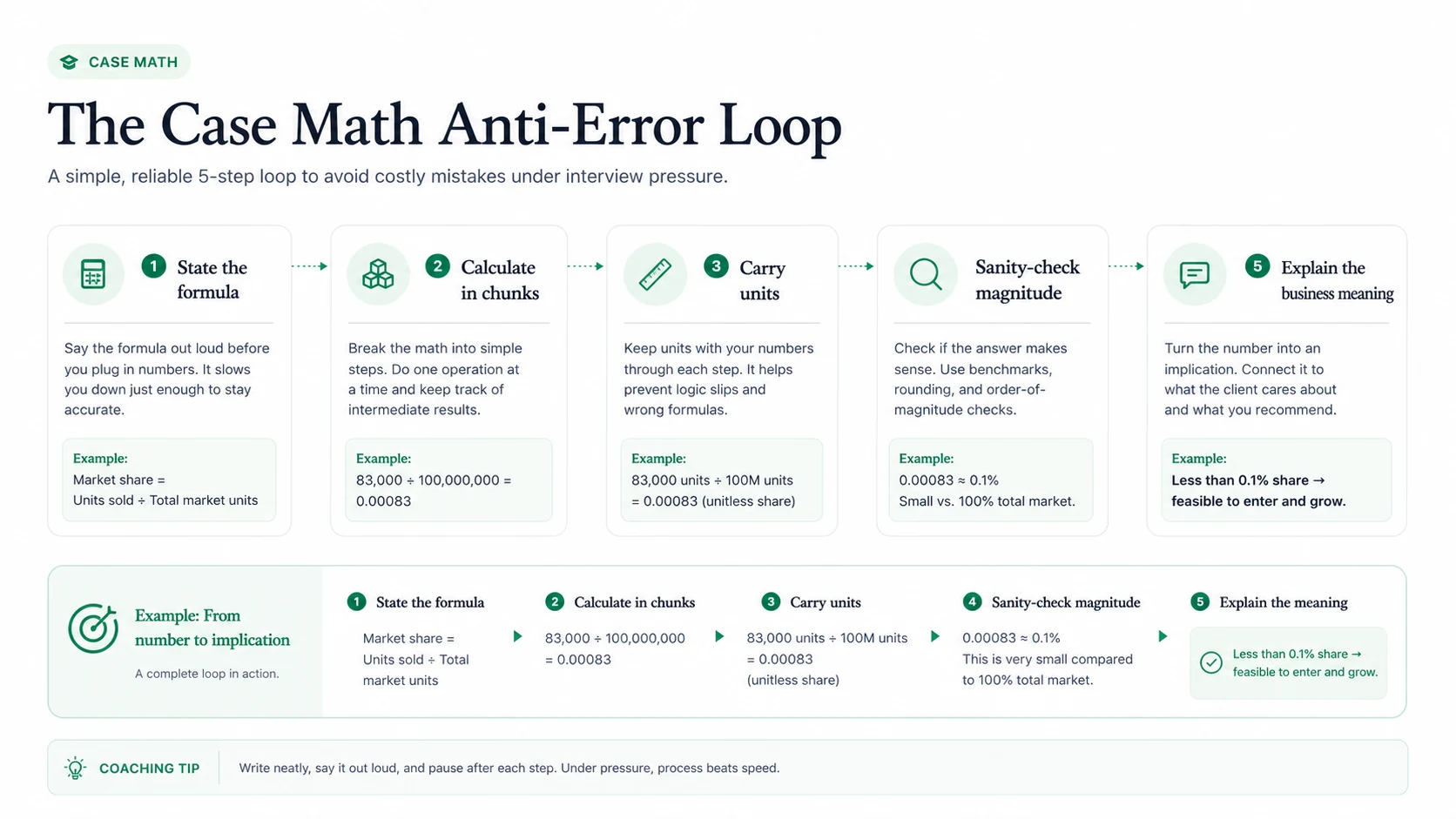
For math specifically, round only when the approximation preserves the decision and say what you changed. "I am rounding 8.3 million to 8 million for simplicity" makes the approximation visible. See the case interview math guide for rounding techniques.
Estimation Brain Teasers
Estimation teasers train you to build a reasonable quantitative answer from limited information, which overlaps with a market-sizing framework. For finance-heavy business analyst interviews, use the Capital One case interview guide only when that role is actually in scope.
Teaser 1: How many piano tuners are there in Chicago?
Question: Estimate the number of working piano tuners in the city of Chicago.
How to approach it: Break into supply vs. demand. Demand: Chicago has about 2.7 million people in roughly 1 million households. Assume 2% own a piano (20,000 household pianos) plus ~5,000 institutional pianos (schools, churches, bars) = 25,000 pianos. Most pianos are tuned once per year: 25,000 tunings/year needed. Supply: a full-time tuner does 4 tunings per day × 250 days = 1,000 tunings/year. Required tuners: 25,000 / 1,000 = 25.
Answer: ~25 piano tuners in Chicago.
What the interviewer is testing: Can you build a two-sided (supply/demand) estimate without prompting? Do you segment sensibly (household vs. institutional) rather than treating all pianos identically?
Teaser 2: How many Starbucks are there in the US?
Question: Without looking it up, estimate the total number of Starbucks locations in the United States.
How to approach it: Use a population density anchor. The US has 330 million people. Starbucks targets the 18-65 urban/suburban demographic, roughly 200 million relevant consumers. Assume one Starbucks serves 20,000 people (it is a premium brand, not as ubiquitous as McDonald's). Result: 200 million / 20,000 = 10,000.
Cross-check: major cities. New York has ~350, LA has ~200, Chicago ~150. There are roughly 30 major metro areas averaging 100 stores each = 3,000. Then smaller cities and suburbs might triple that. ~9,000-12,000.
Answer: ~10,000-12,000 US Starbucks locations. (Actual: ~16,600; our estimate is conservative on suburban penetration.)
What the interviewer is testing: Willingness to cross-check with a second method. Catching your own estimate vs. the reality and explaining the gap shows maturity.
Teaser 3: How many gallons of gasoline does the US consume per day?
Question: Estimate US daily gasoline consumption in gallons.
How to approach it: 280 million registered passenger vehicles. Average vehicle is driven 37 miles/day (13,500 miles/year ÷ 365). Average fuel economy: 28 mpg. Daily gallons per vehicle: 37 / 28 ≈ 1.3 gallons. Total: 280 million × 1.3 = 364 million gallons/day. Add ~20% for commercial vehicles and motorcycles: ~440 million gallons/day.
Answer: ~400-450 million gallons per day. (EIA reports ~370 million gallons/day of motor gasoline, within 20%.)
What the interviewer is testing: Do you handle unit conversions cleanly? Do you remember to include segments you initially omitted (commercial vehicles)?
Teaser 4: How much does the Empire State Building weigh?
Question: Estimate the weight of the Empire State Building in tons.
How to approach it: The building has 102 floors averaging 25,000 sq ft each = 2.55 million sq ft of floor space. Commercial office buildings average ~50 lbs per sq ft of floor (structural steel, concrete, glass, contents). Total: 2.55 million × 50 = 127.5 million lbs ÷ 2,000 = ~64,000 tons. Add foundation and below-grade structure (~20%): ~77,000 tons.
Answer: ~75,000-80,000 tons. (Published figure: ~365,000 tons including full structure and foundation; the interior volume approach underestimates foundation mass significantly. The honest follow-up: "My method excludes the below-grade foundation, which carries most of the load.")
What the interviewer is testing: Knowing the limits of your model. A candidate who identifies why their estimate might be low and says so scores higher than one who defends a wrong number.
Teaser 5: How many text messages are sent in the US per day?
Question: Estimate the number of SMS and iMessage/text messages sent in the United States in a single day.
How to approach it: 260 million smartphone users in the US. Average person sends ~30 texts/day (mix of group chats and one-on-one). 260 million × 30 = 7.8 billion messages/day. Add business texts (marketing, 2FA, alerts), roughly 1 in 5 texts is commercial: total × 1.2 = ~9.4 billion.
Answer: ~8-10 billion texts per day. (CTIA reports ~2 trillion texts per year ÷ 365 = ~5.5 billion/day; our per-person estimate is slightly high. Reasonable range accepted.)
What the interviewer is testing: Segmenting consumer vs. business demand without being prompted.
Teaser 6: How many weddings happen in the US each year?
Question: Estimate the number of weddings performed in the United States annually.
How to approach it: US population 330 million. Adults aged 25-40, a rough proxy for the highest-volume marriage years, total about 65 million. If roughly 1/15 of this cohort marries each year, that gives 4.3 million people marrying. Divide by two people per wedding to estimate about 2.2 million weddings per year. The pair adjustment applies to every couple, so no additional adjustment by couple composition is needed.
Answer: ~2 million weddings per year. (CDC reports ~2.1 million, spot on.)
What the interviewer is testing: Avoiding double-counting. Dividing by two for the "both parties counted" issue is a clean signal of structured thinking.
Teaser 7: How much does a fully loaded Boeing 747 weigh?
Question: Estimate the maximum takeoff weight of a Boeing 747.
How to approach it: Build from components. Passengers: 400 seats × 200 lbs average = 80,000 lbs. Checked luggage: 400 passengers × 50 lbs = 20,000 lbs. Fuel: a 747 has ~57,000 gallon capacity × 6.7 lbs/gallon = 382,000 lbs. Cargo hold: ~100,000 lbs (additional freight). Airframe empty weight: large wide-body jets are roughly 350,000-400,000 lbs empty. Total: 80K + 20K + 382K + 100K + 375K = ~957,000 lbs ≈ 480 tons.
Answer: ~450-500 tons. (Boeing spec: 910,000 lbs max takeoff = ~455 tons. Excellent estimate.)
Practice skill: Component-based estimation with explicit assumptions for passengers, fuel, cargo, and airframe weight.
Teaser 8: How many hours of video are uploaded to YouTube per minute?
Question: Estimate the number of hours of video content uploaded to YouTube every minute.
How to approach it: Start with 50 million active creators. If 1% upload one 10-minute video per week, that is 500,000 creators × 10 minutes ÷ 10,080 clock minutes per week, or about 496 video-minutes uploaded per clock minute. Divide by 60 to get roughly 8 hours of video per minute. That is far below the published figure of about 500 hours per minute, so the active-uploader share, upload frequency, average length, or creator estimate must be much larger. The useful interview move is to identify which assumption drives the miss and recalibrate it explicitly.
Answer: A published benchmark is about 500 hours per minute. The simple creator-frequency model above produces about 8 hours per minute, which demonstrates why the estimate must be stress-tested rather than defended after the assumptions fail.
What the interviewer is testing: Intellectual honesty when the answer feels too extreme. Self-correcting on the spot is a top signal.
Teaser 9: How many dentists are in the United States?
Question: Estimate the total number of practicing dentists in the US.
How to approach it: Demand: 260 million adults. Assume 50% visit a dentist once per year = 130 million annual visits. Average visit is 1 hour including cleaning; a dentist works 8 patients/day × 240 working days = 1,920 patients/year. Dentists needed: 130 million / 1,920 = ~68,000.
That feels low. Cross-check: 330 million people / 1,500 people per dentist = ~220,000. The gap comes from two adults and children seeing dentists, plus specialist dentists (orthodontists, oral surgeons). A better denominator: 1 dentist per 1,500 people = ~220,000.
Answer: ~180,000-220,000 dentists. (ADA reports ~201,000; the population-ratio method is closer.)
What the interviewer is testing: Two-method cross-checking. Recognizing when Method 1 produces a suspicious result and adjusting.
Teaser 10: How much does it cost to build a mile of highway?
Question: Estimate the construction cost of one mile of new US interstate highway.
How to approach it: A standard interstate is 4 lanes wide (76 feet). Cost components per mile: land acquisition (varies wildly by location, skip for construction cost), earthwork and grading (~$500K), paving (4 lanes × 1 mile × 4-inch asphalt layer): call it $1.5M, drainage and culverts: $300K, bridges (assume 0.3 bridges per mile on average at $5M each): $1.5M, guardrails, signage, lighting: $500K, engineering and project management (~20% of construction): $860K. Total: ~$5.2M/mile.
Answer: ~$4-7 million per mile for rural interstate construction. (FHWA estimates range $2M-$10M+ per mile depending on terrain and urban vs. rural; $5-6M is a fair mid-range.)
What the interviewer is testing: Segmenting a complex cost structure without getting lost. Calling out that bridges are the high-variance item shows practical judgment.
Practice brain-teaser pressure with drills
Use Road to Offer drills to rehearse estimation, case math, and structured thinking before a live interview.
Logic Brain Teasers
Logic brain teasers test deductive reasoning: given a set of constraints, what must be true? There is always one correct answer (unlike lateral thinking, which rewards the right question). The interviewer is watching whether you organize information before leaping to conclusions.
Teaser 11: The Three Light Switches
Question: You are outside a room with three light switches, all off. Inside the room is one incandescent light bulb. You can flip switches however you want, but you may only enter the room once. How do you determine which switch controls the bulb?
How to approach it: The key insight: light bulbs generate heat. Flip Switch 1 on for five minutes, then turn it off. Flip Switch 2 on. Enter the room. If the bulb is on: Switch 2. If the bulb is off but warm: Switch 1. If the bulb is off and cold: Switch 3.
Answer: Use heat as a second signal. Flip Switch 1 for 5 minutes, turn it off, flip Switch 2 on, enter once. On = Switch 2; off + warm = Switch 1; off + cold = Switch 3.
What the interviewer is testing: Do you identify that the constraint (one entry) forces you to encode two states per switch? This is a signal for creative use of available information.
Teaser 12: The Two Doors
Question: Two doors stand before you. One leads to a job offer; the other to rejection. One guard always tells the truth, the other always lies. You do not know which guard is which. You may ask one guard one question. What do you ask?
How to approach it: Ask either guard: "If I asked the other guard which door leads to the offer, what would they say?" Then choose the opposite door. The truth-teller would accurately report that the liar would point to the wrong door. The liar would misrepresent that the truth-teller would point to the wrong door. Both answers point to the wrong door.
Answer: Ask either guard: "What would the other guard say is the offer door?" Then take the other door.
What the interviewer is testing: Second-order reasoning: modeling what another party would do and inverting it.
Teaser 13: The 12 Balls and a Scale
Question: You have 12 balls, one of which is slightly heavier or lighter than the others. You have a balance scale and three weighings. How do you identify the odd ball and determine if it is heavier or lighter?
How to approach it: Label the balls 1 through 12. First weigh 1, 2, 3, 4 against 5, 6, 7, 8.
If it balances, balls 1 through 8 are normal. Weigh 9, 10, 11 against 1, 2, 3. If that balances, ball 12 is odd; compare it with ball 1 to determine whether it is heavy or light. If 9, 10, 11 are heavier or lighter, compare 9 with 10: the ball that moves in the known direction is odd, and a balance makes ball 11 odd.
If the first weighing has 1 through 4 heavier, the suspects are 1 through 4 heavy or 5 through 8 light. Weigh 1, 2, 5 against 3, 6, 9, where 9 is known normal. If it balances, the suspects are 4 heavy, 7 light, or 8 light; compare 7 with 8. If the left side is heavier, the suspects are 1 heavy, 2 heavy, or 6 light; compare 1 with 2. If the right side is heavier, the suspects are 3 heavy or 5 light; compare 3 with normal ball 9. When the first weighing has 1 through 4 lighter, use the same branches with heavy and light reversed.
Answer: The decision tree above identifies both the odd ball and whether it is heavier or lighter within three weighings. Each second-weighing outcome leaves no more than three labeled possibilities for the final comparison.
What the interviewer is testing: Can you handle a branching decision tree without writing anything down? The skill here is explicitly tracking what each outcome tells you before choosing the next action.
Teaser 14: Crossing the Bridge at Night
Question: Four people need to cross a rickety bridge at night. They have one torch. The bridge holds only 2 at a time. The four cross at their own individual speeds: 1, 2, 5, and 10 minutes. When two cross together, they go at the slower person's pace. What is the minimum time for all four to cross?
How to approach it: The naive solution (always pair the fastest with the slowest) takes 19 minutes. The optimal solution uses the two fastest as "shuttle" runners. Send the 1-minute and 2-minute person across (2 min). Send the 1-minute person back (1 min). Send the 10-minute and 5-minute person across (10 min). Send the 2-minute person back (2 min). Send the 1-minute and 2-minute person across (2 min). Total: 2 + 1 + 10 + 2 + 2 = 17 minutes.
Answer: 17 minutes.
What the interviewer is testing: Resisting the intuitive (but suboptimal) greedy algorithm. The willingness to say "let me check if there is a better approach" before committing is the differentiator.
Teaser 15: The Egg Drop Problem (Simplified)
Question: You have 2 identical eggs and a 100-floor building. You need to find the highest floor from which an egg can be dropped without breaking. What is the minimum number of drops needed to guarantee you find the answer?
How to approach it: If you had 1 egg, you would have to start from floor 1 and go up (worst case 100 drops). With 2 eggs: drop the first egg at intervals of n floors. If it breaks, linearly test with the second egg from the last safe floor. Optimal interval: n + (n-1) + (n-2) + ... + 1 ≥ 100. Solving: n(n+1)/2 ≥ 100, so n ≥ 14 (14×15/2 = 105). Start at floor 14, then 27, 39, 50... worst case 14 total drops.
Answer: 14 drops minimum to guarantee a result with 2 eggs and 100 floors.
What the interviewer is testing: Mathematical reasoning under constraints. The interviewer is not expecting you to know the formula; they are watching whether you set up the optimization correctly.
Teaser 16: The Water Jug Problem
Question: You have a 5-liter jug and a 3-liter jug, and an unlimited water supply. How do you measure exactly 4 liters?
How to approach it: Fill the 5-liter. Pour into 3-liter until full (leaves 2 liters in 5-liter). Empty 3-liter. Pour the 2 liters from 5-liter into 3-liter. Fill 5-liter again. Pour from 5-liter into 3-liter until full (3-liter already has 2, so takes 1 liter). 5-liter now has exactly 4 liters.
Answer: Fill 5L → pour into 3L → empty 3L → pour remaining 2L into 3L → fill 5L → top up 3L. 5L now holds 4L.
What the interviewer is testing: Systematic state-tracking. Most people who fail this problem are trying to solve it mentally without tracking each state, the same error consultants make in complex analyses.
Teaser 17: The Prisoners and the Light Bulb
Question: 100 prisoners are placed in solitary cells. A light bulb in a central room starts in the "off" position. Each day, one prisoner is chosen at random to enter the room and may toggle the switch or leave it alone. A prisoner can at any time declare "All 100 prisoners have been in this room." If correct, all are freed; if wrong, all are executed. The prisoners can strategize before being separated. What is their strategy?
How to approach it: Designate one prisoner as the "counter." The rule: every non-counter who enters the room for the first time with the light off turns it on once only. Every subsequent visit, non-counters do nothing. The counter turns off the light every time they find it on and increments their count. When the counter's count reaches 99 (everyone else has been in), they declare freedom.
Answer: Designate a counter. Non-counters: turn the light on once (first time entering with light off). Counter: each time they find the light on, turn it off and add 1. At count 99, declare all 100 have visited.
What the interviewer is testing: Designing a communication protocol with a single information channel. This tests system design thinking, a core consulting skill when you have incomplete information.
Teaser 18: The Counterfeit Coin Stack
Question: You have 10 stacks of coins, each with 10 coins. Nine stacks have real coins weighing 10 grams each. One stack has all counterfeit coins weighing 9 grams each. You have a digital scale (not a balance). What is the minimum number of weighings needed to identify the counterfeit stack?
How to approach it: One weighing. Take 1 coin from Stack 1, 2 coins from Stack 2, 3 from Stack 3... 10 from Stack 10. Weigh all 55 coins together. If all were genuine: 55 × 10 = 550 grams. The actual reading will be 550 minus the number of counterfeit coins in the batch. If the reading is 547, then 3 coins are counterfeit, meaning the counterfeit stack is Stack 3.
Answer: Exactly 1 weighing using the indexed-coin method.
What the interviewer is testing: Encoding information into the measurement itself. This is a direct analogy to consulting data collection: good study design extracts maximum insight from minimum data points.
Teaser 19: The Fox, Chicken, and Grain
Question: A farmer must cross a river with a fox, a chicken, and a bag of grain. His boat holds only him and one item. The fox eats the chicken if left alone with it; the chicken eats the grain if left alone with it. How does the farmer get everything across?
How to approach it: Take chicken across. Return alone. Take fox across. Return with chicken. Take grain across. Return alone. Take chicken across. (Or substitute grain for fox in the middle steps; same logic.)
Answer: Chicken first; return; fox over; bring chicken back; grain over; return; chicken over. Total: 7 crossings.
What the interviewer is testing: Willingness to move something backward to resolve a constraint. Many candidates stall because they assume forward-only progress. The "bring something back" insight is the test.
Teaser 20: Red and Blue Hats
Question: 100 prisoners stand in a line, each wearing either a red or blue hat. Each prisoner can see all the hats in front of them but not their own or those behind. Starting from the back, each prisoner must call out either "red" or "blue." A prisoner is freed if they call their own hat color correctly. The prisoners can agree on a strategy beforehand. What strategy maximizes the number freed?
How to approach it: The prisoner at the back counts the red hats they can see. If the count is odd, they say "red." If even, they say "blue." This establishes a parity baseline. Each subsequent prisoner counts the red hats they can see plus infers from those behind them whether parity has shifted. They can determine their own hat color with certainty. The first prisoner has a 50/50 chance. All 99 others can be freed with certainty.
Answer: Parity strategy. First prisoner gambles (50/50). All others use cumulative parity to deduce their hat color with certainty. Expected: 99.5 freed out of 100.
What the interviewer is testing: Information theory: how one person's sacrifice encodes the maximum amount of signal for everyone downstream.
Teaser 21: The Missing Dollar
Question: Three friends check into a hotel room. The desk clerk charges $30 ($10 each). Later, the manager realizes the room is only $25, so he sends the bellhop with $5 in change. The bellhop keeps $2 as a tip and gives $1 back to each guest. So each guest paid $9 (3 × $9 = $27). The bellhop has $2. $27 + $2 = $29. Where is the missing dollar?
How to approach it: The "missing dollar" is a framing trick. The guests paid $27 total: $25 to the hotel and $2 to the bellhop. There is no $30 to account for; that was the original charge, which was refunded in part. The $27 paid is already the correct net amount; adding the bellhop's $2 to $27 makes no logical sense because the $2 is part of the $27, not in addition to it.
Answer: There is no missing dollar. The $27 (paid) = $25 (hotel) + $2 (bellhop). The puzzle misleads by adding $2 to the guests' net cost instead of subtracting it.
What the interviewer is testing: Resistance to misleading accounting. In consulting, clients often present data that seems paradoxical due to double-counting or category mismatch. Catching the framing error is the skill.
Teaser 22: Five Pirates and the Gold
Question: Five pirates (numbered 1 to 5, with Pirate 5 the most senior and Pirate 1 the most junior) find 100 gold coins. The most senior pirate proposes a distribution. All pirates vote; if 50%+ approve, the distribution stands. If not, the proposer is thrown overboard and the next senior pirate proposes. Pirates are perfectly rational and want to (1) survive, (2) maximize their gold, and (3) kill other pirates if indifferent. What does Pirate 5 (most senior) propose?
How to approach it: Work backward. With 2 pirates, Pirate 2's own vote reaches the 50% threshold, so the proposer takes all. With 3, Pirate 3 needs 2 total votes, their own plus one more. Pirate 1 gets 0 in the two-pirate outcome, so Pirate 3 offers Pirate 1 one coin. With 4, Pirate 4 needs 2 total votes, their own plus one more, and can offer Pirate 2 one coin because Pirate 2 would get 0 in the three-pirate outcome. With 5, Pirate 5 needs 3 total votes and offers one coin each to Pirates 3 and 1. Result: 5: 98, 4: 0, 3: 1, 2: 0, 1: 1.
Answer: Pirate 5 (most senior) proposes: 98 for themselves, 1 for Pirate 3, 1 for Pirate 1 (the most junior), 0 for the rest.
What the interviewer is testing: Game theory reasoning and backward induction, the same logic used in competitive strategy.
Math Brain Teasers
Math brain teasers in consulting interviews rarely require advanced mathematics. They require speed and comfort with percentages, ratios, compounding, and rates. The mental math shortcuts you use matter as much as the answer.
Practice consulting math brain teasers from the Road to Offer drill engine. Answer a real prompt and get AI-scored feedback. Free accounts include 5 drills per day for the first 3 days after signup.
Teaser 23: The Shrinking Lily Pad
Question: A lily pad doubles in size every day. On day 30, it covers the entire pond. On what day was the pond half covered?
How to approach it: If the lily pad covers the whole pond on day 30 and doubles every day, it was half the pond on day 29. No math required beyond recognizing that doubling means the previous day was half.
Answer: Day 29.
What the interviewer is testing: Do you overcomplicate an exponential growth problem, or do you recognize the trivial answer immediately? Speed and clarity here signal mathematical fluency.
Teaser 24: The Train Collision
Question: Two trains are 200 miles apart, moving toward each other. Train A travels at 70 mph; Train B at 30 mph. A fly travels back and forth between the trains at 150 mph until they collide. How far does the fly travel?
How to approach it: The trains close the 200-mile gap at a combined 100 mph. Time to collision: 200 / 100 = 2 hours. The fly flies continuously for 2 hours at 150 mph. Distance: 150 × 2 = 300 miles.
Answer: 300 miles.
What the interviewer is testing: Resisting the temptation to solve an infinite series (summing back-and-forth trips). When you reframe as "how long does the fly fly?" the problem collapses. Reframing is a top consulting skill.
Teaser 25: Percentage of a Percentage
Question: A retailer marks up a product 25% above unit cost, then discounts the sale price by 20%. What is the resulting gross margin before other expenses?
How to approach it: Say unit cost = $100. Marked up 25%: sale price = $125. Discounted 20%: final price = $125 × 0.80 = $100. Revenue equals unit cost. Gross margin before other expenses = 0%.
Answer: 0% gross margin before other expenses. The discount exactly wipes out the markup.
What the interviewer is testing: Percentage chains. A common error is adding and subtracting percentages directly (25% - 20% = 5%). Interviewers use this to catch candidates who do not apply percentages to the correct base.
Teaser 26: The Rope and the Earth
Question: A rope is wrapped tightly around the Earth's equator (circumference ~25,000 miles). You add 1 meter of extra rope and lift the rope uniformly above the surface. How high above the ground does the rope float?
How to approach it: Circumference = 2πr. Adding 1 meter to circumference means: 2π(r + h) = 2πr + 1. So 2πh = 1, meaning h = 1/(2π) ≈ 0.16 meters, about 16 centimeters.
Answer: ~16 centimeters above the surface, regardless of the Earth's actual size.
What the interviewer is testing: Mathematical intuition. The surprising result (the answer is independent of the Earth's size) rewards candidates who work through the algebra rather than guessing "almost nothing" or "a huge amount."
Teaser 27: The Rule of 72
Question: An investment grows at 6% per year. Approximately how many years until it doubles?
How to approach it: The Rule of 72: divide 72 by the annual interest rate to get the approximate doubling time. 72 / 6 = 12 years.
Answer: ~12 years (exact: 11.9 years).
What the interviewer is testing: Whether you know and can apply the Rule of 72. This is a core case interview math shortcut. Candidates who compute this from scratch using logarithms are slower and more error-prone.
Teaser 28: The Clock Hands
Question: How many times do the hour and minute hands of a clock overlap in a 24-hour period?
How to approach it: The minute hand gains 360° on the hour hand every 65.45 minutes (60 minutes of clock time). They overlap every 720/11 ≈ 65.45 minutes. In 12 hours: 12 × 60 / (720/11) = 11 overlaps. In 24 hours: 22 overlaps. (Common wrong answer: 24. The 12:00 position counts once at midnight and once at noon; 12 hours produce 11 overlaps, not 12, because the hands start overlapping.)
Answer: 22 times in 24 hours.
What the interviewer is testing: Whether you can reason about rates and relative motion rather than counting naively.
Teaser 29: The Sock Drawer
Question: A drawer has 10 red socks and 10 blue socks. You are in the dark and need a matching pair. How many socks must you pull out to guarantee a matching pair?
How to approach it: Worst case: you pull one red and one blue first. The third sock must match one of the two you already have. 3 socks guarantee a matching pair.
Answer: 3 socks.
What the interviewer is testing: Worst-case reasoning. The word "guarantee" is the signal that you need to think adversarially, not about expected values. This distinction maps directly to risk analysis in consulting.
Teaser 30: Price, Volume, Mix
Question: A company's revenue grew 10% last year. Unit volume was flat. Price per unit fell 5%. How is this possible?
How to approach it: Revenue = price × volume × mix. If average selling price fell 5% but overall revenue grew 10% with flat unit volume, the product mix must have shifted toward higher-priced products. Mix effect: if the proportion of expensive SKUs increased enough to offset the 5% price decline and deliver a 10% revenue gain, mix is doing all the work. Example: selling more premium units at even the discounted rate raises average revenue per unit overall.
Answer: Product mix shifted toward higher-priced items, more than offsetting the price decline. Price × volume × mix accounting explains the gap.
Practice skill: Price-volume-mix decomposition. The apparent contradiction disappears once mix is separated from the stated unit-price change.
Teaser 31: The Burning Ropes
Question: You have two ropes. Each burns completely in exactly 60 minutes, but not at a uniform rate (so you cannot use half a rope to measure 30 minutes). How do you measure exactly 45 minutes?
How to approach it: Light both ends of Rope 1 simultaneously, and one end of Rope 2 at the same time. Rope 1 burns out in 30 minutes (both ends burning). The moment Rope 1 goes out, light the other end of Rope 2. Rope 2 had 30 minutes left; burning from both ends now takes 15 minutes. Total: 30 + 15 = 45 minutes.
Answer: Light Rope 1 from both ends and Rope 2 from one end simultaneously. When Rope 1 burns out (30 min), light Rope 2's second end. When Rope 2 burns out: 45 minutes elapsed.
What the interviewer is testing: Layering simultaneous processes. The insight that lighting both ends of one rope halves its burn time, even non-uniformly, is the key. This tests comfort with rate-doubling logic.
Teaser 32: The Discount Paradox
Question: A store offers two promotions: (A) buy one, get one 50% off; or (B) 25% off everything. Which is better for a customer buying two identical items?
How to approach it: Say each item costs $100. Promotion A: $100 + $50 = $150 for two items. Promotion B: $75 + $75 = $150 for two items. They are identical. (25% off everything = 25% off the total; buy-one-get-one-50%-off = 25% off the pair as well, since 50% off one item in a two-item purchase = 25% off the total.)
Answer: Both promotions are equivalent: exactly 25% savings on a two-item purchase.
What the interviewer is testing: Translating retail marketing language into math. Candidates who see through the framing and find the equivalence quickly show sharp analytical instincts.
Teaser 33: The Unexpected Inheritance
Question: A client's revenue is $100M. Costs are $80M. Profit margin is 20%. If revenue grows 10% and costs grow 5%, what is the new profit margin?
How to approach it: New revenue: $110M. New costs: $84M. New profit: $26M. New margin: 26/110 = 23.6%.
Answer: ~23.6%, up from 20%.
What the interviewer is testing: Operating leverage. When revenue grows faster than costs, margins expand. This is a core profitability concept tested constantly in case interview math.
Teaser 34: The Infinite Hotel
Question: A hotel has infinitely many rooms, all occupied. A new guest arrives. How does the manager accommodate them?
How to approach it: Move the guest in room 1 to room 2, room 2 to room 3, room n to room n+1. Since there are infinitely many rooms, every existing guest gets a new room, and room 1 is now empty for the new guest.
Answer: Move each current guest from room n to room n+1. Room 1 becomes available.
What the interviewer is testing: Comfort with counterintuitive results and set theory reasoning. Hilbert's Hotel is used to test whether candidates can hold an abstract mathematical concept without getting confused.
Lateral Thinking Brain Teasers
Lateral thinking teasers are different from the other three types: the answer is not reached by calculating or deducing, but by asking the right clarifying question. In a consulting interview, these test whether you challenge assumptions before diving in, a critical skill when a client's brief contains hidden constraints.
Teaser 35: The Man in the Elevator
Question: A man lives on the 30th floor of an apartment building. Every morning he takes the elevator down to the lobby and goes to work. When he returns in the evening, he takes the elevator to the 15th floor and walks up the stairs the rest of the way, unless it is raining or there are other passengers in the elevator. Why?
How to approach it: The man is short. He can reach the button for floor 15 but not the button for floor 30. On rainy days he has an umbrella to press the higher button. When other passengers are in the elevator, he asks them to press 30 for him.
Answer: He is too short to reach the button for floor 30. He can reach the button for floor 15 on his own.
What the interviewer is testing: Assumption identification. Most people assume the man has a physical reason related to the building (elevator only goes to 15 in the evening) or a habit. The real answer challenges the assumption that both buttons are accessible to him.
Teaser 36: The Surgeon's Son
Question: A father and his son are in a car accident. The father dies at the scene. The son is rushed to the hospital. In the operating room, the surgeon looks at the boy and says, "I cannot operate on this patient. He is my son." How is this possible?
How to approach it: The surgeon is the boy's mother.
Answer: The surgeon is the boy's mother.
What the interviewer is testing: Implicit bias recognition. This is a classic used to test whether candidates surface hidden assumptions (in this case, that surgeons are male). Consulting demands similar assumption-busting when analyzing organizational or market problems.
Teaser 37: The Unlit Road
Question: A woman drives her car without headlights on a road with no streetlights. The moon is not visible and there are no other light sources. Yet she has no trouble seeing. How?
How to approach it: It is daytime.
Answer: It is daytime. The problem never states it is night.
What the interviewer is testing: Resisting false context. The problem primes you to think about darkness, but the actual constraint is "no artificial lights"; it says nothing about the sun. Consulting interviews often front-load irrelevant information to test what you actually use.
Teaser 38: The Poisoned Water
Question: Two people drink from the same jug of water. One person drinks five glasses quickly; the other drinks one glass slowly. The slow drinker dies. The fast drinker survives. The water contained poison. How?
How to approach it: The poison was in the ice cubes. The fast drinker finished before the ice melted. The slow drinker waited long enough for the ice to melt and contaminate their glass.
Answer: The poison was in the ice. The slow drinker's ice melted and released the poison; the fast drinker finished before the ice melted.
What the interviewer is testing: Non-linear causality. The "obvious" culprit (the jug, the water) is not the actual cause. This maps to consulting diagnostics where the stated problem (declining sales) often has a non-obvious root cause (a channel shift, not a product issue).
Teaser 39: The Man Who Hanged Himself
Question: In the middle of an empty field, a man is found hanging from a rope. There is nothing within 10 feet of him. The nearest structure is over 100 yards away. He is 8 feet off the ground. How did he hang himself?
How to approach it: He stood on a block of ice. The ice melted.
Answer: He stood on a large block of ice, which has since melted.
What the interviewer is testing: Thinking about change over time. The scene you are shown is the end state, not the beginning. Consulting analysis frequently requires reconstructing what a situation looked like before the data was collected.
Teaser 40: The Three Mislabeled Boxes
Question: Three closed boxes are labeled Apples, Oranges, and Mixed. Every label is wrong. You may take one fruit from one box without looking inside. How can you label all three boxes correctly?
How to approach it: Draw from the box labeled Mixed. Because every label is wrong, that box cannot be mixed. The fruit you draw therefore identifies its entire contents. If you draw an apple, relabel that box Apples. The box currently labeled Oranges cannot contain oranges and cannot contain apples, so it must be Mixed. The remaining box must be Oranges. Reverse apples and oranges if you draw an orange.
Answer: Draw one fruit from the box labeled Mixed, use it to identify that single-fruit box, then resolve the other two labels by elimination.
What the interviewer is testing: Whether you use the strongest constraint first. The all-labels-wrong condition makes one sample sufficient when it comes from the box that cannot be mixed.
Teaser 41: The Coal, Carrot, and Scarf
Question: A field contains coal, a carrot, and a scarf. Nobody put them there. How did they get there?
How to approach it: They are the remnants of a melted snowman. Someone built the snowman using coal for eyes, a carrot for a nose, and a scarf around its neck. The snowman melted.
Answer: A snowman was built in the field and melted, leaving its accessories.
What the interviewer is testing: Pattern recognition across disparate data points. The three unrelated objects are actually a coherent story when you find the right context. This maps to synthesizing inconsistent data into a single client insight.
Teaser 42: The Push That Saved Lives
Question: A woman pushes a car up to a hotel and tells the owner she is bankrupt. What is happening?
How to approach it: She is playing Monopoly. She pushed her car token to the hotel space on the board, and the hotel's rent has bankrupted her.
Answer: She is playing Monopoly. The "car" is her game piece, and the "hotel" is a property square with a hotel.
What the interviewer is testing: Willingness to consider metaphorical or non-literal contexts. In consulting, a client saying "we are losing the war" rarely means an actual war. Literal interpretation can lead to completely wrong problem definitions.
Teaser 43: The 100-Story Building Window Cleaner
Question: A window cleaner is cleaning the windows of a 100-story building when he slips and falls. He is not injured. There are no nets, no safety equipment, and he did not land in water. How?
How to approach it: Separate the facts you are given from the facts you assume. The prompt tells you he is cleaning a 100-story building and that he slipped, but it never says how high off the ground he was when he fell. Challenge the assumption that "100-story building" means he fell from height.
Answer: He slipped while working at or near ground level (for example, cleaning a ground-floor window or standing on a low ledge), so the fall caused no injury. The phrase "100-story building" primes you to picture a long drop, but the question never states the height he actually fell from.
What the interviewer is testing: Ambiguity recognition. The detail about a 100-story building primes a fall-from-height assumption, but re-reading shows the question only tells you he was cleaning that building, not how high he was when he slipped. Strong candidates flag the gap between stated facts and assumed ones rather than solving the version of the problem they imagined.
Teaser 44: The Two Brothers
Question: A boy in a family says, "I have the same number of brothers as sisters." His sister says, "I have twice as many brothers as sisters." How many brothers and sisters are there in the family?
How to approach it: Let B = the number of brothers and S = the number of sisters. The first speaker is a boy, so he sees B-1 brothers and S sisters; "the same number of brothers as sisters" gives B-1 = S. The second speaker is a girl, so she sees B brothers and S-1 sisters; "twice as many brothers as sisters" gives B = 2(S-1). Substitute B = S+1 into the second equation: S+1 = 2(S-1) = 2S-2, so S = 3. Then B = S+1 = 4. Check: a brother sees 3 brothers and 3 sisters (equal), and a sister sees 4 brothers and 2 sisters (4 is twice 2). Both statements hold.
Answer: 4 brothers and 3 sisters.
Practice skill: Translate each person's statement into an equation, solve the system, and verify the result from both perspectives.
Do consulting firms still ask brain teasers?
Some interviews may include puzzle-style reasoning, estimation, or short quantitative questions, but there is no trustworthy universal firm-by-firm list. Current official pages from McKinsey, BCG, and Bain emphasize cases, problem solving, assessments, and experience interviews rather than publishing banks of classic riddles.
Use this decision rule:
If your invitation confirms a full case, practice the complete interaction rather than assuming a brain teaser predicts it.

Profitability · easy
Practice brain teasers in a real case interview
Matched to this brain teasers guide: a live CPG profitability case with an AI interviewer. Free, scored on every step.
How to Practice
Practice aloud, score the eight dimensions, and route the first failure into one targeted drill. Do not use a universal puzzle count or timer as proof of interview readiness.
Attempt each puzzle before reading the worked answer. Then record one miss, practice that exact behavior, and retry a different prompt. When the isolated skills hold, move to a complete case because a puzzle does not test the full interview interaction.
Turn these brain teasers into timed reps
Run free Road to Offer drills so you can practice out loud, get feedback, and fix the reasoning step that breaks first.
Related Guides
- Guesstimate Questions: 10 Examples with Solutions
- Market Sizing Framework: Top-Down vs Bottom-Up
- Case Interview Math: Mental Shortcuts
- Mental Math for Case Interviews
- What Is a Case Interview?
- Case Interview Preparation Guide
Sources and Further Reading (checked July 20, 2026)
Frequently asked questions
Resources and related guides
- Practice brain teasers in a real case interviewPractice
- Browse all free resourcesResource hub
- PrepLounge Alternatives: Choose by Practice JobFundamentals · May 20, 2026
- Case Interview Communication: How to Think Out LoudFundamentals · Mar 1, 2026
- Consulting Interview Dress Code: What to Wear to a Case Interview (2026)Fundamentals · Apr 1, 2026
- STAR Method for Consulting Interviews: Story BankFundamentals · Jun 12, 2026