
Best Market Sizing Practice Resources (Worked Examples + Drill Plan)
The best market sizing practice resources for case interviews, with a fully worked example, a reference-figure cheat sheet, sanity-check benchmarks, and a weekly drill plan.
On this page
The best market sizing practice resources are not the longest link lists. They are the ones that force you to clarify the market, choose a top-down or bottom-up path, defend assumptions out loud, calculate cleanly, and sanity-check the result under interview pressure. Most candidates over-collect and under-attempt. They read ten solved examples, feel productive, then freeze on the first live prompt because they never practiced making the choices themselves.
This guide ranks resources by the job they do for your current answer, gives you a fully worked example with the actual arithmetic, a reference-number cheat sheet, and a two-week drill plan. Road to Offer is mentioned as the active-practice layer because it gives you a fresh prompt and feedback instead of another static answer to admire, and that publisher relationship is disclosed so the comparison below stays honest.
What should a market sizing resource actually teach?
Passive reading feels productive because a solved example looks clean after someone else made the choices. It is the weakest form of prep because the interviewer is not checking whether you can admire a finished answer. They are watching how you scope the market, pick a route, defend assumptions, handle arithmetic, and recover when the estimate looks strange.
A useful resource must end in a spoken or written attempt. If you read a sample answer, cover the solution and rebuild it. If you watch a case video, pause before the math and say your own formula. If you scan official prep guidance, translate it into behaviors you can drill: sharper clarifying questions, a cleaner tree, more defensible assumptions, faster calculation, and a final answer phrased as a recommendation rather than a number dump.
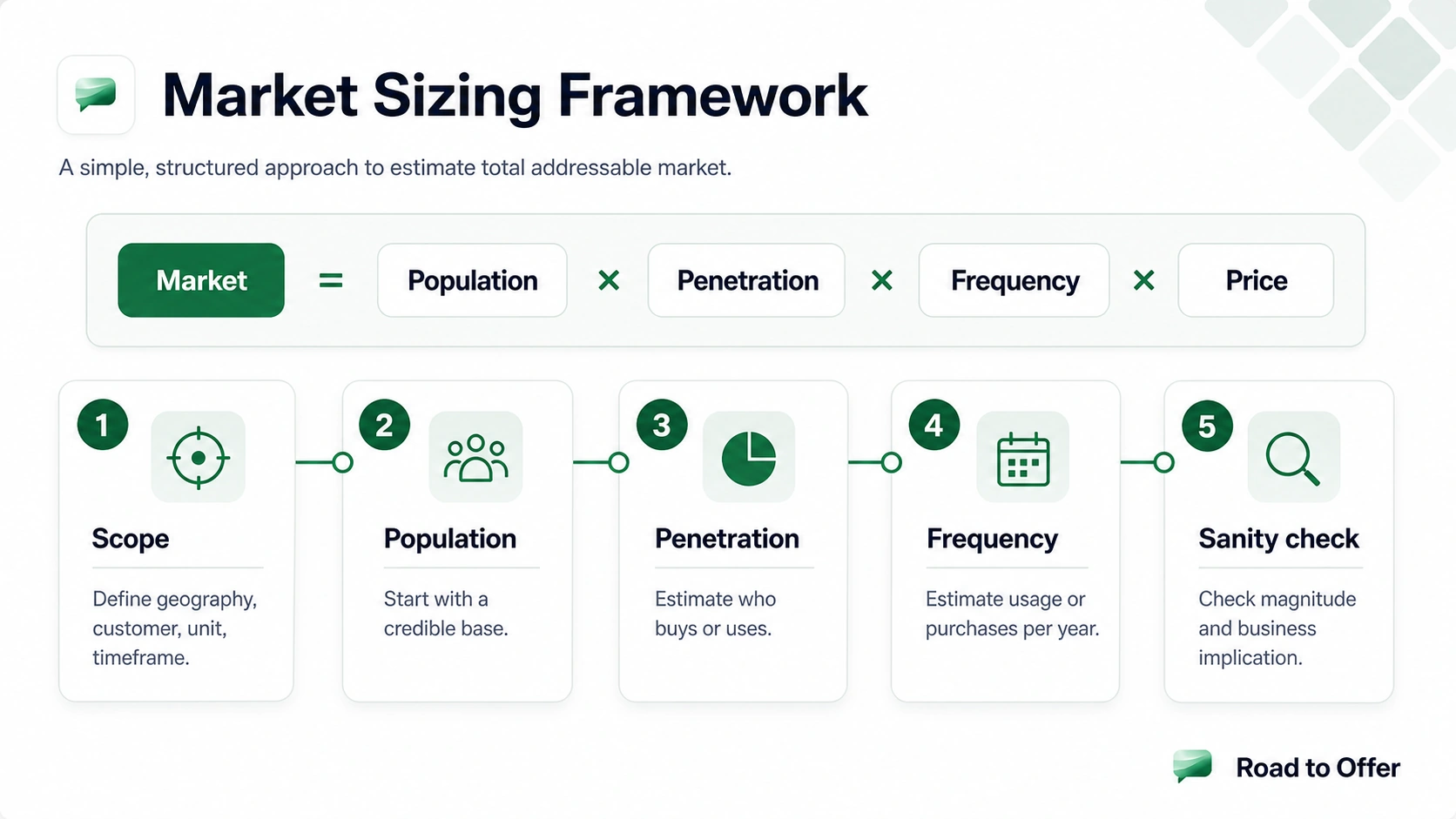
Most published guides agree on the same base formula, which is worth memorizing because it covers the majority of consumer prompts:
market size = number of users times purchase quantity per user per year times average price
The skill is not the formula. It is deciding what counts as a user, what the realistic quantity is, and which price to use, then defending each choice in a sentence.
Resource comparison: best option by market sizing weakness
Do not rank resources by vague popularity. Rank them by the weakness they fix. A candidate who freezes on assumptions needs a different resource from one who knows the framework but loses the calculation.
A fully worked market sizing example: school buses in the US
Reading the steps is not the same as running them. Here is a complete estimate with every number shown, using a classic prompt that appears in most published question banks: how many school buses are there in the United States?
Step 1, clarify the scope. Confirm you mean active K-12 school buses currently in service in the US, not buses ever manufactured. Ask close-ended questions so you steer toward a definition you can solve.
Step 2, choose the approach. This is a supply-from-demand estimate, so go bottom-up: start from the students who need rides and work back to the number of buses required.
Step 3, segment and calculate.
- US population: about 330 million.
- Share who are K-12 students: roughly 25 percent, so 330M times 0.25 = about 82 million students.
- Share who ride a bus (rural and suburban yes, many urban kids walk or take transit): about 67 percent, so 82M times 0.67 = about 55 million bus riders.
- Students one bus serves per day: a 60-seat bus runs roughly 1.5 routes (a morning and a partial second run), so 60 times 1.5 = about 90 students per bus per day.
- Buses needed: 55,000,000 divided by 90 = about 610,000 buses.
Step 4, sanity-check. Round the answer to about 600,000 and test it. The real figure is roughly 480,000, so the estimate is within about 25 percent. For a no-data estimate that is a strong result, and an interviewer cares far more about that defensible logic than about hitting the exact number.
Notice where the judgment lived: the 67 percent ridership and the 1.5 routes per bus. Those are the assumptions you should be ready to flex if the interviewer pushes back. If your branches overlapped or double-counted, that is a structure drill. If the division slowed you down, that is a math drill before your next full estimate.
Now run the same arc yourself, out loud, on three prompts built from the numbers above.
Top-down or bottom-up: how do you choose?
Both routes should land in the same ballpark, and the best answer often runs one as the main estimate and the other as the sanity check.
Top-down starts from a large known total and slices down with percentages. Use it when the market begins with a population or a macro figure you can anchor confidently. Example, annual coffee spend in a city: start from city population, multiply by the share who drink coffee daily, by cups per day, by days per year, by price per cup.
Bottom-up builds from a small unit and scales up. Use it when the market starts from a countable asset or a clear per-unit behavior. Example, the school bus estimate above, which built from riders per bus up to total buses.
A quick contrast on the same prompt, annual takeaway coffee market in the US:
- Top-down: 330M population times 50 percent daily drinkers times 1.5 cups per day times 350 days times $4 = about 350M times 1.5 times 350 times 4, which is roughly $345 billion.
- Bottom-up: about 35,000 coffee outlets times 300 cups per day times 350 days times $4 = about $14.7 billion of cafe-channel sales.
The gap is the lesson, not a failure. The top-down figure captures all takeaway coffee including grocery and convenience, while the bottom-up figure captures only the dedicated-cafe channel. Naming that difference out loud is exactly the judgment interviewers reward. For the full method behind both routes, use the market sizing step-by-step guide.
The reference-number cheat sheet (so you never freeze on anchors)
Spend your thinking on structure, not on recalling basic figures. Memorize this short list and you can anchor most prompts in seconds:
Rounding to friendly numbers (350 days, $4 coffee, 2.5 people per household) is not sloppy. It is a deliberate choice that cuts arithmetic errors, which is the single most common way candidates lose a market sizing case. If raw arithmetic is your bottleneck, drill it separately with mental math for case interviews and the shortcuts in case interview math practice so it stops eating your airtime.
How do you sanity-check the answer?
A number with no check reads as a guess. Three fast techniques turn it into a defended estimate:
- Order-of-magnitude test. Is the answer plausible against something you know? About 600,000 school buses against 82 million students is roughly one bus per 135 students, which feels right. A figure of 6 million or 60,000 would fail this instantly.
- Re-derive the other way. If you went bottom-up, run a quick top-down pass. If they land in the same range, you can defend the number, as the coffee contrast above showed.
- Benchmark against a trusted total. For macro estimates, compare to a known population or to GDP. For population-driven markets, the World Bank's population data confirms anchors during a debrief, and the BEA's GDP data tells you whether a market-value estimate is wildly out of range.
The trap is turning data into a memorization game. In a live interview the interviewer cares less about whether you know the exact outside number and more about whether your assumption is reasonable, transparent, and easy to adjust. Data should sharpen your debrief, not replace your judgment.
What kinds of market sizing questions should you prepare for?
Published question banks cluster prompts into a few recognizable types, and rotating across all of them stops you from over-fitting to coffee and golf balls:
- High-exposure markets use everyday items where your intuition is decent: cups of coffee sold daily, running shoes per year, smartphones in Europe.
- Low-exposure markets use items you rarely think about, so you lean harder on structure: commercial aircraft tires replaced annually, MRI machines in a country, charging sessions on a highway network.
- Fictional or future markets have no clean data, so judgment is everything: demand for a product that does not exist yet, or seats at a stadium that has not been built.
- Business-value estimates size revenue or a valuation rather than units: the revenue opportunity from a coffee chain's expansion, or annual contract value across eligible B2B accounts.
A few prompts worth rehearsing across those types: mattresses sold annually in the US, the European shoe market, EV charging sessions along a highway corridor, and B2B workflow software for mid-market companies. For the related estimation format that shows up in the same interviews, see guesstimate interview questions, and to place sizing inside the full set of formats you will face, see case interview types.
A two-week drill plan to improve market sizing fast
Volume without a debrief loop does not move the needle. Use this loop on 2 to 3 prompts per day for about two weeks, roughly 30 to 40 reps total.
- Attempt a prompt out loud and timed.
- Write the formula before you calculate anything.
- Narrate every assumption in one sentence each.
- Do the math cleanly with rounded anchors.
- Sanity-check with the three techniques above.
- Debrief the single weakest step.
- Route that weakness to the next drill.
Then route by failure mode. Wrong approach choice goes back to the method page and a structure drill. Right formula but dragging arithmetic goes to a math drill. A final answer that sounded like a number dump goes to a synthesis drill so you practice turning the estimate into a recommendation. If you cannot tell which step failed, run another short market sizing drill and let the next rep expose it.
When isolated reps feel steadier, move to free case practice. Market sizing rarely appears as a neat standalone exercise in a real interview. It usually sits inside a larger profitability, growth, pricing, or market-entry case, which is why the profitability framework and the case interview prep guide are the right next steps once your sizing is solid. If you are switching into consulting from another field and need a broader on-ramp, start with case interview prep for career changers.
What do McKinsey, BCG, and Bain actually evaluate?
Official firm pages will not hand you a market sizing routine, but they tell you what to optimize for. McKinsey's interviewing page frames the case around client-style problem solving and sample cases, which is why an isolated estimate should eventually transfer into a full case conversation. BCG's case interview preparation page names the behaviors directly: structuring an approach, asking thoughtful questions, analyzing data, doing quick calculations, and identifying key factors. Bain's interviewing page reinforces the same standard of logical structure, sensible assumptions, quick math, and constructive problem solving.
None of this is firm-specific in a way that should change your prep. The evaluation criteria are essentially the same across MBB, so build the generic skill until it survives pressure, then practice it inside full cases. University hubs such as Yale OCS and MIT CAPD are useful supplementary shelves for finding extra cases, but treat them as discovery, not as a substitute for the next attempt.
Practice market sizing with feedback
Run a focused sizing drill, then use the debrief to decide whether the next rep should be structure, math, or synthesis.
Sources
- IGotAnOffer - 21 market sizing questions with answers (checked June 18, 2026)
- MConsultingPrep - Market-sizing questions: 5-step guide (checked June 18, 2026)
- PrepLounge - Market sizing cases in consulting case interviews (checked June 18, 2026)
- McKinsey & Company - Interviewing at McKinsey (checked June 18, 2026)
- Boston Consulting Group - Case interview preparation (checked June 18, 2026)
- Bain & Company - Interviewing (checked June 18, 2026)
- World Bank - Population, total (checked June 18, 2026)
- U.S. Bureau of Economic Analysis - Gross Domestic Product (checked June 18, 2026)
Frequently asked questions
Resources and related guides
- Practice sizing inside a full casePractice
- Browse all free resourcesResource hub
- Calm Case Math: A Repeatable Process for Interview DayMath And Quant · May 1, 2026
- Case Interview Math: Mental Shortcuts to Calculate FasterMath And Quant · Mar 1, 2026
- Case Interview Math Practice: 12 Graded Mental Math DrillsMath And Quant · Feb 6, 2026
- Market Sizing Framework: Top-Down vs Bottom-Up, Step by Step (2026)Math And Quant · Feb 1, 2026