
Consulting Firms in Chicago 2026: Firms Built for the Midwest
Consulting firms in Chicago for 2026: compare MBB, Big 4, and local leaders; Booth sent 36.7% of its 2025 MBA class into consulting by industry.
On this page
Consulting firms in Chicago in 2026 offer candidates something different from a coastal headquarters market: global strategy offices sit beside firms built in the city and practices shaped by Midwest operators. Kearney's own history page traces its predecessor to Chicago in 1926; AArete, Huron, and West Monroe are headquartered here; and ZS is based nearby in Evanston. McKinsey, BCG, Bain, and the Big 4 add large generalist and implementation platforms. For candidates, that mix means real choice among strategy, industrial operations, consumer products, healthcare, technology, and private-equity work. This guide organizes the market around Chicago's roots and client base, then connects those options to Booth and Kellogg recruiting, current compensation evidence, and interview preparation. It is not a buyer directory or a single prestige ranking. The right target depends on the problems you want to solve, the office currently hiring, and the assessment process published for that exact role.
Chicago firms with local roots
Chicago's history matters because several firms were not merely opened here. They were formed here or chose the city for their headquarters, creating deeper local networks and differentiated hiring tracks.
Kearney: an operations lineage that started in Chicago
The firm now known as Kearney traces its predecessor to Chicago in 1926. Tom Kearney became managing partner in 1935, and the Chicago office separated from the wider business in 1939. That history aligns with the firm's present reputation in operations, procurement, and industrial transformation. Candidates who want board-level strategy tied closely to implementation should compare its current roles with the top manufacturing consulting firms.
AArete: a Chicago-headquartered challenger
AArete says it was founded in 2008, is headquartered in Chicago, and has 500+ people. Its positioning combines management and technology consulting, with healthcare payer work among its visible specialties. This can suit a candidate who wants a smaller platform and more focused industry exposure than a global generalist firm.
Huron: healthcare, education, and transformation
Huron is headquartered in Chicago and is especially relevant for healthcare, education, financial advisory, and enterprise transformation. Its project mix can be a better match than general strategy for candidates with hospital, university, finance, or technology experience.
West Monroe: business and technology together
West Monroe says Chicago is its headquarters and largest office. The firm was founded in Chicago in 2002 and positions its work at the intersection of business and technology. That makes it a distinct path for candidates who want implementation ownership, not strategy ending at a recommendation deck.
The five rows are not interchangeable boutiques. Kearney's 1926 Chicago lineage supports a strong operations and procurement identity. AArete's 2008 founding and 500-plus workforce point to a smaller, hands-on platform with healthcare payer depth. Huron's Chicago headquarters anchors healthcare and higher education work, while West Monroe's headquarters is also its largest office and joins consulting with product and technology delivery. ZS operates from nearby Evanston, putting its life-sciences analytics and commercial strategy teams inside the same recruiting market.
The timeline spans almost a century: Kearney's predecessor began in Chicago in 1926 and split from McKinsey in 1939, BCG opened locally in 1979, West Monroe was founded in 2002, and AArete in 2008. The dates reinforce the market split between long-established global offices and Chicago-built challengers.
For an applicant, the office fact should change the application. Kearney candidates can foreground supply chain, procurement, manufacturing, and execution. AArete and Huron candidates need evidence that they understand healthcare economics and stakeholder constraints. West Monroe applicants should show that they have built or implemented something, not only recommended it. ZS candidates benefit from commercial analytics, life-sciences, or quantitative evidence. The firms all recruit analytical people, but the proof each one values is different.
Practice the case round Chicago offices run
Run a scored voice case and get feedback on structure, math, and synthesis before you apply to a Chicago strategy or industrial practice.
How Chicago's industries shape consulting work
Chicago's strongest candidate paths follow the region's clients. Instead of treating every firm as a generalist, match your background to one of four case families.
McKinsey's Chicago office names consumer packaged goods, retail, healthcare, pharmaceuticals, aerospace, technology, financial services, transportation, and the public sector among its work. Bain's Chicago page similarly highlights consumer products, retail, healthcare, technology, telecom, industrials, financial services, and private equity. These are office-level signals, not promises that every practice is hiring.
An operations case is the most direct test of the city's industrial profile.
 Bain
BainOperations · medium
Solve a manufacturing cost problem
Diagnose an industrial client's economics and defend an operational recommendation.
MBB and Big 4 offices in Chicago
The locally rooted firms do not replace the global platforms. They widen the choice.
- McKinsey has a broad Chicago industry mix and recruits generalists plus practice-specific talent.
- BCG opened its Chicago office in 1979 and describes it as one of the firm's largest offices.
- Bain names a wide cross-section of Midwest industries on its Chicago office page.
- Deloitte, PwC, EY, and KPMG combine strategy teams with much larger technology, risk, deals, operations, and transformation businesses. Use the Big 4 consulting guide before assuming each brand offers one interchangeable path.
This is where Chicago differs from a simple “top 10” list. A Kearney operations role, a Huron healthcare role, a West Monroe product role, and a BCG generalist role can all be strong outcomes while training different muscles and producing different exits.
The global offices also have concrete local histories. BCG opened Chicago in 1979, making it one of the firm's early US offices, and identifies the location as one of its largest. Bain lists consumer products, retail, healthcare, technology, telecom, industrials, financial services, and private equity in the local client mix. McKinsey's Chicago page names many of the same industries, plus aerospace, transportation, and the public sector. Those lists explain why a Chicago generalist can see both board-level growth work and operating questions rooted in the Midwest economy.
The Big 4 add another distinction: their Chicago teams can carry a project from strategy through systems, risk, workforce, and implementation. Monitor Deloitte, Strategy&, EY-Parthenon, and KPMG Strategy compete for strategy talent, while their parent networks recruit far larger sets of functional specialists. Read the role title carefully. “Consultant” can mean a generalist case-interview path, an enterprise-platform implementation seat, a transactions team, a cyber role, or a human-capital practice, each with its own interview design and exit path.
For a market with heavier financial-services, media, deals, and restructuring concentration, compare the consulting firms in New York.
Booth and Kellogg recruiting pipelines
Chicago Booth's 2025 report says consulting was the top industry and job function for its full-time MBA graduates. Its related outcome figures show 36.7% entering consulting by industry and 37.8% by function. Booth also names BCG, McKinsey, and Bain among leading employers.
Kellogg's 2025 employment outcomes list consulting employers including McKinsey, BCG, Bain, Deloitte, Kearney, Strategy&, EY-Parthenon, Oliver Wyman, and ZS. An employer list proves recruiting outcomes, not that every graduate joined Chicago. Use the Chicago Booth case book and Kellogg case book to practice, while keeping office choice separate from school affiliation.
The pipelines are significant, but neither school is a requirement. Chicago firms also hire undergraduates, specialized graduate students, experienced operators, clinicians, technologists, and lateral consultants.
Together, Booth's 36.7% industry share and Kellogg's named-employer list show two large MBA channels into consulting. They sit beside undergraduate, advanced-degree, and experienced-hire routes, so candidates outside those programs still have direct office and role applications.
How to read current Chicago pay evidence
Booth reports a $175,000 median base salary and $30,000 median sign-on bonus for 2025 graduates reporting those figures. These are useful anchors for MBA outcomes across the class. They are not consulting-only figures and do not isolate Chicago placements.
The BLS May 2025 release shows why Chicago is a different pay story from New York. Chicago metro jobs averaged $35.28 an hour, only about 5% above the $33.54 national average. Management occupations averaged $72.18 against $69.84 nationally, and business and financial operations roles $46.54 against $45.78. Local wage levels sit close to the national line while firms such as McKinsey, BCG, and Bain run the same levels and bands across US offices, so a Chicago offer tends to stretch further than the same nominal figure in New York.
Three rules keep comparisons honest:
- Compare the same level and practice.
- Separate base salary, sign-on bonus, performance bonus, and retirement benefits.
- Use the written offer, then weigh Chicago housing and commuting costs alongside nominal pay.
The consulting salary by city guide gives the broader framework without pretending that one school or vacancy represents the whole market.
A Chicago application plan
Build the list in three rings instead of sending identical applications to every logo.
Ring 1: role fit. Pick three or four firms whose Chicago work matches your strongest evidence. An engineer might lead with Kearney and industrial practices; a healthcare operator with Huron and AArete; a product manager with West Monroe; an MBA generalist with MBB.
Ring 2: adjacent options. Add firms where the skill transfers. Healthcare candidates can include ZS and Big 4 health teams. Industrial candidates can add MBB operations practices. Technology candidates can add Deloitte and PwC transformation roles.
Ring 3: format diversification. Include large and focused firms so one recruiting calendar or assessment type does not control the whole search. Save each live role's eligibility, deadline, office, and interview stages.
Aim for a portfolio of six to eight serious applications, not a list of twenty logos. A manufacturing candidate might choose Kearney, two MBB offices, Deloitte operations, West Monroe, and one specialist. A healthcare candidate could combine Huron, AArete, ZS, an MBB healthcare practice, and two Big 4 health teams. The count matters less than the rule: every firm should have a distinct reason tied to its Chicago work and your evidence.
Before networking, capture the office's founding or headquarters fact, two locally named industries, the exact entry role, and the current interview stages. Then ask one question that the website cannot answer, such as how Chicago staffing crosses practice lines or how much delivery ownership a first-year consultant receives. That produces useful comparison data and signals that you selected the office deliberately.
Your consulting resume should make the same practice thesis visible through quantified impact. If a cover letter is requested, the consulting cover letter guide shows how to connect that evidence to a specific office rather than praising Chicago in general.
Find a partner preparing for Chicago consulting interviews
- Post your firm, timezone, and interview date to find candidates interviewing the same month
- Free prep material in the group, no Road to Offer account or email needed (a Facebook login is)
- Run live mocks with a real person between your solo reps
The group opens MBB Case Interview Prep on Facebook
Prepare for the cases Chicago teams are likely to use
Do not memorize a “Chicago framework.” Build transferable skills, then practice on the economics most relevant to your target practices.
Practice the math behind an operations case from the Road to Offer drill engine. Answer a real prompt and get AI-scored feedback. Free accounts include 5 drills per day for the first 3 days after signup.
- Industrials: break costs into fixed and variable drivers, follow capacity and throughput, and connect the recommendation to implementation risk.
- Consumer and retail: segment customers, channels, and products before proposing growth. Avoid treating market size as demand your client automatically wins.
- Healthcare: identify the payer, provider, patient, and regulator incentives before optimizing one metric. The healthcare case interview guide covers the recurring economics.
- Technology transformation: tie the system or product change to revenue, cost, customer, and adoption outcomes.
If the arithmetic slows down your diagnosis, isolate it before adding a full case.
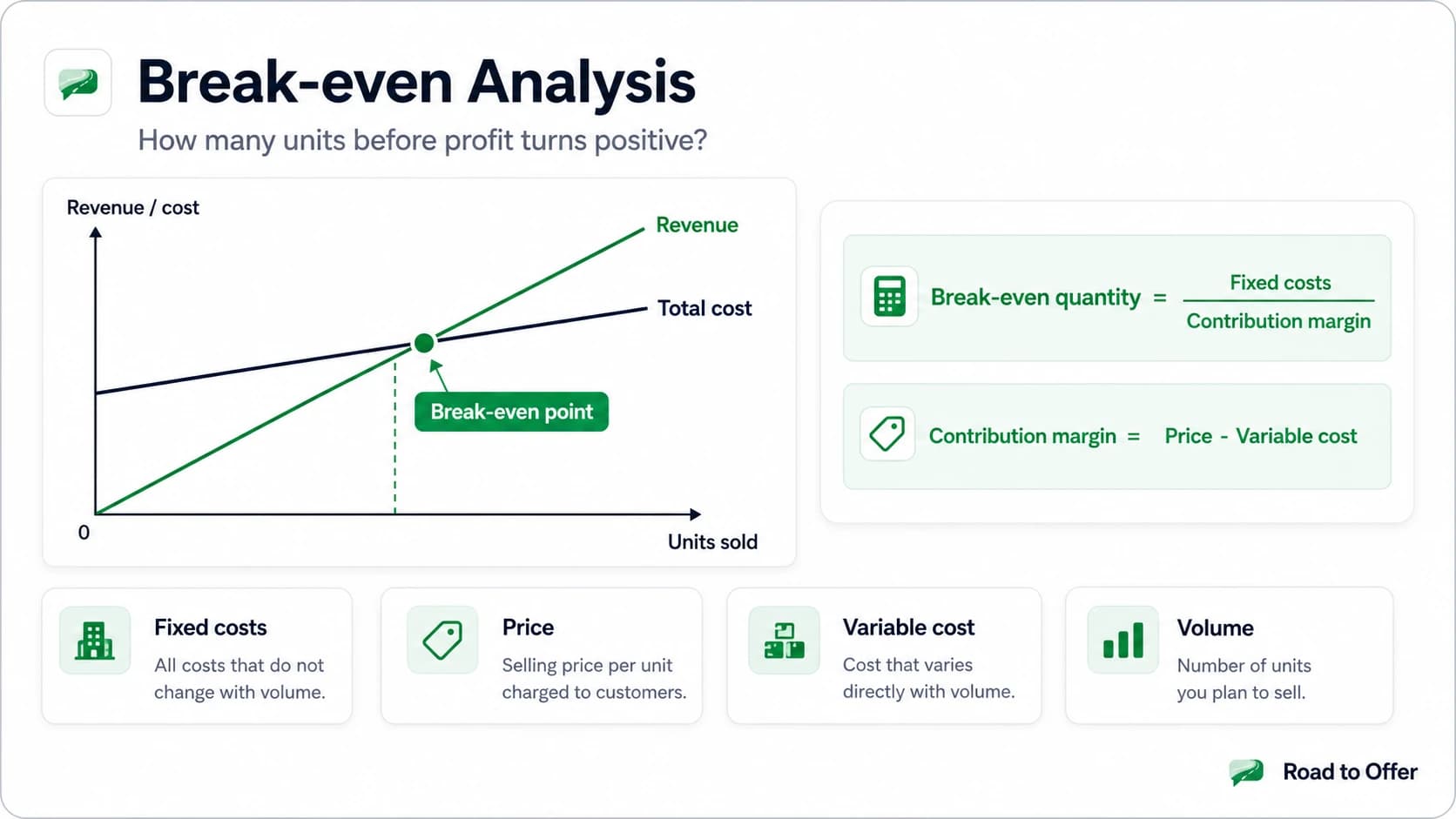
Learn the case math method
Setup, units, and shortcut math, linked to timed scored reps.
Sources
- McKinsey Chicago office. Current office industry coverage.
- BCG Chicago office. Opening year, scale, and office overview.
- Bain Chicago office. Opening year and local industry coverage.
- Kearney history. Chicago founding lineage and 1939 separation.
- AArete About Us. Headquarters, founding year, and stated employee count.
- Huron company overview. Headquarters and company focus.
- West Monroe Chicago office. Founding year, headquarters, and office scale.
- ZS United States office locations. Evanston headquarters and Chicago-area offices.
- Chicago Booth 2025 MBA Employment Report. Consulting placement and class compensation figures.
- Kellogg 2025 Full-Time MBA Employment Outcomes. Consulting employer list and outcome context.
- BLS, Occupational Employment and Wages in Chicago-Naperville-Elgin, May 2025. Metro wage and employment context.
Is your firm on this list?
Feature your firm, sponsor a guide, or correct a detail about your firm. Sponsored placements are always labeled.
Get featured or send a fixFrequently asked questions
Resources and related guides
- Consulting application trackerPractice
- Browse all free resourcesResource hub
- Consulting Firms in Germany: Candidate Map by Specialty, Office, and Interview (2026)Getting Started · Aug 13, 2026
- Consulting Firms in Canada 2026: Firms, Cities, and HiringGetting Started · Sep 21, 2026
- Consulting Firms in Dubai 2026: The Complete GuideGetting Started · Jul 23, 2026
- Consulting Firms in Saudi Arabia 2026: Riyadh and HiringGetting Started · Sep 21, 2026