
ZS Associates Case Interview: Cross-Industry Quantitative Cases and Prep Guide (2026)
ZS Associates publishes practice cases across airlines, pharma, and consumer goods. Learn the quantitative case approach, worked examples, and prep plan.
On this page
ZS Associates is a management consulting and technology firm with deep life sciences expertise and work in other industries. Founded in 1983 by Northwestern Kellogg professors Prabhakant Sinha and Andris Zoltners, the firm publishes official practice cases covering airlines, pharma, and consumer goods. The "Z" and "S" in the name are the founders' last names. Interview stages vary by role and location, so use the invitation for the current sequence and any written exercise.
This guide covers role-specific process checks, cross-industry practice, worked examples, and a prep plan. Confirm any written exercise and evaluation format from your invitation.
If you need the broader pharma and biotech vocabulary before drilling ZS cases, start with the life sciences consulting case interview guide, then come back here for the ZS-specific process and written-case details.
Practice pharma and life sciences cases with AI feedback
Road to Offer includes ZS-style candidate-led cases with quantitative data exhibits. Get real-time feedback on your structure and math.
The ZS Associates Interview Process: Every Stage
ZS interview stages vary by role and location. The sequence below lists components candidates may encounter, not a universal four-stage process.
Stage 1: Online Aptitude Assessment
If your invitation includes an online test, use its stated content and timing as the source of truth. Quantitative and logical practice can still help; our case interview math mental shortcuts guide covers core techniques.
Possible component: Recruiter Phone Screen
Standard behavioral screen. Expect: "Walk me through your background," "Why ZS?", "Why consulting over industry?" and basic fit questions. "Why ZS?" deserves a specific answer. Saying you want "impact in healthcare" is too vague. Say something specific about ZS's commercial analytics work or their pharma launch expertise. Vague health impact answers visibly annoy ZS interviewers.
Possible component: Live Interviews
Your process may include case and behavioral interviews. ZS's official practice page spans airline, pharma, and consumer-goods prompts, so match industry preparation to the role rather than assuming a pharma case.
Possible component: Later-Round or Written Exercise
If your invitation includes additional cases, behavioral interviews, or a written exercise, follow its stated duration, packet, and output requirements. The generic written-case practice below is not a claim about one universal ZS format.
Why ZS Cases Are Different From Everything Else You've Practiced
Standard MBB prep gives you a toolkit for profitability trees, market entry frameworks, and generic growth cases. That toolkit applies at ZS, but only once you've adapted it to a pharma lens. Interviewers notice immediately when a candidate tries to apply a generic retail profitability structure to a drug pricing question.
The differences run deep:
Industry specificity. Match your domain preparation to the role. ZS's official practice page spans airlines, pharma, and consumer goods. For a life sciences role, know what a formulary is, how payer access works, what sales force deployment means, and why generic competition changes a brand's go-to-market. For other roles, practice the same structured analysis in the relevant industry.
Quantitative weight is higher. According to candidate reports on PrepLounge, ZS cases involve more explicit calculation than typical MBB cases. You're expected to build patient funnel models, calculate market sizing with real demographic data, and work through drug pricing scenarios with specific numbers. Being directionally right isn't enough. Show your work.
Practice data interpretation when relevant. If your invitation includes exhibit work or a written case, rehearse synthesizing information from multiple exhibits under its stated time limit.
Candidate-led execution. Like BCG and Bain (and unlike McKinsey's interviewer-led format), ZS expects you to own the case. Drive the structure, request the data you need, and deliver the recommendation. Waiting for the interviewer to prompt you registers as a weakness.
ZS-Specific Frameworks You Must Know
Importing generic frameworks into ZS interviews is a red flag. Here are the four frameworks that actually show up, and how to use them.
1. The Patient Funnel (Drug Market Sizing)
Instead of a generic top-down revenue tree, ZS cases use a patient funnel structure to size drug markets. This is the standard approach for any market sizing question involving a drug or therapeutic area:
Drug Market Sizing Patient Funnel
- 01
Total Population. Start with total US (or global) population. Reference: US = ~335 million people.
- 02
Prevalence Rate. What % has the condition? Use epidemiological data. COPD affects ~5% of US adults = ~16.5M patients.
- 03
Diagnosed Rate. Of those with the condition, what % has been diagnosed? Often 50–75% for chronic conditions.
- 04
Treatment-Eligible Rate. Of diagnosed patients, what % meets criteria for this drug's indicated use?
- 05
Treatment Rate. Of eligible patients, what % is actually being treated (any drug)? Accounts for compliance and access.
- 06
Market Share. Of treated patients, what % would use this specific drug? Depends on pricing, efficacy, formulary status.
- 07
Revenue. Patients × annual drug cost = annual revenue. Adjust for payer discounts (WAC vs. net price).
When to use it: Any case involving a drug's commercial potential, market entry, competitive positioning, or pricing analysis.
Practice this next: Run a market sizing drill and force your answer through the patient funnel: population, prevalence, diagnosis, eligibility, treatment, share, and revenue. ZS rewards the sequence as much as the arithmetic.
2. Drug Pricing Framework
This is the most ZS-specific framework. Generic pricing models (cost-plus, value-based, competitive) apply, but pharma pricing requires adding three layers that don't exist in other industries:
- Payer Landscape: Who actually pays? Medicare Part D, commercial insurers, Medicaid, and patient out-of-pocket each have different leverage points. A drug priced above what formularies will cover doesn't get prescribed regardless of efficacy.
- ICER Analysis: The Institute for Clinical and Economic Review publishes cost-effectiveness benchmarks. Drugs priced above ~$150,000 per quality-adjusted life year (QALY) face payer pushback.
- WAC vs. Net Price: Wholesale Acquisition Cost (list price) vs. net price after rebates can differ by 30–50%. Interviewers expect you to know this distinction exists.
- Competitor Dynamics: Patent cliffs, generic entry timing, and biosimilar competition radically alter pricing power.
Practice prompt: A new specialty drug is clinically stronger than two competitors but may lose preferred formulary placement if its net price is too high. Build the first 90 seconds of your pricing structure before checking any numbers, then test the math with a free case math drill.
3. Sales Force Sizing Formula
ZS's founders literally wrote the academic papers on sales force optimization, one of their heritage capabilities. The core formula is:
Reps Needed = (Target Physicians × Calls per Physician per Year) ÷ Calls per Rep per Year
A worked example:
- Target: 15,000 high-prescribing primary care physicians nationwide
- Desired call frequency: 12 calls per physician per year (monthly)
- Each rep can make 4 calls per day × 250 working days = 1,000 calls/year
Calculation: (15,000 × 12) ÷ 1,000 = 180 reps
Adjust for geographic coverage inefficiencies (add ~15–20% buffer): ~207–216 reps
Expect this to show up in at least one of your ZS interviews, either directly or as a component of a larger case.
4. Launch Readiness Framework
For go-to-market and launch strategy cases, ZS uses a structured launch readiness lens:
Build pharma case fluency with real-time AI coaching
Practice ZS-style drug pricing and market sizing cases. AI feedback identifies exactly where your structure breaks down before you're in the real interview.
Worked Example: The SINHA Drug Pricing Case
ZS publishes a real practice case on their careers site. Here's how to work through it step by step using the frameworks above.
Setup: Zoltners Pharma is awaiting FDA approval for SINHA, a drug treating COPD (chronic obstructive pulmonary disease). Two competitors exist: Drug A priced at $400/year and Drug B priced at $300/year. SINHA has superior clinical trial results: higher efficacy and lower side effects. The client asks: What price should we set for SINHA?
Before reading the walkthrough, try a candidate-led healthcare pricing case where you weigh willingness to pay, competitive price points, and a buyer's budget, the same logic ZS rewards in SINHA.

Market entry · medium
Practice for ZS Associates in a real case interview
Matched to this ZS Associates guide: a live healthcare market entry case with an AI interviewer. Free, scored on every step.
Step 1: Confirm the objective
"Before I structure my approach, I want to confirm: are we looking for a single recommended price point, or a pricing range with different scenarios? And is the goal to maximize revenue, market share, or both?" (Interviewers will tell you revenue maximization is primary, with market penetration as a secondary goal.)
Step 2: Structure the problem
Open with: "I'd like to think about this across four dimensions: the competitive pricing landscape, payer dynamics, patient sensitivity, and SINHA's value proposition relative to competitors. Let me start with the competitive context."
Step 3: Competitive analysis
Drug A = $400/year, Drug B = $300/year. SINHA is superior to both. Premium pricing is warranted, but how much premium?
Step 4: Market sizing to estimate revenue impact
Use the patient funnel:
- US adults with COPD: ~5% × 335M = 16.75M
- Diagnosed: ~70% = 11.7M
- Currently on medication: ~50% = 5.85M (many COPD patients are managed with inhalers, not this drug class)
- Addressable for SINHA given its indication: ~40% = 2.34M potential patients
At different price points:
Each row here is a price times share times patients calculation under illustrative case assumptions.
Step 5: Payer check
At $300/year, SINHA is at parity with the lowest-priced competitor. Commercial payers will likely grant favorable formulary placement given superior efficacy. Medicaid programs will push for rebates, and net price might drop to $220–$240 at scale.
Step 6: Recommendation
"I recommend pricing SINHA at $300/year, parity with the lowest competitor, for the initial launch. This maximizes revenue given payer constraints, positions favorably for formulary inclusion, and lets us build market share rapidly before considering a price increase in Year 3 as we establish SINHA's clinical track record with prescribers."
This is the type of structured, data-driven, quantitatively rigorous recommendation ZS interviewers reward. Note: you get to this answer through logic and math, not instinct.
How to Survive the ZS Written Case
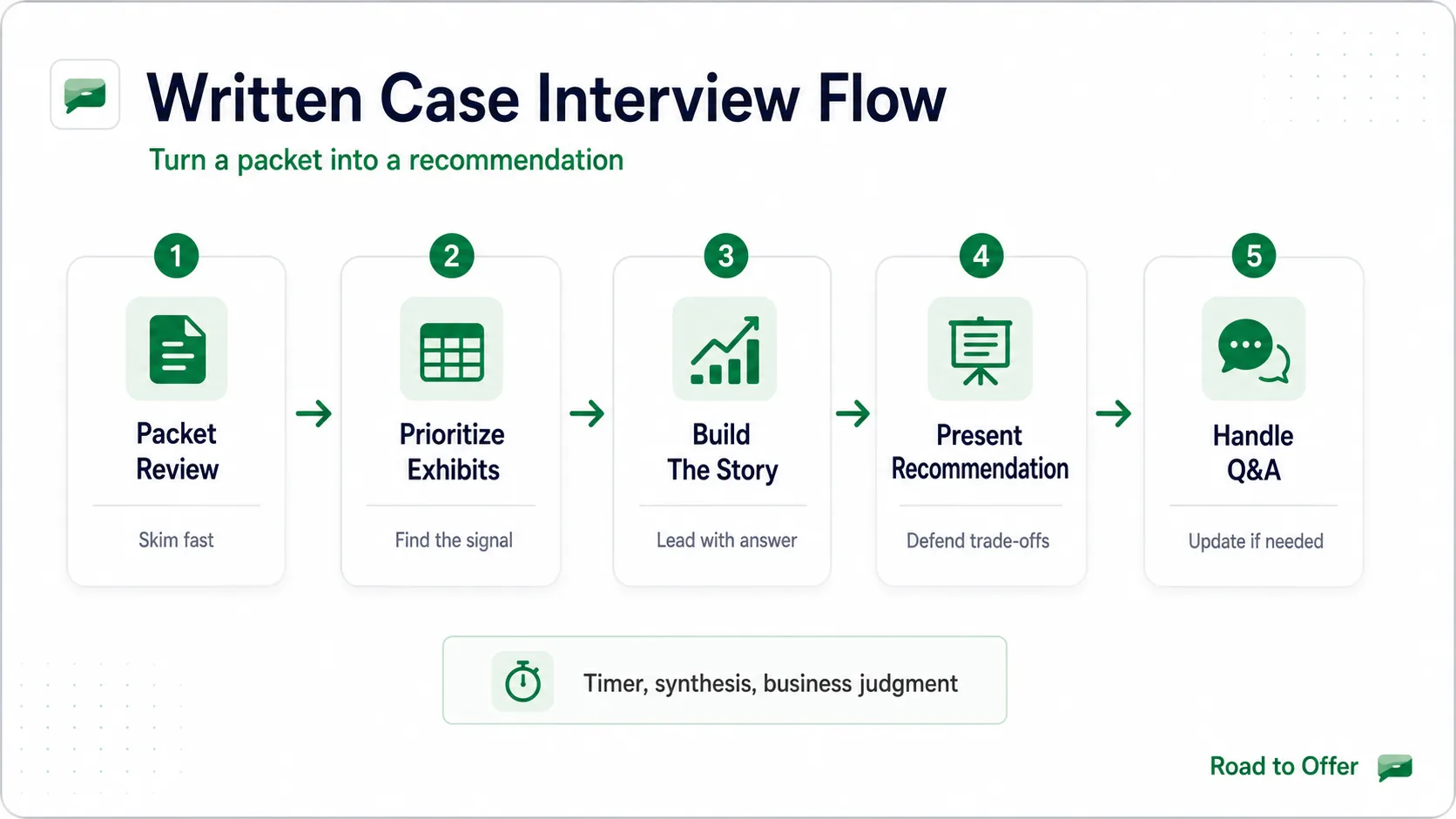
If your invitation includes a written case, treat it as a distinct skill and follow its exact instructions. A generic practice version can involve:
- 8–10 slides with charts, tables, and background context
- 4–8 specific questions ranging from data interpretation to strategic recommendation
- A requirement to synthesize across multiple exhibits, not just answer each question in isolation
Our detailed written case interview guide covers the full technique. For practice:
Time allocation is everything. Divide the invitation's time limit across the required questions, reserving an initial scan and a final synthesis.
Pharma-specific chart types to recognize:
- Waterfall charts: Revenue or cost breakdowns showing where margin is being lost or gained
- Patient funnel diagrams: Visual representation of the treatment pathway we covered above
- Market share trend lines: Multiple competitors' share over time, often showing patent cliff effects
- Sales force productivity curves: Revenue per rep vs. rep headcount (shows diminishing returns)
- Payer mix charts: Commercial vs. Medicare vs. Medicaid proportion of patient volume
The synthesis trap. ZS doesn't want you to answer each question in a vacuum. The questions build toward a recommendation. If your answers to questions 1–7 don't support a coherent conclusion in question 8, interviewers notice. As you answer each sub-question, keep asking: "How does this piece fit the overall story?"
Review our guide on structuring a case interview synthesis; the same principles apply to written case conclusions.
Practice this next: Use an exhibit drill and narrate the so-what in one sentence after each chart. For ZS written cases, the goal is not to describe every exhibit; it is to connect the few exhibits that support a recommendation.
What ZS Interviewers Actually Evaluate
The following four dimensions form a Road to Offer practice rubric, not a published ZS weighting scheme.
1. Structured Problem-Solving
Can you break a complex pharma scenario into a logical, MECE structure? Can you identify the right questions to ask rather than collecting every piece of data available? ZS cases often have more data than you need, and selecting the relevant subset is itself being evaluated. Review the case interview frameworks guide to build MECE structures for pharma contexts specifically.
2. Quantitative and Analytical Rigor
Math accuracy matters. Data interpretation accuracy matters. Unlike some firms where being directionally right is sufficient, ZS's pharma clients work with precise numbers (drug pricing, patient populations, sales force productivity) and they expect consultants who can work precisely. One arithmetic error that cascades into a wrong recommendation is a red flag.
3. Communication and Synthesis
ZS works primarily with pharma executives who aren't management consultants. The ability to translate complex analysis into plain language is a core job skill. Interviewers listen for: clear hypothesis statements, logical transitions between sections, and a crisp one-sentence recommendation at the end. Our case interview scoring rubric breakdown explains how interviewers convert these observations into scores.
4. Adaptability and Learning
ZS interviewers will sometimes push back on your hypothesis or give you a contradicting data point mid-case. They're watching whether you rigidly defend your initial structure or update intelligently. Update when the data warrants it, but don't capitulate just because the interviewer pushed back.
Common Mistakes That Kill ZS Candidates
Using generic frameworks without pharma adaptation. A profitability tree that doesn't mention payer rebates, gross-to-net adjustments, or generic competition is immediately identified as generic prep. Spend time learning pharma commercial vocabulary.
Underpreparing a written exercise named in your invitation. Practice under the stated time limit with a set of charts and synthesize a recommendation before time ends.
Treating "Why ZS?" as a throwaway question. According to Glassdoor ZS interview reviews, interviewers consistently flag weak "Why ZS?" answers. The firm cares about your genuine interest in pharma/life sciences. If you don't have it, practice articulating a specific angle (a project, a course, a personal experience with the healthcare system) that makes your interest credible.
Insufficient pharma domain knowledge. You don't need to know drug mechanisms, but you need to understand how drugs get to market (FDA approval, Phase trials), how they get paid for (formulary, prior auth, rebates), and how they get prescribed (sales reps, physician targeting, KOL influence). This context makes your frameworks feel natural rather than forced.
ZS vs. Competing Healthcare Consulting Firms
If you're considering ZS alongside other specialized or large consulting firms, here's how the interview experiences compare:
See our EY-Parthenon case interview guide if you're running a parallel process. The quant emphasis has some overlap, though the pharma specialization is ZS-specific. To see how a pharma-focused analytics firm like ZS compares to other consulting firm types, from MBB to Big 4 to specialist boutiques, read where ZS sits in the broader consulting landscape. Candidates weighing pharma-data-and-analytics firms should also read the IQVIA case interview guide, since IQVIA competes directly with ZS for commercial-analytics and real-world-evidence work. If you're targeting ZS's analytics track that tests SQL, Python, and experiment design, the data science case interview guide covers the technical case formats that track layers on top of the standard pharma cases.
6-Week ZS Prep Plan
Execution checklist
Weeks 1–2: Pharma Industry Foundation. Build core commercial vocabulary: patient funnel, payer dynamics, formulary, ICER, sales force deployment. Read 3–5 ZS industry articles from their website. Work through the official SINHA practice case.
Week 3: Framework Adaptation. Take 5 standard case frameworks (profitability, market entry, growth strategy, pricing, market sizing) and rewrite each for a pharma context. Practice with a partner using ZS-style pharma scenarios.
Week 4: Quantitative Drilling. 30+ patient funnel calculations, drug pricing math with payer rebates, and sales force sizing exercises. Aim for zero arithmetic errors under timed conditions. Use our market sizing drills for additional reps.
Week 5: Written Case Practice. Find 3–5 slide packets (your business school career center, online prep sources, or ZS's own practice cases) and do full 45-minute timed runs. Practice synthesizing across 5+ exhibits into one recommendation.
Week 6: Full Interview Simulation. Full candidate-led case with a partner, full written case simulation, and behavioral interview prep. Focus especially on 'Why ZS?', 'Why pharma/life sciences?', and 3 strong leadership stories.













Prep plans for McKinsey, BCG, Bain, Deloitte, Accenture, EY-Parthenon, Kearney, Oliver Wyman, Roland Berger, L.E.K., OC&C, Strategy&, Simon-Kucher, Arthur D. Little, Capital One and your target firm. Choose your firm in the plan builder.
Get your prep plan
A week-by-week schedule built around your target firm and interview date.
Practice Drills: ZS Style
Where to Find More ZS Practice Cases
Beyond Road to Offer, these sources have ZS-specific materials:
- ZS Official Practice Cases: Two official practice cases including SINHA drug pricing
- My Consulting Offer ZS Guide: Detailed process walkthrough and example cases
- MConsultingPrep ZS Interview Guide: Framework-specific prep for pharma cases
- PrepLounge ZS Discussion Thread: Candidate experience reports from recent interviews
For general case interview technique, our how to practice case interviews guide covers the most effective solo and partner practice methods. For market sizing specifically (one of ZS's highest-weighted quantitative skills), see the market sizing step-by-step walkthrough.
Drill the ZS skills that decide the interview
Start with timed market sizing, case math, and exhibit drills, then move into a full pharma-style case once the mechanics are reliable.
Sources and Further Reading (checked June 17, 2026)
- ZS Associates official interview process: https://www.zs.com/careers/interview-process
- ZS Associates practice case (SINHA drug pricing): https://www.zs.com/careers/hiring-process/case-interview-practice/practice-case-two
- Hacking the Case Interview, ZS Associates guide
- My Consulting Offer, ZS Associates ultimate interview guide
- MConsultingPrep, ZS Associates case interview 2024
- PrepLounge, ZS case interview candidate forum
- Glassdoor, ZS Associates interview reviews: https://www.glassdoor.com/Interview/ZS-Associates-Interview-Questions-E115506.htm
- Glassdoor, ZS Associates Associate Consultant salary data: https://www.glassdoor.com/Salary/ZS-Associates-Associate-Consultant-Salaries-E115506_D_KO14,34.htm
Frequently asked questions
Resources and related guides
- Practice for ZS Associates in a real case interviewPractice
- Browse all free resourcesResource hub
- L.E.K. Salary 2026: LEK Consulting Pay by Level, Associate to PartnerFirm Specific · Jul 31, 2026
- Life Sciences Consulting Case Interview: Pharma, Biotech, and MedTech Cases (2026)Firm Specific · Apr 1, 2026
- McKinsey vs BCG: 10 Real Differences (2026 Guide)Firm Specific · May 1, 2026