
Healthcare Case Interview: Framework, Key Questions, and Worked Examples (2026)
Healthcare case interviews require industry-specific thinking beyond standard frameworks. The 5-part framework, key stakeholders, and worked examples explained.

McKinseyMustard ClinicProfitability · Medium
Start a free healthcare case interview
Hear the case, say or type your answer, get your score.

Don't know how to case yet? Learn how to case
On this page
Healthcare case interviews trip up more candidates than almost any other industry vertical. The problems look familiar (profitability, market entry, M&A), but the business model is fundamentally different. Hospitals get paid by insurers, not patients. Drug pricing depends on clinical evidence, not cost-plus math. Regulatory approval can take a decade.
Miss those nuances and your "profitability framework" falls apart in the first five minutes.
Why Healthcare Cases Are Different
Standard case interviews assume simple, direct business relationships: a company sells a product, earns revenue, manages costs. Healthcare breaks every one of those assumptions.
For pharma, biotech, MedTech, and market access interviews specifically, use the life sciences consulting case interview guide alongside this healthcare framework. It goes deeper on FDA pathways, payer access, HEOR, and life sciences firm expectations. If your target is provider transformation or academic health systems, continue instead to the Huron case interview guide.
Three structural differences you must understand before walking into any healthcare case:
1. Revenue comes from payers, not patients. A hospital's primary customer is an insurance company (or CMS for Medicare/Medicaid), not the patient receiving care. Pricing is negotiated, regulated, and often capped. A "revenue decline" at a hospital usually starts with a reimbursement rate change, not a volume problem.
2. Products require regulatory approval. A pharma company can't just launch a new drug. FDA approval (US), EMA approval (EU), and local market authorization can take years and require major investment. The strategic question isn't just "should we enter this market?" but "when can we enter, and at what regulatory cost?"
3. Clinical outcomes drive value and pricing. Value-based care is reshaping how providers get paid. Instead of fee-for-service (paid per procedure), more providers are moving to value-based contracts tied to patient outcomes. This changes the profitability math entirely.
Practice healthcare cases with AI feedback
Get real-time coaching on your healthcare case frameworks and stakeholder analysis.
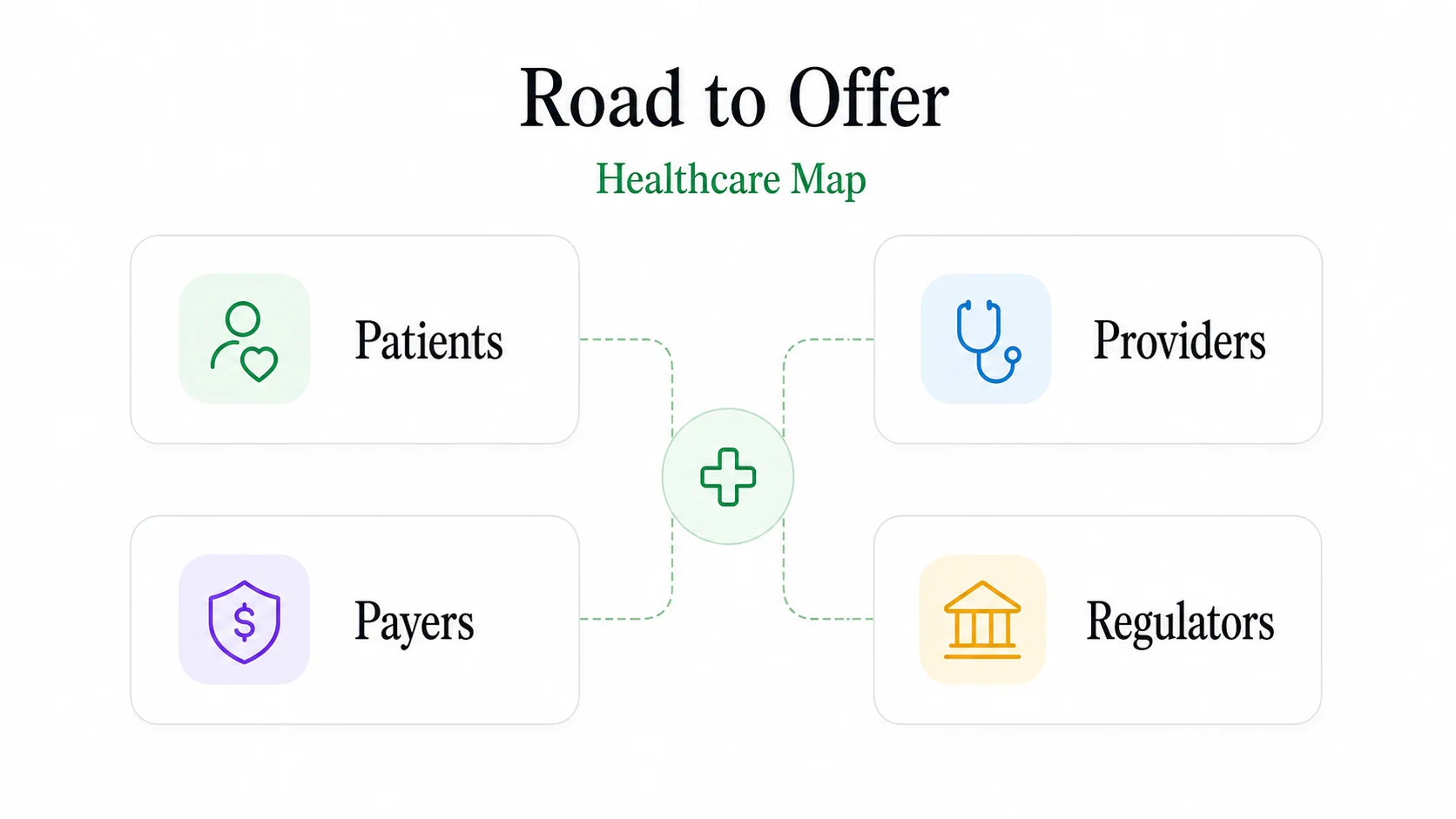
The 5-Stakeholder Healthcare Ecosystem
Every healthcare case involves at least three of these five actors. Map them before building your framework.
In a drug pricing case, your client is typically the pharma company, but you must model payer (insurer) willingness to reimburse, provider willingness to prescribe, and patient willingness to pay out-of-pocket. Missing any one stakeholder's perspective produces a flawed recommendation.
The Healthcare Case Interview Framework (5 Dimensions)
Unlike standard business cases where profitability = revenue − cost, healthcare cases require five dimensions:
Healthcare Case Framework
- 01
1. Market Definition. Who are the patients? What condition? What geography? What's the addressable population and unmet need?
- 02
2. Competitive Landscape. What existing treatments exist? What are their clinical limitations? What is our product's differentiation?
- 03
3. Regulatory & Reimbursement Pathway. What approvals are needed? What payer coverage looks like today? What is the access strategy?
- 04
4. Economics. What is the pricing strategy? What is the revenue potential? What are the cost drivers (R&D, manufacturing, sales force)?
- 05
5. Go-to-Market Execution. How do we reach physicians, payers, and patients? What does the sales channel look like? What are launch risks?
You won't need all five dimensions in every case. A hospital profitability case might focus heavily on dimensions 3 and 4. A drug launch case needs all five. The skill is picking the right 3–4 dimensions for the specific problem.
Worked Example: Drug Launch Pricing Case
Case prompt: Your client, a mid-sized pharmaceutical company, has developed a new drug for Type 2 diabetes. The drug shows a 33.3% better reduction in HbA1c (a key blood sugar marker) compared to the current standard of care. The client wants to know how to price the drug in the US market.
Step 1: Clarify the market
- Approximately 38 million Americans have Type 2 diabetes (CDC, 2024).
- For this fictional exercise, assume a low-cost generic standard of care and a higher-priced branded competitor.
- Also assume the fictional drug competes in the premium segment based on interviewer-provided clinical evidence.
Step 2: Competitive positioning
Under the fictional case assumptions, the drug's 33.3% improvement over the comparator may support a value argument. Whether payers pay requires separate access and cost-offset evidence.
Step 3: Pricing approaches
Three frameworks apply here:
- Cost-plus: Manufacturing + R&D amortization + margin → floors the price but ignores value
- Competitor-based: Test a premium to the fictional comparator using interviewer-provided willingness-to-pay assumptions
- Value-based: What is the incremental 0.6 percentage-point HbA1c improvement, from 1.8% to 2.4%, worth in avoided hospitalizations and complications?
The 15% complication-rate reduction is an illustrative assumption independent of the HbA1c result; do not infer payer savings from HbA1c alone.
Illustrative recommendation: Under the fictional inputs, test $1,150/month and lead payer discussions with health-economic evidence. Do not claim a real formulary tier without payer-specific access evidence.
Master the health economics framework
Practice drug pricing, hospital profitability, and market access cases with AI coaching tailored to your case type.
Common Healthcare Case Types (and What They Test)
These five types are the pharma consulting case studies and provider cases you will actually sit, each with the prompt shape and what the interviewer is testing.
1. Drug or Device Launch Strategy
Tests: Market sizing, pricing, go-to-market, stakeholder sequencing.
Key questions to always ask:
- What stage of approval is the product in?
- Which market (US, EU, global)?
- Is this a brand-new treatment category or competing against existing drugs?
- What is the payer landscape (commercial vs. Medicare/Medicaid)?
2. Hospital or Clinic Profitability
Tests: Revenue mix analysis, cost structure, service line economics.
Hospital revenue = Volume × Reimbursement rate per procedure. Costs split into fixed (facilities, staff) and variable (supplies, meds).
Common root causes: declining reimbursement rates from payers, patient volume shift (e.g., outpatient migration), inefficient service mix, high readmission penalties.
3. Market Entry: New Therapeutic Area
Tests: Market attractiveness, regulatory hurdles, competitive positioning, build vs. buy.
Typical case structure:
- Market attractiveness: patient population size, growth rate, disease burden, unmet need
- Competitive intensity: how crowded is the space?
- Capability fit: does the client have the R&D, regulatory, and commercial capabilities to compete?
- Entry mode: organic development, partnership, or acquisition?
4. Healthcare M&A Due Diligence
Tests: Financial analysis, synergy identification, integration risk.
Common scenarios: hospital system acquiring physician groups, pharma company acquiring a biotech, health insurer acquiring a PBM (pharmacy benefit manager).
Key diligence questions: What is the revenue concentration risk? What regulatory approvals are needed for the deal? Are there reimbursement changes that could erode target revenues post-close?
5. Digital Health Strategy
Tests: Business model innovation, patient adoption, payer integration.
Digital health cases (telehealth, remote monitoring, AI diagnostics) are increasingly common. The key tension: clinical value versus payer reimbursement. Many digital health tools show strong outcomes but face reimbursement barriers because CMS hasn't created billing codes.
Structure a Bain market entry case under a profit target. A solar installer must clear $2M of year-1 EBITDA to justify entering the Texas home battery market. Answer this Bain market entry case step in the article, then continue the full case. Continue the full case on Road to Offer
Key Healthcare Terms You Must Know
Memorize these before your interview:
Preparation Plan for Healthcare Cases
Execution checklist
Understand the 5-stakeholder ecosystem cold. Healthcare cases require you to model multiple stakeholders' incentives simultaneously
Learn basic healthcare revenue models. Fee-for-service vs. value-based care determines how profitability problems are structured
Read the AHA or McKinsey healthcare practice page. 3 hours of background reading replaces 10 hours of improvisation in a case
Practice 5+ healthcare-specific cases from PrepLounge. Industry cases require pattern recognition on top of framework skill
Study one drug launch case end-to-end. Drug pricing is a recurring healthcare case type at pharma-focused firms
Know directional financial benchmarks. Hospital margin ranges, pharma R&D cost context, and GLP-1 pricing ranges help you sanity-check case math
Which Firms Conduct Healthcare Cases?
If you're targeting healthcare-focused roles, know what each firm emphasizes. For a broader market map, use the top healthcare consulting firms guide. If you are a physician or clinician weighing this move, the doctor vs MBB consultant comparison breaks down how a medical background translates into a consulting career.
See our ZS Associates case interview guide, L.E.K. case interview guide and IQVIA case interview guide for firm-specific prep, or use the top healthcare consulting firms guide to compare the broader sector landscape.
Drill It: Structure a Healthcare Prompt
Healthcare cases reward candidates who adapt the standard tree for payers, regulation, and clinical value instead of applying a retail framework unmodified. Take 60 seconds per prompt to name your structure.

M&A · medium
Try a free live healthcare case interview
Matched to this healthcare guide: a live healthcare M&A case with an AI interviewer. Free, scored on every step.
Connecting to Standard Case Skills
Healthcare cases still test the same fundamentals as all other cases. You still need to:
- Build an issue tree that's MECE
- Size the market accurately
- Apply profitability thinking to healthcare economics
- Interpret exhibits with graph and data interpretation discipline
- Synthesize a clear recommendation
The healthcare layer adds complexity. It doesn't replace fundamentals. Candidates who've mastered core frameworks and then added healthcare knowledge outperform those who try to memorize industry-specific frameworks without the underlying skills. The fastest way to build that combination is to practice full healthcare cases with live AI feedback.
If you're new to case interviews, start with case interview for beginners before adding the healthcare layer.
For adjacent industry cases, the pharma case interview guide goes deeper on drug launch pricing and FDA approval pathways. The fintech case interview is relevant when digital health platforms, insurance tech, or payer billing systems are at the center of the case. The government and public sector case interview covers the payer and regulatory side of public health cases. The nonprofit case interview guide applies when the client is a community health organization or global health NGO. The ESG sustainability case interview is worth reviewing for cases where health equity or environmental health outcomes factor into recommendations.
See how you stack up on healthcare cases
Practice healthcare case structure, stakeholder logic, and exhibit interpretation before your next interview.
Sources and Further Reading (checked June 17, 2026)
- CDC Type 2 Diabetes Statistics: cdc.gov/diabetes/data
- American Hospital Association Hospital Statistics: aha.org/statistics
- McKinsey Healthcare Practice Overview: mckinsey.com/industries/healthcare
- Hacking the Case Interview, Healthcare Guide: hackingthecaseinterview.com/pages/healthcare-consulting-case-interviews
- BCG Growth-Share Matrix Origins: bcg.com/about/overview/our-history/growth-share-matrix
- ZS Associates Case Interview Prep: hackingthecaseinterview.com/pages/zs-associates-case-interview
Frequently asked questions
Resources and related guides
- Try a free live healthcare case interviewPractice
- Browse all free resourcesResource hub
- Pharma Case Interview: Drug Launch, Pipeline Valuation, and Pricing Strategy (2026)Frameworks · Mar 25, 2026
- Airline Case Interview: Profitability Framework, Revenue Drivers, and Worked Examples (2026)Frameworks · Mar 29, 2026
- Ansoff Matrix Case Interview: The 2x2 Growth Framework Explained with ExamplesFrameworks · Mar 25, 2026
- Nonprofit Case Interview: IFOS Framework, Bridgespan Process, and Prep Plan (2026)Frameworks · Mar 31, 2026