



Sea Wolf
Save $20
$49
$29one-time
- Ten Sea Wolf simulations
- Microbe classification and treatment selection
- Scored debrief on every stage
Practice
Learn
Assessments
Profile the site, screen its cultures and build a treatment, then see your score.
Road to Offer is independent and not affiliated with or endorsed by McKinsey. This is original practice content built from publicly available information about the assessment format, not a copy of the live assessment. Formats change between offices and recruiting cycles.
New to Sea Wolf? Read the complete Sea Wolf guide below and the full McKinsey Solve guide.
One full simulation: three contaminated sites treated in order, every decision checked against the site rules, and a worked solution when you finish. The free run is the first site of Simulation 1. Sites, cultures and numbers are original Road to Offer content.
| Free | Site 1 of Simulation 1: one site, four decisions, 10 minutes in Simulation mode. Your free run shows your score; the full worked review opens with a one-time unlock or a plan. The full three-site simulations are in paid packs. |
|---|---|
| Goal | Treat three sites in order. Each site brings its own cultures, target ranges and traits. |
| Each site, step 1 | Site profile: choose one attribute range and one trait from the briefing. It is not scored and does not change the six cultures you start with. |
| Each site, step 2 | Classification: sort every available culture as Here, Later or Reject. |
| Each site, step 3 | Prospect pool: four rounds, picking one new culture in each. |
| Each site, step 4 | Treatment: choose three different cultures whose averages fall inside all three site ranges, with the site's needed trait and without its banned one. |
| The numbers | Every culture has three attributes on a 1 to 10 scale: fuel breakdown, spread containment and cold resilience. Ranges include their end points. Each site names one needed trait and one excluded trait, and a culture with the excluded trait cannot go in that site's treatment. |
| Your result | Your score, where the points went at each site, what to improve, and a review of every decision against the site rules. In Simulation mode, correctness and coaching stay hidden until you finish. |
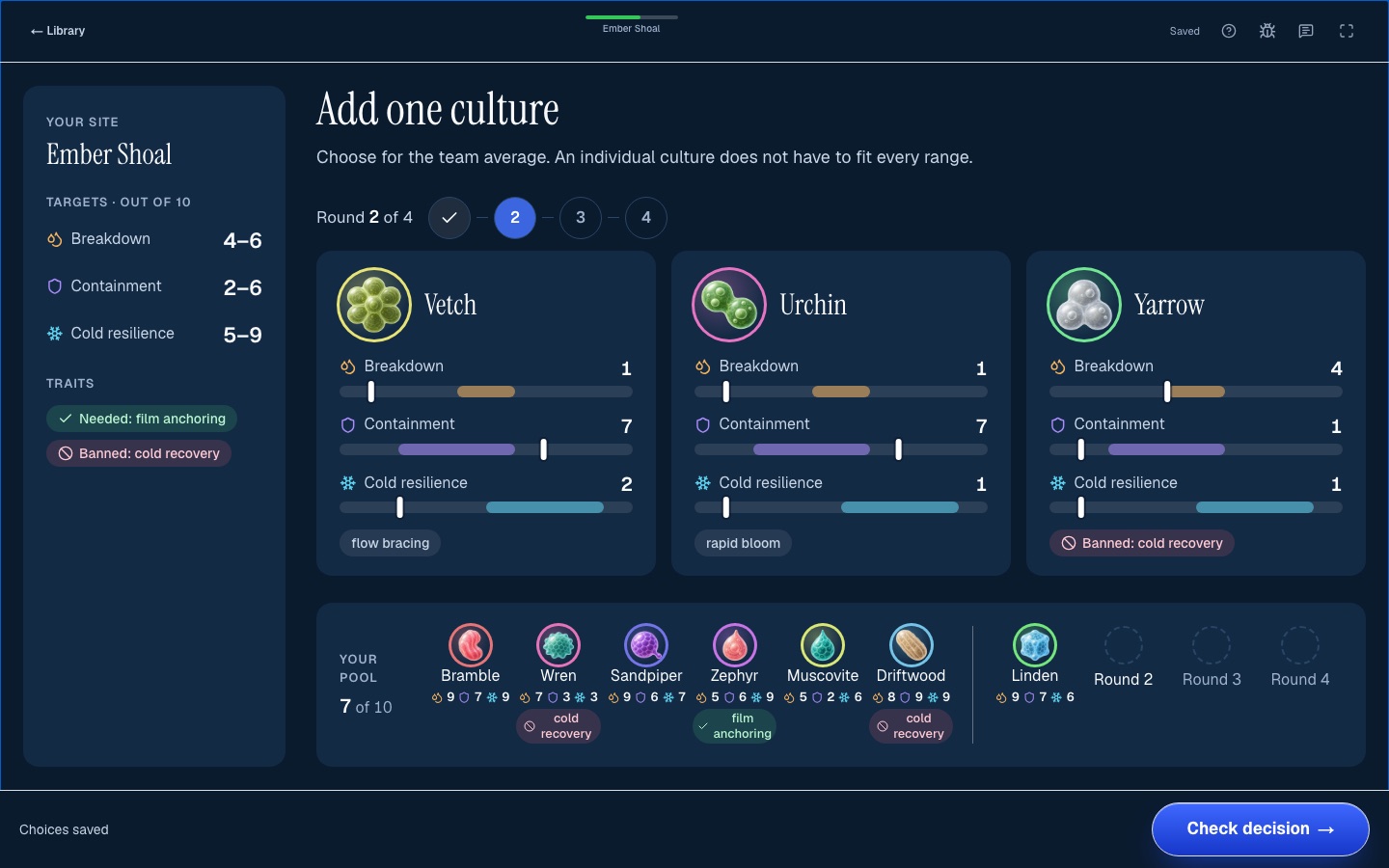
The quick version: Sea Wolf is the McKinsey Solve module where you select and evaluate microbes to clean contamination. McKinsey's own innovation blog describes it in those terms. Site count, species, attribute names, and timing in the live game differ from this practice version and change between cycles.
Ten simulations, $29 once. Site 1 of Simulation 1 is free.
Each site names the trait that matters and the one that disqualifies.
Screen every culture, then build the treatment from each round's pool.
Your answer beside the worked one, then three runs to fix it.
Finish 5 of 10 Sea Wolf and 5 of 10 Red Rock simulations first.
Nothing in Sea Wolf requires knowing anything about marine microbiology. What it requires is the discipline to separate hard eliminations from optimization, and to do it in the right order. Candidates who start by hunting for the best-performing microbes lose time and usually end up with a set that violates a disqualifying rule. Candidates who filter first work with a smaller set and a clearer objective. That two-stage habit, eliminate on the binding constraints then optimize on the scored ones, is the same one that makes a candidate fast on case interview screening questions.
Each site runs the same loop: read the site card and rules, set the site profile, sort the briefing cultures as current, later, or reject, add prospects round by round, then build a treatment whose averages sit inside every range, with the desired trait in and the undesired trait out. The free run is the scenario's first site; the full runs play all three sites in sequence and are available in paid packs. A pack run can be untimed Learning with feedback and one repair after each decision, or a timed Simulation, 10 minutes per site, with feedback held for the final debrief. Only the treatment is scored, with credit for each range and trait rule it clears; sorting and the profile earn nothing and leave your pool unchanged, and prospect picks shape what you can build but earn nothing on their own. Our original practice rules are shown in the simulation and are not an official McKinsey scoring specification.
Work through each before reading the approach.
None. Disqualifying rules are binary and apply before any attribute comparison. Strong numbers on a disqualified option are a deliberate distraction.
Eliminate it immediately and never revisit it.
Work backwards from both ends of the range. Three picks need a total from 18 to 24, and 9 plus 8 is already 17, so the third slot must score from 1 to 7.
Anything from 1 to 7. An 8 or higher breaks the range however good it looks elsewhere.
Constraints are not preferences to balance. Find the intersection of options satisfying all of them; if the intersection is a single set, that is the answer regardless of which one you would have preferred.
Solve for the intersection, not the compromise.
McKinsey's public description of Sea Wolf is short: the Solve game where you select and evaluate microbes to clean up contaminated sites. It does not publish the steps or the scoring, so everything below about structure comes from what candidates and prep providers report. On the core flow they largely agree.
The useful mental model is simple: Sea Wolf is a constraint-matching game, not a biology test. As reported, you treat 3 ocean sites in about 30 minutes, run the same four steps at each, and finish each site with 3 microbes judged on their averages, not one by one.
The labels vary between write-ups (Energy, Adhesion and Speed in one; Rigidity, Mobility and Size in another), which suggests the names are drawn per test. The structure does not change. Write-ups of the 2023 to 2024 beta, sometimes called Ocean Cleanup, describe a shorter one- or two-site version, and Ecosystem Building is a separate Solve game whose advice does not transfer. If your tutorial uses different wording than a guide you read online, trust the tutorial in front of you.
Sea Wolf shows up inside McKinsey Solve, which most applicants complete early in the process, typically after the application and before first-round interviews. The most commonly reported 2026 format pairs Sea Wolf with Redrock Study in a roughly 65-minute sitting, with Sea Wolf usually second. Longer invitations add the Sustainable Futures Lab: candidates report a 20-minute version in 85-minute invitations and, since late August 2026, a newer 30-minute version in 95-minute invitations. McKinsey does not publish the line-up, so your invitation email states the length and the in-test instructions confirm the games. The McKinsey Solve guide covers the full assessment flow, the variants, and how Solve feeds into the interview rounds.
Candidates and prep providers describe the same flow: an untimed tutorial, then 3 ocean sites that share one 30-minute clock. Time carries over, so minutes you save on site 1 are yours for site 3. Each site runs the same four steps, and before sites 2 and 3 there is a short review of the microbes you saved for that site.
You track three things at once: each microbe's attribute values, its one trait, and how a group of 3 averages out against the site. The names change between versions; the building blocks candidates and prep providers report do not.
The mechanic candidates most often underweight is the set-level view. A microbe with one value outside a range is not a failure: a partner on the other side of the range can pull the average back in. The only single-microbe problem the treatment cannot absorb is the undesired trait. So ask what the full set needs to add up to, then assemble microbes that hit that target together.
McKinsey does not publish a Sea Wolf score formula. Candidates and prep providers do report a consistent efficiency rule for the treatment, and a second, behavioral score that nobody outside McKinsey can see.
Also unknown: whether the profile quietly changes which microbes you get, and where the pass bar sits. McKinsey publishes no pass rate or percentile, so treat any figure you see online as a prep provider's estimate. The takeaway: clear the five checks at every site, accept a capped site without chasing it, and keep your process orderly. The simulation on this page scores your treatment on the same five checks, and its debrief is practice evidence, not an official McKinsey score.
Suppose a site needs:
Heat-Resistant microbe (desired trait)Light-Sensitive microbe (undesired trait)The trio needs totals of Energy 9 to 15, Adhesion 18 to 24 and Speed 6 to 12. Three microbes from your pool (the names are invented):
Now check the sums against 3 times each end of the range:
4 + 2 + 6 = 12, inside 9 to 15, so the average is 47 + 6 + 7 = 20, inside 18 to 24, so the average is 6.673 + 4 + 2 = 9, inside 6 to 12, so the average is 3All five checks pass: three averages in range, one desired trait, no undesired trait, so under the reported rule this treatment scores 100%. Notice that Pelto Virus and Quask Amoeba are each outside the Energy range on their own. The group fits, and the group is what counts. Swap Vorin Alga for a look-alike with the same numbers and a neutral trait, and the treatment drops to 80%. That is the practical point of Sea Wolf prep.
Use one move per step: profile the hardest constraint, serve the current site first, pick for the trio, validate the set. Prep providers largely agree on these moves, even where they number the steps differently.
This method is intentionally less glamorous than a solver. That is the point: it remains usable when the labels, values, or interface change.
The best prep is boring in a good way:
A timed self-simulation also works on paper: invent a few sites with three attribute ranges, a desired and an undesired trait, and a pool of ten microbes, then pick the best trio against a clock and score it with the 20% rule. It drills the same muscles: range-to-sum, trait screening and set-level checking.
If your invite does not list module names, do not panic about memorizing labels. Focus on clean arithmetic, calm reasoning, and reading the tutorial carefully once the task opens.
Do not review only the final treatment. Find the first step where your reasoning left the rules. A weak treatment can begin with a profile that ignored the hardest range, a microbe rejected for one out-of-range value, a pool pick that doubled up on what you already had, or a trio that looked fine one microbe at a time.
Then replay the logic without changing the rule order. Improvement comes from making the checking routine dependable, not from discovering a new trick after every attempt.
Sea Wolf concentrates on multi-constraint selection. Redrock concentrates on evidence retention, exhibit interpretation, and calculation: the Redrock study guide goes phase by phase and the Red Rock practice study runs the loop free. SFL concentrates on prioritization and stakeholder judgment, and the SFL practice simulation covers it. All three reward structured problem solving, but practicing only one does not reproduce the switching cost of a longer Solve invitation. Bain runs a comparable digital screen you can rehearse in the Bain SOVA simulator, and the MBB assessment simulator roundup maps every free option in one place.
Solve is only one gate. After that, you still need to handle live case interviews and the Personal Experience Interview.
McKinsey and Solve are trademarks of McKinsey & Company. Road to Offer is independent and is not endorsed by McKinsey.

Turn your result into one focused practice rep: the treatment you missed, worked through, and the next run that fixes it.