
Customer Segmentation Framework: Segment, Score, Target
Segment a market in a case interview, score each segment on attractiveness and ability to win, pick a primary target, and quantify the revenue impact with two fully worked examples.
On this page
Customer segmentation in a 2026 case interview means dividing a market into distinct groups, scoring each on attractiveness and ability to win, then picking one or two targets with quantified rationale. It is rarely a case on its own; it is the step inside a growth, go-to-market, or profitability case where the binding question is "who do we go after" or "which group is dragging the average." The bar interviewers hold candidates to is well documented: Harvard Business Review's "Rediscovering Market Segmentation" argues that useful segmentation identifies customers whose behavior can actually be changed or whose needs are genuinely unmet, not groups that merely look tidy on a slide. In the worked examples below, that discipline is what separates the right call from the obvious one: serious athletes, a segment less than a third the size of casual gym-goers, still win as the primary target because they clear a 6.2x LTV-to-CAC ratio versus 3.4x for the larger group. This guide gives you a repeatable five-step method, the 2x2 scoring matrix, two fully worked numeric examples, and the specific mistakes that separate an offer from a ding.
Why Does Segmentation Appear in Case Interviews?
Segmentation is not a standalone case type like profitability or market entry. It appears as a critical step inside broader cases where "who to target" is the binding question. Growth cases ask which segments to prioritize for expansion. Go-to-market cases ask who the primary target is for a new product. Profitability cases use it differently: there, segmentation is how you find a mix effect, the hidden reason a blended average moved.
What separates strong candidates from average ones is the move from description to decision. Average candidates describe segments. Strong candidates score them, rank them, and explain the trade-offs of what they are leaving on the table.
What Are the Five Steps of the Segmentation Framework?
The segmentation framework has five steps: define the objective, choose dimensions, score segments, prioritize, and activate. Each step builds on the previous one, and skipping any of them is the most common reason candidates lose points.
- Step 1 (Define objective): Clarify whether the goal is revenue growth, margin improvement, retention, or cross-sell. This takes 15-30 seconds but prevents building segments that are interesting but irrelevant.
- Step 2 (Choose dimensions): Use exactly two dimensions to create 3-5 segments. Combine an observable dimension (demographics, geography) with a behavioral or needs-based one. Single-dimension segmentation rarely predicts profitability.
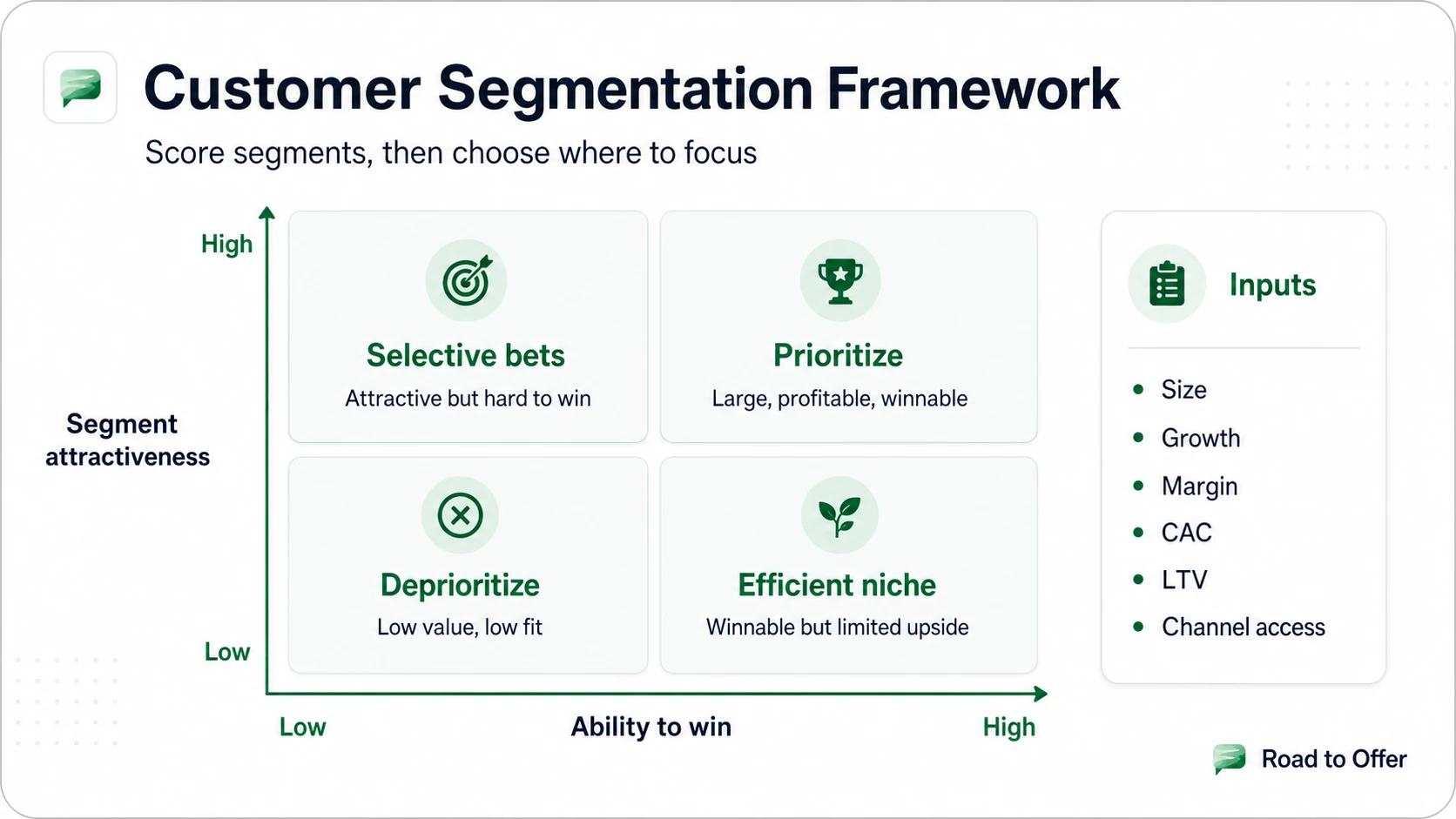
- Step 3 (Score segments): Rate each segment on attractiveness (size, growth, margin, LTV) and ability to win (product fit, CAC, channel access, competitive intensity) using a 1-5 scale or High/Medium/Low.
- Step 4 (Prioritize): Pick one primary target (upper-right quadrant of the 2x2) and one secondary target. Explicitly name what you are deprioritizing.
- Step 5 (Activate): Connect targeting to specific go-to-market actions: product, channel, pricing, and messaging tailored to the chosen segment.
Which Segmentation Dimensions Should You Use?
The four classic marketing families are geographic, demographic, psychographic, and behavioral. In a consulting case you will often add a fifth lens, needs-based or value-based, which groups customers by the problem they are solving and what it is worth to them. The classic Harvard Business Review argument is that segmentation should identify customers whose behavior can be changed or whose needs are unmet, not just sort people into relatable advertising personas (Source: HBR, "Rediscovering Market Segmentation"). In practice, behavioral, needs-based, and value-based dimensions predict profitability better than demographics on their own, which is why they earn more points in an interview.
A practical test: if every segment ends up roughly equal in size and attractiveness, your dimensions are not cutting the market usefully. Good dimensions create segments that are clearly different on metrics that matter. A second practical test, from market-sizing practice, is whether the split is MECE, meaning mutually exclusive (no customer sits in two segments) and collectively exhaustive (every customer fits somewhere). If it is not, see the MECE principle explained before you go further.
How Do You Score Segments with a 2x2 Matrix?
The scoring step earns the most points in an interview, and it is where most candidates are weakest. Move from qualitative descriptions to quantified scores on two axes.
Attractiveness axis: Segment size, growth rate (annual %), margin quality, customer lifetime value, strategic fit.
Ability to win axis: Product-market fit, channel access, competitive intensity, CAC relative to LTV, switching costs.
Example: B2C fitness app scoring
Recommendation: Serious athletes as primary target, because they show the best LTV-to-CAC ratio (340 / 55 = 6.2x), 8% growth, and strong product fit. Corporate wellness as secondary, because it has the highest absolute LTV (580) but requires building a B2B sales motion over 12-18 months. Deprioritize rehab, which requires clinical partnerships the company lacks. Notice the move: casual gym-goers are the largest segment by far (12M), but size alone does not win. The 6.2x return on every acquisition dollar is what makes athletes the call.
The hard part is building this scoring logic live, under interviewer pressure, without a table in front of you. Drill it below.
Interactive drill set. Write an answer before revealing the worked solution, then continue into Road to Offer for scored practice and AI feedback.
Worked Example: Online Grocery Segmentation
Case prompt: A European online grocery company with EUR 200M revenue has seen growth slow from 25% to 8%. The CEO wants to reignite growth to 15%+, requiring roughly EUR 14M in incremental annual revenue above the current trajectory.
Dimensions chosen: Order frequency (behavioral) x basket value (value-based).
Primary target: Regular families. Increasing average basket from EUR 62 to EUR 72 through meal-kit bundles generates EUR 38/customer/month. Across 56,000 customers, that is EUR 25.5M annually, exceeding the EUR 14M gap. Investment: EUR 3M loyalty program. Payback: under 2 months. Sizing a segment like this in your head is its own skill worth having automatic before the interviewer is waiting on you.
Secondary target: Occasional users. Converting 20% (14,000 customers) from 1.4 to 3.0 orders/month adds EUR 12.9M. Investment: EUR 5M in subscription incentives. Payback: 5 months.
Deprioritize: Lapsed customers (high reactivation cost, uncertain return) and incremental investment in power shoppers (already at maximum engagement, low margins from delivery intensity).
Segment a BCG grocery profitability case. Revenue grew from $600M to $680M but gross margin stayed flat at $135M after two prepared food launches. Answer this BCG profitability case step in the article, then continue the full case. Continue the full case on Road to Offer
How Does Segmentation Reveal a Mix Effect?
In a growth or go-to-market case, segmentation answers "who to target." In a profitability case, it does something different: it exposes a mix effect, which is when a blended average moves because the weighting of segments shifts, not because any single segment got better or worse. This is one of the most common hidden root causes in a margin or revenue-decline case, and segmenting the metric is the only way to see it.
Work a quick one. A software company reports that average revenue per customer fell from EUR 1,190 to EUR 920, a worrying 23% drop, and the CEO wants to know why. Segment the base before touching the average:
Year 1 blended revenue per customer is (200 x 2,000 + 200 x 380) / 400 = 476,000 / 400 = EUR 1,190. Year 2 is (200 x 2,000 + 400 x 380) / 600 = 552,000 / 600 = EUR 920. Spotting a mix effect this fast is a structuring reflex worth building before you panic about a falling average. Now read the segments: enterprise held flat at EUR 2,000 and SMB held flat at EUR 380. Not a single euro of per-customer value was lost. The blended average fell only because SMB customers doubled (200 to 400) while enterprise stayed flat, so the cheaper segment now carries more weight in the mix. The "decline" is a pure mix effect, and rapid SMB acquisition may be exactly what you want. The fix is not to rescue a falling blend; it is to report enterprise and SMB separately and stop managing to a misleading average. This is the logic Crafting Cases teaches: segment a metric whenever you suspect a mix effect, because the average can move without any underlying performance change (Source: Crafting Cases, segmentations).
Now apply segmentation in a live case
Run a growth or go-to-market case with AI coaching that pressure-tests your segment split, your scoring, and the target you pick the way an interviewer would.
What Are the Most Common Segmentation Mistakes?
When Should You Use Segmentation vs. Other Frameworks?
Segmentation is not always the right tool. If the case has a clear quantitative target (why did margin drop 400 bps?), start with profitability and use segmentation inside it to find the mix effect. If it asks about market-level attractiveness before you know the customers, start with market entry or the 3Cs framework.
Related Framework Guides
Practice segmentation under real interview pressure
Reading the method is the easy part. Run live cases with AI coaching that scores your segment choices, your prioritization, and your final recommendation.
Segmentation rarely stands alone, so pair it with the framework that owns the rest of the case:
- Growth strategy case framework, for choosing which segments to expand into.
- Market entry framework, for sizing a new market before you know its customers.
- Profitability framework, where segmentation surfaces the mix effect behind a margin drop.
- Customer profitability and segmentation guide, for cost-to-serve and contribution-margin scoring.
- 4Ps framework in case interviews, for activating a chosen segment with product, price, place, and promotion.
- Value chain framework and the MECE principle explained, for keeping your splits clean.
- Case interview frameworks complete guide, the hub that ties every framework together.
If you are switching careers into consulting and want a structured way to drill these, the case interview prep guide for career changers walks through how to build the habit.
Sources
Sources checked June 18, 2026.
- Harvard Business Review, "Rediscovering Market Segmentation" (segmentation should target changeable behavior and unmet needs, not advertising personas): hbr.org/2006/02/rediscovering-market-segmentation
- IGotAnOffer, common case interview frameworks and how to build your own (interviewers penalize memorized frameworks; tailor to the case): igotanoffer.com/blogs/mckinsey-case-interview-blog/118288068-case-interviews-frameworks-comprehensive-guide
- Crafting Cases, "The 5 ways to be MECE: segmentations" (segment a metric when you suspect a mix effect): craftingcases.com/the-5-ways-to-be-mece-part-6/
- MyConsultingCoach, how to segment in case interviews (iterative, MECE, tree-structure segmentation for sizing): myconsultingcoach.com/case-interview-how-to-segment
- PrepLounge, identify your case type (segmentation appears as a step inside larger cases): preplounge.com/en/case-interview-basics/case-cracking-toolbox/identify-your-case-type
- Bain & Company, customer strategy and marketing insights (further reading on segmentation in practice): bain.com/insights/topics/customer-strategy-and-marketing/
Frequently asked questions
Resources and related guides
- Practice customer segmentation in a real case interviewPractice
- Browse all free resourcesResource hub
- 4Ps Framework Case Interview: Product, Price, Place, PromotionFrameworks · Feb 6, 2026
- Product Launch Case Interview: Framework and Example (2026)Frameworks · Mar 31, 2026
- Segmentation Framework in Business Analysis: Structure GuideFrameworks · Jun 2, 2026
- Market Sizing Questions with Answers: 20 Examples + PDF Practice (2026)Frameworks · Mar 30, 2026