
Product Launch Case Interview: Framework and Example (2026)
Solve product launch cases from the actual objective, with channel economics, cannibalization, a worked example, and matched practice.
On this page
A product launch case interview asks you to decide whether to launch, design the launch, diagnose failure, or scale an existing product. Confirm the objective first. Then connect customer demand, pricing, channel contribution, cannibalization, and execution risk to that decision. Use the market-entry method where relevant, and adapt your structure as evidence changes.
Before practicing, name the decision and one condition that would change your recommendation. A launch-approval question needs incremental profit and risk; an approved rollout needs segment, channel, and sequencing choices.

Growth · medium
Practice product launch in a real case interview
Matched to this product launch guide: a live education growth case with an AI interviewer. Free, scored on every step.
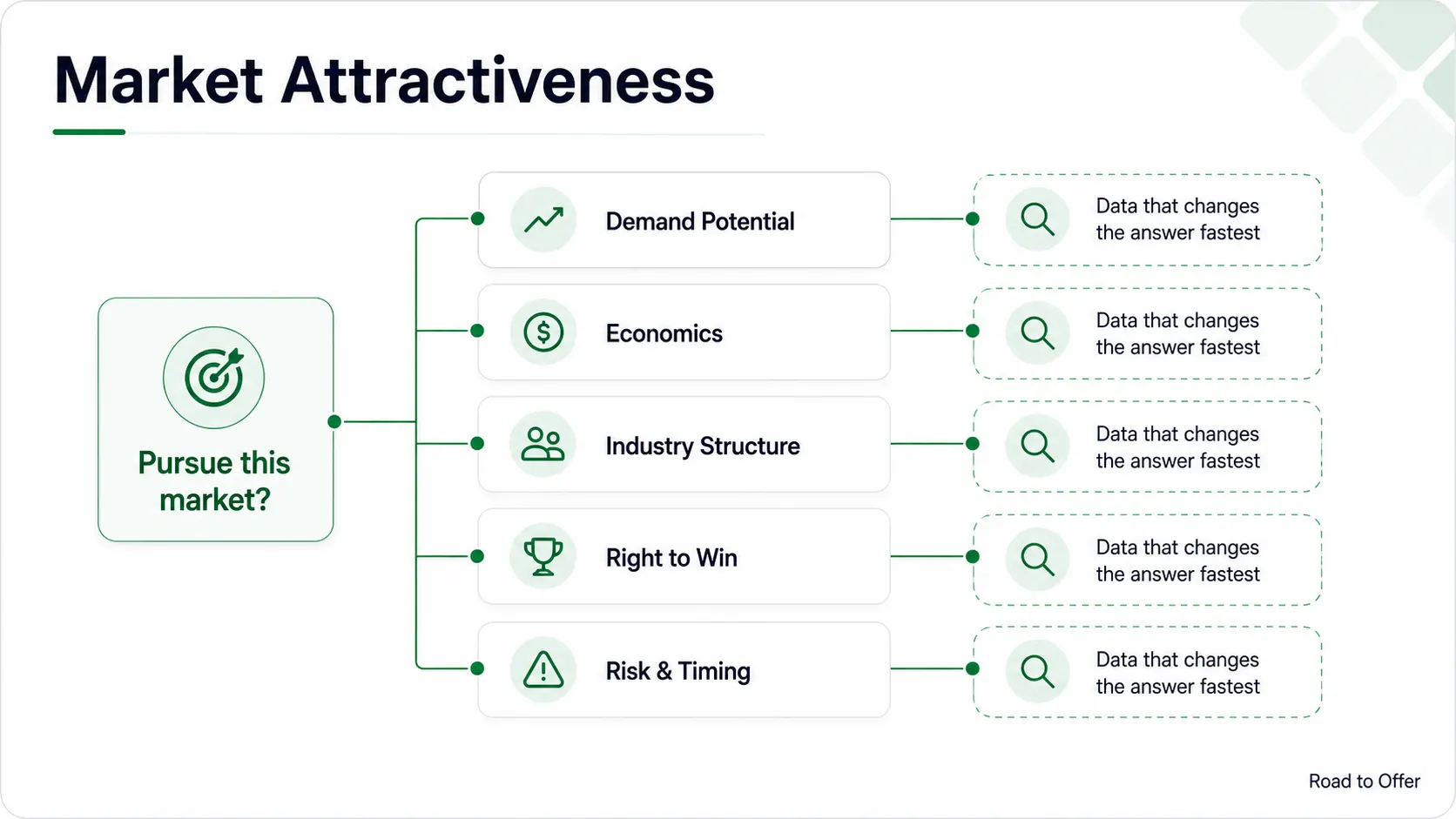
How Is a Product Launch Case Interview Different from Market Entry?
This distinction matters because candidates who apply a generic market entry framework to a launch case miss the execution depth that interviewers are looking for.
The overlap: both require market sizing and competitive analysis. The difference: launch cases require you to get specific on execution decisions with financial backing.
What Is the 5-Step Product Launch Case Framework?
Product Launch Case Framework
- 01
Step 1: Market Sizing. Quantify the total addressable market, serviceable addressable market, and realistic year-1 penetration. Use both top-down and bottom-up approaches and sanity-check them against each other.
- 02
Step 2: Customer Segmentation. Identify 2–3 distinct segments by willingness to pay, use case, and acquisition channel. Prioritize the segment with the highest value and lowest acquisition cost for the initial launch.
- 03
Step 3: Pricing Strategy. Set price based on value-based logic (% of value captured), competitive anchoring, or cost-plus as a floor. Compare feasible prices using demand, contribution, and competitive response.
- 04
Step 4: Distribution and Go-to-Market Channels. Select channels (direct, retail, digital, partnerships) based on where the target segment shops and the cost to reach them. Calculate channel economics: gross margin after channel fees.
- 05
Step 5: Success Metrics and Milestones. Define 3–4 KPIs with specific numeric targets. Cover adoption (market share, CAC), engagement (30-day retention, NPS), and financial (revenue, LTV/CAC ratio). Set 6-month and 12-month milestones.
Use the relevant steps in the order the objective requires. Use a market sizing drill for Step 1, a case interview structure drill for segmentation and channel branches, a case interview math drill for pricing and channel economics, and a case interview synthesis drill for the final launch recommendation.
How Do Channel Economics Change a Launch Decision?
Teaching prompt: A connected-bottle maker wants to know whether a first-year launch creates incremental operating profit. All inputs below are RTO teaching assumptions, not market research. The product sells for $39, costs $18 to produce, and is forecast to sell 100,000 units: 40,000 direct and 60,000 through retailers. Direct fulfillment costs $3 per unit. Retailers retain 40% of the shelf price; delivery to retailers costs $1 per unit. Direct acquisition costs $10 per first-order customer, with one unit per customer. Launch fixed costs are $300,000. Another 20,000 sales replace an existing bottle that contributed $8 per unit. Assume every forecast unit sells in year one, with no other incremental costs or taxes in this simplified case.
Before reading the calculation, decide which channel contributes more per unit and whether the launch covers fixed costs and displaced contribution.
Retail manufacturer revenue is $39 x (1 - 40%) = $23.40. Retail contribution is $23.40 - $18 - $1 = $4.40. Direct contribution is $39 - $18 - $3 - $10 = $8. The retailer's margin is a share of shelf price, not a markup on the manufacturer's cost.
Use unit economics to reconcile the launch:
- Direct contribution: 40,000 x $8 = $320,000.
- Retail contribution: 60,000 x $4.40 = $264,000.
- Contribution before launch fixed costs: $584,000.
- Displaced contribution: 20,000 x $8 = $160,000.
- Incremental operating profit: $584,000 - $300,000 - $160,000 = $124,000.
For a packaged-goods launch, use the consumer-goods exhibit to separate retailer stocking from shopper demand before extrapolating reorders.
The manufacturer recognizes $2,964,000 of revenue: 40,000 x $39 + 60,000 x $23.40. The $3.9 million shoppers spend is retail sales value, not manufacturer revenue. Do not use it as the denominator for manufacturer margin.
What Would Turn the Launch Into a No?
At the stated channel mix and a constant 20% cannibalization rate, net incremental contribution per new unit is $5.84 - $1.60 = $4.24. Break-even volume is $300,000 / $4.24, or 70,755 units rounded up. This follows the SBA contribution approach, checked September 5, 2026, with displaced contribution explicitly included.
If direct acquisition cost rises from $10 to $14, the extra 40,000 x $4 = $160,000 turns the result into a $36,000 loss. The launch therefore needs evidence for acquisition cost, channel mix, and cannibalization, not just a large market forecast.
Recommendation: Pilot the launch before committing to the forecast. The base case creates $124,000 incremental operating profit, but a $4 increase in direct acquisition cost erases it. Measure first-order acquisition cost, actual retailer reorders, and substitution from the existing bottle. Then decide whether to scale, change the channel mix, or stop.
If the calculation is slow, use the case-math lesson, then practice math setup and units. Those drills train the skill on fresh inputs; they do not replay this bottle example.
What Are Common Product Launch Case Interview Traps?
Trap 1: Treating "launch" as "enter the market" Ask whether the client wants launch approval or an execution plan. Do not assume approval from the word "launch." Restate the requested decision before choosing branches.
Trap 2: Single-segment thinking Recommending one generic customer profile misses the segmentation analysis that differentiates strong candidates. Always identify at least 2 segments and explain why you're prioritizing one for the initial launch.
Trap 3: Cost-plus pricing as default Starting with COGS and adding a margin is the weakest form of pricing analysis. Lead with value-based or competitive pricing, then use cost-plus as a floor check.
Trap 4: Ignoring channel economics Recommending "sell through retail" without calculating the gross margin impact of a 40% retailer margin fails to demonstrate financial rigor. Always compute channel-level unit economics.
Trap 5: Vanity metrics in success criteria "Number of app downloads" or "social media mentions" are not success metrics. Root every metric in financial value or leading indicators of financial value (LTV/CAC, retention, market share).
How Do Product Launch Cases Connect to Go-to-Market Strategy?
Product launch cases frequently appear alongside market sizing framework questions, profitability framework analysis (once the product is live), and case interview data interpretation challenges where you receive a mid-case exhibit showing disappointing early sales data and must diagnose the issue. If that exhibit is the weak point, use a case interview chart drill.
For firm-specific case styles, BCG tends to ask launch cases with detailed financial exhibits. See BCG case interview guide for BCG-specific preparation. McKinsey launch cases often emphasize the customer segmentation and competitive response angles. See McKinsey case interview guide.
For adjacent archetype cases: the market entry case interview guide covers the strategic go/no-go decision that precedes the launch. The pricing strategy cases guide gives depth on how to set the launch price. The revenue growth case interview is the year-2 question once the product is live and the client wants to accelerate adoption. The growth strategy cases guide frames product launches as a product development lever inside the Ansoff matrix. The customer profitability case interview applies when the launch targets specific customer segments and you need to model segment-level margin.
For adjacent practice, use the Solara Voice case to assess hardware market entry. Adapt your branches to its prompt rather than forcing the bottle example onto it.

Market entry · medium
Practice a real energy market entry case
Matched to this product launch guide: a live energy market entry case with an AI interviewer. Free, scored on every step.
Learn the case sequence before a launch decision
Use the how-to-case lesson to practice the sequence from objective to recommendation.
Sources and Further Reading (checked June 17, 2026)
- BCG: How to Launch a New Product: BCG perspective on go-to-market strategy frameworks
- McKinsey: Getting Product Launch Right: McKinsey perspective on product launch factors driving success
- Harvard Business Review: A Better Way to Think About Your Business Model: foundation for value-based pricing frameworks
- Statista: US Fitness Tracking Device Market: market size data for fitness technology segment
- Profitwell: SaaS Pricing Strategy Research: research on value-based vs. cost-plus pricing outcomes
Frequently asked questions
Resources and related guides
- Practice product launch in a real case interviewPractice
- Browse all free resourcesResource hub
- 4Ps Framework Case Interview: Product, Price, Place, PromotionFrameworks · Feb 6, 2026
- 3Cs Framework: Company, Customer, Competitor (Worked Example)Frameworks · Feb 6, 2026
- Ansoff Matrix vs BCG Matrix for Case InterviewsFrameworks · Jun 2, 2026
- Porter's Five Forces for Case Interviews: How to Analyze Industry AttractivenessFrameworks · Feb 6, 2026
- Market Entry Framework (2026): 5 Steps + Full Worked CaseFrameworks · Feb 1, 2026