
4Ps Framework Case Interview: Product, Price, Place, Promotion
Use the 4Ps framework (Product, Price, Place, Promotion) in case interviews: the questions under each P, a fully worked DTC numeric example, when to use 4Ps vs 3Cs, and the mistakes that flag a memorized answer.
On this page
The 4Ps framework (Product, Price, Place, Promotion) structures go-to-market and commercial-growth cases by isolating the one or two marketing-mix levers that drive most of the value. The interview skill is not reciting all four. It is scanning all four fast, then spending most of your time on the lever that moves the answer, and quantifying the impact. This guide gives the diagnostic questions under each P, a fully worked direct-to-consumer launch example with the arithmetic, the 7Ps service extension, and a clear decision rule for when to reach for 4Ps versus 3Cs, Porter's Five Forces, or the profitability framework.
What Is the 4Ps Framework and When Does It Fit?
The 4Ps is a marketing-mix model McCarthy introduced in 1960 for structuring go-to-market and commercial decisions. In case interviews it fits when the question is about how to launch, reposition, price, distribute, or grow a product, not about broad strategic positioning (where the 3Cs framework is stronger) or industry attractiveness (Porter's Five Forces).
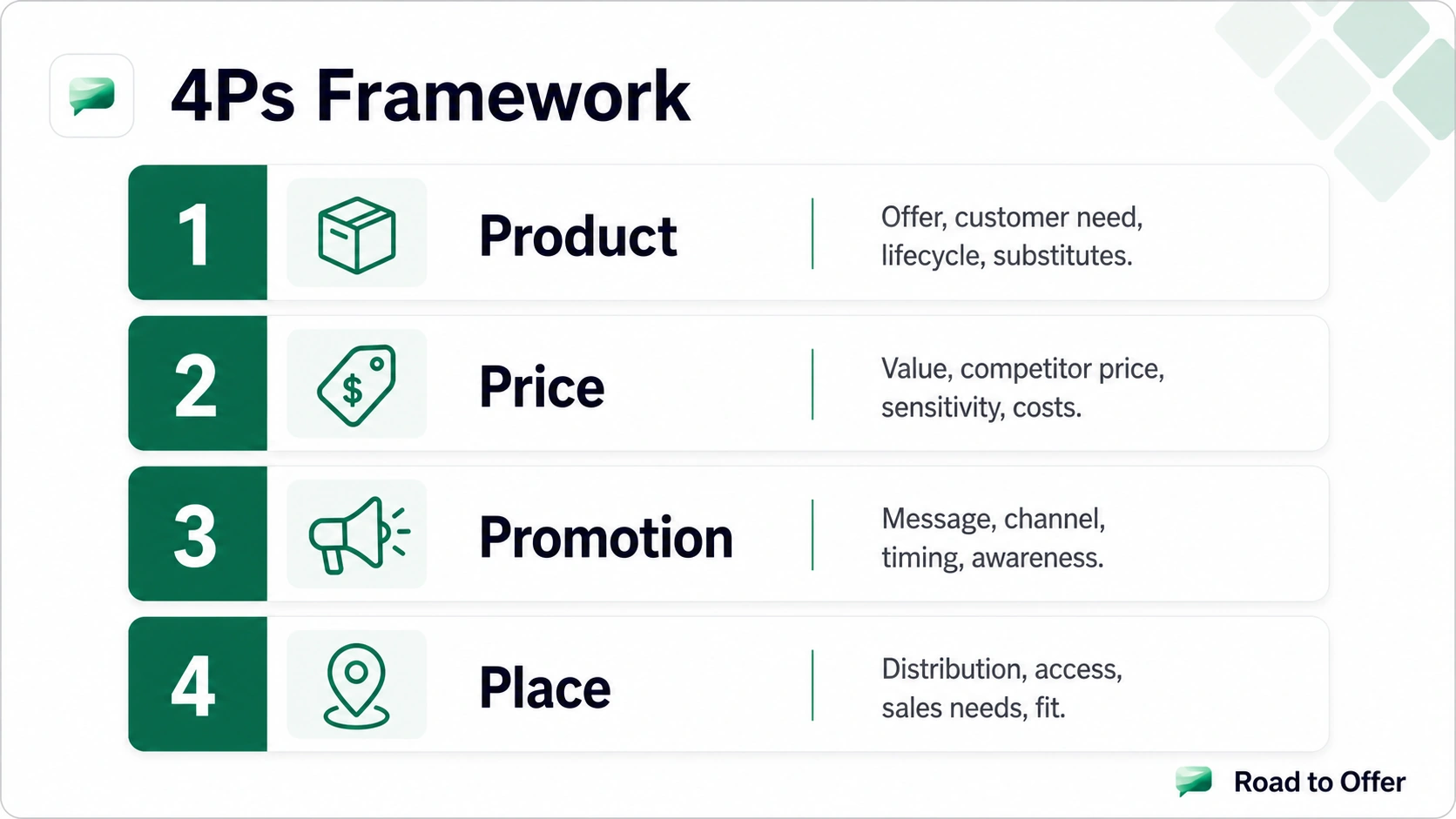
The order of the four Ps matters less than the discipline. Strong candidates do not memorize the 4Ps as a script; they use it as a checklist to confirm they have not missed a commercial lever, then build a tailored structure on top of it. For more on structuring an opening, see the case interview frameworks guide.
Practice go-to-market cases with AI feedback
Road to Offer scores your framework, your math, and your recommendation logic on commercial cases.
Product: What Are We Selling and Does Anyone Need It?
Product analysis is not a feature list. It answers one question: does this product solve a real problem for a specific segment better than the alternatives? Work it in three quick passes.
- Segment-problem fit. Who is the target customer, and what job are they hiring this product to do? A product built for everyone usually serves no one well. Name the one or two use cases that drive most of the value.
- Differentiation. What does this product do that competitors cannot easily copy? Push for specifics: is the edge in performance, cost, convenience, or brand? A clear, hard-to-replicate advantage is what separates a real launch from a me-too product that competes only on price.
- Over-engineering and lifecycle. Many prompts describe broad feature sets with narrow actual usage. If most users only touch two features, the team is spending on things that do not drive retention or willingness to pay. That feeds straight into pricing strategy: you cannot price what you do not know customers value. A product in early growth also needs different tactics (awareness, fit) than one in maturity (differentiation, bundling, cost).
Price: Are We Capturing the Value We Create?
Pricing is the highest-leverage P. A change in price flows straight to operating profit with no added cost, so it has more upside than an equivalent move in volume or cost. This is where you can show the most quantitative muscle.
- The three pricing lenses. Cost-plus sets the floor (cover variable cost plus a contribution to fixed). Competitive pricing sets the reference range (what alternatives charge). Value-based pricing sets the ceiling (what the customer will pay for the economic value delivered). The deep mechanics are in the pricing strategy cases guide.
- Price architecture. One price point or tiers? A single price leaves money on the table when segments differ in willingness to pay. Ask whether power users underpay relative to their value and whether light users are priced out.
- Discounting discipline. Undisciplined discounting is one of the most common margin destroyers. If sales routinely discounts 15 to 20 percent, realized price is far below list. Always ask about the gap between list price and average realized price.
- Elasticity intuition. If we raise price 10 percent, how much volume do we lose? You do not need a precise number, just a direction. Commoditized products with many substitutes are elastic; differentiated products with switching costs are not.
Place: How Does the Product Reach the Customer?
Place (distribution) is the P most candidates under-analyze. They say "we sell through retail and online" and move on. Channel strategy is where you show commercial depth.
- Direct vs. indirect. Direct channels (owned stores, e-commerce, inside sales) give control over price, brand, and customer data. Indirect channels (distributors, retailers, marketplaces) give reach and scale but cost margin and data. The question is which channels maximize long-term value, not just volume.
- The margin stack by channel. This is where quantitative candidates stand out. Take a consumer good with a $10 manufacturer cost: sold wholesale to a distributor at $15, on to a retailer at $20, and to the consumer at $30. Your channel choice decides how much of that $30 you capture. Sell direct at $25 and you keep $15. Sell through retail and you keep $5. Same product, triple the margin.
- Channel conflict. When you sell both direct and through partners, pricing and territory conflicts are near-inevitable. If your direct site undercuts retail partners, they deprioritize you. Flag this explicitly; interviewers read it as commercial maturity.
- Digital distribution. For digital products, Place means platform strategy (app stores, web, API integrations) and the take rates attached. Apple and Google take 15 to 30 percent on app-store transactions, economically identical to a retail margin.
- Coverage. Even the best product at the right price fails if customers cannot find it. Ask about coverage, fill rates, and whether the channel reaches the target segment where they actually shop. This matters most in market entry cases, where the company may have no existing channel relationships.
Promotion: Are We Converting Awareness Into Revenue?
Promotion is not "advertising." It is everything that moves a customer from awareness to purchase. Structure it around the funnel, not campaign types.
- Top of funnel (awareness). How does the target segment first hear about the product: paid media, organic search, word of mouth, partnerships? Watch cost per reach and whether the message hits the right segment. Broad spend on untargeted audiences is the most common budget waste.
- Middle of funnel (consideration). What makes an aware prospect seriously consider buying? Ehrenberg-Bass Institute research argues the biggest driver is mental availability, whether the brand comes to mind in a buying situation (Byron Sharp, How Brands Grow). Check that the core value proposition is communicated clearly.
- Bottom of funnel (conversion). What is the conversion rate, and where do prospects drop? Common leaks are the pricing page (price shock), checkout (friction), and trial expiry (not enough value shown). Each leak has a different fix.
- ROI and payback. This is where you quantify. A $100K campaign that acquires 500 customers at $200 first-year revenue generates $100K of revenue, or $60K of contribution at 60 percent margin, so it does not pay back in year one on acquisition alone. If lifetime is three years at 80 percent retention, the LTV-based return looks very different. Always ask for retention and LTV, not just acquisition.
- Attribution. Customers touch many channels before buying. You do not need to solve multi-touch attribution in a case, but acknowledge it and avoid handing all credit to the last touch.
When Should You Use the 7Ps Instead?
The original 4Ps were built for physical products. In 1981, Booms and Bitner extended them to 7Ps by adding People, Process, and Physical Evidence for service businesses (Booms and Bitner, "Marketing Strategies and Organization Structures for Service Firms").
- People are everyone who delivers the service. In a consulting firm the consultants are the product; in a restaurant the front-of-house staff shape the experience more than the menu. Where quality depends on human delivery, People is often the most important lever.
- Process is the systems and workflows that deliver consistently: hotel check-in, a bank's loan approval, a SaaS onboarding flow. Process failures surface as inconsistency, delays, and churn.
- Physical Evidence is the tangible proof the service was delivered well: a consulting deck, the hotel room itself, a clean product UI and confirmation email. It reduces perceived risk for buyers who cannot evaluate the service before purchase.
How Do the 4Ps Work in a Full Case? (FreshBrew DTC Launch)
Prompt: FreshBrew is a specialty coffee roaster selling through 200 independent cafes. Revenue is $8M. They want to launch a direct-to-consumer subscription. The CEO asks: should we do it, and what would the commercial model look like? The figures below are illustrative, built to show the arithmetic, not real company data.
Product
FreshBrew's core product is single-origin, small-batch coffee rated 88+ on the SCA scale. For DTC, the product needs adaptation: pre-ground options for drip brewers (most home consumers do not own a burr grinder), sample/discovery packs for first-time buyers, and a subscription cadence of every 2 or 4 weeks. The product itself is differentiated, but the format must match the DTC customer's behavior.
Price
Current wholesale price to cafes: $12/lb (cafe retail price: $18-22/cup equivalent). For DTC, the pricing analysis looks like this:
- Cost floor: COGS $5.50/lb + packaging $1.20 + shipping $3.80 = $10.50 total delivered cost
- Competitive reference: Blue Bottle and Trade Coffee charge $16-22/lb for comparable quality DTC subscriptions
- Value ceiling: Survey data suggests specialty coffee subscribers have $18-24 willingness to pay for single-origin, freshly roasted coffee delivered to home
Recommended DTC price: $18/lb. This yields $7.50 gross margin per pound (42% gross margin), compared to $6.50 margin on wholesale ($12 minus $5.50 COGS). DTC is accretive on a per-unit basis, but the margin advantage disappears if customer acquisition cost is too high.
Place (Channel Economics)
Here is the margin comparison by channel:
DTC captures the most absolute margin per pound. Amazon looks attractive on price but the 30% marketplace fee plus higher shipping costs make it the worst margin channel. The recommendation: launch DTC as primary, avoid Amazon in year one, and maintain wholesale for volume and brand building in cafes.
Channel conflict risk: Cafe partners may feel undercut if DTC prices are lower than their retail equivalent. Mitigation: DTC subscription price ($18/lb) is positioned as a premium convenience offering, and cafes get first access to limited releases.
Promotion (ROI Calculation)
Planned launch spend: $150K across paid social ($80K), influencer partnerships ($40K), and email marketing to existing cafe customers ($30K).
- Paid social: Estimated CAC of $35 per subscriber. $80K / $35 = ~2,300 new subscribers
- Influencer: Estimated CAC of $25 per subscriber. $40K / $25 = ~1,600 new subscribers
- Email (existing cafe customers): Estimated CAC of $8. $30K / $8 = ~3,750 new subscribers
Total projected subscribers in year one: ~7,650. Average consumption: 1.5 lbs/month. Annual revenue per subscriber: 18 lbs x $18 = $324. With 70% average retention across the year (subscribers churn, especially early), effective revenue per acquired subscriber in year one is ~$227.
Year one unit economics:
- Total acquisition spend: $150K
- Blended CAC: $150K / 7,650 = ~$19.60
- Monthly gross profit per active subscriber: $7.50 margin/lb x 1.5 lbs = $11.25
- Payback period: ~1.7 months ($19.60 CAC / $11.25 monthly gross profit), so an active subscriber repays acquisition cost inside the first two months
- Year one gross profit per acquired subscriber (after ~70% retention): $227 revenue x 42% = ~$95, comfortably above the ~$19.60 CAC
Recommendation
Launch DTC subscription at $18/lb with a 3-tier offer (single bag, 2-bag, discovery sampler). Allocate initial marketing budget toward email conversion of existing cafe customers (lowest CAC) and influencer partnerships (best brand fit), with paid social as a scale lever once unit economics are validated. Maintain wholesale pricing and give cafe partners exclusive access to limited releases to manage channel conflict. Target: 7,500+ subscribers and $1.7M DTC revenue in year one.
Apply the 4Ps to a Bain growth strategy case. A US coffee shop chain with 750 stores wants advice on how to grow its revenue. Answer this Bain growth strategy case step in the article, then continue the full case. Continue the full case on Road to Offer
When Should You Use 4Ps vs. Another Framework?
Choosing the right framework is itself a signal. The 4Ps is a specialist tool for commercial execution: how an existing product is priced, distributed, promoted, and positioned. For other intents, a different lens reads as sharper judgment.
The 3Cs framework handles strategic positioning (company, customer, competitor) before you reach execution. Porter's Five Forces answers whether the industry is worth being in. The profitability framework drives a diagnostic revenue-minus-cost decomposition, and if the root cause is a pricing or channel issue you can pivot to 4Ps for the fix. The market entry framework wraps a 4Ps-style commercial analysis inside market-attractiveness and ability-to-win checks. For cost reduction, reach for a cost tree; for an acquisition, the M&A case framework; for supply-chain or logistics questions, the value chain framework.
What Are the Most Common 4Ps Mistakes?
- Listing all four equally. The single most common error is reciting Product, Price, Place, Promotion at the same depth. Scan all four, then commit time to the one or two that drive the answer.
- Skipping the arithmetic. "We should optimize pricing" is a hypothesis, not an answer. Show the margin stack, the CAC by channel, or the payback period. The numbers are where the framework earns its score, and a quick market sizing estimate often sets the volume assumption you need.
- Forcing 4Ps onto the wrong case. Cost cutting, operations, due diligence, and pure profitability diagnostics are not 4Ps cases. Using it there gives a surface-level answer.
- Treating it as a memorized script. Interviewers reward a tailored structure built on the 4Ps as a checklist, not a recited template. The mistake competitors warn about most is misalignment: premium pricing with discount messaging, or a quality product sold through a low-credibility channel.
Practice: Which P Would You Investigate First?
Interactive drill set. Write an answer before revealing the worked solution, then continue into Road to Offer for scored practice and AI feedback.
Sources and Further Reading (checked June 18, 2026)
- McCarthy, E. Jerome. Basic Marketing: A Managerial Approach. Richard D. Irwin, 1960.
- Booms, Bernard H. and Mary Jo Bitner. "Marketing Strategies and Organization Structures for Service Firms." Marketing of Services, American Marketing Association, 1981.
- McKinsey & Company, "Using big data to make better pricing decisions" and "The power of pricing": mckinsey.com/capabilities/growth-marketing-and-sales/our-insights
- Sharp, Byron. How Brands Grow. Oxford University Press, 2010 (Ehrenberg-Bass Institute research on mental availability).
- PrepLounge, "The 4P Framework in Case Interviews": preplounge.com/en/case-interview-basics/4p
- Corporate Finance Institute, "Marketing Mix (4Ps)": corporatefinanceinstitute.com/resources/management/marketing-mix/
- Harvard Business Review, pricing and value-communication resources: hbr.org/topic/pricing-strategy
Related Guides
Frequently asked questions
Resources and related guides
- Practice the 4Ps framework in a real case interviewPractice
- Browse all free resourcesResource hub
- Product Launch Case Interview: Framework and Example (2026)Frameworks · Mar 31, 2026
- 3Cs Framework: Company, Customer, Competitor (Worked Example)Frameworks · Feb 6, 2026
- Ansoff Matrix vs BCG Matrix for Case InterviewsFrameworks · Jun 2, 2026
- Mock Consulting Case Interview Prep: Frameworks and FeedbackFrameworks · May 1, 2026
- Customer Segmentation Framework: Segment, Score, TargetFrameworks · Feb 6, 2026