
Ansoff Matrix vs BCG Matrix for Case Interviews
Ansoff Matrix vs BCG Matrix: when to use each in a consulting case, the four quadrants of both, worked examples, and the decision rule that picks the right lens fast.
On this page
Ansoff Matrix vs BCG Matrix is a framework-choice problem, not a contest between two diagrams. Use the Ansoff Matrix when the client is deciding how to grow across products and markets: deeper penetration, new markets, new products, or diversification. Use the BCG Matrix when the client already owns a set of products, brands, business units, or geographies and wants to decide where to invest, maintain, harvest, fix, or exit. The strongest candidate does not recite either matrix as a script. They name the client decision, define the unit of analysis, and translate the useful axes into a custom issue tree. If both frameworks seem relevant, sequence them: Ansoff generates growth paths, BCG allocates capital across what already exists. The interviewer is testing whether your structure fits the business question, not whether you memorized a diagram.
For a deeper single-framework walkthrough, read the Ansoff Matrix case interview guide after this comparison, and the BCG growth-share matrix guide for the portfolio side.
What is the difference between the Ansoff Matrix and the BCG Matrix?
The cleanest way to hold the two apart is by the question each one answers.
The Ansoff Matrix answers how to grow. Often called the Product/Market Expansion Grid, it is a 2x2 that crosses products (existing or new) against markets (existing or new), producing four growth strategies. It came out of Igor Ansoff's 1957 Harvard Business Review article "Strategies for Diversification," so its whole reason for existing is to structure expansion decisions.
The BCG Matrix answers where to invest. Created by Bruce Henderson at Boston Consulting Group around 1970, it is a 2x2 that crosses market growth rate against relative market share, sorting an existing portfolio into stars, cash cows, question marks, and dogs. Its job is capital allocation across business units you already own.
So the practical split is simple. Ansoff looks forward at growth options that may not exist yet. BCG looks at the current portfolio and decides what to feed and what to starve. Corporate Finance Institute describes the Ansoff grid as a framework for planning and evaluating growth initiatives and the BCG matrix as a tool that classifies products into a 2x2 by growth and share.
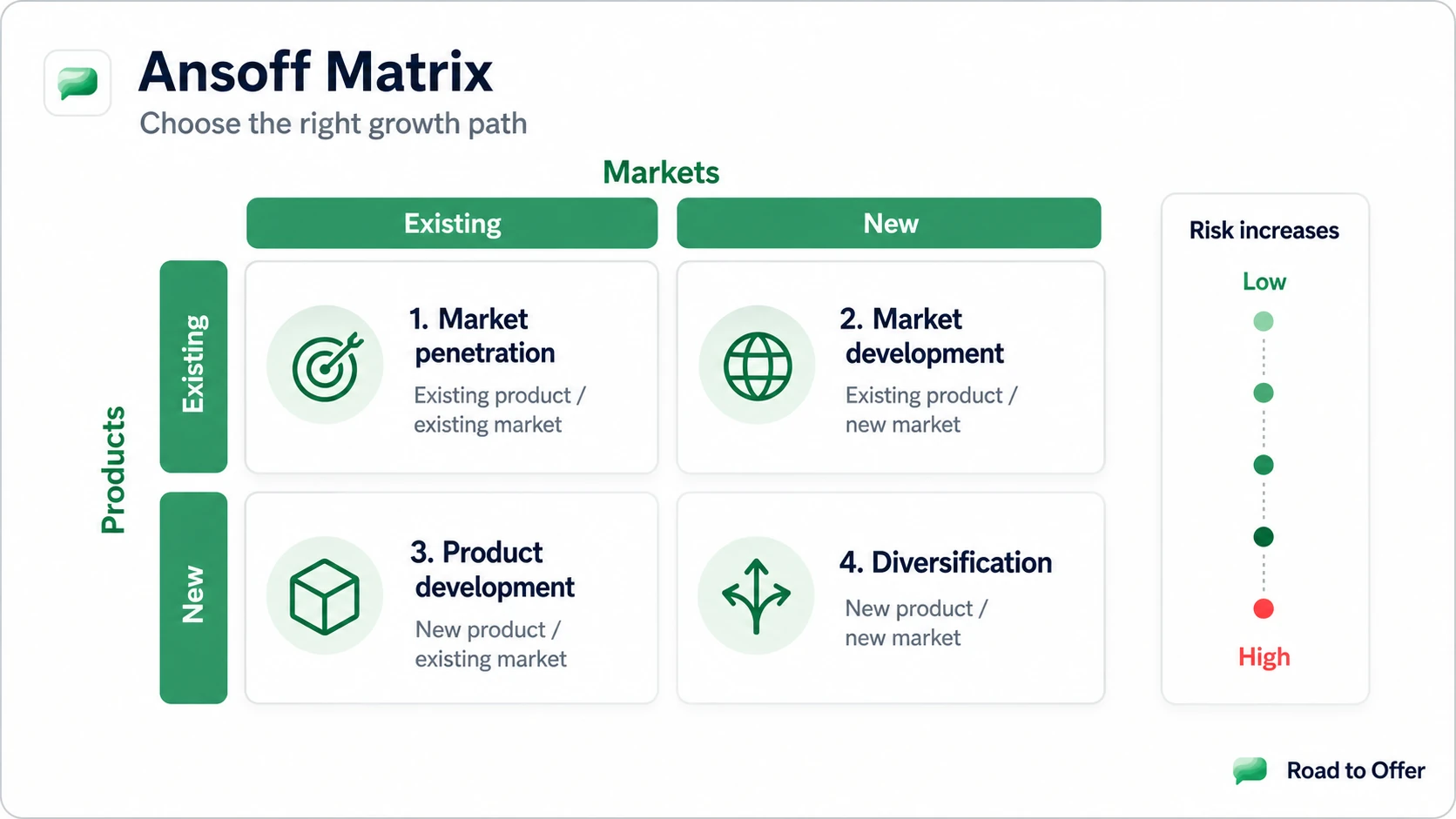
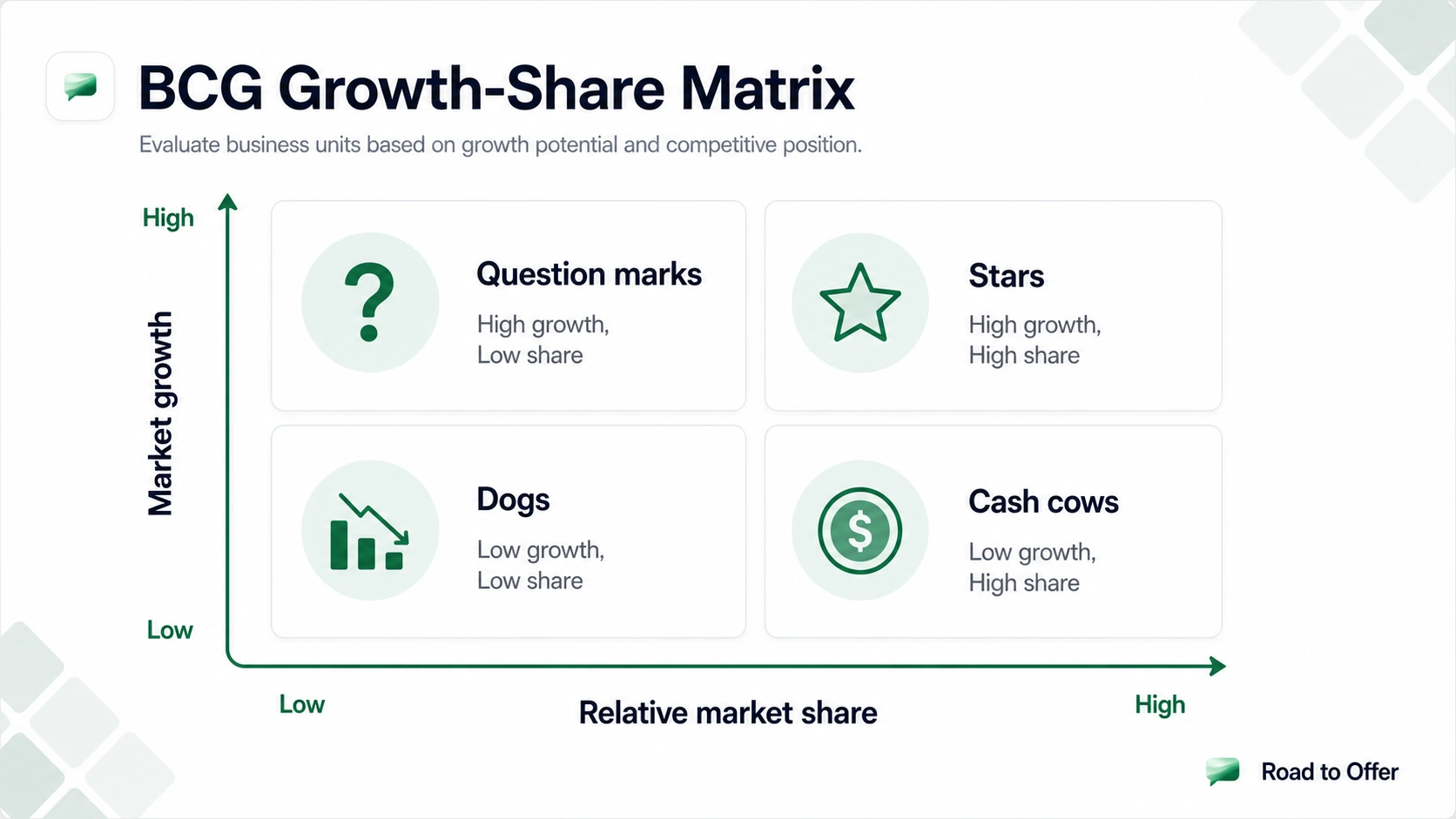
What are the four cells of each matrix?
Ansoff's four growth strategies, in rough order of risk:
- Market penetration (existing product, existing market): sell more to current customers. Lowest risk. Example: Coca-Cola pushing more volume through existing channels.
- Market development (existing product, new market): take the current product into a new geography or segment. Example: Spotify entering a new country.
- Product development (new product, existing market): build something new for current customers. Example: Apple launching the Apple Watch to its existing base.
- Diversification (new product, new market): both axes change at once. Highest risk. Example: Virgin moving from music into airlines, or Tesla extending from cars into home energy storage.
BCG's four portfolio quadrants:
- Stars (high growth, high share): leaders in fast markets. They generate cash but also consume it to defend the lead. Example: a flagship product still scaling, like the iPhone in its early years.
- Cash cows (low growth, high share): mature leaders that throw off more cash than they need. They fund the rest of the portfolio. Example: Microsoft Windows.
- Question marks (high growth, low share): the bets. They need heavy investment to gain share, and not all of them will. Example: a new category entry where the firm is a minor player.
- Dogs (low growth, low share): weak position in a weak market. Often candidates for harvest or exit, but only after you check economics and strategic role.
When should I use the Ansoff Matrix vs the BCG Matrix in a case?
The table below maps the client question to the better lens, the opening branches it implies, and the data you would request next. Treat it as a starting point, not a script.
In a live case the client question selects the lens, and the lens then becomes a MECE issue tree with a data request attached to each branch. If the prompt is broader than either matrix (a falling-profit case, for example), reach for the profitability framework first and only borrow matrix axes where they sharpen a sub-branch.
Worked example: which matrix fits a growth case?
Prompt: a regional coffee chain's core stores have matured, and leadership wants a new growth plan.
A weak answer forces labels too early: "I would use Ansoff to find growth ideas and BCG to classify the business." It sounds prepared, but it does not clarify the decision. The interviewer still does not know whether you are solving for expansion path, capital allocation, economics, brand position, or execution risk.
A better answer starts with the CEO's actual question. If the CEO asks how the chain should grow, Ansoff logic fits. You separate options into selling more through current stores (penetration), expanding into new segments or geographies (market development), adding new products like packaged retail goods (product development), or combining a new product with a new market (diversification). Then you test each path against demand, margin, operational fit, brand risk, and competitor response.
If instead the CEO asks which formats or brands deserve capital, BCG logic fits. You compare the portfolio by market growth, relative position, cash generation, and investment need. A promising new format may be a question mark worth funding. A mature drive-through format may be a cash cow that funds other bets. A weak format in a declining market may be a dog that needs repair or exit, but only after you check economics and strategic role.
Candidate line you can say out loud: "First I want to confirm whether the CEO is choosing a growth path or allocating capital across the current portfolio. If it is a growth-path question, I will use product and market logic. If it is a portfolio question, I will compare market attractiveness, competitive position, and economics." On Road to Offer, candidates who say a line like that before drawing any boxes consistently score higher on structure than candidates who name a framework in the first sentence. The reps that move the needle are the ones where you choose the lens and justify it before you analyze.
How do companies use Ansoff and BCG together?
In real strategy work the two are complementary, not competing. The common sequence is three steps:
- Use Ansoff to identify the expansion options on the table.
- Use BCG to assess the strength of the existing portfolio.
- Allocate resources by funding the chosen growth path from the cash the portfolio can spare.
The bridge sentence is concrete: a company may spot a new-market opportunity with Ansoff, then use BCG to confirm that its cash cows generate enough surplus to fund the move without starving its stars. In a case, only run both when the prompt actually contains both questions. Running two frameworks to look thorough is the fastest way to lose the thread and run out of time.
What are common mistakes that make both matrices weak?
The most common mistake is label-first structure. The candidate hears "growth" and announces Ansoff, or hears "portfolio" and announces BCG. Interviewers do not reward the label. They reward the fit between the client objective, the branches, and the evidence requested. This is the single error that separates a memorized framework from a custom structure.
A second mistake is overlapping branches. If market development already covers new geographies, new channels, and new customers, do not list those same ideas again under diversification unless the product also changes. Clean separation matters, which is why MECE thinking keeps the analysis from collapsing under pressure.
A third mistake is treating BCG quadrants as recommendations. Stars, cash cows, question marks, and dogs are labels, not verdicts. A cash cow may still need defensive investment. A question mark may deserve funding or may waste capital. A dog can be strategically useful inside a broader customer relationship. You need economics, feasibility, and the client objective before recommending action.
The last mistake is no data request. Strong frameworks make the next analysis obvious. Weak frameworks produce a pretty diagram and then stop. For a fuller catalog of these traps, see consulting framework mistakes.
Strengths and limits: which framework should you trust?
Ansoff's strengths are that it is simple, expansion-focused, and forces an explicit read on risk (diversification flags the riskiest bet). Its limits are real: it ignores competitive dynamics, carries no financial metrics, and offers no portfolio view. It tells you the type of growth, not whether you can win.
BCG's strengths are a clear portfolio structure, direct support for resource allocation, and a link from strategy to cash. Its limits are that it oversimplifies markets to two axes, leans heavily on relative market share as a proxy for profitability, and can miss emerging opportunities that do not yet show up as high growth or high share.
Because each has a blind spot, neither should be your only lens. In a case, that is the point: you borrow the axis that earns its place in your tree and drop the rest. For the broader toolkit and when to reach for each, the case interview frameworks complete guide is the hub.
Practice drill: turn the matrix into a custom issue tree
Use this drill with mixed prompts. Read the prompt, choose Ansoff, BCG, hybrid, or neither, build the opening issue-tree layer, say your opening data request out loud, and state what would make you switch approach.
Interactive drill set. Write an answer before revealing the worked solution, then continue into Road to Offer for scored practice and AI feedback.
Score yourself on five things. Fit: the lens matches the client decision. MECE: branches do not overlap. Prioritization: you can name the path to test first. Evidence: every branch has a data need. Spoken clarity: an interviewer can follow your logic without seeing your notes. When that feels natural, the next step is a full case where structure, math, and synthesis all interact at once, which you can run through the case interview prep guide.
Practice choosing the right structure
Use a free structure drill to turn Ansoff or BCG logic into a clean issue tree you can explain out loud under pressure.
Sources
- Corporate Finance Institute, Ansoff Matrix (checked June 17, 2026)
- Corporate Finance Institute, BCG Matrix (checked June 17, 2026)
- FourWeekMBA, BCG Matrix vs Ansoff Matrix (checked June 17, 2026)
- WallStreetMojo, BCG Matrix explained and vs Ansoff Matrix (checked June 17, 2026)
- Boston Consulting Group Careers, Case Interview Preparation (checked June 17, 2026)
Frequently asked questions
Resources and related guides
- Practice the Ansoff Matrix in a real case interviewPractice
- Browse all free resourcesResource hub
- VRIO Framework: How to Analyze Competitive Advantage in a CaseFrameworks · Jun 2, 2026
- 3Cs Framework: Company, Customer, Competitor (Worked Example)Frameworks · Feb 6, 2026
- 4Ps Framework Case Interview: Product, Price, Place, PromotionFrameworks · Feb 6, 2026
- Duke Fuqua Case Book: Adapting Frameworks by TypeFrameworks · Jul 18, 2026
- Driver Tree: Case Interview Examples, Math, and PitfallsFrameworks · May 22, 2026