
3Cs Framework: Company, Customer, Competitor (Worked Example)
Learn the 3Cs framework (Company, Customer, Competitor) for case interviews: when to use it, the questions under each C, a fully worked numeric example, and the mistakes that flag a memorized answer.
On this page
Use the 3Cs framework when the case is really asking how a company should compete. Your answer should connect three facts at once: what the company can realistically do, what customers value enough to pay for, and where competitors leave an opening. If the prompt is mainly about a profit decline, cost spike, or operating bottleneck, start with a profitability framework or issue tree instead, then bring in the 3Cs only after you know the strategic choice.
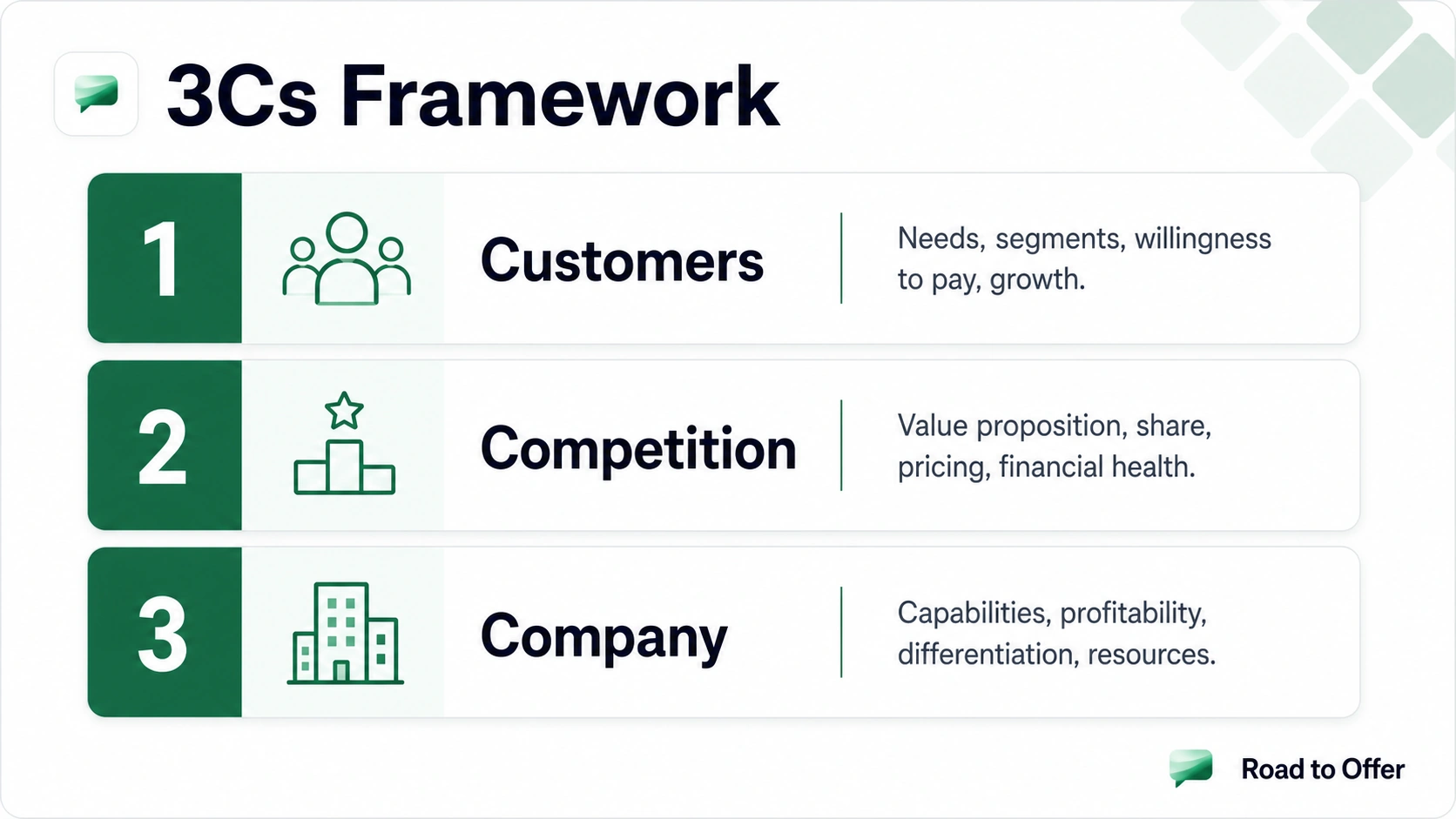
The 3Cs comes from Kenichi Ohmae, a former McKinsey partner who introduced it in his 1982 book The Mind of the Strategist. His point: strong strategy is not internal planning in a vacuum, it is the overlap of three forces he called the strategic triangle. In a case that matters because strong answers do not stop at "the market is attractive." They show why this client can win with these customers against those competitors, while keeping the branches clean enough to pass the MECE test.
When Should You Use the 3Cs Framework?
The 3Cs framework is strongest when the case is about positioning, growth, or competitive response.
Good use cases:
- market share decline
- customer retention issues
- brand positioning
- go-to-market strategy
- new segment targeting
- "how should we compete?" questions
Weak use cases:
- pure profitability diagnosis
- cost cutting
- supply chain problems
- org redesign
- restructuring
The mistake candidates make is using the 3Cs as a universal template. Interviewers notice that fast. If the prompt says "why did margin fall?", diagnose economics first. If it says "which segment should we pursue?" or "how should we respond to a new entrant?", the 3Cs is usually a strong opening lens.
Interactive drill set. Write an answer before revealing the worked solution, then continue into Road to Offer for scored practice and AI feedback.
What Do You Analyze Under Each C?
Company
Start with what the client can actually do.
Useful questions:
- What capabilities does the client already have?
- Where is the cost position stronger or weaker than peers?
- What brand, channel, data, or product advantages already exist?
- What constraints make certain strategies unrealistic?
This keeps the answer grounded. A company cannot pursue a premium strategy without brand trust, or a low-cost strategy if its unit economics are structurally weak. If this branch turns into a cost diagnosis, switch into a profitability tree rather than forcing every issue under "Company."
Customer
This is where many weak case answers go soft. "Customers want quality and price" is not analysis.
Better questions:
- Which segment matters most?
- What job is the customer hiring the product to do?
- What drives willingness to pay?
- What causes churn or switching?
- Who makes the decision, and is the buyer the same as the user? In healthcare the doctor prescribes, the insurer pays, and the patient uses, so three people shape one purchase.
If the customer branch is vague, the whole framework becomes generic. For segmentation-heavy cases, go deeper with the customer segmentation framework instead of leaving "Customer" as one broad bucket.
Competitor
Competitor analysis is not just a list of rivals. It is about how the playing field shapes the client's options.
Useful questions:
- Who are the real alternatives, including indirect substitutes?
- How are competitors positioned on price, product, and channel?
- Where are they strong?
- Where are they vulnerable?
- What would they do if the client changed strategy?
That last question is the one most candidates skip. A move only works if competitors cannot copy it cheaply, so always ask how a rival would react. This branch is what prevents nice-sounding but unrealistic recommendations.
What Is the Strategic Triangle?
The three branches are not a checklist, they are a triangle. Ohmae argued that a defensible strategy lives where all three overlap:
- a real, prioritized customer need
- a company capability that serves it better than rivals can
- a spot where competitors are weak or slow to respond
Hit only two of the three and the strategy leaks. A customer need you cannot serve profitably is a money pit. A capability customers do not value is a vanity project. A move competitors can copy in a week is a price war waiting to happen. The job in a case is to find the one overlap that satisfies all three, then build the recommendation there.
How Do You Turn the 3Cs into a Case Structure?
The 3Cs should sound like a tailored structure, not like you memorized a textbook.
A good setup sounds like this:
"Because the core question is how the client can win in this market, I would like to look at three areas: first, the client's capabilities and constraints; second, which customer segments are most attractive and what they value; and third, how competitors are positioned and where there may be whitespace. I will then look for the overlap, the move that fits a real customer need, plays to a company strength, and lands where rivals are weak."
That is much better than just saying "I will use the 3Cs framework."
Turn the 3Cs into a Bain market entry structure. A residential solar installer wants to enter the Texas home battery market and hit $2M of year-1 EBITDA. Answer this Bain market entry case step in the article, then continue the full case. Continue the full case on Road to Offer
How Do You Triangulate a Cause of Lost Share?
The 3Cs is also a diagnostic, not just a planning tool. When a client is losing share, the cause lives in one of the three Cs, and each points to a different fix:
- Company got worse: a quality slip, a price increase, a slower product, weaker service.
- Competitor got better: a new product, lower prices, a new distribution partner, heavier marketing.
- Customer changed: shifting preferences, a demographic shift, or a move to a substitute.
So when an interviewer says "share fell from 30 to 24 percent in two years," do not jump to ideas. Ask which C moved. If the client's product and prices held steady while a rival launched a cheaper line that pulled the price-sensitive segment, the cause is Competitor plus Customer, and the fix is a positioning or tiering response, not an internal turnaround. Naming the C that moved keeps you from solving the wrong problem.
Worked Example: A Real-World Triangle (Sakura vs Fuji)
Ohmae's own example is the cleanest way to see the triangle work. In the Japanese film market, Sakura was losing share to Fuji, the larger brand known for sharp color. A price cut was the obvious move, but a price war against a bigger rival is exactly the trap the triangle warns against: the competitor matches it and Sakura just bleeds margin. To rehearse that translation from framework to tailored tree, build it in the free case structure builder and read the feedback on where your three branches overlap.
Walk the three Cs instead:
- Company: Sakura could not out-spend Fuji on brand or out-shoot it on image quality, but it was cost-efficient enough to package film differently.
- Customer: buyers were growing more cost-conscious. The job they were hiring film to do was "more pictures per yen," not "the sharpest possible image."
- Competitor: Fuji was anchored on its 20-exposure roll and its quality reputation, and was unlikely to undercut its own premium positioning quickly.
The intersection: Sakura launched a 24-exposure roll priced the same as Fuji's 20-exposure roll. At an identical shelf price, that is 24 versus 20 exposures, 20 percent more pictures for the same money, so the cost per shot falls without any visible discount. The move sat at the center of the triangle: a company strength (cost-efficient packaging), a customer need (lower cost per shot), and a competitor blind spot (Fuji would not cannibalize its premium roll to match). No price war required.
Finding that overlap is a live skill, not a reading exercise. To apply the 3Cs end to end, practice this framework on a real case where company capability, customer need, and competitor position all drive the recommendation.
Worked Example: Putting Numbers on the Intersection
Now apply the same logic to a typical prompt. The client is a mid-market software company losing share to cheaper rivals in the SMB (small and mid-size business) segment. A solid 3Cs structure should lead to a sized choice, not a checklist.
- Company: best-in-class reporting, but an expensive enterprise sales model (about $4,000 to acquire each customer) and slow onboarding.
- Customer: SMB buyers want easy setup and predictable pricing. One underserved slice is compliance-driven SMBs who need audit-grade reporting, the client's strength, an estimated 30,000 target accounts.
- Competitor: Rival A wins on price, Rival B on distribution, but neither offers the reporting quality compliance buyers need.
Synthesis: Sizing the Intersection
The intersection is clear: target compliance-driven SMBs with a lighter, self-serve tier built on the reporting strength rivals lack. Now size it. Suppose self-serve cuts acquisition cost from $4,000 to $1,500 and the client captures 5 percent of the 30,000 target accounts in year one, at $3,000 revenue per account:
- accounts won: 30,000 x 5% = 1,500
- year-one new revenue: 1,500 x $3,000 = $4.5M
- acquisition spend: 1,500 x $1,500 = $2.25M, versus $6M at the old $4,000 cost, a $3.75M go-to-market saving
So the recommendation is not "compete harder." It is:
"Launch a self-serve tier for compliance-driven SMBs built on the reporting advantage. That captures roughly 1,500 accounts and $4.5M of new revenue in year one while cutting acquisition cost by about $3.75M, because it matches an underserved customer need, fits a company strength, and exploits a gap both rivals share."
That is what a good 3Cs answer does. It finds the intersection, then puts a number on it.
Interactive drill set. Write an answer before revealing the worked solution, then continue into Road to Offer for scored practice and AI feedback.
Practice Checkpoint
Try this prompt: "A regional gym chain is losing members to low-cost national gyms and boutique fitness studios. How should it respond?"
Do not open with "Company, Customer, Competitor" as labels only. Make each branch specific to the decision:
How should the gym chain compete?
+-- Company: local brand trust, locations, class capacity, cost floor
+-- Customer: segments at risk, willingness to pay, switching triggers
+-- Competitor: low-cost gyms on price, boutiques on experience, likely response
The first hypothesis could be: "I would test whether the client can defend busy professionals who value convenience and classes, rather than matching national chains on price." That answer uses the 3Cs correctly because it links capability, customer need, and competitor position, and it leads with a hypothesis instead of a blank checklist. Drill this exact prompt below before you move on:
Interactive drill set. Write an answer before revealing the worked solution, then continue into Road to Offer for scored practice and AI feedback.
To apply the 3Cs end to end on a live prompt, work a case where customer need, company capability, and competitor position all drive the decision.

Market entry · hard
Practice the 3Cs framework in a real case interview
Matched to this 3Cs framework guide: a live consumer services market entry case with an AI interviewer. Free, scored on every step.
How Does the 3Cs Compare to Other Frameworks?
This is where candidates usually overuse the 3Cs.
A note on the close cousins. The 4Ps (product, price, place, promotion) is marketing execution, used after the strategy is set. The 4Cs adds Context (regulation, tech shifts, macro trends) as a fourth lens, worth folding into your Competitor or Company branch on regulation-heavy prompts. The 3Cs is the strategic diagnosis that comes first.
In real cases you combine frameworks: use Five Forces for market attractiveness then the 3Cs for how to compete, or a profitability tree to find the problem then the 3Cs to design the response. For a wider map, see the complete frameworks guide and the difference between a case structure and a case framework.
What Are the Most Common 3Cs Mistakes?
Treating each C as a checklist
If you ask 20 shallow questions, the structure sounds busy but not insightful. Depth on the two or three questions that matter beats coverage.
Forgetting that the Cs are connected
The framework works because the branches interact. A great customer opportunity means little if the company cannot serve it profitably or competitors can copy it instantly. The triangle is the point.
Using the 3Cs on the wrong case
If the case is about a cost spike, the interviewer probably wants a profitability tree, not a market analysis. See more pattern-matching traps in framework mistakes to avoid.
Giving generic customer analysis
"Customers want high quality and low price" is almost always useless. Segment, need, willingness to pay, and switching behavior are the useful parts.
Ending without synthesis
Good candidates do not just summarize Company, Customer, and Competitor separately. They use the intersection to make a recommendation, then size it, the way every strong case synthesis closes.
Sources (checked June 18, 2026)
- Umbrex - 3Cs framework by Ohmae: https://umbrex.com/resources/frameworks/marketing-frameworks/3cs-framework-company-customer-competitor-ohmae/
- Tom Spencer - Three C's Framework: https://www.spencertom.com/2015/07/17/three-cs-framework/
- B2B Frameworks - 3Cs (Sakura vs Fuji example): https://www.b2bframeworks.com/frameworks/3cs
- Management Consulted - Case Interview Frameworks
- IGotAnOffer - Common Case Interview Frameworks
Frequently asked questions
Resources and related guides
- Practice the 3Cs framework in a real case interviewPractice
- Browse all free resourcesResource hub
- 4Ps Framework Case Interview: Product, Price, Place, PromotionFrameworks · Feb 6, 2026
- Ansoff Matrix vs BCG Matrix for Case InterviewsFrameworks · Jun 2, 2026
- M&A Case Interview Framework: 5 Steps + Synergy Math (2026)Frameworks · Feb 6, 2026
- Mock Consulting Case Interview Prep: Frameworks and FeedbackFrameworks · May 1, 2026