
Oliver Wyman Practice Cases: 8 Math-Heavy Worked Examples (2026)
Oliver Wyman practice cases with worked math, including every official OW case decoded (Wumbleworld, Aqualine, Dairy Farm, Supermarket Pharmacy) plus 8 worked OW-style cases with full math.
On this page
Oliver Wyman publishes eight of its own practice cases, more free first-party material than most consulting firms release, and each one is a candidate-led problem that ends on a hard quantitative verdict. The Supermarket Pharmacy case gives a $4 million investment, a 25% drug margin, and a 2-year payback constraint, and lands at roughly 24 months on pharmacy profit alone. The Dairy Farm case sets two Illinois farms at the same 25% profit margin so the answer turns on scale, with Farm One holding over 70% of local production. The Oil Gas Price Strategy case is rejected outright on an 11.4-year payback against a required 5-year threshold.
The firm's own guidance frames the case as collaboration rather than interrogation: "think of your case interviewer as your client. They want you to solve the problem, and can help you to do so." It then publishes a six-step method, pinpoint the issue, break it down, pick an approach, analyze the issues, use numbers, and make a recommendation, which is effectively a rubric you can rehearse against.
This page decodes all eight official cases, then gives 8 additional OW-style practice cases with full worked arithmetic, weighted toward the financial services and industrial prompts that generalist practice material skips. For the format overview, round structure, and a 30-day plan, see the Oliver Wyman Case Interview Guide.
What Should an Oliver Wyman Practice Example Show?
A useful OW example is not a transcript. It is the four things you can actually rehearse: the prompt with its constraint, the first structure you would propose out loud, the calculation that decides the answer, and the recommendation with a number attached to it.
Work each case in that order and you will find your failure point in one pass. Most candidates discover it is not structure. It is that the arithmetic slows down enough that the structure stops mattering.
Oliver Wyman vs MBB: What Actually Differs for Practice
Oliver Wyman sits in a different part of the market than MBB, and the practice implications are concrete rather than reputational.
Two practical consequences. First, if you have only practiced McKinsey-style cases where exhibits arrive with the question attached, OW will feel harder because you have to decide which analysis is worth running. Second, if your arithmetic is only fast enough for a calculator-free screen, the case round will expose it, because OW cases stack calculations rather than isolating them.
The fastest way to find out which of those two is your problem is to take one graded arithmetic rep before you read another case.
Rep the calculator-free arithmetic an OW case runs on from the Road to Offer drill engine. Answer a real prompt and get AI-scored feedback. Free accounts include 5 drills per day for the first 3 days after signup.
The Question Types Inside an Oliver Wyman Case
Oliver Wyman's published six-step method maps almost one to one onto the question types you will be asked. Each one is a separate skill, and each one can be rehearsed on its own before you ever sit a full case.
Notice what is missing from that list: nothing about naming a framework. OW's method never asks you to label your structure. It asks you to break the problem down and then justify which piece you attack first. That justification is the scored moment, and it is the one most candidates skip.
The structure step is also the one you cannot grade yourself, because a tree you invented always looks MECE to the person who invented it. Get one scored before you work the official cases.
Build a candidate-led structure and get it scored from the Road to Offer drill engine. Answer a real prompt and get AI-scored feedback. Free accounts include 5 drills per day for the first 3 days after signup.
The Official Oliver Wyman Cases, Decoded
These are the cases Oliver Wyman itself publishes. Work them before any third-party material, because they are the only prompts you can be confident reflect how OW actually writes a case.
Wumbleworld: the chart-reading profitability case
An amusement park operator in China has declining profits and asks Oliver Wyman to find the cause and reverse it. The case is built around exhibits, so the job is to read a chart, say what it changes about your hypothesis, and move on rather than narrating every series on the page.
What it trains: exhibit triage and the revenue-versus-cost split inside a profitability framework. The trap is treating each chart as its own question instead of building one running hypothesis across all of them.
Aqualine: the growth and case-math case
Aqualine manufactures small powerboats. Its CEO wants to know why sales have slowed and where growth could come from. This is the case most often recommended for arithmetic practice, because the analysis is a chain of revenue decompositions rather than a single calculation.
What it trains: breaking revenue into volume, price, and mix, then estimating the size of each recovery lever. If you find yourself losing track of units, that is the case telling you something.
Supermarket Pharmacy: the payback case
A supermarket owner wants to know whether to open an in-store pharmacy, subject to a payback period of two years or less. Oliver Wyman publishes the data and the answer.
The given data: city population of 50,000 and stable; 10,000 monthly supermarket visitors; $10 million in monthly supermarket sales; three competing pharmacies in the area; 66% of Americans use prescription drugs; average out-of-pocket drug spend of $100 per person per month; $4 million initial investment; 25% profit margin on prescription drugs; 10% incremental supermarket sales if the pharmacy opens; 5% supermarket profit margin.
The arithmetic that decides it. Addressable customers are 50,000 times 66%, so 33,000 people. At $100 per month that is a $3.3 million monthly local drug market. Take a 20% share against three incumbents and you get $660,000 of monthly pharmacy revenue. At a 25% margin that is $165,000 of monthly profit. Against a $4 million investment, payback is $4,000,000 divided by $165,000, which is roughly 24 months. That sits exactly on the two-year constraint, which is why the case does not end there: the incremental grocery contribution, 10% of $10 million at a 5% margin, adds a further $50,000 a month and pulls the payback comfortably inside the hurdle. The published recommendation is yes, open the pharmacy.
What it trains: holding a constraint in mind while you build the number, and knowing that a marginal answer means you have not yet counted every benefit stream.
Dairy Farm: the two-option comparison
A private equity firm with no farming experience is choosing between two dairy farms in Illinois. Oliver Wyman gives you both operations and asks which to buy.
The given data: Farm One runs 10,000 cows producing 100 units of milk each, so 1,000,000 units, with variable costs of $10 per unit and $5 million of fixed costs. Farm Two runs 5,000 cows producing 80 units each, so 400,000 units, with variable costs of $15 per unit and $3 million of fixed costs. Standard milk sells for $20 per unit and organic for $30.
The arithmetic that decides it. Farm One at standard pricing earns $20 million of revenue, $10 million of variable cost, $5 million of fixed cost, so $5 million of profit on $20 million, a 25% margin. Farm Two selling organic earns $12 million of revenue, $6 million of variable cost, $3 million of fixed cost, so $3 million of profit on $12 million, also a 25% margin. The margins tie deliberately. Farm One wins on $2 million of extra absolute profit and on holding more than 70% of local market share by both herd size and production volume.
What it trains: noticing when a ratio comparison is designed to be uninformative. When two options match on percentage, the decision moves to absolute value, share, and risk. The published answer also accepts a defensible no, on the grounds that a PE firm without operating expertise in the sector may be the wrong owner.
Oil Gas Price Strategy: the market sizing and payback case
An Indian midstream oil and gas company wants to grow revenue and is considering entering drinking water distribution through purification plants sold to municipal corporations.
The sizing step. Bangalore has a population of 12 million in roughly 3 million households. Municipal water is priced at Rs. 10 per kilolitre. Coverage runs at 20% for low-income households, 50% for medium, and 100% for high-income, with daily consumption of 1, 2, and 4 kilolitres respectively. The published estimate lands at total daily demand of about 2,500,000 kilolitres, with the growth story sitting in the roughly 90% of the population that is underserved.
The viability step. Assume a 10% share, so 250,000 kilolitres per day. Fixed costs are Rs. 20 crore a year, variable costs Rs. 5 per kilolitre, and initial capex Rs. 200 crore. The published answer computes a payback period of 11.4 years against a client threshold of five years, and rejects the entry. Reproduce that arithmetic yourself rather than accepting it, because the reconciliation between the sizing and the volume assumption is exactly where a real interviewer will push you.
What it trains: a segmented sizing built from household income bands, then the discipline of testing the result against a stated hurdle instead of declaring a market "large".
Urban Grocers, Autism Digital Device, and Poseidon Water Park
Oliver Wyman's interview preparation page links three further cases: Urban Grocers, a retail problem; Autism Digital Device, a medical device and market access problem; and Poseidon Water Park, a leisure operations and profitability problem. They matter for one reason beyond the practice: they show that the "Oliver Wyman only cases financial services" belief is wrong. The firm's published prompts run across grocery retail, agriculture, energy midstream, health devices, and leisure. Financial services vocabulary matters if you are interviewing into those practices, but the case archetypes are general.
The Oil Gas case is also the clearest signal in the whole set that OW openers can be sizing questions with a decision hanging off them. Build one under time pressure and see whether your segment logic survives.
Size a market the way an OW opener demands from the Road to Offer drill engine. Answer a real prompt and get AI-scored feedback. Free accounts include 5 drills per day for the first 3 days after signup.
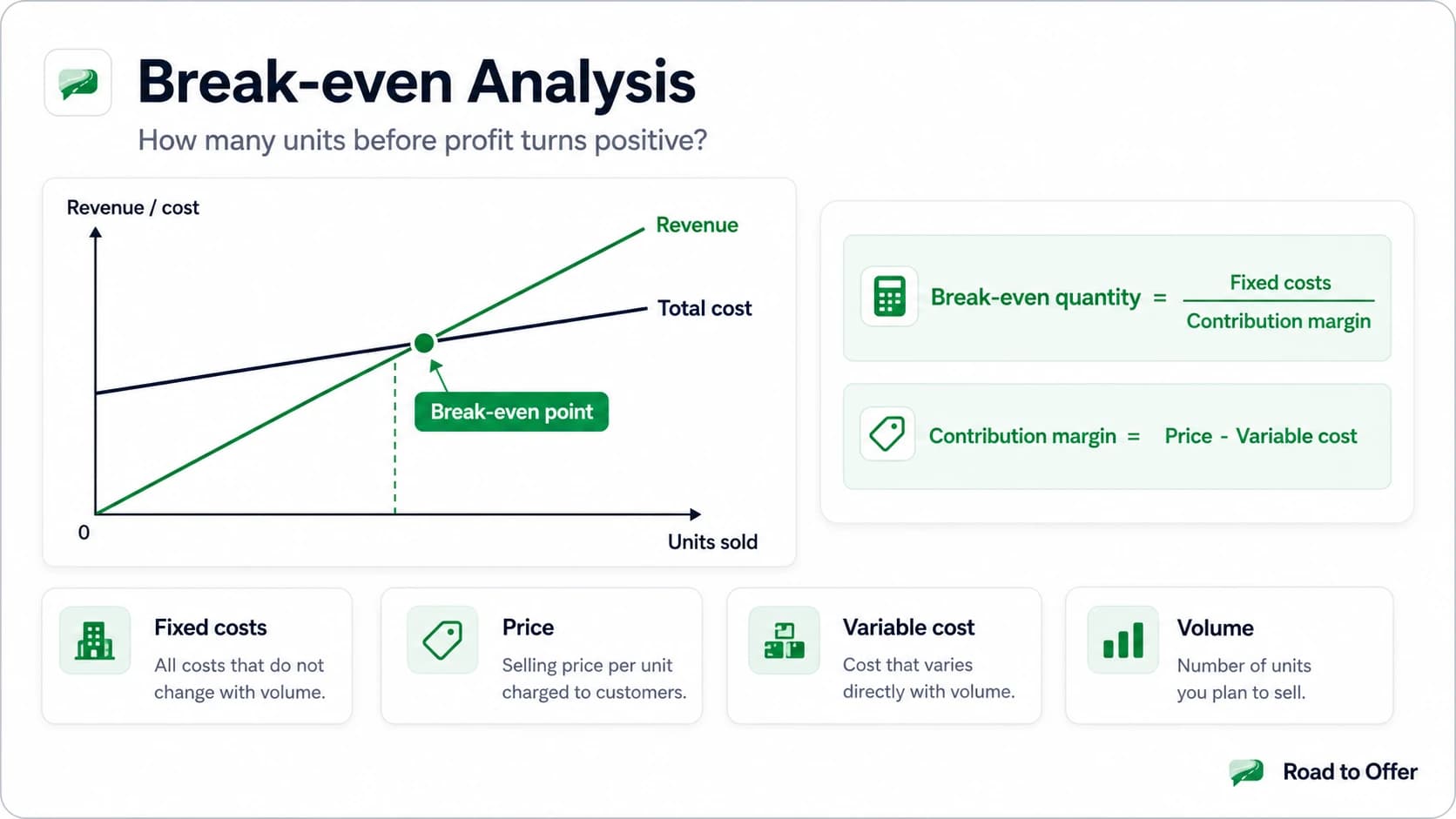
Learn the case math method
Setup, units, and shortcut math, linked to timed scored reps.
8 Oliver Wyman Style Practice Cases With Worked Solutions
Every prompt below is written in the OW shape: candidate-led, with a stated constraint, and decided by arithmetic you can do on paper. The numbers are case assumptions, not published external data. Cover the worked approach, do the calculation, then compare.
Case 1: Retail bank branch network profitability
Prompt: A European retail bank has 800 branches. Cost-to-income ratio has risen from 58% to 66% over three years while deposits grew 4% a year. The CEO wants the ratio back under 60% within two years without losing deposit share. Where do you start?
A candidate-led structure: three testable branches. First, is the income side weak (net interest margin compression from falling rates, or fee income decline)? Second, is the cost side heavy (branch property and staff, or central functions)? Third, is the branch network itself mispriced against how customers now transact?
Worked approach:
- Decompose the ratio. If income is flat at 3.0 billion euros and costs rose from 1.74 billion to 1.98 billion, the entire deterioration is cost-side and you can drop the income branch quickly. Saying that out loud is the scored moment.
- Split the 240 million euro cost increase. If branch staff and property account for 180 million of it while central functions account for 60 million, the network is the problem.
- Test the network against usage. If 30% of branches serve under 40 transactions a day and each costs 400,000 euros a year to run, that tail is 240 branches costing 96 million euros a year.
- Size the fix. Closing or converting half of that tail saves roughly 48 million euros, which moves the ratio by 1.6 points. That is not enough on its own, so the answer needs a second lever: shifting servicing volume to digital channels to take out the variable staffing behind the remaining low-traffic branches.
Recommendation: convert the lowest-traffic 120 branches to self-service formats and consolidate central functions, targeting roughly 150 million euros of cost, which returns the ratio to about 61%. Close the remaining gap with fee repricing rather than further closures, because deposit share is the stated constraint.
The step that separates a strong answer here is the decomposition in point one, which is a pure arithmetic move under time pressure. If reading a cost-to-income ratio and immediately knowing which side moved is not automatic yet, that is the drill to run.
 Bain
BainProfitability · hard
Run a live European margin-recovery case
Different client, same skill this OW-style branch case tests: decompose the margin, find which side moved, and quantify the fix before you recommend it.
Case 2: Motor insurer underwriting turnaround
Prompt: A motor insurer's combined ratio has moved from 97% to 104% in two years. Premiums grew 9% annually over the same period. The board wants the combined ratio back under 100% in 18 months. What is happening, and what would you do?
Why this is an OW case: the vocabulary is the barrier. Combined ratio is the loss ratio plus the expense ratio, expressed against earned premium. Above 100% means the underwriting book loses money before investment income. Generalist case prep does not teach this, and OW insurance interviews assume it.
Worked approach:
- Split the seven-point deterioration. If the loss ratio moved from 68% to 76% while the expense ratio fell from 29% to 28%, the problem is entirely claims, and cost programs are the wrong answer.
- Split the loss ratio by frequency and severity. If claim frequency is flat at 6% of policies but average claim severity rose from 2,400 to 2,850 euros, that is a 19% severity increase against 9% premium growth, which explains the gap almost exactly.
- Ask what drives severity. Parts inflation, repair labour rates, and a mix shift toward newer vehicles with sensor-laden bumpers are the usual candidates. If the book grew 9% by writing more new-vehicle business at unchanged rates, growth caused the loss.
- Size the repricing. Closing a seven-point gap on a 76% loss ratio needs roughly a 9% rate increase on the affected segment, or a smaller increase paired with a deductible change.
Recommendation: reprice the newer-vehicle segment by 9% and raise the deductible on the highest-severity cohort, accepting a volume loss of a few points. Do not cut expenses, because the expense ratio already improved and cutting it further would not close the gap.
Case 3: Market sizing opener, urban gyms
Prompt: Before we discuss the strategy, size the annual revenue of the boutique fitness studio market in a European city of 3 million people.
Why OW opens this way: as the Oil Gas case shows, an OW sizing question usually carries a decision behind it. Your number sets whether the subsequent strategy conversation is about capturing a large market or defending a niche.
Worked approach (segmented, top-down):
- City population 3 million. Adults aged 20 to 55, the realistic boutique fitness population, are roughly 45%, so 1.35 million people.
- Gym membership penetration in that group is roughly 20%, so 270,000 gym members.
- Boutique studios (as opposed to large chain gyms) take roughly 25% of members, so about 68,000 boutique members.
- Average boutique spend is about 90 euros per month, so 1,080 euros a year.
- Market size: 68,000 times 1,080, which is roughly 73 million euros a year.
Sanity check: that is about 24 euros per city resident per year on boutique fitness, which is plausible for a wealthy European city and clearly too high for a low-income one. State the check out loud. A number without a sanity check reads as guessing even when it is right.
How it connects: a 73 million euro market with, say, 40 studios means average studio revenue of 1.8 million euros. If your client's studios do 900,000 euros each, the case is about underperformance, not market size. That pivot is what the opener exists to enable. For the method behind this, see market sizing step by step and the worked prompts in market sizing questions.
Case 4: Asset manager cost reduction
Prompt: An asset manager with 120 billion euros of assets under management earns 38 basis points in fees. Operating costs are 340 million euros a year. The CEO wants operating margin up 8 points in two years. Where does that come from?
Worked approach:
- Establish the baseline. Revenue is 120 billion times 0.0038, so 456 million euros. Costs of 340 million leave 116 million of operating profit, a 25.4% margin. Adding 8 points means reaching 33.4%, so profit of roughly 152 million, which means costs must fall to about 304 million. That is a 36 million euro reduction, or 10.6% of the cost base.
- Decompose the cost base. Typical splits are investment staff (35%), distribution and sales (25%), operations and technology (25%), and corporate functions (15%). That is 119, 85, 85 and 51 million euros.
- Test each for elasticity. Investment staff cuts damage performance and therefore future flows, so that branch is constrained. Operations and technology carries the most structural fat: outsourcing middle-office functions and consolidating fund administration platforms is the standard 20% to 30% reduction lever, which on 85 million is 17 to 25 million.
- Find the rest. Corporate function consolidation at 15% gives roughly 8 million. Rationalising subscale funds removes both operations cost and distribution effort: closing funds below 200 million euros of assets typically removes 5% to 8% of the operational load.
Recommendation: target 36 million euros through a middle-office outsourcing program (20 million), corporate function consolidation (8 million), and subscale fund rationalisation (8 million). Hold investment staff flat, because the constraint is a margin improvement that does not cost future flows.
Why it is OW-shaped: the arithmetic in point one is the whole case. If you cannot convert "8 margin points" into "36 million euros of cost" quickly, you spend the case discussing levers without knowing whether any of them are big enough.
Case 5: Payments processor pricing
Prompt: A payments processor charges merchants a blended 1.9% of transaction value. A competitor has entered at 1.6%. The client is losing its largest merchants. Should it match?
Worked approach:
- Establish unit economics. On 20 billion euros of annual processed volume, 1.9% is 380 million of revenue. Interchange and scheme fees passed through are roughly 1.3%, so 260 million, leaving a net take of 0.6%, or 120 million. Fixed platform costs are 70 million, so contribution is 50 million.
- Test the match. Cutting to 1.6% leaves a net take of 0.3%, so 60 million against 70 million of fixed cost. Matching across the whole book makes the business lossmaking. That is the answer to the question as asked.
- Segment instead. If the top 20 merchants are 60% of volume and are the only ones under attack, matching only on that segment costs 0.3% on 12 billion euros, so 36 million, leaving total net revenue of 36 plus 48, which is 84 million, still above the 70 million fixed base.
- Ask what else the client sells. Fraud tooling, settlement speed, and multi-currency support are the standard defences. If the large merchants value settlement speed, a same-day settlement product at 10 basis points recovers part of the price cut.
Recommendation: do not match across the book. Match selectively on the top merchants where the volume is defensible, and bundle a paid settlement or fraud product to recover the margin. State the number: a blanket match destroys 50 million euros of contribution and turns the business negative.
 McKinsey
Pricing · hard
Run a live pricing case
Same skill as Case 5: build the pricing structure, work the multi-step math, and land a defensible number.
Case 6: Airline ancillary and loyalty economics
Prompt: A European airline's ticket revenue is flat. The CFO wants EBIT margin up 3 points in two years. Where should the client look?
Worked approach:
- Break revenue into ticket, ancillary (bags, seats, boarding), cargo, and loyalty. On 6 billion euros of revenue, if ancillary is 12% and the low-cost benchmark is 25%, the gap is 13 points, worth 780 million euros of potential revenue at a very high incremental margin.
- Test whether the gap is a pricing or an attachment problem. If bag attachment is 35% against a 55% benchmark at similar prices, it is attachment, which is a booking-flow design problem rather than a pricing one.
- Size the loyalty lever. Airline loyalty programmes are usually the highest-margin part of the business because co-brand card agreements are financial products. If the current agreement was signed five years ago, repricing it typically moves group EBIT by 1 to 2 points on its own.
- Sequence by time to realise. Ancillary attachment changes ship in 6 to 9 months. Loyalty renegotiation takes 12 to 24 months.
Recommendation: two levers. Fix ancillary attachment first for roughly 1.5 points of margin inside a year, then renegotiate the co-brand agreement for a further 1.5 points. Do not open a network restructuring, which is slower than the two-year constraint allows.
Case 7: Private equity diligence on a pharmacy distributor
Prompt: A PE fund is considering a 420 million euro acquisition of a regional pharmaceutical distributor with 900 million euros of revenue and 4% EBITDA margin. Is this a good deal?
Worked approach:
- Convert to multiples. EBITDA is 900 million times 4%, so 36 million. At 420 million the entry multiple is 11.7 times, which is high for a low-margin distribution business unless there is a clear margin path.
- Test the margin path. Distribution margins move on route density, warehouse automation, and generic mix. If generics are 30% of volume at a 7% margin against 2% on branded, shifting mix by 10 points adds roughly 45 basis points of blended margin, which is about 4 million of EBITDA.
- Test the density lever. If the client serves 4,000 pharmacies from 6 depots and a competitor serves 6,000 from 4, consolidating to 4 depots is worth roughly 1 point of margin, so 9 million of EBITDA.
- Rebuild the multiple. At 36 plus 13, so 49 million of EBITDA, the entry multiple falls to 8.6 times, which is defensible. But both levers require operating capability the fund must have.
Recommendation: proceed only with an operating partner who has run distribution networks, and underwrite to the 49 million EBITDA case rather than the 36 million one. Without the capability, 11.7 times on a 4% margin business is overpaying. Note the parallel with the official Dairy Farm case: the recurring OW test is whether the buyer is the right owner, not just whether the asset is good.
 Bain
BainM&A · medium
Run a live diligence case
Same skill as Case 7: test the multiple, quantify the synergies, and close on an invest or pass call.
Case 8: Energy retailer churn and revenue growth
Prompt: A retail energy supplier with 2 million customers is losing 18% of them a year to switching. Average gross margin is 80 euros per customer per year. Acquisition cost is 120 euros. The CEO wants profitable growth. What do you do?
Worked approach:
- Establish the lifetime economics. At 18% annual churn, average customer life is 1 divided by 0.18, so roughly 5.6 years. Lifetime gross margin is 5.6 times 80, so about 445 euros against a 120 euro acquisition cost. The unit economics are positive, so growth is not inherently unprofitable.
- Find where the churn concentrates. If customers acquired through price comparison sites churn at 30% while direct customers churn at 9%, the blended figure hides two different businesses. Comparison-site customers have a lifetime margin of 267 euros against the same 120 euro acquisition cost, so still positive but half as valuable.
- Quantify the retention lever. Cutting blended churn from 18% to 14% extends average life from 5.6 to 7.1 years, adding roughly 120 euros of lifetime margin per customer. Across 2 million customers that is a very large number, which is the point: retention beats acquisition arithmetically at this churn level.
- Test the growth channels against that. Adding customers through comparison sites grows the book but dilutes the average.
Recommendation: shift spend from acquisition to retention, targeting the 14% churn level through fixed-term contract offers at renewal, and cap comparison-site acquisition at its current share so the mix does not deteriorate. Growth comes from holding the customers already paid for.
Reading Exhibits in an Oliver Wyman Case
The Wumbleworld case exists because chart reading is a distinct failure mode, and the written case in the final round is essentially a 30-minute exhibit triage exercise done alone. The scored behaviour is a fixed three-step loop: describe what the chart shows, interpret what it means for the client, then quantify the implication.
Where candidates lose points is between step one and step two. Reading a waterfall aloud is not analysis. Saying "volume added 12 points and price took away 19, so this is a pricing problem and the volume story is a distraction" is. In a written case where you have 40 minutes of material and 30 minutes to work, the triage decision (which exhibits are irrelevant to the question asked) is worth more than the reading speed.
Practise the loop against a chart you have not seen before, under time, and see whether you reach the client implication or stop at the description. For the underlying technique, see reading charts and exhibits in case interviews.
Read an exhibit and state the client implication from the Road to Offer drill engine. Answer a real prompt and get AI-scored feedback. Free accounts include 5 drills per day for the first 3 days after signup.
Self-Diagnostic: Are You Practising Like an Oliver Wyman Candidate?
After working the official cases and the eight above, answer these honestly.
- Did you hold the constraint in mind throughout? The Supermarket Pharmacy case is only interesting because of the two-year payback rule, and the Oil Gas case is only rejected because of the five-year threshold. If you built a number without checking it against the hurdle, you solved a different problem.
- Did you finish every calculation without a calculator? Some OW offices screen with 40 GMAT-style questions in 60 minutes and no calculator before you reach a case. If your arithmetic depends on a tool, the screen removes you before the case round can judge your thinking.
- Did you say which branch you would test first, and why? OW's method has "pick an approach" as its own step. A structure with no prioritisation is half an answer in a candidate-led case.
- Did your recommendation carry a number? Every published OW answer does.
- Did you notice when a ratio comparison was designed to tie? The Dairy Farm case sets both farms at 25% on purpose. If you stopped at the margin, you missed the case.
- Can you use financial services vocabulary without translating? Combined ratio, loss ratio, net interest margin, cost-to-income, and return on equity should be as automatic as revenue minus cost. If they are not, that is a content gap, not a technique gap, and it is the single highest-yield thing to fix before an OW insurance or banking interview.
The behavioural side carries real weight in the OW process, often described as roughly half the assessment, so treat it as a separate workstream rather than an afterthought. Prepare it against the actual questions in Oliver Wyman behavioral interview questions, and build the motivation answer from why Oliver Wyman rather than improvising it in the room.
Oliver Wyman's Official Practice Resources
Work these first. They are free, they are first-party, and they are the only prompts guaranteed to reflect how OW writes a case.
- The interview preparation page, which carries the six-step case method and links the current case set: oliverwyman.com/careers/entry-level/interview-preparation
- Supermarket Pharmacy, the payback case with full data and a published recommendation: supermarket pharmacy case interview
- Dairy Farm, the two-option comparison with a deliberate margin tie: dairy farm case interview
- Oil Gas Price Strategy, the segmented market sizing plus payback rejection: oil gas price strategy case interview
- Wumbleworld and Aqualine, the two classic OW cases, still the most widely circulated: chart-heavy profitability and revenue growth respectively.
Once you have worked OW's own material, the constraint stops being prompts and starts being reps under pressure with feedback. Browse the case library and pick candidate-led profitability, growth, and market entry cases to run end to end, and put your resume through the consulting resume grader before the round opens, since fewer than a third of applicants clear the resume screen.
How to Use These Oliver Wyman Practice Cases
Reading a worked case teaches you almost nothing. Working it prompt-first and comparing afterwards teaches you where you break. Use this loop on every case above.
- Read only the prompt and the constraint. Cover everything else.
- Spend two minutes writing your structure on paper, then say out loud which branch you would test first and why. That sentence is the OW "pick an approach" step.
- Do the arithmetic without a calculator, writing each intermediate value with its unit attached. Time yourself.
- Write your recommendation as one sentence with a number in it.
- Uncover the worked approach and compare three things separately: your structure, your arithmetic, and your recommendation. They fail for different reasons and need different fixes.
Then wire each failure to the specific rep rather than doing another full case:
- Structure came out as a template: work issue trees, then rep it on the structure drill.
- Arithmetic was slow or wrong: use case interview math practice and the mental math shortcuts that matter most for calculator-free work.
- The sizing opener wobbled: rebuild the method with market sizing step by step and rep it on the free drills.
- Exhibits took too long: run the describe, interpret, quantify loop against the chart drill until the client implication arrives before the clock does.
- The recommendation rambled: tighten it with the synthesis guide.
- The numerical screen worries you: check the format and practice pattern in the Oliver Wyman assessment guide before the test window opens.
- Financial services content is the gap: the Oliver Wyman case interview guide carries the vocabulary and a 30-day plan built around it.
For worked examples across other firm formats, see case interview examples.
If your application file is not in yet, the Oliver Wyman resume guide covers what the screen reads before anyone sees you case.
Sources and Further Reading (checked July 31, 2026)
- Oliver Wyman interview preparation, six-step case method and official case list: oliverwyman.com/careers/entry-level/interview-preparation
- Oliver Wyman Supermarket Pharmacy case: oliverwyman.com supermarket pharmacy case interview
- Oliver Wyman Dairy Farm case: oliverwyman.com dairy farm case interview
- Oliver Wyman Oil Gas Price Strategy case: oliverwyman.com oil gas price strategy case interview
- Oliver Wyman careers case studies (Wumbleworld and Aqualine): oliverwyman.com/careers/apply/case-studies/aqualine
- Career in Consulting, Oliver Wyman recruitment process, screening rates and numerical test format: careerinconsulting.com/oliver-wyman-recruitment-process
- CaseBasix Oliver Wyman case interview overview, round structure and written case timings: casebasix.com/pages/oliver-wyman-case-interview
- Practice Aptitude Tests, Oliver Wyman online assessments: practiceaptitudetests.com Oliver Wyman assessments
Talk through a candidate-led profitability case out loud
An OW-shaped problem: you open the structure, call for the data you need, run the arithmetic without a calculator, and get scored on the recommendation and the number behind it.
Frequently asked questions
Resources and related guides
- Run a real case interviewPractice
- Browse all free resourcesResource hub
- BCG Case Interview Examples: 10 Practice Cases (2026)Firm Specific · Mar 1, 2026
- Práctica de entrevistas de casos BCG: 10 ejemplos y qué esperarFirm Specific · Mar 1, 2026
- Pratique des entretiens de cas BCG : 10 exemples et à quoi s'attendreFirm Specific · Mar 1, 2026
- Roland Berger Practice Cases: 8 Candidate-Led Worked Examples (2026)Firm Specific · Jul 31, 2026