
Automotive Case Interview: Value Chain, Examples & Prep
Automotive case interview guide: value chain, five case archetypes, EV scale-up math, profitability turnaround, and practice drills.
On this page
An automotive case interview in 2026 tests one uncomfortable skill: structuring a problem in an industry you may not know cold while an interviewer who has spent years in the sector watches you think. The good news, as RocketBlocks puts it, is that you can close most of that knowledge gap in a single focused day. You do not need to become a powertrain engineer. You need the value chain, the five case archetypes, and enough current context on the EV transition to sound credible. Demand for this prep is real: PrepLounge says its Electric Mobility scale-up case has been solved roughly 13,900 times and rated about 4.2 from more than 400 ratings, which tells you EV-plus-operations cases are heavily tested. This guide gives you the filled-in cheat sheet, two fully worked cases with the math, and a drill so you can practice an automotive case the moment you finish reading.
Why firms test automotive cases and who recruits for them
Automotive is one of the largest and most disrupted industries on earth, which makes it a near-perfect case backdrop. A single prompt can touch manufacturing operations, global supply chains, consumer demand, capital investment, regulation, and a technology transition all at once. That is exactly the kind of multi-layered problem consulting firms get paid to solve, so they use it to see how you think.
All three MBB firms (McKinsey, BCG, and Bain) run automotive cases because the sector is a major revenue line for each of them. The pattern intensifies at operations-focused Tier-2 firms: Roland Berger has deep automotive roots, Kearney (formerly A.T. Kearney) is known for manufacturing and procurement work, and restructuring specialists like Alvarez and Marsal see plenty of distressed-OEM and supplier turnaround work. If you want the full firm-by-firm picture of who staffs the most auto engagements and where the practice strength sits, read our guide to the top automotive consulting firms.
The recruiting reality: an auto case can land in any consulting interview, but it is close to a certainty if you are targeting a firm with a named industrials or mobility practice. Treat industry fluency as table stakes, not a bonus.
Practice an automotive case with AI feedback
Automotive cases pair value-chain structure with scale-up and sizing math. Run one and find where your reasoning or arithmetic wobbles before interview day.
The automotive value chain you must know cold
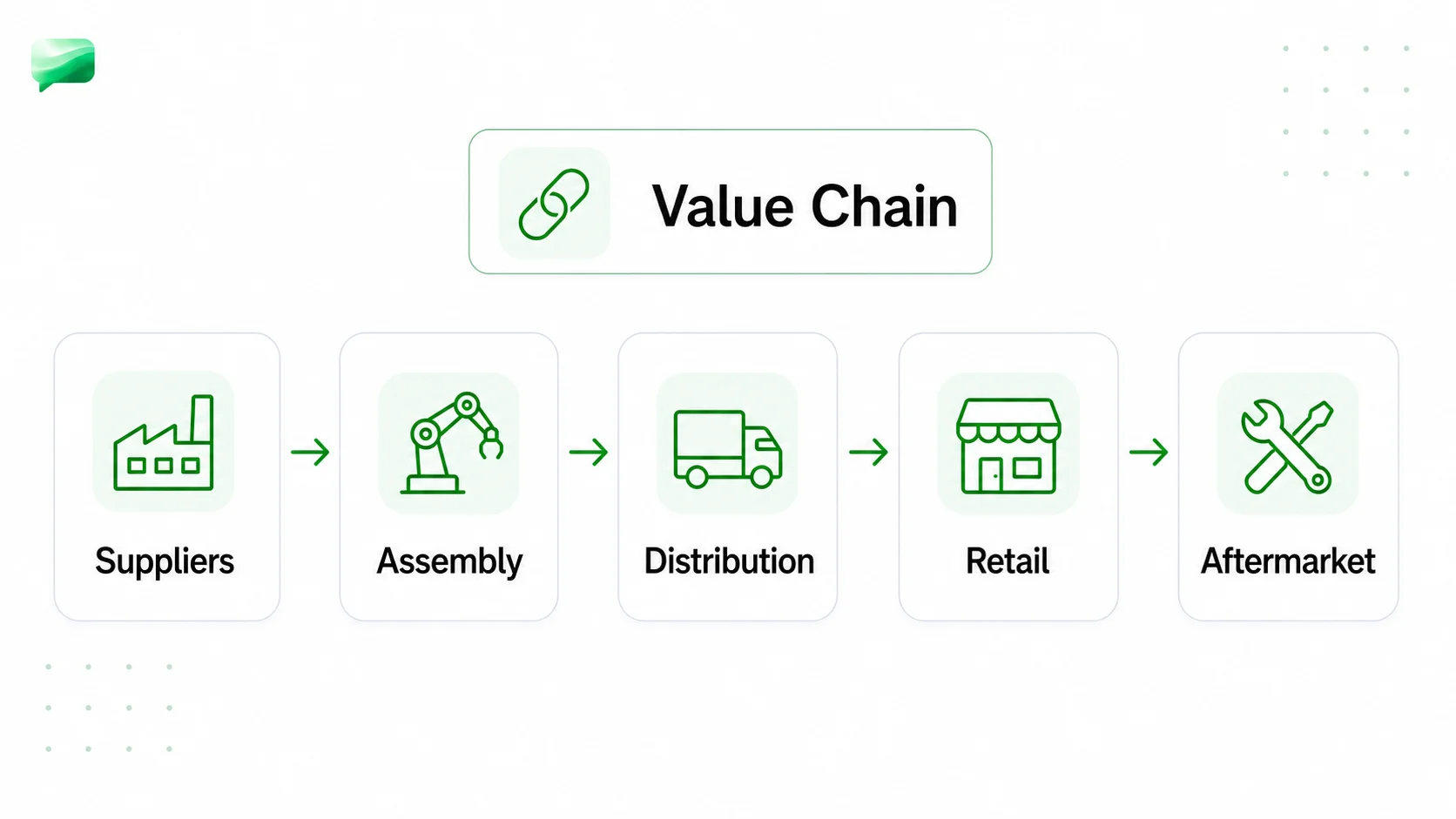
Most of the industry knowledge you need fits into one mental map: the value chain from research to resale. If you can name each stage and the economics that govern it, you can locate almost any case prompt instantly. This is that cheat sheet, filled in.
Two things candidates routinely miss. First, the supplier tier is where a lot of cost and risk lives, so ignoring it is a fast way to look shallow. Our supply chain case interview guide goes deep on tier risk, single-sourcing, and disruption. Second, the value chain is shifting: financing and new mobility (subscriptions and software features) are growing profit pools while the traditional vehicle margin compresses. A strong answer treats the chain as moving, not static.
The five automotive case archetypes
Almost every automotive prompt is a variant of one of five archetypes. Recognize the type and you already know the spine of your structure.
- Market entry. A carmaker (say BMW) wants to enter a new country. Is it attractive, can the client win, and how should it enter? Use a dedicated market entry framework covering market attractiveness, competitive position, and entry mode (build, partner, or acquire).
- Market sizing. Estimate the EV market in Germany, or annual US new light-vehicle volume. Tests structured estimation, top-down versus bottom-up, and sanity-checking.
- Profitability turnaround. Margin has fallen and you must isolate whether the problem is revenue or cost, then go one level deeper.
- EV transition and production scale-up. Move from a handful of prototypes to mass production. Tests operations, capacity, build-vs-outsource, and headcount math.
- Cost reduction and benchmarking. Find savings across materials, labor, logistics, and overhead, usually against a competitor benchmark.
The skill is not memorizing five templates. It is building a tailored structure on the spot. Practice that muscle in the case below.

Profitability · medium
Try a free live automotive case interview
Matched to this automotive guide: a live automotive profitability case with an AI interviewer. Free, scored on every step.
Interactive drill set. Write an answer before revealing the worked solution, then continue into Road to Offer for scored practice and AI feedback.
Practice automotive issue trees before the full case
Automotive cases jump across OEMs, suppliers, EVs, and dealers. Drill the structure first so the value chain turns into a usable case map.
How to learn the automotive industry in a day
You will not become a sector expert by interview day, and you do not need to. RocketBlocks frames the anxiety honestly: the people interviewing you have years of business experience and you may have none, so how do you act like you belong? Their answer is a repeatable loop you can run in a few hours.
- Set the goal and grab a framework. Decide what you actually need (the value chain above plus current trends), and anchor on a structure so new facts have somewhere to attach.
- Consume content fast. Read one strong industry primer, skim recent OEM news, and note the few numbers that recur (vehicle volumes, EV mix, battery cost direction).
- Deliberate practice. Run two or three auto cases out loud. Application beats passive reading every time.
- Consolidate. Write a one-page cheat sheet from memory: value chain, five archetypes, three trends. If you can reproduce it, you are ready.
One concrete fact to anchor the EV-transition theme: per RocketBlocks, General Motors stated a long-term goal of phasing out combustion-engine production by 2035. Knowing one or two real anchors like this lets you sound current without faking expertise.
Worked example 1: EV mass-production scale-up
Here is a fully worked case based on PrepLounge's Electric Mobility scale-up case, including the math, not just the prompt.
Prompt. A startup has built 3 prototypes of an electric light vehicle and wants to scale to 100,000 cars in Year 1, priced between $35,000 and $50,000. Each car requires 600 unique assembly steps at about 30 seconds each. A plant runs 10 hours per day, roughly 50 hours per week, for 50 weeks per year. How should the client think about the scale-up, and how many production employees are needed in Year 1?
Structure
This is an operations problem, so structure it across five buckets:
- Market segmentation. At a $35,000 to $50,000 price, which buyer segment are we targeting, and does 100,000 units match realistic demand in that segment?
- Build vs outsource. Of the 600 assembly steps, which are core (battery integration, final assembly) and which should suppliers handle? This is where the supplier tier matters.
- US vs abroad. Where do we build? Trade off labor cost, logistics, tariffs, talent, and proximity to demand.
- Cost reduction. Where do the five labor-hours per car and the component bill compress as volume rises (learning curve, automation, supplier scale)?
- Year-1 headcount. Size the production workforce required to hit volume.
The math
Work the headcount step by step:
So Year 1 needs roughly 200 production employees at this throughput, before adding quality, logistics, and support staff. For a revenue sanity check, 100,000 cars at $35,000 to $50,000 implies a Year-1 revenue range of $3.5B to $5.0B, which is the order of magnitude that justifies the plant investment.
Worked example 2: a profitability-decline turnaround
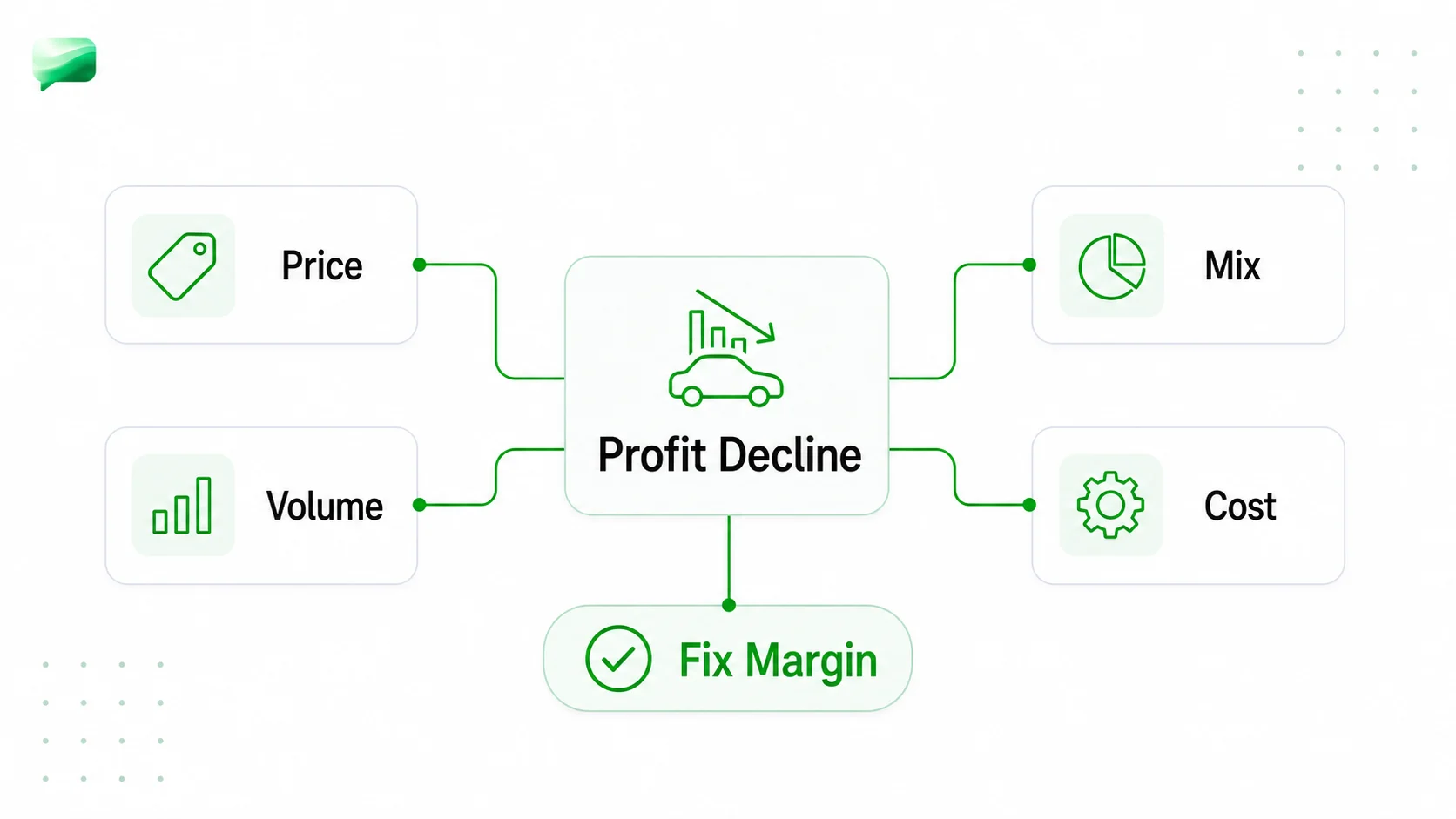
Prompt. A car manufacturer's operating margin has fallen from roughly 10% to roughly 2% over three years. Diagnose the cause and recommend a fix. (These are illustrative case-design inputs, not a market statistic.)
Even though margin is the symptom, bolting on a textbook tree without tailoring it is what loses points here. Build the issue tree, then go deeper on the side the data points to.
Profit = Revenue - Cost. Split each branch:
- Revenue = Volume x Price x Mix.
- Volume: is the whole market shrinking, or is the client losing share? Is EV demand cannibalizing the client's combustion lineup?
- Price: heavier incentives and fleet discounting drag realized price.
- Mix: a shift toward lower-margin trims or segments quietly erodes margin even when units hold.
- Cost = Variable + Fixed.
- Variable: battery and raw-material costs, supplier tier pressure, labor, logistics.
- Fixed: plant overhead at low utilization, plus heavy EV R&D and new-plant capital expenditure.
Isolating the driver. Ask for the data that separates these. A common 2026 pattern, and a real anchor you can cite: per RocketBlocks, GM faced 2023 to 2024 struggles pushing EV sales while its combustion-engine sales over-performed. Map that onto this case: if combustion volume is healthy but margin collapsed, the likely culprit is the cost side, specifically heavy EV investment (R&D plus new capacity) that has not yet earned its volume. The same RocketBlocks material references a Detroit auto-parts supplier scenario where the company lost about half its stock price, a reminder that the supplier tier can be the real source of distress.
Recommendation shape. Lead with the diagnosis (margin fell because EV investment outran EV volume while fixed costs stayed high), then sequence the fix: pace EV capacity to demand, protect the cash-generating combustion line through the transition, and pressure-test the supplier base for cost and risk. Specificity beats "improve profitability."
Worked example 3: automotive market sizing, step by step
Sizing questions reward a clean method and an honest sanity check. Take US annual new light-vehicle sales and solve it both ways.
Bottom-up (state every assumption aloud, the interviewer will calibrate).
- Assume a driving-age population and an ownership rate to get vehicles in operation. Say roughly 250M driving-age adults and about 0.8 vehicles per adult, which is about 200M vehicles on the road. (These are your stated estimates, not facts.)
- Apply a replacement cycle. Assume the average vehicle is replaced about every 12 years. Replacement demand is then 200M / 12, which is about 16.7M vehicles per year.
- Adjust down for used-vehicle substitution and deferred purchases to approach new-vehicle sales.
Top-down. Start from total household spending or the total vehicle parc, segment to households in-market this year, and multiply by purchase rate. Use it to cross-check the bottom-up figure rather than as your primary path.
Reality check. ConsultingCase101 cites US new light-vehicle sales of about 11.7M for 2010, with a forecast rising to 13.5M in 2011. Our gross bottom-up estimate of about 16.7M is the right order of magnitude; the gap is mostly used-car substitution and deferral. Important caveat: those 2010 to 2011 figures are dated, so pull current data before quoting any number in a live interview. The lesson is the method and the reconciliation, not the stale headline.
To convert units to market value, multiply your unit estimate by an assumed average selling price (state it, verify the current figure later). That bridges a sizing question into a revenue-pool discussion, which interviewers love.
Trends to weave in so you sound credible
A few current threads, dropped in at the right moment, signal that you understand where the industry is going:
- EV transition and combustion phase-out. Anchor on a real timeline, such as GM's stated 2035 goal to phase out combustion-engine production (per RocketBlocks). Always ask how the transition reshapes cost, demand, and capacity in your case.
- Autonomous driving. The industry taxonomy runs from no automation (Level 0) up to full self-driving (Level 5). Most production vehicles sit at partial automation today, and the path upward is gated by software, sensors, and regulation, which is a rich source of investment and partnership cases.
- Subscription and feature monetization. OEMs increasingly sell software-enabled features and subscriptions after the sale, the kind of new profit pool a Mercedes-Benz strategy team would explore. This is why financing and new-mobility revenue belong in your value chain.
- Mobility-as-a-service. Ride and car sharing reframe the customer from a one-time buyer to a recurring user, changing unit economics entirely.
Use these to pressure-test recommendations: any answer that ignores the EV shift or a regulatory deadline is incomplete.
The automotive quant you will actually face
Automotive cases are math-forward. The calculations that recur:
- Plant capacity and throughput. Convert assembly steps and cycle times into cars per shift, per day, and per year (as in worked example 1).
- Breakeven and unit economics. Contribution per vehicle (price minus variable cost) against fixed cost to find breakeven volume.
- Headcount estimation. Total labor-hours divided by available hours per worker.
- Market sizing. Top-down and bottom-up unit estimates, then conversion to value via price.
None of this is exotic, but it has to be fast and clean under pressure. If your arithmetic wobbles, that is the first thing to drill.
Common mistakes and how to stand out
- Jumping into a generic framework. "Let me use a profitability framework" with no tailoring is the most common failure. Build a structure that fits the specific automotive problem in front of you.
- Ignoring the supplier tier. A huge share of cost and risk sits with Tier 1, 2, and 3 suppliers. Candidates who only look at the OEM look shallow.
- Treating the industry as static. Recommendations that do not account for the EV transition, autonomy, or regulation get pressure-tested and fall apart. Stress-test your own answer first.
- Computing without concluding. Getting to 200 workers or 16.7M units is necessary but not sufficient. Tie every number back to the decision.
- Faking expertise. You do not need engine trivia. You need the value chain, the archetypes, and one or two real anchors (the GM 2035 goal, the EV-volume mismatch). Authentic structure beats name-dropping.
Practice an automotive case now
You have the cheat sheet and two worked cases. The fastest way to lock it in is the deliberate-practice step: run an auto case out loud and get feedback on structure, math, and synthesis. Use the structure drill above to build the issue tree quickly, then run a full timed case to find your real bottleneck.
See where you stand on an automotive case
Run a free, AI-guided automotive-style case to benchmark your structure, your scale-up and sizing math, and your recommendation quality. No PDF, no login wall.
Sources
- RocketBlocks, Automotive industry for consulting interviews: (checked June 26, 2026)
- PrepLounge, Electric Mobility scale-up case: (checked June 26, 2026)
- ConsultingCase101, Automotive and motor vehicles cases: (checked June 26, 2026)
Frequently asked questions
Resources and related guides
- Try a free live automotive case interviewPractice
- Browse all free resourcesResource hub
- Banking Case Interview: Framework, Examples & PrepFundamentals · Jun 30, 2026
- Consumer Goods Case Interview: CPG Frameworks & ExamplesFundamentals · Jun 30, 2026
- Insurance Case Interview: Framework, Ratios & ExampleFundamentals · Jun 30, 2026
- Operations Case Interview: Framework, Math & ExampleFundamentals · Jun 30, 2026