
Market Attractiveness Framework: Dimensions, Scorecard, and Case Use
The market attractiveness framework with its six dimensions, a weighted scorecard, the GE-McKinsey matrix, real industry data, and case interview use.
On this page
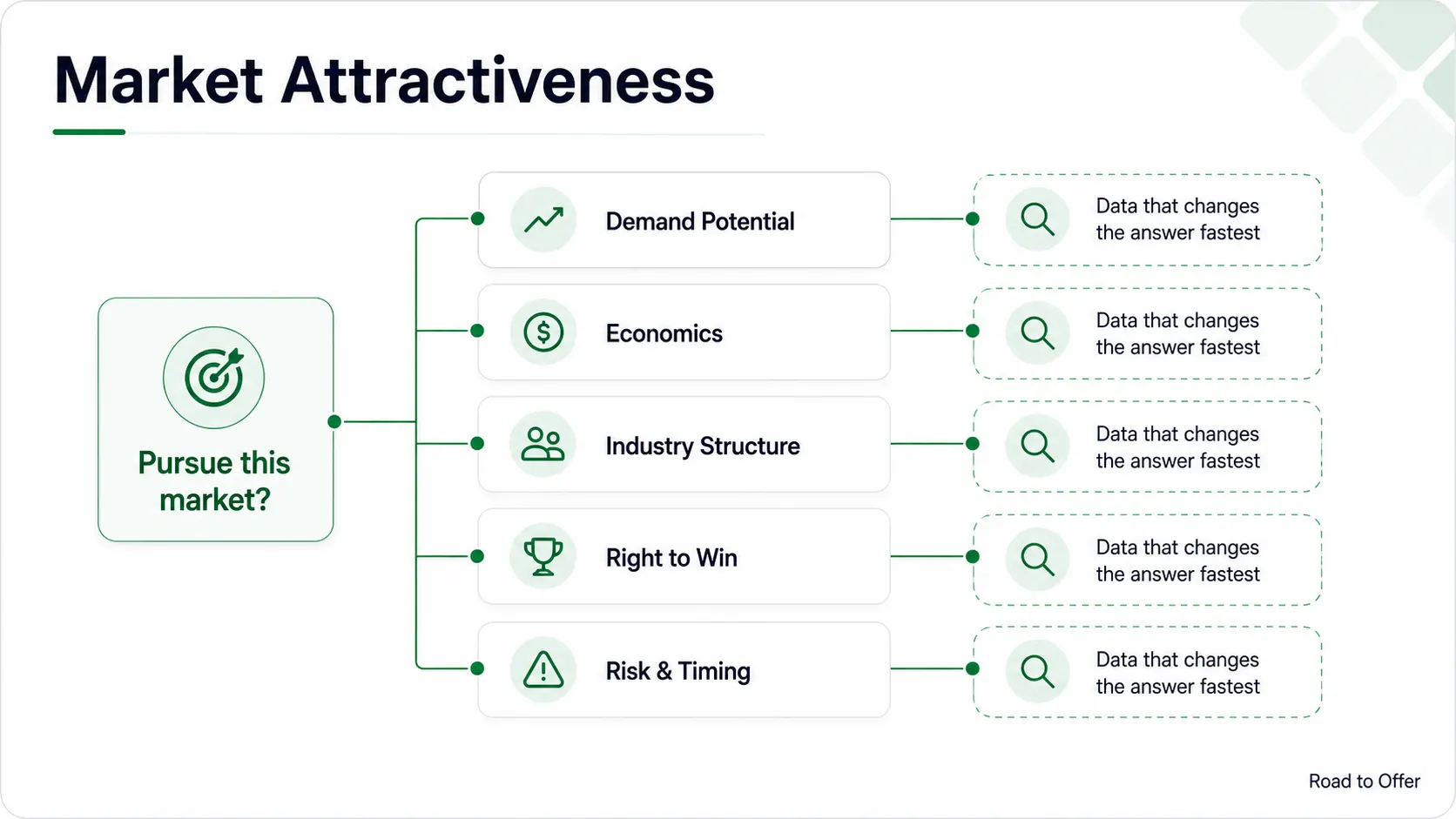
The market attractiveness framework is a structured way to decide whether a market is worth pursuing before anyone designs an entry plan. It scores a market across six dimensions, demand, economics, competitive intensity, access, right to win, and risk, and a strong answer never calls a market attractive just because it is large. It explains who would buy, why the economics work, how competition affects profit, whether the client has a credible path in, and what would make the opportunity unattractive. Strategy teams use it as a screen and a scorecard. Case interviewers use it to test whether you can connect a vague market question to a real business decision. This guide covers both: the dimensions and the math for analysts, and the spoken structure and branch prioritization for candidates.
What does the market attractiveness framework actually decide?
Market attractiveness sits upstream of market entry. Market entry asks whether the client can win and how they should enter. Market attractiveness asks whether the market is worth the client's attention in the first place. It is a screen, not a launch plan.
The single most important idea is that a market is never attractive in absolute terms. It is attractive relative to a specific company's capabilities, cost structure, and position. A city, segment, or product category can be a great market for an incumbent with strong distribution and a poor one for a new entrant with none, which is why attractiveness scoring only becomes a decision when you read it next to the client's competitive position. That is exactly what the GE-McKinsey matrix does later in this guide.
The same relativity matters in a case interview, where the interviewer is not grading your ability to name categories. Bain's interviewing page frames cases around client problems and structured problem solving, and Yale's consulting overview frames the work around profitability, growth, and strategy. The framework is useful because it forces you to connect the client's objective to a practical business decision.
Start with the decision sentence: our client is deciding whether to pursue this market because they want growth, margin expansion, strategic control, or a stronger position in a related category. Once that is clear, the issue tree should be custom enough to fit the client and clean enough to avoid overlap. The MECE principle is useful here because the six dimensions should be separate, but still complete enough to support a recommendation.
Industry structure belongs in the framework, but it is not the entire answer. Harvard's Institute for Strategy and Competitiveness describes industry structure as driven by five competitive forces, which makes competitive intensity a real dimension of attractiveness. Still, demand, economics, access, right to win, and risk each need their own space.
Run a market attractiveness case live
Take this structure into a full case interview, get pressure-tested on branch choice, and see how the recommendation holds when the numbers move.
What are the six dimensions of market attractiveness?
Different sources name anywhere from four to eight factors, but they collapse into six dimensions. The classic four (size, growth, profitability, competitive intensity) cover demand and economics and competition. Access, right to win, and risk are what separate a generic checklist from a usable decision. Use the table as a live issue tree, not a static list. The goal is to ask for the data that would move the recommendation, then interpret it.
A good driver tree helps you turn these dimensions into testable drivers instead of repeating market size, growth, and competition. For international markets, add country distance factors: the academic version scores institutional context (political, economic, product, labor, and capital markets) and the cultural, administrative, geographic, and economic distance between home and target, which is why a market that scores well at home can score poorly abroad. On real projects the U.S. Census Bureau's Economic Census can ground market size, but in an interview you should ask for the type of data before asserting a value.
Interactive drill set. Write an answer before revealing the worked solution, then continue into Road to Offer for scored practice and AI feedback.
How do you calculate a market attractiveness score?
When a client needs to compare several markets, the six dimensions become a weighted scorecard. Strategy teams use a repeatable six-step method, and you can run a lighter version of it on a case exhibit.
- Define the market precisely: product, segment, geography, channel, and time horizon. A vague market produces a vague score.
- Choose five to eight criteria from the six dimensions. Resist scoring twenty factors; the long tail adds noise, not signal.
- Assign weights that sum to 100 percent and reflect the client's objective. If the client needs profitable growth quickly, profitability and access carry more weight than raw size.
- Score each market on a 1 to 5 scale using evidence, not gut feel. Anchor each score to a benchmark so a 4 means something specific.
- Calculate the weighted score. Multiply each score by its weight and sum the results to get one comparable number per market.
- Stress test the result. Flip the two largest weights and check whether the ranking holds. If it does not, the decision hinges on a judgment call you should surface, not bury.
A workable default weighting for a growth-oriented client might be profitability 25 percent, demand and growth 20 percent, competitive intensity 20 percent, access and barriers 20 percent, and risk and timing 15 percent. Those numbers are a starting point, not a law. The scorecard is only as honest as the weights, which is the same trap the BCG growth-share matrix avoids by using two observable axes instead of subjective weights.
How does the GE-McKinsey matrix use market attractiveness?
A single attractiveness score answers half the question. The other half is whether the client can win, which is competitive position. The GE-McKinsey nine-box matrix, developed for General Electric in the 1970s, plots the two against each other. Market attractiveness sits on one axis, scored with the six dimensions above. Competitive position sits on the other, scored on relative market share, relative cost position, differentiation, channel access, and capability strength. Each business unit becomes a bubble, often sized by revenue, dropped into a three-by-three grid.
The grid maps directly to capital decisions.
This is why market attractiveness rarely travels alone in real strategy work. A high attractiveness score in a market where the client is weak does not mean invest. It means double down only if there is a believable path to a strong position, otherwise stay out. The growth strategy cases guide shows how this invest-versus-exit logic shows up in interview prompts.
Reading the nine-box grid correctly, not just naming it, is what separates a candidate who memorized the matrix from one who can use it live.
Interactive drill set. Write an answer before revealing the worked solution, then continue into Road to Offer for scored practice and AI feedback.
Why does size not equal attractiveness? Three real markets
Three real markets show how one dimension can override the headline number. Airlines are enormous and barely profitable: the International Air Transport Association projected industry revenue near 979 billion US dollars for 2025 on a net profit margin of about 3.7 percent, roughly 7 US dollars per passenger. High demand, weak economics. Semiconductors show the opposite signal: worldwide sales reached about 627.6 billion US dollars in 2024 with strong double-digit growth into 2025 as AI demand surged, but capital intensity for a leading-edge fab runs into the tens of billions, so the access and right-to-win dimensions are punishing. And electric vehicles, where global sales passed 17 million in 2024 and topped 20 percent of new car sales, stayed thin on margin for many entrants under price competition, so attractiveness depends on which part of the value chain the client occupies. Strong demand, contested economics, and a right-to-win question is a recurring pattern, and the same logic underpins a profitability framework breakdown when a case turns to the economics branch.
Worked example: should a client pursue a new market?
Prompt: A regional cafe chain is considering entering a nearby city. The CEO wants to know whether the city is attractive enough to justify expansion.
Weak answer: market size, growth, competition, profitability. That sounds organized for a few seconds, but it does not tell the interviewer what you are trying to prove. It also treats every cafe chain as if it had the same brand, cost base, locations, and operating strengths.
A stronger spoken structure starts from the decision and a priority. I would assess whether this city is attractive for our client by testing demand for the cafe concept, the economics of serving it, the competitive landscape, our right to win through locations and brand fit, and key risks such as rent, labor, or regulation. I would start with demand and location access, because if target customers are not concentrated near viable sites, the economics will not matter. The first data request could be foot traffic by neighborhood, cafe spending patterns, competitor density, and storefront economics. You do not need to invent numbers, only to say what data would prove the market is attractive.
The recommendation logic is then simple. If target customers cluster near viable sites, competitors leave room to differentiate, and unit economics work at expected rents, the city is worth deeper entry planning. If demand exists but all viable sites are locked up or pricing cannot cover costs, the market is interesting but unattractive for this client.
Reading the structure is one thing; defending it against an interviewer's follow-ups is another. Now use the framework in a live case where the data pushes back.
Score a real market in a BCG market entry case. A Chinese data-center cooling maker wants into the US market as AI drives demand. Answer this BCG market entry case step in the article, then continue the full case. Continue the full case on Road to Offer
Which branch should you test first?
The main difference between a framework user and a strong candidate is branch selection. A framework user walks through every dimension in order. A strong candidate asks which one could break the recommendation and leads with that.
Before you commit to the issue tree, ask what would make this market a clear no-go. If the answer is weak customer need, lead with demand. If it is thin margin, lead with economics. If incumbents control distribution, lead with access and competitive intensity. If the client has no credible reason to win, lead with right to win. Then ask what data would change the answer fastest. That question keeps the structure tied to action and stops you from making the tree sound balanced when the case clearly hinges on one uncertainty. The fastest way to build this instinct is to drill prioritized structures until leading with the breaking branch feels automatic.
What are the most common market attractiveness mistakes?
The large-market fallacy is the most common mistake. A market can be large and still be unattractive because customers are expensive to reach, margins are thin, competition is intense, or the client has no right to win. Large is not the same as accessible, profitable, or defensible.
The second mistake is building a scorecard before defining the decision. A scorecard can be useful after you know the client's objective, but arbitrary weights make the answer feel fake. In a case, explain what matters most and why. If the client needs profitable growth quickly, economics and access may matter more than broad market excitement.
The third mistake is ignoring client capabilities. Market attractiveness is not universal. A city, segment, or product category may look attractive for an incumbent with strong channels and unattractive for a new entrant with no distribution. This is where right to win matters.
The fourth mistake is double-counting competition. Candidates often put competitors under market size, pricing, barriers, and risk until every branch says the same thing. Keep competitive intensity in one clear place, then explain how it affects economics and recommendation logic.
The final mistake is treating case structure versus case framework backward, memorizing a framework label and forcing the case into it. Porter's Five Forces can sharpen the competitive intensity dimension, but it should not replace the full attractiveness answer, and the value chain framework is a better tool when the real question is where the profit pool sits along the chain.
How can you practice the framework under pressure?
Speak the first layer out loud against a fresh prompt: a home battery company is considering a new regional market and wants to know whether the opportunity is attractive. Define the decision, build the first issue tree, pick the branch you would test first, and name the data that would prove or disprove attractiveness without drifting into launch tactics. If the case hints that adoption is uncertain, start with demand. If it mentions strong incumbents, start with competition and access. If the client already has customers nearby, start with economics and channel leverage.
Because attractiveness usually hinges on whether reachable demand is large enough to matter, practice sizing that demand directly before you score the market. A quick market-sizing drill on the segment you would target is the cleanest way to pressure-test the demand branch.
Interactive drill set. Write an answer before revealing the worked solution, then continue into Road to Offer for scored practice and AI feedback.
For more reps, use the Road to Offer drill engine for targeted practice across structure, synthesis, chart reading, and math, then take it into a full case so the framework has to survive an interviewer's follow-ups. Duke Career Hub's case resources point the same direction: you improve this framework by using it under pressure, not by rereading it.
Sources and Further Reading (checked June 18, 2026)
- Institute for Strategy and Competitiveness at Harvard Business School - Industry structure is driven by five competitive forces, which is relevant to the competitive intensity dimension of market attractiveness.
- Institute for Strategy and Competitiveness at Harvard Business School - The Five Forces
- International Air Transport Association - Industry profit and revenue outlook for 2025
- Semiconductor Industry Association - Global semiconductor sales and growth data
- International Energy Agency - Global EV Outlook 2025
- Washington State University Open Text - Measuring Market Attractiveness
- Bain & Company - Interviewing
- Yale Office of Career Strategy - Consulting
- Duke Career Hub - Case Interview Resources
- U.S. Census Bureau - Economic Census
Frequently asked questions
Resources and related guides
- Practice market attractiveness in a real case interviewPractice
- Browse all free resourcesResource hub
- PESTLE Framework Analysis: External Market Analysis GuideFrameworks · Jun 2, 2026
- Ansoff Matrix vs BCG Matrix for Case InterviewsFrameworks · Jun 2, 2026
- Cost-Benefit Analysis Framework for Case InterviewsFrameworks · Jun 1, 2026
- Porter's Five Forces: Definition, Examples & Case UseFrameworks · Apr 25, 2026