Road to Offer
HomeBlogHubsDirectoryPricing
Log in
Start free
Road to Offer Logo
PrivacyTermsContactFAQPricing

© 2026 Road to Offer

SWOT Analysis in Case Interviews: When It Works, When It Doesn't, and How to Use It

Published

Mar 15, 2026

Category

Frameworks

Tags

Swot Analysis Case Interview, Case Interview Frameworks, Strategic Analysis, Consulting Frameworks, Swot Analysis

Road to Offer Team

Road to Offer

We built Road to Offer to make deliberate case practice accessible to every candidate — not just those who can afford $200/hour coaching.

  • -Strategy consulting background
  • -200+ candidates coached

Published Mar 15, 2026

Blog›SWOT Analysis in Case Interviews: When It Works, When It Doesn't, and How to Use It
A 2x2 SWOT matrix drawn on a glass whiteboard in a modern consulting office, with Strengths and Weaknesses in the top row and Opportunities and Threats in the bottom row, annotated in colored markers, floor-to-ceiling windows revealing a city skyline in cool morning light

SWOT Analysis in Case Interviews: When It Works, When It Doesn't, and How to Use It

Mar 15, 2026

Frameworks · Swot Analysis Case Interview, Case Interview Frameworks, Strategic Analysis

Road to Offer Team

Road to Offer

We built Road to Offer to make deliberate case practice accessible to every candidate — not just those who can afford $200/hour coaching.

  • -Strategy consulting background
  • -200+ candidates coached

Published Mar 15, 2026

PostShare

Summary

SWOT analysis can help or hurt your case interview depending on how you use it. Learn when to deploy it, when to avoid it, and a worked example.

SWOT analysis in a case interview is a diagnostic framework that maps a company's internal Strengths and Weaknesses against external Opportunities and Threats. Developed by Albert Humphrey at Stanford Research Institute between 1960 and 1970 through research across approximately 1,100 organizations, SWOT is appropriate in 4 specific consulting case situations: when the client explicitly requests a strategic assessment, during broad organizational health cases, when evaluating new market entry, and when comparing two strategic options side by side. At McKinsey, BCG, and Bain, it is rarely the right primary framework — MBB interviewers view unanchored SWOT as a generic template that avoids the specific analytical work the case requires. Used correctly, however, it is a structured diagnostic entry point that transitions into sharper analysis via the TOWS matrix extension.

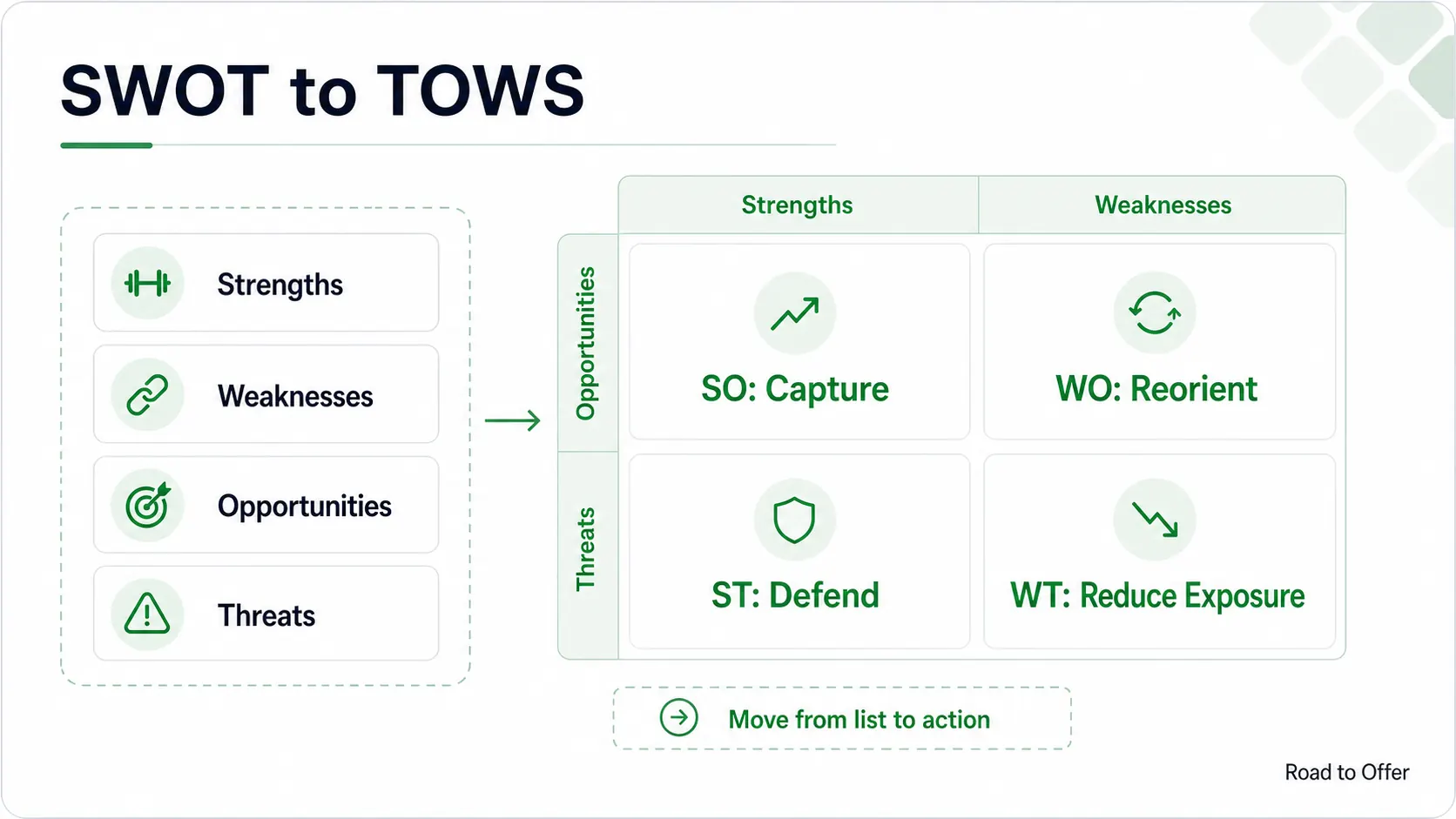
SWOT analysis is a 2×2 strategic framework that classifies a company's position across 4 dimensions: internal Strengths and Weaknesses (factors the company controls) and external Opportunities and Threats (market forces it cannot). The TOWS matrix, developed by Heinz Weihrich in 1982, extends SWOT by crossing these quadrants to generate 4 strategic directions: SO (aggressive), ST (defensive), WO (reorientation), and WT (survival or retrenchment).

Why SWOT Has a Credibility Problem at MBB

SWOT's reputation in case interviews is complicated by its ubiquity. Albert Humphrey developed it at the Stanford Research Institute between 1960 and 1970, analyzing Fortune 500 companies to understand why corporate planning failed. His team surveyed approximately 5,000 executives across 1,100 organizations — a serious empirical undertaking, not a classroom exercise. The original acronym was actually SOFT (Satisfactory, Opportunity, Fault, Threat). At a Long Range Planning seminar in Zurich in 1964, researchers Urick and Orr renamed the "F" to "W" — creating SWOT. Humphrey's own account of the name change: "This was later changed to SWOT — don't ask."

The 2x2 matrix format candidates recognize today came even later, from Heinz Weihrich's 1982 restructuring of Humphrey's original work.

The point: SWOT was built for large organizations doing annual strategic planning, not for the 25-minute case interview context where specificity and creative structuring are what get evaluated. Ex-Bain consultants on PrepLounge's forum have been blunt about this: "I would not take a job in a consulting firm that would ask me to perform a SWOT analysis in an interview." McKinsey, BCG, and Bain virtually never request SWOT by name.

That said, Management Consulted notes that SWOT is "broad and high level and therefore almost universally applicable when trying to understand current business context" — and that's exactly the kind of case where it still earns a seat at the table.

SWOT is classified as a "mini-framework" by most elite prep resources — appropriate as a diagnostic entry point, not as a standalone analytical conclusion. MConsultingPrep explicitly states it is "seldom used in case interviews and consulting work because it's very generic."

Not sure which framework fits your case?

Road to Offer's AI coach gives you real-time feedback on framework selection, not just whether you structured something — but whether you structured the right thing.

Try a free case →

The 4 Situations Where SWOT Actually Works

1. The Client Has Explicitly Requested a SWOT

This is the clearest use case. In real consulting engagements, Hacking the Case Interview notes that firms "rarely use SWOT analysis, and usually when they do is because the clients are specifically requesting one." The same logic applies in interviews: if the prompt says "the client has asked for a strategic assessment of the company's position," you have implicit permission — and arguably an obligation — to structure around Strengths, Weaknesses, Opportunities, and Threats.

2. Broad Strategy or Organizational Health Cases

When a case prompt describes a CEO asking "what should we focus on over the next three years?" or "how do we improve our competitive position?" without specifying a particular problem driver, SWOT gives you a structured way to establish a baseline before going deeper. Think of it as a triage tool: spend two to three minutes building a SWOT to map the company's position, then pivot to a targeted framework for the specific issue that matters most.

This is very different from using SWOT as the entire analysis. It's a diagnostic gateway, not the destination.

3. New Market or Product Entry Assessments

When the case asks whether a company should enter a new geography or launch a new product line, SWOT lets you simultaneously assess the company's internal readiness (S/W) and the external environment it would be entering (O/T). A market entry framework typically focuses on market attractiveness and competitive dynamics — SWOT adds the internal readiness layer that pure market analysis misses.

Practically: you can open with SWOT to frame the internal/external split, then use specific sub-frameworks within each quadrant (Porter's Five Forces for the T quadrant, capability mapping for the W quadrant, revenue potential analysis for the O quadrant).

4. Comparing Two Strategic Options Under Uncertainty

When a client is choosing between two distinct paths — organic growth vs. acquisition, licensing vs. building in-house, entering market A vs. market B — SWOT can structure the side-by-side evaluation. Map each option's Strengths and Weaknesses relative to the company's current capabilities, and each option's Opportunity and Threat landscape. You're not running SWOT on the company; you're running it on each decision branch.

When SWOT Will Hurt Your Score

Three case types where SWOT is the wrong call — and what to use instead:

Case TypeWhy SWOT FailsBetter Framework
Profitability declineSWOT doesn't isolate revenue vs. cost drivers; you'll waste time on analysis that doesn't answer the questionProfitability framework: Revenue → Volume/Price; Costs → Fixed/Variable
Market sizingSWOT has no quantitative structure; interviewers want numerical segmentation, not strategic assessmentTop-down or bottom-up segmentation tree
Pricing strategySWOT tells you nothing about willingness to pay, competitive price anchors, or customer perceived valuePricing strategy cases: Value-based, cost-plus, competitive pricing analysis
M&A due diligenceSWOT is too high-level for deal-specific analysis; you need strategic fit, synergy quantification, and risk assessmentM&A case framework: Strategic rationale → Synergies → Integration risks
Operations casesInternal/external framing doesn't map to operational root-cause analysisValue chain framework: Input → Process → Output bottleneck analysis

The meta-rule: if your case has a clear quantitative target (revenues, costs, market share, deal value), SWOT is probably not the primary tool. SWOT answers "how is this company positioned?" — not "why did margin drop 400 bps?" or "how large is this market?"

IGotAnOffer's comprehensive frameworks guide — one of the most-cited MBB prep resources — does not include SWOT in its seven core frameworks at all. The omission is deliberate: MBB interviewers actively penalize candidates who reach for SWOT when a more targeted analysis is needed.

How to Run SWOT Without Being Generic

The single biggest mistake candidates make with SWOT is confusing the format for the analysis. Writing "strong brand" under Strengths and "economic downturn" under Threats is not strategic thinking — it's transcription. Here's how to make SWOT rigorous.

Step 1: Anchor Every SWOT Item to the Case Question

Before you write a single item, ask: what does this SWOT need to answer? If the question is "should we enter the German market?", your SWOT items should all be relevant to market entry, not generic company characteristics.

Generic (fails): "Strong management team" (Strength) Case-specific (passes): "Operations leadership has executed two previous international expansions successfully — Germany would be the third" (Strength relevant to market entry readiness)

Step 2: Quantify Where You Can

Numbers transform SWOT from a checklist into evidence.

Generic: "Growing market opportunity" (Opportunity) Quantified: "German premium pet food market growing at 8% annually; current penetration by foreign brands is under 15%" (Opportunity — with magnitude)

Step 3: Prioritize — SWOT Gives You 4 Quadrants, Not 40 Items

Most candidates list 3-5 items per quadrant, producing a 12-20 item matrix that's impossible to synthesize. The discipline is in selecting the 2-3 most material items per quadrant — and in the case interview context, you have 2-3 minutes for the framework before analysis begins. Prioritize ruthlessly.

SWOT Analysis Application Protocol

11. Anchor to the case question

Before listing any items, state clearly what the SWOT needs to answer. Every item must connect to that question.

22. Map Internal factors (S/W)

Strengths: what the company does better than alternatives. Weaknesses: internal constraints, capability gaps, or cost disadvantages relative to what the case requires.

33. Map External factors (O/T)

Opportunities: market conditions, regulatory changes, or competitor vulnerabilities that favor the client. Threats: external forces that could undermine the strategy.

44. Quantify at least 2 items

Pick the most material item in each quadrant and attach a number, timeframe, or comparative benchmark.

55. Run the TOWS crossover

Cross the quadrants to generate strategic options: SO (leverage strengths for opportunities), ST (use strengths to counter threats), WO (fix weaknesses to access opportunities), WT (defensive moves to minimize exposure).

66. Synthesize in one recommendation

SWOT is not the conclusion — it's the setup. End with a clear strategic direction that flows from your most important SWOT findings.

Step 4: Upgrade to TOWS

SWOT identifies the situation. TOWS tells you what to do about it. Heinz Weihrich's 1982 extension of SWOT produces four strategic directions by crossing the quadrants:

Opportunities (O)Threats (T)
Strengths (S)SO — Aggressive strategy: Use strengths to capture opportunitiesST — Defensive strategy: Use strengths to neutralize threats
Weaknesses (W)WO — Reorientation strategy: Overcome weaknesses to access opportunitiesWT — Survival strategy: Minimize weaknesses to reduce threat exposure

In an interview, you don't need to label the quadrants explicitly. You just need your synthesis to flow from the crossover: "Given the company's distribution strength (S) and the channel consolidation happening in the market (T), the most defensible move is to lock in exclusive retailer partnerships before competitors do — that's the ST play here."

This is what separates candidates who "used SWOT" from candidates who did strategic analysis.

Practice turning SWOT into strategy under pressure

Road to Offer cases include synthesis prompts where the AI coach evaluates whether your recommendation actually flows from your analysis — not just whether you covered all four quadrants.

Practice framework synthesis →

Worked Example: Retail Chain Facing E-Commerce Disruption

Case prompt: "Your client is a mid-size specialty sporting goods retailer with 120 stores across the Midwest. Revenue is $850M, margins are at 6% (down from 11% four years ago). The CEO believes their brick-and-mortar model is under threat from e-commerce. She wants to understand their strategic position before committing to a major digital investment. How would you structure this analysis?"

This is a legitimate SWOT use case: the CEO wants a strategic position assessment before making a capital commitment. It's not a pure profitability question (margins are given, not the diagnosis to find). It's not a market sizing question. It's a strategic options evaluation.

Running the SWOT

Strengths (Internal — What we do well):

  • Physical presence in 120 mid-market locations creates a logistics advantage for buy-online/pick-up-in-store (BOPIS)
  • Proprietary staff expertise in gear fitting — particularly for running and cycling, where fit matters and customers return for service
  • $850M revenue base gives buying leverage with major brands

Weaknesses (Internal — Where we fall short):

  • E-commerce platform is 6 years old and lacks product recommendation engine; conversion rate is 1.8% vs. 3.2% industry average
  • Margin at 6% leaves minimal capital for a major digital transformation (estimated $40-60M investment)
  • Inventory management is store-level rather than centralized — makes omnichannel fulfillment difficult

Opportunities (External — Favorable forces):

  • Post-pandemic outdoor activity participation is up 23% across key categories (running, cycling, hiking) — see U.S. Outdoor Industry Association data
  • 3 regional competitors have closed 18 locations in the past 18 months — geographic consolidation opportunity
  • BOPIS adoption is at 34% of online orders in sporting goods — favorable to a physical-network-plus-digital strategy

Threats (External — Forces working against us):

  • Amazon Sports and REI are investing $200M+ in personalization and delivery speed; commodity products are already lost
  • Gross margin compression from direct-to-consumer brands bypassing retailers entirely
  • Gen Z customers (fastest-growing segment) show 67% preference for digital-first discovery — if acquisition channels aren't digital, the brand ages out

Running the TOWS Crossover

OpportunitiesThreats
StrengthsSO: Launch BOPIS aggressively — convert physical network into fulfillment advantage; acquire 2-3 competitor locations in high-density marketsST: Double down on fit-expertise services (bike fitting, gait analysis) — that's the one thing Amazon can't digitize; build recurring revenue from service contracts
WeaknessesWO: Fix e-commerce platform conversion (1.8% → 3.2% = ~$30M incremental revenue at current traffic) before expanding inventory — fund the digital investment through the conversion improvement itselfWT: Exit commodity categories (basic apparel, entry-level gear) and redirect shelf space to high-margin, expertise-dependent categories competitors aren't defending

Synthesis (The Recommendation)

"Our client's core strategic challenge is that their strengths — physical network and service expertise — are being commoditized by digital players, while their weaknesses prevent them from competing on digital terms. The critical insight is that e-commerce conversion improvement funds digital investment: closing the gap from 1.8% to the 3.2% industry average on existing traffic alone generates approximately $30M at current contribution margins — enough to self-fund the platform rebuild without a capital call. In parallel, the BOPIS opportunity maps directly to their 120-location footprint, and the competitor consolidation creates geographic acquisitions at distressed prices. I'd recommend a 90-day sprint to model the conversion economics before the CEO commits to the $40-60M digital transformation budget."

That's SWOT done right: specific items, quantified material factors, and a recommendation that flows directly from the analysis.

Three SWOT Mistakes That Cost Candidates Offers

1. Using SWOT as a conclusion, not a springboard. SWOT tells you where the company is. The interviewer wants to know what to do about it. Candidates who end the analysis at the matrix without generating strategic options — ideally via TOWS crossover — leave the hardest and most impressive part of the work on the table. Case interview synthesis is where SWOT's value is realized, not in the matrix itself.

2. Listing generic items that could apply to any company. "Strong brand," "experienced management," "macroeconomic uncertainty" — these are SWOT-shaped filler, not analysis. Every item needs to be case-specific. If a competitor in the same case could have the same Strengths list, you haven't done the thinking.

3. Failing to prioritize within quadrants. An interviewer-evaluator does not want a comprehensive catalogue — they want to see you identify what's most material. The candidate who says "of these five threats, the one that matters most in this case is X because it has the highest magnitude and is the hardest to offset" is demonstrating judgment. The candidate who recites ten threats is demonstrating preparation. Judgment beats preparation every time.

The MECE principle applies to SWOT. Before finalizing your four quadrants, ask: are any items overlapping between Weaknesses and Threats? (A high cost structure is an internal weakness; rising commodity prices are an external threat — different categories, easy to confuse.) Is each quadrant exhaustive given what the case requires? MECE discipline turns a loose brainstorm into a credible structure.

How SWOT Connects to Other Frameworks in Your Toolkit

SWOT doesn't live in isolation. Understanding how it relates to the other frameworks in your complete case interview frameworks guide determines when to reach for it vs. when to reach for something else.

SWOT vs. Porter's Five Forces: Porter's is purely external — it analyzes industry-level competitive dynamics. SWOT is internal + external but at the company level. Use Porter's when the question is "how attractive is this industry?" Use SWOT when the question is "how positioned is this company?"

SWOT vs. 3Cs Framework: The 3Cs (Company, Customer, Competitor) is more granular on the competitive and customer dimensions than SWOT's binary Opportunities/Threats split. For cases where market positioning and customer insight are central, 3Cs gives you more diagnostic leverage.

SWOT and hypothesis-driven thinking: SWOT can help you generate a hypothesis quickly. After 60 seconds of SWOT thinking, you might form an initial hypothesis: "Given the company's distribution strength against a fragmented competitive threat, I'd hypothesize the fastest path to margin recovery is defensive pricing in the core channel." SWOT becomes the evidence base; the hypothesis becomes the direction.

SWOT and growth strategy cases: Growth cases often benefit from the WO (Weakness-Opportunity) and SO (Strength-Opportunity) crossovers. Where can the company's existing strengths compound? Where can a resolved weakness unlock a market they're currently blocked from?

The best candidates aren't applying frameworks sequentially — they're using frameworks as lenses that complement each other. SWOT is one lens, valuable in specific viewing conditions, limited when you need spectral detail that a broader scope can't provide.

Test Your Knowledge

Test yourself

Question 1 of 3

QuizA candidate opens a McKinsey case about declining margins at a retail bank by proposing to run a full SWOT analysis. What is the most likely interviewer reaction?

SWOT Preparation Checklist

Execution checklist

  • Memorize the 4 SWOT triggers

    Client-requested assessment, organizational health case, market/product entry evaluation, two-option strategic comparison — know these cold so you can deploy SWOT confidently when it fits

  • Practice the TOWS crossover out loud

    Most candidates can draw the matrix; few can generate the SO/ST/WO/WT strategic options under time pressure. Run 3-4 TOWS exercises until crossing the quadrants feels automatic

  • Build a 'specificity drill' habit

    After writing any SWOT item, ask: could this apply to a different company in a different industry? If yes, make it more specific — add a number, a name, a market reference

  • Practice switching frameworks mid-case

    Open with SWOT for 60-90 seconds, then transition to a targeted framework for the key driver. The pivot — 'the most material factor here is the weakness in distribution, so let me apply a value chain lens to that specific dimension' — is a high-signal interviewer moment

  • Review case types where SWOT fails

    The profitability framework, pricing analysis, and operational diagnostics are the three most common cases where candidates wrongly reach for SWOT. Know the alternatives cold so you never default to SWOT out of habit

See how your framework selection scores under real case pressure

Road to Offer's AI evaluates not just structure but strategic judgment — including whether you chose the right framework for the case, not just whether you applied one consistently.

Take free readiness assessment →

Sources and Further Reading (checked March 15, 2026)

  • History of SWOT Analysis (Humphrey, SRI, 1960–1970): rapidbi.com/history-of-the-swot-analysis
  • Albert S. Humphrey biography and SOFT/SWOT origins: toolshero.com/toolsheroes/albert-humphrey
  • PrepLounge: SWOT Analysis in Case Interviews: preplounge.com/en/case-interview-basics/swot-analysis
  • PrepLounge community forum — ex-Bain consultant on SWOT in interviews: preplounge.com/consulting-forum/case-interviews-swot-and-matrix-14566
  • Hacking the Case Interview: SWOT in Consulting: hackingthecaseinterview.com/pages/swot-analysis-in-consulting
  • Management Consulted: Utilizing SWOT in a Business Case: managementconsulted.com/utilizing-swot-in-a-business-case
  • MConsultingPrep: Case Interview Framework (SWOT as mini-framework): mconsultingprep.com/case-interview-framework
  • IGotAnOffer: Case Interview Frameworks Comprehensive Guide (SWOT excluded): igotanoffer.com/blogs/mckinsey-case-interview-blog/118288068-case-interviews-frameworks-comprehensive-guide
  • U.S. Outdoor Industry Association participation trends: outdoorindustry.org/resource/2023-outdoor-participation-trends-report

Frequently asked questions

Continue your prep path

Next actions based on this article: one pillar hub, two related guides, and one conversion step.

Pillar hub

Case Interview Frameworks Hub

Related guide

Digital Transformation Case Interview: Framework, Build vs Buy, Platform Strategy, and Worked Examples (2026)

Related guide

Market Sizing Framework: Top-Down vs Bottom-Up, 5-Step Method, and 3 Worked Examples

Try a free voice case

Related articles

Digital Transformation Case Interview: Framework, Build vs Buy, Platform Strategy, and Worked Examples (2026)

Master digital transformation case interviews with a proven 5-layer framework, build vs buy decision guide, platform strategy, change management, and two full worked examples.

Frameworks
Mar 15, 2026

Market Sizing Framework: Top-Down vs Bottom-Up, 5-Step Method, and 3 Worked Examples

Master the market sizing framework with top-down vs bottom-up approaches, a repeatable 5-step method, three fully worked examples, and common patterns that appear at McKinsey, BCG, and Bain.

Frameworks
Mar 15, 2026

Private Equity Case Interview Guide: LBO Basics, Deal Screening, Commercial Due Diligence, and Worked Examples (2026)

Master private equity case interviews with a proven deal-screening framework, LBO basics, commercial due diligence approach, and two fully worked examples with real numbers.

Frameworks
Mar 15, 2026

On this page

  • Why SWOT Has a Credibility Problem at MBB
  • The 4 Situations Where SWOT Actually Works
  • 1. The Client Has Explicitly Requested a SWOT
  • 2. Broad Strategy or Organizational Health Cases
  • 3. New Market or Product Entry Assessments
  • 4. Comparing Two Strategic Options Under Uncertainty
  • When SWOT Will Hurt Your Score
  • How to Run SWOT Without Being Generic
  • Step 1: Anchor Every SWOT Item to the Case Question
  • Step 2: Quantify Where You Can
  • Step 3: Prioritize — SWOT Gives You 4 Quadrants, Not 40 Items
  • Step 4: Upgrade to TOWS
  • Worked Example: Retail Chain Facing E-Commerce Disruption
  • Running the SWOT
  • Running the TOWS Crossover
  • Synthesis (The Recommendation)
  • Three SWOT Mistakes That Cost Candidates Offers
  • How SWOT Connects to Other Frameworks in Your Toolkit
  • Test Your Knowledge
  • SWOT Preparation Checklist
  • Sources and Further Reading (checked March 15, 2026)

Practice with AI

Get feedback on structure and delivery in real time.

Try a free voice case