
PESTLE Framework Analysis: External Market Analysis Guide
Learn when to use PESTLE framework analysis in case interviews, how to turn each factor into a testable branch, and how to practice it with a worked example.
On this page
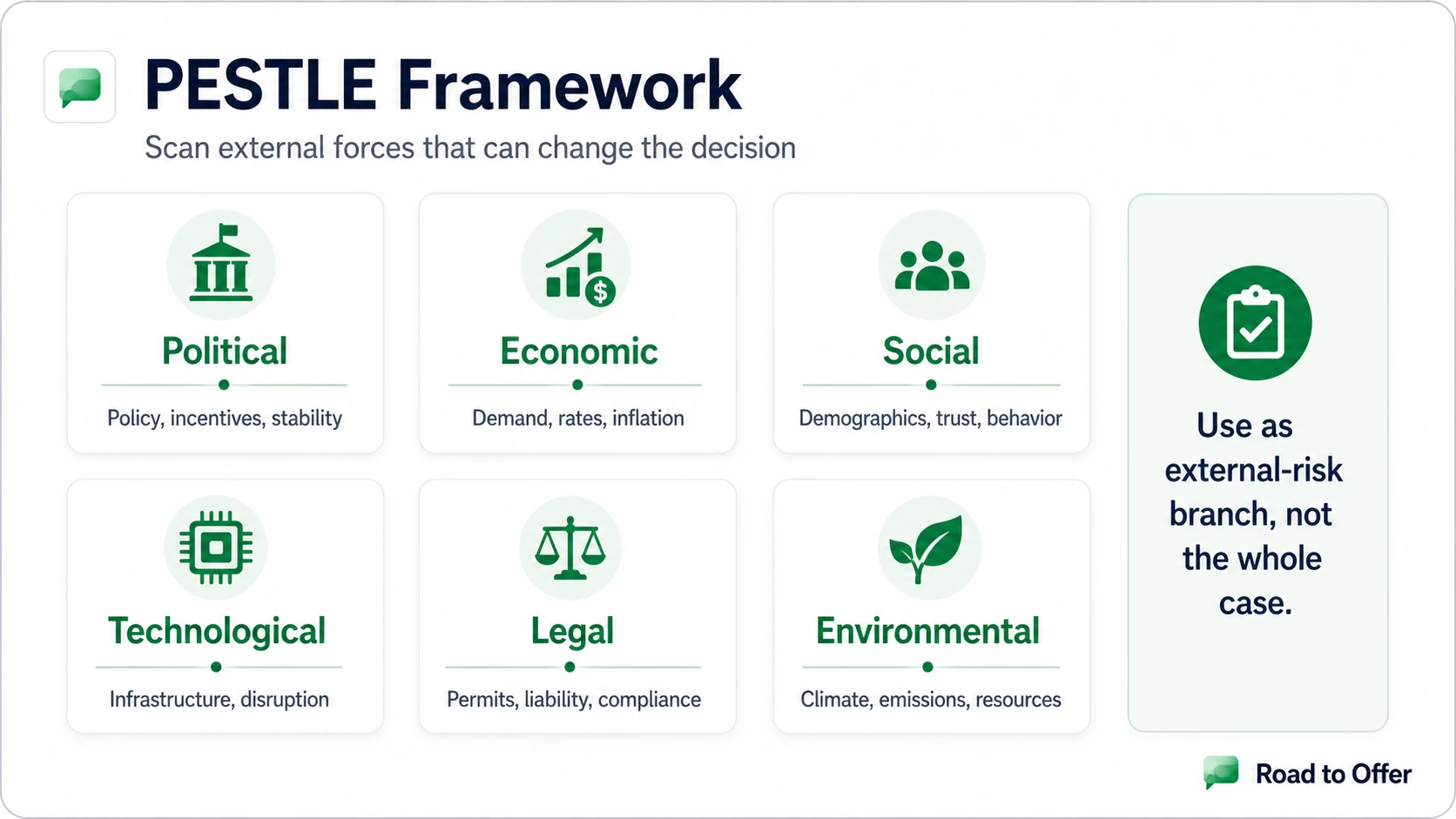
PESTLE framework analysis helps you scan the external forces around a business decision: political, economic, social or sociological, technological, legal, and environmental. In a case interview, it works best when the prompt is about market entry, international expansion, regulation, public sector constraints, energy transition, healthcare, technology adoption, or an external shock. It works poorly when you use it as a memorized acronym for every case. A consulting answer needs a client objective, a clean issue tree, a data request for each relevant branch, and a clear explanation of how the evidence would change your recommendation. Use PESTLE to pressure-test macro risk, then connect it to demand, competition, economics, and capability fit. If the case is a narrow profit decline or pricing decision, PESTLE may belong in a small risk branch, not the main structure. That is the difference between using the framework and hiding behind it.
For a wider market-entry answer, pair this with the market entry case interview guide and the case interview frameworks complete guide for a view of how PESTLE fits alongside Porter's Five Forces, SWOT, and the market entry framework. For industry-level structural analysis, Porter's Five Forces examines competitive forces rather than macro forces, making the two frameworks complementary rather than interchangeable. When an expansion decision requires scoring multiple markets against each other, the market attractiveness framework applies the macro scan to a prioritization decision.
What PESTLE framework analysis actually does
PESTLE is a macro environment lens. It asks what outside forces could change the attractiveness, feasibility, risk, or timing of a client decision. Corporate Finance Institute describes PESTEL as a strategic framework for evaluating the business environment. In interview terms, that means PESTLE is useful when the market around the client matters more than the client's internal operations.
The trap is treating the acronym as the answer. Political factors do not matter because the letter P exists. They matter if incentives, approvals, public policy, trade rules, or instability could change whether the client should enter, wait, partner, or walk away. The same logic applies to every factor. A good answer starts from the client objective, selects the external forces that could alter the decision, and connects them to evidence. If you are unsure whether you are building a structure or repeating a framework, read case structure vs case framework before memorizing another acronym.
When PESTLE fits a case and when it does not
PESTLE fits when the prompt has external uncertainty baked into it: a market entry case, international expansion, public-sector decision, regulated healthcare launch, energy transition investment, technology adoption question, or external shock. In those cases, the client may be capable and the economics may look good, yet policy, permits, trust, infrastructure, or environmental exposure can still change the recommendation.
It fits poorly as the main structure for a narrow profit decline, pricing decision, capacity problem, or valuation exercise. You can still include an external-risk branch if the prompt hints at regulation or market disruption, but it should not crowd out the core economics. BCG's case interview preparation guidance emphasizes structuring the approach, asking thoughtful questions, analyzing data, doing quick calculations, and identifying important factors. That is the behavior PESTLE needs to support.
Candidate script: I would structure this as a market attractiveness question. I would test demand, competition, economics, and capability fit, and I would include external risk as a branch because regulation and adoption risk could change the recommendation.
PESTLE template: turn each factor into a testable branch
Use the framework as a translation device: factor to question, question to data request, data to recommendation. The table below is the consulting version, not a corporate planning checklist.
After building the table for your prompt, use the case structure drill to convert the relevant rows into a clean issue tree. The test is whether a person can hear your structure and understand what decision each branch helps make.
Turn PESTLE signals into a case structure from the Road to Offer drill engine. Answer a real prompt and get AI-scored feedback. Free accounts include 5 drills per day for the first 3 days after signup.
If you want to test whether this translation is working under pressure, Road to Offer helps by turning the PESTLE prompt into a spoken structure drill, with branches, evidence, and prioritization instead of acronym recall.
Turn PESTLE into a case structure
Practice converting an external-market prompt into a clean issue tree, data requests, and a prioritized first branch.
Worked example: home battery market entry
Prompt: a residential solar installer is considering entering the home battery market in Texas. The client objective is to decide whether the move is attractive and feasible, given its existing customer base, installation capabilities, and risk appetite.
A clean opening structure would not be PESTLE alone. It could be: market attractiveness, external risk, competition, unit economics, and capability fit. PESTLE sits inside external risk. For a full expansion structure, the market attractiveness framework helps connect macro risk to demand, competition, and economics.
Political: battery incentives, grid reliability policy, interconnection rules, and local public approvals could affect adoption. The data request would be incentive eligibility, policy direction, and approval friction.
Economic: household affordability and financing could shape demand. The data request would be customer willingness to pay, financing availability, installation cost, and margin under conservative assumptions.
Social or sociological: homeowners may value resilience, energy independence, or sustainability, but trust and sales education matter. The data request would be customer interviews, attach-rate evidence from existing solar customers, and objections from recent sales calls.
Technological: battery performance, vendor reliability, software integration, and installer training could change execution risk. The data request would be vendor maturity, failure rates if available in the case materials, installation complexity, and support requirements.
Legal and environmental: permitting, liability, safety rules, storm exposure, and sustainability expectations could affect cost and messaging. The data request would be permitting steps, warranty exposure, insurance constraints, and climate resilience needs.
A conditional recommendation might be: enter with a limited launch if incentives, customer demand, and installer readiness are favorable, but avoid a broad rollout until permitting friction, support cost, and vendor reliability are clearer.
Run the Texas home battery Bain market entry case. Can a solar installer clear $2M of year one EBITDA in Texas home batteries? Answer this Bain market entry case step in the article, then continue the full case. Continue the full case on Road to Offer
Questions to ask before choosing a PESTLE branch
Start with clarifying questions that define relevance. What decision does the client need to make? Which external force could kill the strategy even if the economics look attractive? Is the client comparing markets, entering a regulated space, responding to policy change, or reacting to a shock? Which uncertainty would change the recommendation most?
Then ask data-request questions. What evidence do we have on policy direction, customer adoption, financing conditions, technology readiness, permitting, and environmental exposure? Which external risks are binding constraints, and which are manageable sensitivities? Does any branch overlap with another part of the structure?
Prioritize the branch with the highest decision impact, not the branch's acronym position. If regulation could stop the launch, start with political and legal. If adoption behavior is unknown, start with social or sociological. If unit economics are already weak, PESTLE may be secondary. This is where MECE framework thinking matters: do not let legal, political, economic, and social all become vague risk buckets.
PESTLE vs Porter's Five Forces, market attractiveness, and SWOT
PESTLE scans macro forces around the market. Porter's Five Forces diagnoses industry structure: rivalry, substitutes, buyers, suppliers, and entry barriers. The tools answer different questions. PESTLE asks what outside forces shape the playing field. Five Forces asks how attractive the competitive game is after you are on that field.
Market attractiveness is broader than both. It usually combines demand, growth quality, customer needs, competition, economics, risk, and client fit. PESTLE can feed the risk portion, but it should not replace the rest of the answer.
SWOT is weaker as an opening case structure because it mixes internal and external observations into a summary. It can be useful near the end, after you already know the evidence. In interviews, named frameworks matter less than clean reasoning. Bain's hiring-process page connects case interviews with working through a problem and showing problem-solving skills, which is why a memorized label is less persuasive than a tailored issue tree.
Common misuse checklist and practice drill
The common mistakes are predictable. Candidates recite the letters without tying them to the client objective. They double-count political and legal issues instead of separating policy intent from binding compliance. They make every branch equal even when only a few could change the answer. They request no evidence. Worst, they stop at analysis and never explain what the client should do.
Weak branch: Legal and political could be risky.
Stronger branch: I would test whether policy incentives, public approvals, and binding permit rules could change the launch decision. If incentives are unstable or permits delay installation, I would recommend a staged entry or a partner model rather than a full rollout.
That rewrite shows structure, prioritization, and business judgment. It also gives the interviewer something to test. BCG's interview-process guidance frames case interviews around problem-solving, analytical, and communication skills, so your PESTLE branch should make your reasoning easier to follow, not harder.
On Road to Offer, treat this as a spoken issue-tree skill. Start with the Case interview structure drill: take a market-entry prompt, build the external-risk branch, choose the relevant PESTLE factors, and say what evidence would change your answer. If the prompt requires market sizing, add Market sizing questions. If the interviewer gives external data in an exhibit, use the Chart and exhibit drill. For the ending, use the Synthesis drill so the recommendation does not trail off.
Targeted drills are useful when you want focused reps, while free case practice is better once you can prioritize branches out loud. If you need the whole prep sequence around this skill, the complete case interview preparation guide gives the wider map.
Once the branches make sense, Road to Offer can test whether they survive a full case with math, evidence, and synthesis, not just a clean opening structure.
Test your structure in a full case
Run a free AI-guided case and see whether your structure, math, evidence, and synthesis hold together from prompt to recommendation.
Sources and Further Reading (checked 2026-06-02)
- CIPD - PESTLE audits six external influences around an organisation.
- Corporate Finance Institute - PESTEL Analysis & Uses in Finance
- Boston Consulting Group - BCG describes case interviews as realistic business challenges where candidates work through the problem step by step.
- Boston Consulting Group - Consulting Interview Process
- Bain & Company - Bain's official hiring-process page connects case interviews with working through a problem and evaluating problem-solving skills.
- Yale Office of Career Strategy - Consulting
- Yale Office of Career Strategy - Interview Preparation
Frequently asked questions
Resources and related guides
- Practice PESTLE analysis in a real case interviewPractice
- Browse all free resourcesResource hub
- Market Attractiveness Framework: Dimensions, Scorecard, and Case UseFrameworks · May 30, 2026
- Ansoff Matrix vs BCG Matrix for Case InterviewsFrameworks · Jun 2, 2026
- Cost-Benefit Analysis Framework for Case InterviewsFrameworks · Jun 1, 2026
- Market Entry Framework (2026): 5 Steps + Full Worked CaseFrameworks · Feb 1, 2026