
First Principles Thinking Framework for Case Interviews
Use first principles thinking to build custom case structures from fundamentals: three named techniques, a decomposition table, a fully worked numeric example, when to use it, and common mistakes.
On this page
A first principles thinking framework helps you strip a business problem down to what must be true, what is only an assumption, and what data would prove or disprove the branches that matter. In a consulting case, it is not a canned framework to recite. It is a way to build a custom issue tree from the client objective upward: define the decision, identify the fundamental drivers, separate facts from assumptions, then prioritize the branch most likely to change the recommendation. That matters because case interviews reward visible problem solving, not memorized business labels. Bain describes its hiring process as a chance to work through a problem and show how you think, which is exactly where first principles thinking becomes useful: it turns ambiguity into branches, branches into data requests, and data requests into a recommendation path. The case interview frameworks complete guide is the hub that connects first principles reasoning to the MECE standard and issue tree structure underneath all framework evaluation.
What does first principles thinking mean in a case interview?
Farnam Street defines first principles thinking as separating what is known from what is assumed, then rebuilding from essentials. Untools frames it as breaking a complex problem into basic elements and using questions to reach the root of the issue. In a case interview, you translate that into business language fast.
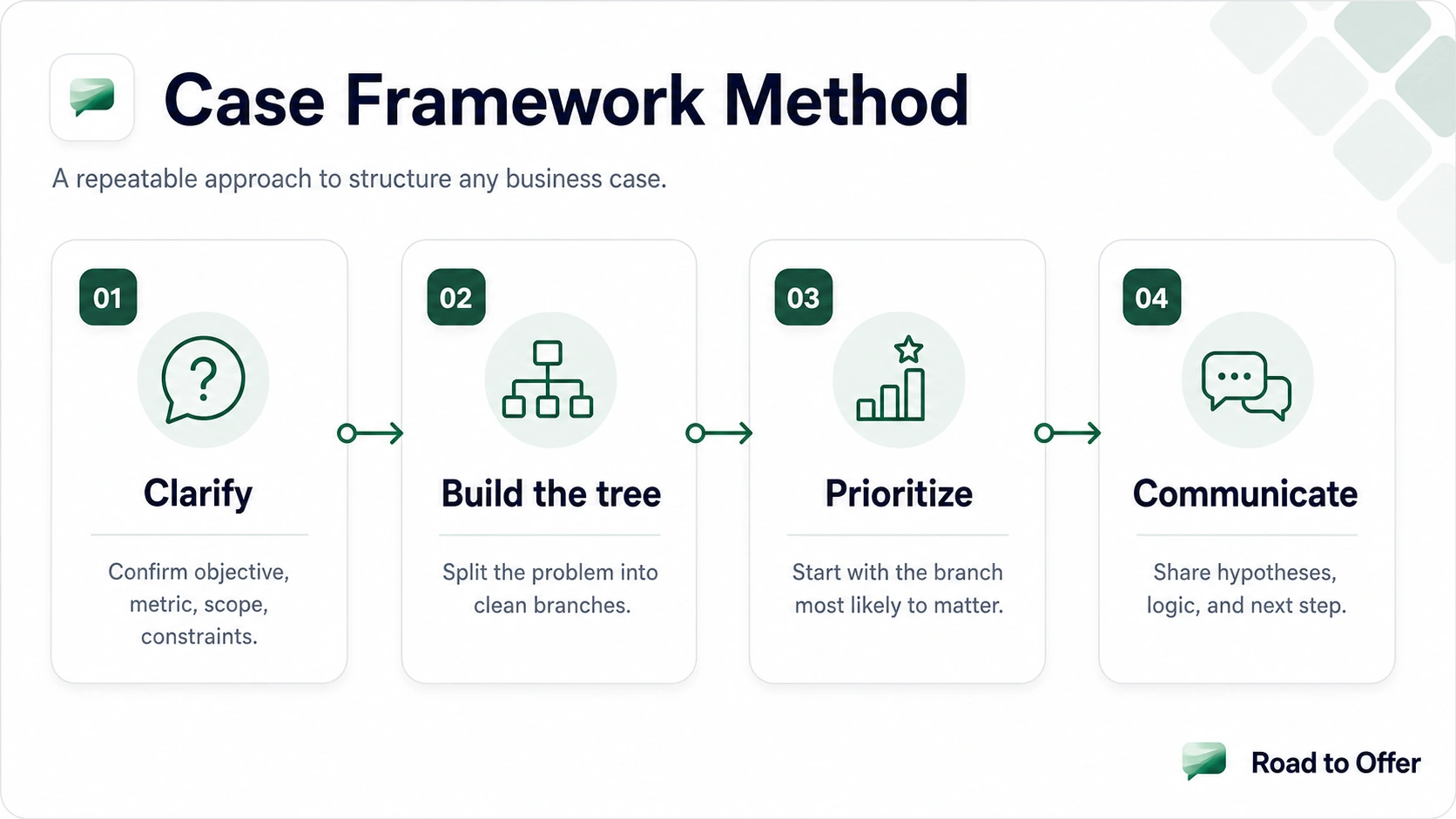
The interviewer does not need a philosophy lesson. They need to see whether you can take a messy client question and create a useful path forward. A first-principles structure starts with the client decision, not with a favorite framework. Ask: what decision are we helping the client make, what must be true for that decision to work, which assumptions are we making, and what evidence would change the answer?
Bad branch: understand customers. Better branch: test whether target customers have enough unmet need and willingness to pay to support the proposed offer. The second version gives you a driver, a test, and an implication. This is the difference between structured thinking in a case interview and a list of topics that sounds organized but tests nothing.
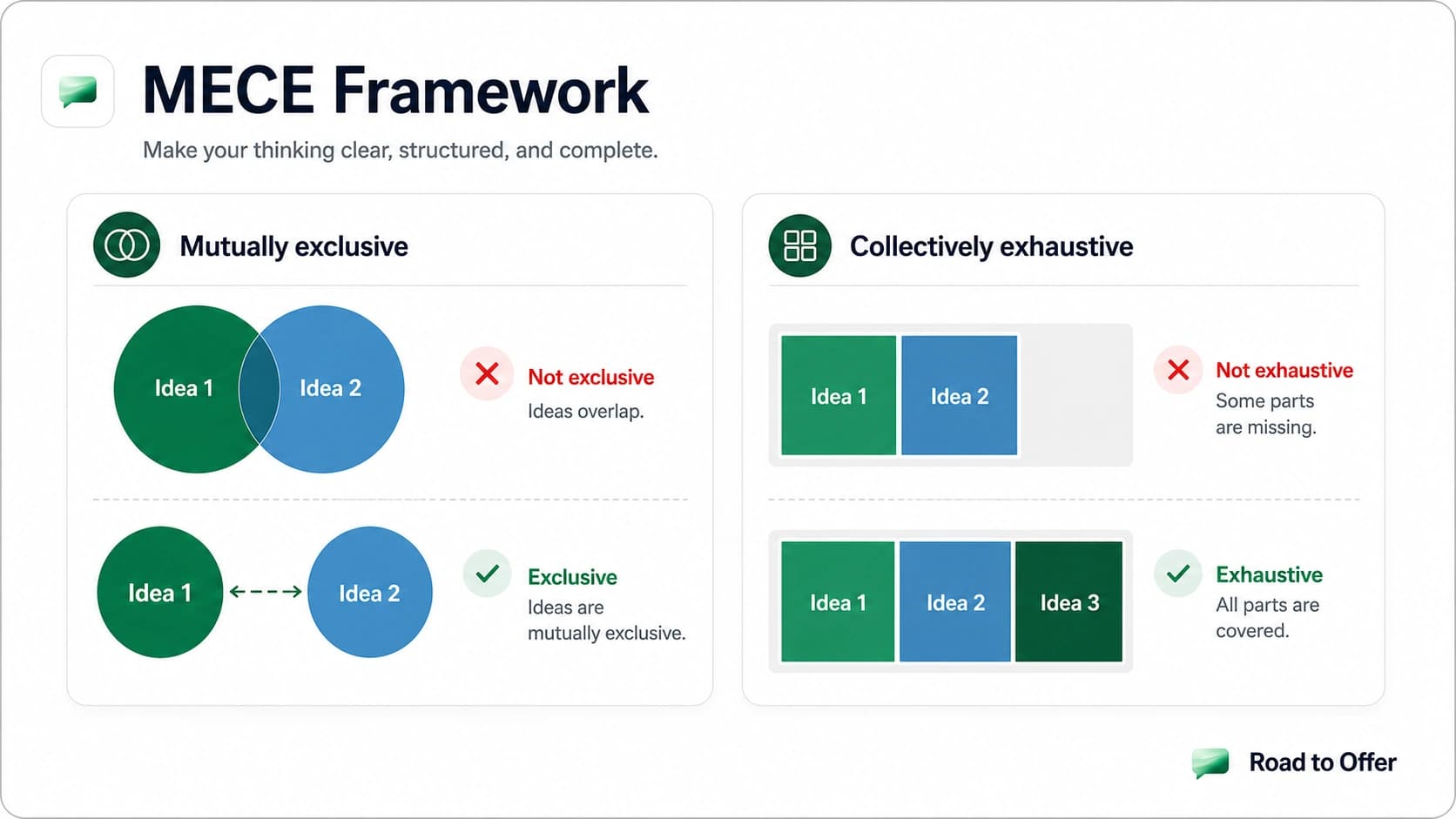
First principles thinking also does not replace MECE discipline. You still need branches that are separate and complete enough to guide the case. If your revenue branch includes demand, and your market branch also includes demand, you are double-counting. The mental model helps you find the basics; the MECE framework helps you keep them clean.

Profitability · medium
Practice first principles thinking in a real case interview
Matched to this first principles thinking guide: a live energy profitability case with an AI interviewer. Free, scored on every step.
Three techniques to reason from first principles
There is no single first-principles algorithm. Three named techniques recur across problem-solving literature, and each maps cleanly onto a case interview.
Socratic questioning. Interrogate each assumption in turn: clarify what you mean, challenge the assumption, look for evidence, consider an alternative view, examine the consequence, then question the question itself. In a case, this is how you decide whether a branch belongs in your tree. If you cannot name the evidence that would support a branch, you are stating a belief, not a driver.
The Five Whys. Keep asking why until you reach a root you cannot reduce further. Profit dropped. Why? Variable cost per unit rose. Why? Input prices rose. Why? A key supplier raised prices. Three or four levels usually reach a root you can act on. This is the engine behind a hypothesis-driven case interview, where you chase the most likely cause instead of opening every branch equally.
Elon Musk's three-step method. Define the current assumptions, break the problem down to its fundamental parts, then rebuild the answer from those parts. The canonical business example is SpaceX, worked out with real numbers in the section below. The point for a candidate is the sequence: do not start from "how is this normally done," start from "what is actually true here."
You do not announce the technique name in an interview. You use it silently to generate branches that test something specific, then speak the branches in plain business language.
Learn frameworks properly
Pick and adapt structures instead of memorizing buckets.
When should you use it in a case?
Use first principles thinking when the prompt is ambiguous, novel, or poorly served by a memorized template. It is useful in new market, pricing, operations redesign, product launch, turnaround, and root cause cases because those prompts often hide the real issue under a broad business objective.
Yale describes consulting work as problem solving across strategy, profitability, structure, management, and growth issues. That range is the reason a single canned structure can feel too narrow. A market entry case might require customer need, competitive response, unit economics, regulation, and execution risk. A cost case might require process time, labor productivity, rework, input costs, and quality constraints. The right branches come from the business logic of the prompt, which is why building a custom framework rewards this method most.
Standard frameworks still have a place. If the prompt is clearly about profit, start with revenue and cost. If it is clearly about market sizing, build a demand tree. If it is clearly about entering a market, a classic market entry framework spine can help. First principles thinking is not a reason to avoid simple tools. It is a way to avoid forcing a generic label when the client decision needs a custom structure. The framework mistakes guide shows what happens when candidates reach for the label first.
How do you decompose a problem? Three lenses
When you do not have a template, you still need a way in. Three decomposition lenses cover most cases.
Component lens. Break the system into its parts. Airline on-time performance splits into internal components (aircraft turnaround, crew, ground operations) and external dependencies (airport capacity, weather, regulation). Use this when the problem is a thing made of parts.
Process lens. Map the sequential steps. Hotel guest satisfaction runs booking, check-in, stay, then follow-up, with an intervention point at each stage. Use this when the problem is a flow over time.
Stakeholder or supply-and-demand lens. Split by who is involved or by the two sides of a market. A pricing problem becomes "what the customer will pay" against "what it costs us to serve," which is the unit economics framework in disguise.
On depth, two to three levels is the right range for a case you have 20 to 30 minutes to crack. Progress from symptom (profit dropped) through driver (variable cost up) to actionable root (a supplier raised prices). A fourteen-branch tree is unworkable. Depth signals rigor, restraint signals judgment.
First-principles decomposition table
The easiest way to make the method tangible is to convert assumptions into testable branches. Think of the table below as a pre-issue-tree scratchpad.
This table becomes an issue tree when you group related branches under the client objective and prioritize the branch most likely to change the answer. For more visual examples of turning fundamentals into branches, compare this with driver tree examples.
Road to Offer also has an issue tree case interview guide you can use after making your own version. The point is not to copy the tree. The point is to check whether your branches are testable, separate, and tied to a decision.
Worked example: the SpaceX cost teardown
The clearest real-world example of first principles thinking is how SpaceX attacked rocket cost, and it carries a lesson that transfers directly to cost cases. In 2002, when Musk priced rockets to buy, quotes ran as high as 65 million dollars per launch vehicle. The assumption-based view said a rocket simply costs tens of millions, full stop.
The first-principles question was different: what is a rocket actually made of, and what do those raw materials cost on the commodity market? Aerospace-grade aluminum alloys, titanium, copper, and carbon fiber. When the raw inputs were priced out, they came to roughly 2 percent of the typical selling price.
Run the arithmetic. If raw materials are 2 percent of a 65 million dollar price, the input cost is about 0.02 times 65 million, which is roughly 1.3 million dollars. The remaining 63.7 million dollars, about 98 percent, is process: fabrication, integration, overhead, margin, and the throwaway design of the rockets themselves. That gap between a 1.3 million dollar input and a 65 million dollar price is the signal. It says the cost problem is almost entirely in the process, not the materials, so the highest-leverage move is to attack manufacturing, integration, and reusability, not to negotiate cheaper aluminum.
The transferable case lesson: decompose price into input cost and process cost, find the biggest gap, then point your analysis at the layer where the gap lives. Do not assume the answer sits where the conventional industry puts it.
Worked example: EV charging profitability case
Prompt: a client operates EV charging hubs and wants to improve profitability. How would you approach the problem?
A weak answer jumps straight into revenue and cost without explaining what matters underneath. A stronger first-principles answer starts with the profit objective, then breaks profit into the drivers that must be true for a charging hub to make money. Profit per site equals revenue per site minus cost per site. Revenue per site equals sessions per day times average revenue per session times days. Cost per site splits into electricity, site rent, maintenance, payment fees, and labor.
Now make it numeric so the structure earns its keep. Take one hub:
- Sessions per day: 40
- Average revenue per session: 12 dollars
- Days per month: 30
Monthly revenue is 40 times 12 times 30, which is 14,400 dollars. On the cost side, suppose electricity is 5,000 dollars, site rent is 4,000 dollars, maintenance and payment fees together are 2,000 dollars, and labor is 2,500 dollars. Total monthly cost is 5,000 plus 4,000 plus 2,000 plus 2,500, which is 13,500 dollars. Monthly profit per site is 14,400 minus 13,500, which is 900 dollars. That is a profit margin of 900 divided by 14,400, about 6.3 percent. Thin.
The first-principles read of those numbers tells you where to push. Revenue is gated by sessions per day, and 40 sessions on, say, 4 chargers is about 10 sessions per charger per day, which is low utilization. If a marketing or location fix lifted sessions per day from 40 to 60, revenue would rise to 60 times 12 times 30, which is 21,600 dollars, and most of the new revenue drops to the bottom line because rent and labor are largely fixed. Profit per site would jump from 900 to roughly 21,600 minus 13,500, which is 8,100 dollars. That sensitivity is the insight: utilization, not price, is the dominant lever, so the first data request should be site-level utilization split by location and time of day, not a pricing study.
This example sits closest to a profitability case interview guide, but the first-principles move (decompose, quantify, find the dominant lever) is what keeps it from becoming a generic revenue-cost answer. For the cost side specifically, the operations and cost framework gives the standard branches you would test against.
Practice first-principles structure
Turn an ambiguous case prompt into a clean issue tree, a prioritized first branch, and a data request.
Which branch should you solve first?
The biggest trap is opening every branch because it feels comprehensive. First principles thinking should make you sharper, not slower. Before you start solving, ask a short set of branch-selection questions.
What must be true for the client objective to be met? This keeps the structure tied to the decision instead of drifting into interesting but irrelevant analysis.
Which assumption, if wrong, would change the recommendation fastest? This helps you avoid low-leverage branches. In the EV charging case, utilization moved profit far more than price did, so utilization comes first.
Which driver is inside the client's control? A branch can be important but not actionable. If the client cannot influence a market constraint, your recommendation may need to focus on pricing, segment choice, operations, or timing.
What data would prove or disprove this branch? In a case, the practical version of Socratic questioning is a data request that can move the answer.
What would I recommend if this branch were true? If you cannot connect a branch to a possible recommendation, it may not belong in your opening structure.
Build a first-principles McKinsey profitability case. A bottled-water producer saw EBITDA fall from $65M to $45M even as revenue grew. Answer this McKinsey profitability case step in the article, then continue the full case. Continue the full case on Road to Offer
First principles vs lateral thinking: how to combine them
First principles thinking decomposes a problem vertically, down to what is provably true. Lateral thinking, Edward de Bono's term, works horizontally: it generates non-obvious branches you would not reach by decomposition alone, such as reversing the constraint or borrowing a structure from another industry. In a case interview the two combine as a hybrid toolkit: use lateral moves to widen the option set (what if the client stopped serving this segment entirely?), then use first-principles decomposition to test each option down to unit economics. Decomposition without lateral thinking produces safe but predictable trees; lateral thinking without decomposition produces clever ideas that do not survive the math. Interviewers reward the combination: a creative branch followed by a rigorous teardown of that branch.
What are the common mistakes with first principles thinking?
First-principles answers become weak when they sound abstract. Candidates say they want to get to fundamentals, then produce branches like customer, company, competition, and market without explaining what each branch would test. That is just a familiar framework wearing a new label, the exact pattern the framework mistakes guide warns against.
Another misuse pattern is over-decomposition. You do not need to break every business problem down to human psychology, physics, or economic theory. In case interviews, the useful stopping point is the level where you can request data and change the recommendation, which is why two to three levels is the working range.
Watch for double-counting. If willingness to pay appears under customers, pricing, and market attractiveness, the structure will become messy. Use MECE as the quality check: are the branches separate enough, and have you covered the major ways the objective can succeed or fail?
Before you speak, run this checklist:
- Did I start from the client decision?
- Did each branch test a specific assumption?
- Did I avoid overlapping branches?
- Did I include a data request for the first branch?
- Can I explain why that branch should come first?
- Would the answer change if this branch proved true or false?
A good case interview structure is useful only if it creates a next step. If your structure does not lead to data, math, or a recommendation, it is decoration. See how to use consulting frameworks for when a template is still the faster path.
How should you practice this?
Practice in layers. Start untimed with one prompt and build the issue tree on paper. Say each branch out loud as a testable assumption, not as a category. Then compare your branches with the case structure vs. framework guide and your own issue tree notes so you can see where you overlapped, skipped a driver, or stayed too vague.
Next, use the Case interview structure drill to practice turning ambiguous prompts into first-principles structures under interview pressure. This is where deliberate reps matter: reps reveal whether your logic survives when you have to speak clearly.
Interactive drill set. Write an answer before revealing the worked solution, then continue into Road to Offer for scored practice and AI feedback.
If you are coming from outside a business background, the case prep guide for career changers maps the building blocks in order.
After that, move into synthesis. First principles thinking should end in a sharp implication, not a beautiful tree. Use the Synthesis drill to practice converting branch findings into a recommendation. When you are ready for a full run, take the method into free case practice and see whether your structure, math, and recommendation still connect.
The goal is simple: build cleaner issue trees, ask better data questions, and choose a first branch with intent. When the method feels clear, the final test is whether it holds across a full case from prompt to recommendation.
Sources
- Bain and Company, Our Hiring Process (checked June 18, 2026)
- Yale Office of Career Strategy, Consulting (checked June 18, 2026)
- Farnam Street, What is First Principles Thinking? (checked June 18, 2026)
- Untools, First principles (checked June 18, 2026)
- ReadyNorth, What Is First Principles Thinking? 3 Popular Approaches (checked June 18, 2026)
Rebuild one ambiguous prompt from its drivers
Turn the client decision into testable branches, choose the first branch, and state the data request that would change your answer.
Frequently asked questions
Resources and related guides
- Practice first principles thinking in a real case interviewPractice
- Browse all free resourcesResource hub
- Driver Tree: Case Interview Examples, Math, and PitfallsFrameworks · May 22, 2026
- Ansoff Matrix vs BCG Matrix for Case InterviewsFrameworks · Jun 2, 2026
- Cost-Benefit Analysis Framework for Case InterviewsFrameworks · Jun 1, 2026
- SCQA Framework: Structure Your Case Recommendation (2026)Frameworks · Jun 28, 2026