
Case Structure vs Case Framework
Why case structure and case frameworks are not the same thing, and how to use frameworks as a starting point instead of a memorized script.
On this page
The difference is simple: a framework is a reusable template, while structure is the custom issue tree you build for the exact client objective. Candidates often use the words interchangeably, but interviewers do not score them the same way. A framework can help you start. A strong structure shows what you will test, why it matters, and where you will begin.
Why Do Candidates Mix These Up?
Most prep content teaches frameworks first because they are easier to memorize. That creates a subtle problem. Candidates learn the shape of a profitability case or a market entry case, then try to reuse the shape before they fully understand the problem.
That approach feels efficient, but it breaks down as soon as the case becomes more specific. A retail profitability case is not the same as a software profitability case. A market entry case for a consumer product is not the same as one for a regulated healthcare service. The objective changes the branches you should explore.
If you want the broader library of templates, use case interview frameworks complete guide. If you want the logic behind building a tree from scratch, pair it with issue tree case interview. This article sits between those two.
What Is A Framework Supposed To Do?
A framework should speed up your thinking, not replace it. It gives you a tested starting point for a common problem class. Profitability, market entry, pricing, customer segmentation, and M&A are all examples of frameworks that can save time in the first minute of a case.
It reduces blank-page panic
When you hear a familiar problem type, a framework gives you immediate orientation. You are not starting from zero.
It gives you vocabulary
Frameworks help you name the major buckets cleanly. That matters because clarity is part of the score.
It still needs adaptation
The branch names, order, and depth should change based on the exact case. If they do not, you are probably overusing the template.
For example, a profitability framework is useful when profits are falling, but the right branches in a manufacturing case are different from the right branches in a software case. A manufacturer might split volume by plant capacity, product mix, scrap rate, labor utilization, and raw material costs. A SaaS company might split the same profit problem into acquisition volume, conversion, churn, ARPU, hosting costs, customer support, and sales efficiency.
What Is Structure Supposed To Do?
Structure is the actual logic of your answer. It maps directly to the case objective and tells the interviewer where you are going and why.
It fits the exact question
If the objective is "Should we enter this market," your structure should reflect market attractiveness, fit, economics, and risks. If the objective is "Why are profits down," your structure should reflect revenue and cost drivers.
The same framework can lead to different structures:
- For "Should our grocery chain enter meal kits?", market entry might become customer demand, right-to-win versus delivery apps, unit economics, and operational complexity.
- For "Should our medical device company enter Brazil?", market entry might become regulatory approval, physician adoption, distributor access, reimbursement, and local competitor response.
Both start from market entry. Only the second layer proves you understood the case.
It is MECE enough to be useful
A good structure separates the problem into branches that do not overlap and do not leave major gaps. That is why MECE principle explained matters so much.
It supports prioritization
Structure should tell the interviewer which branch you want to test first and why. That is what makes the analysis feel consulting-grade instead of textbook-grade.
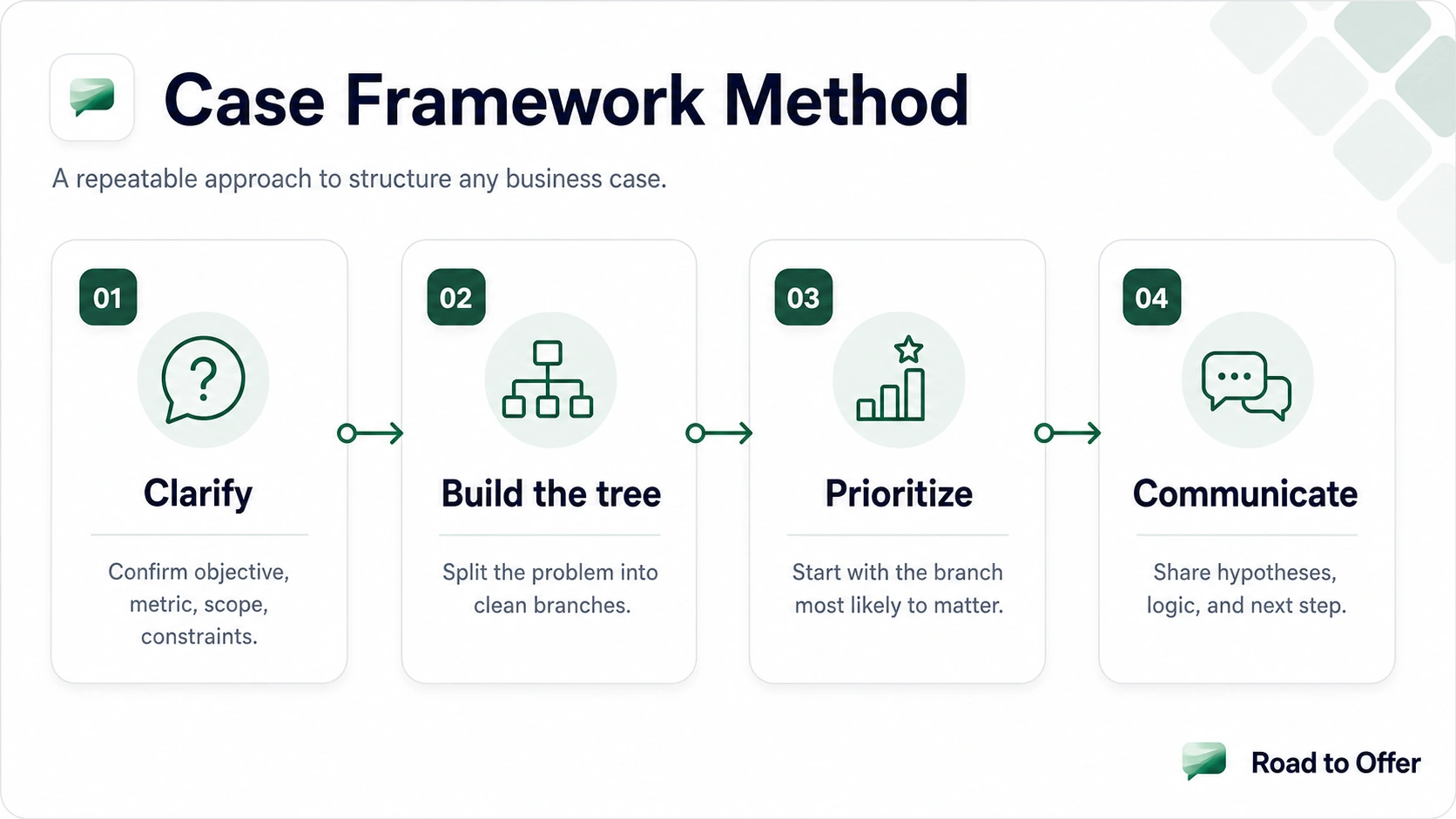
How Do You Build Structure In Real Time?
Start from the objective, not from the framework name. Then ask what has to be true for the client to achieve it.
Step 1: Restate the objective
If the client wants to improve profit, identify the exact profit problem. If they want to enter a market, identify what success would look like.
Step 2: List the drivers
Ask what would have to be true for the objective to work. Revenue, costs, customer demand, competition, execution, and risk are common driver categories, but the exact set should change with the case.
Step 3: Make it MECE
Cut overlap. Fill gaps. If two branches answer the same question, merge them. If a major driver is missing, add it.
Step 4: Prioritize
Tell the interviewer where you want to start and why. This is where a custom structure starts to feel like a real consulting tree.
That process is the heart of building an issue tree from scratch. It is also the difference between sounding rehearsed and sounding present.
What Does A Weak Structure Look Like?
A weak structure usually has one of three problems.
It is copied from memory
The candidate says a framework in neat order, but the branches do not match the objective.
It is too broad
The structure tries to cover everything and ends up explaining nothing.
It is not prioritized
The candidate lists branches without telling the interviewer where to start.
That is why interviewers care so much about the opening. A good opening tells them you understand the problem. A bad opening tells them you know a template.
How Are Frameworks Still Useful?
Frameworks are useful because they reduce the search space. They are especially helpful when the problem is familiar and the time pressure is high.
They give you a fast first draft
If the case is about margins, a profitability template gets you moving quickly.
They keep you from missing basics
Beginners often forget one of the major buckets. Frameworks reduce that risk.
They support drilling
Practice improves faster when you have a known starting point. That is why case interview examples are useful alongside open-ended drills.
The key is to treat the framework as a rough first draft. Once you have it, rewrite the branches until they match the client, industry, objective, and constraints.
How Do Top Candidates Use Both?
Top candidates do not choose between structure and framework. They move through them in sequence.
- Hear the objective.
- Recall the closest framework.
- Adapt it to the case.
- Present a custom structure.
- Test the most important branch first.
That sequence sounds simple, but it takes practice. It also explains why some candidates who know every framework still underperform. They know the labels, but they have not trained the live restructuring step.
If you want to stress-test that transition, the case interview scoring rubric is useful because it shows what interviewers actually score once you start speaking.
How Should You Study This Topic?
Do not study framework names in isolation. Study the decision process that turns a template into a case-specific tree.
Study by case type
Profitability, market entry, pricing, and M&A each push you toward different structure choices.
Study by objective wording
The wording of the prompt tells you what kind of structure the interviewer wants.
Study by live practice
The fastest way to improve is to build trees out loud, then review where you overfit the template.
If you need a clean place to practice that loop, pair free case book reading with free structure drills. One gives you prompts and examples; the other forces you to build the opening tree before you see feedback.
Sources and Further Reading (checked 2026-05-01)
- BCG case interview preparation: https://careers.bcg.com/case-interview-preparation
- McKinsey interviewing: https://www.mckinsey.com/careers/interviewing
- Bain case interview prep: https://www.bain.com/careers/hiring-process/case-interview
- Case interview frameworks complete guide
- Issue tree case interview
- MECE principle explained
- Profitability framework
- Market entry framework
- Case interview examples
- Case interview scoring rubric
FAQ
Frequently asked questions
Keep reading
Related articles
How to Structure Your Case Interview Opening Statement
Master the first 2 minutes of a case interview: clarifying questions, structuring the problem, and opening in a way that signals top-tier quality.
Impact-Effort Matrix: How to Prioritize Like a Consultant
The impact-effort matrix ranks 4 quadrants in 5 minutes. Use it to sequence 20+ competing recommendations into a 3-action plan with a worked case example.
Mock Consulting Case Interview Prep: Frameworks and Feedback
Use mock consulting case interviews to practice structure, math, exhibits, and recommendations under realistic pressure before MBB rounds.
Customer Profitability Case Interview: Segmentation Guide
Solve customer profitability case interviews: segmentation logic, cost-to-serve drivers, contribution margin, worked examples, questions, and practice drills.