
When To Use Consulting Frameworks (And When To Skip Them)
When to use a consulting framework in a case interview, when to skip it, how to pick from profitability, market entry, 3C, and Porter's Five Forces, and how to adapt the branches to the prompt.
On this page
Most candidates ask the wrong question. They ask "which framework do I use here?" The interviewer is asking something different: "can this person break a messy problem apart, decide what matters first, and use the next piece of evidence well?" A consulting framework is a tool that helps you answer the second question, but only when the prompt is broad enough to need one. Used well, it turns an ambiguous business problem into a clean, testable structure. Used badly, it is the single most common reason candidates get dinged on structure: applying a generic template that was never adapted to the case in front of them.
This guide covers the practical decision: when a framework earns its place, when to skip it entirely, how to pick from the small set of structures that actually matter, and how to adapt the branches so your opening sounds like business reasoning instead of a memorized list. For the full library of structures and worked openings, the case interview frameworks guide is the canonical reference; this page is about the judgment of when and how to deploy them.
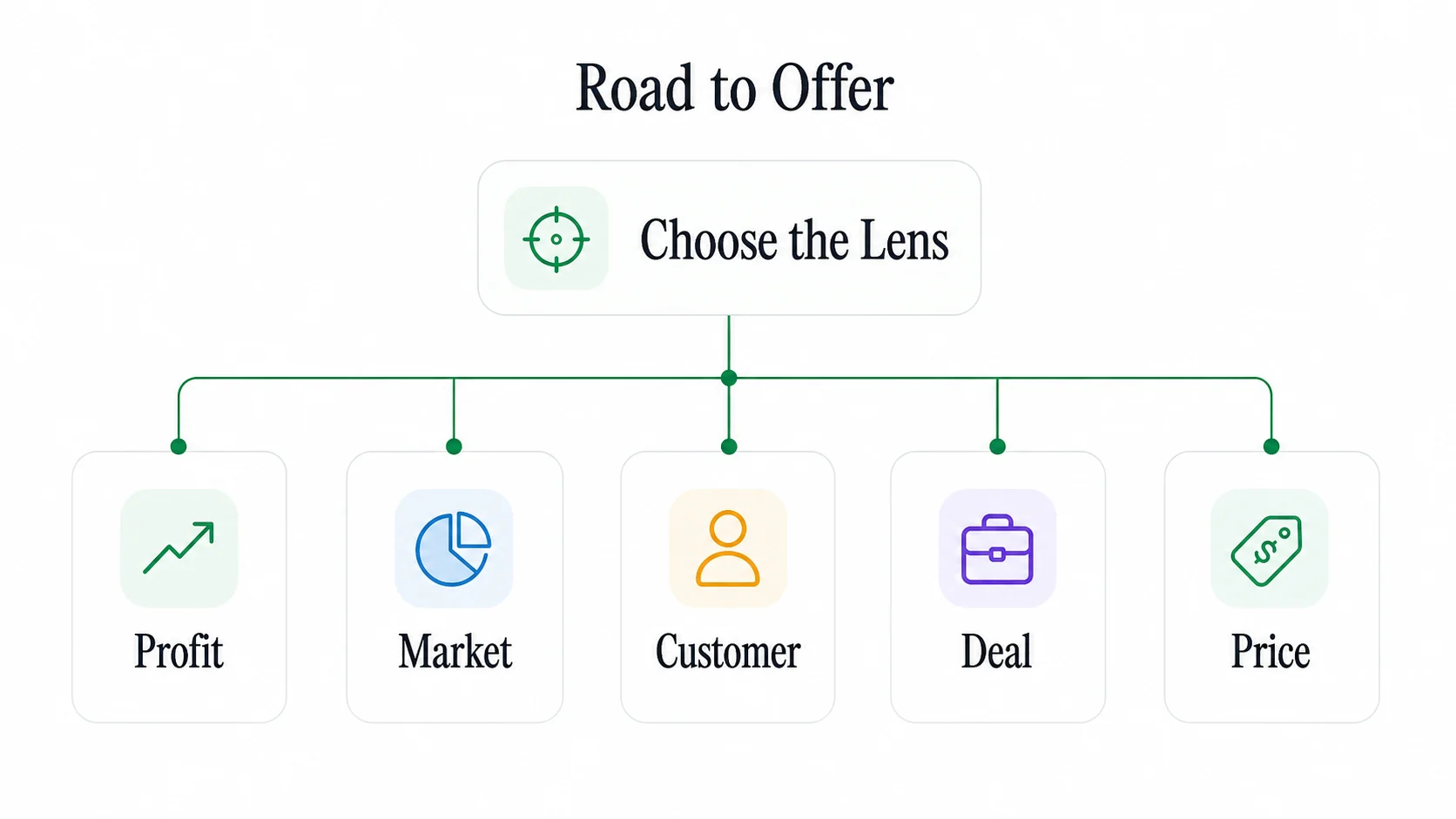
When is a consulting framework actually useful?
A framework earns its place when the prompt is broad enough that you need to create order before you analyze. Use one when you need to clarify the objective, separate possible causes, compare options, or decide which data to request first. A profit decline case needs revenue and cost logic. A market entry case needs attractiveness and feasibility logic. An investment case may need a decision tree framework because the real question is whether one path beats another under uncertainty.
Here is the part most prep guides bury: you do not need 30 frameworks. The seven core structures (profitability, market entry, 3C, 4P, Porter's Five Forces, M&A, and supply and demand) cover roughly 80 to 90 percent of the cases firms actually run. Learning those seven well enough to combine and adapt them beats memorizing a long tail of named models you will never recognize under pressure. Top candidates do not match a prompt to a template; they understand the core structures deeply enough to build a custom version on the spot.
The order matters as much as the choice. Objective first, branches second, data third. If you start with branches before confirming the objective, you risk solving the wrong problem elegantly. If you ask for data before building a structure, you collect facts without knowing how they change the answer. McKinsey describes its case interview as a problem-solving conversation that evaluates analytical thinking and approach to complex problems, which is exactly where a clean structure helps: it makes your approach visible and testable (McKinsey & Company).
Which framework should you use for which prompt?
Consulting work spans strategy, operations, finance, technology, and organizational problems, so candidates need flexible structures rather than one universal template (Yale Office of Career Strategy). Use this table to map the prompt to a starting structure, then customize the branches before you say a word.
For the deeper branch logic behind these, see the profitability framework guide for profit cases, the market entry framework and market attractiveness framework for entry decisions, and Porter's Five Forces for industry structure. For profit and growth cases, a driver tree is often more useful than naming a famous framework because it forces you to connect each branch to measurable business movement.
How do you adapt a framework instead of reciting one?
This is where most candidates lose points. McKinsey, BCG, and Bain interviewers consistently report that one of the most common reasons they give low structure scores is "applied a generic framework without adapting it to the case." The fix is not a better template. It is combining and tailoring.
The skill that earns offers looks like this: a market entry case might pull the attractiveness lens from Porter's Five Forces, the capability lens from the 3C framework, and the math from a profitability tree, then merge them into one custom issue tree. You are not choosing a single model; you are assembling the two or three lenses the objective demands and dropping everything that does not move the answer.
Two practical rules make this land. First, do not announce the framework. Saying "I am going to use the 4 Cs" signals memorization; instead say "I want to look at three things: whether the market is attractive, whether we can win share, and whether it will be profitable." Same logic, no label. Second, keep it to two or three branches that actually matter. Listing every possible bucket tells the interviewer you have not decided what is important. Focus beats breadth.
This is also where MECE stops being decoration. Mutually exclusive, collectively exhaustive branches matter only if they help the interviewer follow your logic and help you decide where to go next. If your buckets are clean but generic, they are not doing enough. To compare your own branches against worked structures, use the issue tree case interview guide.
If you want to test whether your framework choice survives pressure, the move is to turn a fresh prompt into a clean issue tree and commit to a first branch before you hide behind analysis. Road to Offer drills score exactly that step, and across our structure reps the single most common downgrade is the same one interviewers flag: branches that are technically complete but never tailored to the objective. You can practice a free case to see whether your opening structure holds up once the data starts moving.
Worked example: choosing a structure for a profit decline case
Imagine a case where an EV charging hub is losing profit despite strong market demand. A weak memorized opening sounds like this: "I would look at the market, competitors, customers, company, and costs." That is not terrible (it has categories) but it misses the objective. The client has a profit problem, so the structure should explain profit movement before drifting into broad strategy.
A stronger opening starts from the equation Profit = Revenue - Costs and adapts it to the business. On revenue: station utilization, customer mix, price per charging session, fleet discounts, and upsell or service revenue. On cost: energy costs, site rent, maintenance, equipment downtime, staffing, and payment or software fees. Then prioritize out loud: "I would start with utilization, because strong demand with weak profit often means the sites are busy at the wrong times, underused in key locations, or filled by lower-margin segments."
That is a customized profitability framework. It keeps the core revenue and cost spine, then adapts the branches to EV charging economics and names a first move. If the interviewer hands you utilization data, pivot from the broad structure into a sharper question: is the issue too few sessions, poor time-of-day mix, weak pricing, or high cost per session? Notice what did not happen: the candidate never said the word "framework," never listed all five branches as equals, and never waited for the interviewer to choose where to go.
Adapt a profit tree to a McKinsey profitability case. EBITDA fell from $65M to $45M while revenue still grew modestly. Answer this McKinsey profitability case step in the article, then continue the full case. Continue the full case on Road to Offer
When should you skip the framework entirely?
The most underrated skill is knowing when not to structure at all. Launching a full framework on a narrow task is the fastest way to look like you are running a script.
Do not launch a framework when the interviewer asks for a single calculation. If the task is to estimate a market, run market sizing logic instead: define assumptions, calculate cleanly, sanity-check the answer, and explain the implication.
Do not use a broad structure for a direct chart question. Read the exhibit, identify the key pattern, explain what it means for the client, and ask for the next useful cut. The exhibit is the structure.
Do not rebuild the whole case when the interviewer has already isolated the driver. If the data shows costs are the issue, move into cost drivers. If the issue is customer churn, structure churn causes. A framework should narrow with evidence, not reset to your prepared buckets.
Do not add a framework at the recommendation stage. Synthesis beats more structuring: state the answer, support it with the strongest evidence, name the risk, and give the next step. More buckets at the end signal you do not have a point of view. Harvard interview guidance emphasizes clear communication and a coherent expression of contribution, which maps directly here: the recommendation should sound like a decision, not another tree (Harvard FAS Mignone Center for Career Success).
What common mistakes make a framework sound memorized?
Four failure patterns show up over and over, and each maps to a specific fix.
The first is the wrong framework for the objective: a market entry structure on a profit decline case, or a profitability tree on a pricing case that ignores willingness to pay and competitive response. Fix: derive the structure from the objective, not from the case "type" you guessed.
The second is over-bucketing: listing every possible branch because more buckets feel more rigorous. The opposite is true. Generic, exhaustive lists tell the interviewer you have not decided what matters. Fix: two or three branches that genuinely move the answer.
The third is treating MECE as a label instead of a discipline. Announcing "this is MECE" does not make it useful. The branches still have to separate the main explanations and guide the next data request.
The fourth is refusing to adapt. Once the interviewer gives data, the framework should narrow. If a chart points to utilization, talk about utilization; do not return to your original buckets just because you prepared them. Berkeley career guidance makes the practical point that planning and thinking through answers has to convert into actual interview practice, not just preparation on paper (UC Berkeley Career Engagement).
How should you practice turning frameworks into interview skill?
Reading framework advice does not change interview behavior by itself. Three reps, in order, do.
Start with untimed structure reps. Take prompts from case interview questions, identify the objective, choose the broad structure, then rewrite the branches until each one explains the objective. Do not judge the rep by whether it matches a famous framework. Judge it by whether the first data request is obvious. Keep a one-page case interview cheat sheet nearby so you are recalling the core equations, not re-deriving them mid-rep.
Then move into targeted feedback. A structure drill is best when your structures are too generic, not MECE enough, or missing a clear first-branch priority. If you are unsure whether the weakness is structure, math, charts, or synthesis, target the rep rather than doing random practice.
Finally, apply the structure in a full case. A live case is the right next step when you can build a framework but do not yet know whether it survives interviewer pressure, data pivots, math, and final synthesis. After each case, debrief one question: did the opening framework actually guide the analysis, or did it collapse once the case started moving? EY advises candidates to understand what an organization does, what it looks for, and how to present skills coherently, which maps to frameworks: the structure should fit the firm and the business problem, not sound detached from context (EY). For a broader weekly plan beyond frameworks, use the case interview prep guide.
The shift that separates strong candidates: stop asking whether you know enough frameworks and start asking whether your structure changes the quality of your analysis.
Sources and Further Reading (checked June 17, 2026)
- IGotAnOffer - Case Interview Frameworks (and how to create your own)
- StrategyU - Case Interview Frameworks: The Complete Guide
- Hacking the Case Interview - Case Interview Frameworks: The Ultimate Guide
- McKinsey & Company - Interviewing at McKinsey
- Yale Office of Career Strategy - Consulting
- Harvard FAS Mignone Center for Career Success - Prepare for an Interview
- UC Berkeley Career Engagement - Interview Preparation
- EY - Interview tips
Frequently asked questions
Resources and related guides
- Practice a real case interviewPractice
- Browse all free resourcesResource hub
- How to Structure Your Case Interview Opening StatementFrameworks · Mar 1, 2026
- Impact-Effort Matrix: How to Prioritize Like a ConsultantFrameworks · Jun 12, 2026
- 3Cs Framework: Company, Customer, Competitor (Worked Example)Frameworks · Feb 6, 2026
- SWOT Analysis Business Case: When to Use It in InterviewsFrameworks · Mar 15, 2026