
Consulting Framework Mistakes: 9 That Get You Rejected (2026)
The 9 consulting framework mistakes that get candidates rejected at McKinsey, BCG, and Bain, with worked fixes, branch-selection questions, and a free structure drill.
On this page
Frameworks are not the problem. The way most candidates use them is. The most common consulting framework mistake is reaching for a memorized label before you understand the client question, then defending that label even after the case has moved. McKinsey, BCG, and Bain interviewers have a name for it: framework fitting, applying the same template to every case regardless of context. They detect it immediately and score it down. A framework should help you isolate the decision, split the problem into non-overlapping drivers, and decide what evidence would change the recommendation. It fails when the branches overlap, ignore the business, treat every branch as equal, or stay frozen after new data arrives. This guide breaks down the nine mistakes that get candidates rejected and the exact fix for each.
Why do consulting framework mistakes happen?
Consulting framework mistakes happen because frameworks feel safer than ambiguity. A candidate hears profits, market, growth, or pricing, then reaches for the nearest template. That move calms nerves, but it replaces thinking with recall, and recall is exactly what interviewers are trained to catch.
There are two failure modes, and they pull in opposite directions. The first is memorizing one framework and using it for every case. The second is memorizing 15 to 20 frameworks and trying to recall the right one under time pressure. Both produce the same symptom: a structure that sounds like a menu rather than a plan. The candidate names customers, competitors, company, product, revenue, and costs, but the interviewer cannot see which part matters or what evidence would change the recommendation.
Official firm guidance points in the other direction. McKinsey's interviewing guidance frames the case around problem solving in a client scenario, not framework recall. BCG's case interview preparation page describes candidates structuring an approach, asking questions, analyzing data, communicating clearly, and showing reasoning quality. As MConsultingPrep puts it bluntly, no firm pays hundreds of thousands of dollars for someone to recite a textbook. What impresses interviewers is a candidate who clearly knows what they are talking about.
The practical standard is simple: your structure should make the case easier to solve. If the client asks whether to expand an EV charging network, a generic market entry framework may help you think, but your spoken answer must reflect the decision owner, economics, demand, operating constraints, and risks in that specific prompt. If you are still deciding whether you even need a named framework or a custom tree, the distinction between a case structure versus a case framework is worth getting straight first.
Practice building a custom structure in a real case
Start a free case with AI, structure a messy prompt your own way, and get scored on whether your issue tree is tailored and prioritized or just a recited template.
What are the 9 most common framework mistakes?
Here are the nine errors that show up most often in mock interviews and real rounds, what each one sounds like, why it fails, and the better move. Most rejections trace back to one or two of these, not a knowledge gap.
If you want to test whether your framework survives a messy prompt, the structure drill forces the exact transition candidates skip: prompt, then tailored issue tree, then a clear first branch to test. That single jump is where most of these nine mistakes get exposed.
Mistake 3, overlapping branches, is one of the easiest to catch once you know what to look for. Practice spotting and fixing it before moving to the worked example.
How do you fix a forced profitability framework? (Worked example)
Prompt: A client operates EV charging hubs and profits have declined. The client wants to understand the drivers and what to do.
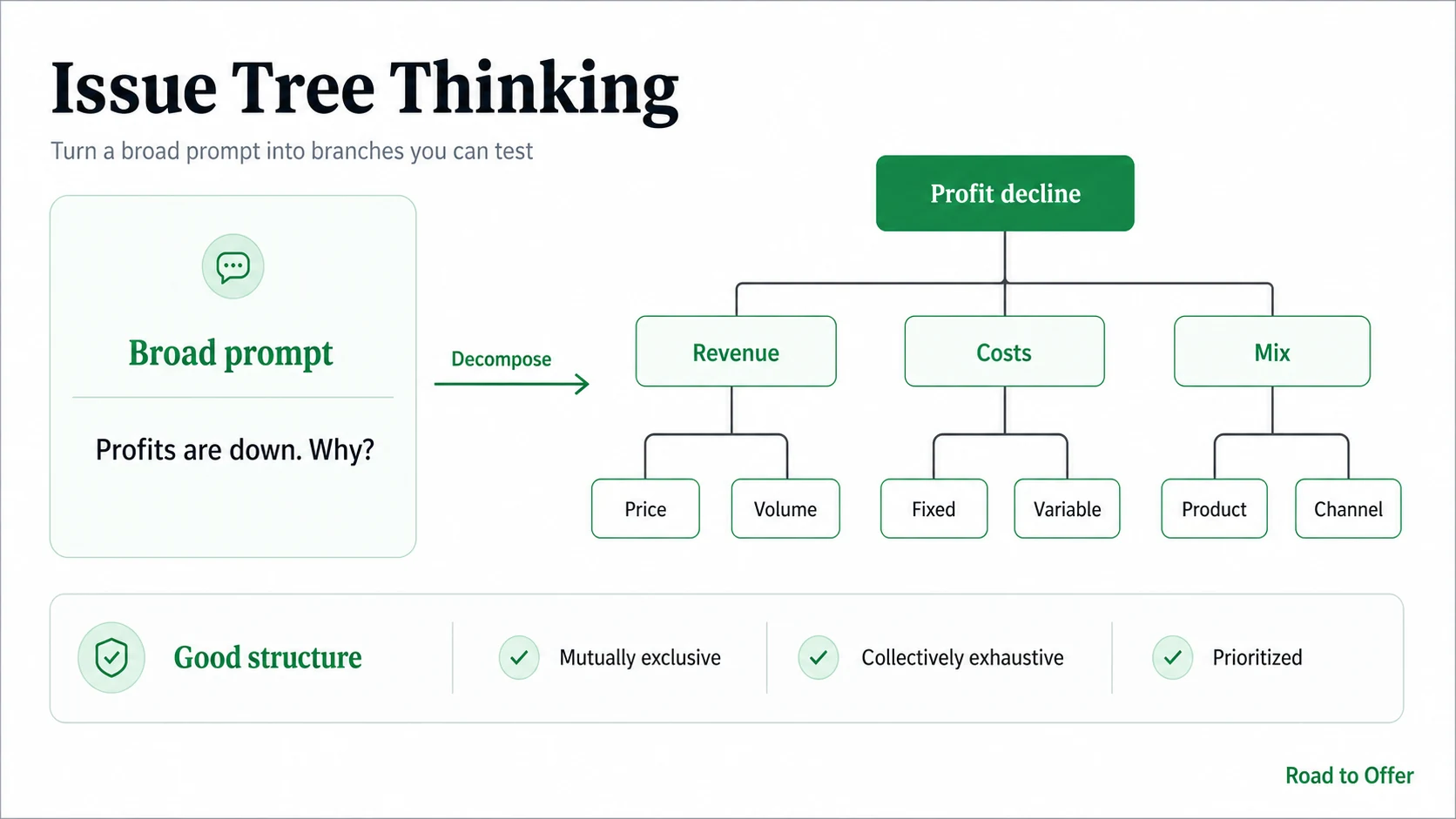
A weak answer sounds like this: I would split the problem into revenue and costs. On revenue, I would look at price and volume. On costs, I would look at fixed and variable costs.
That answer is not wrong at the highest level. It is just too generic. It uses the profitability framework correctly as math, but it does not show that the candidate understands EV charging as a business, and it gives no clue about what to prioritize. This is mistake 1 (framework fitting) and mistake 8 (treating every branch equally) at the same time.
A stronger version keeps profitability logic but speaks the language of the business:
This is still revenue minus cost at the root, but now the issue tree is tailored to the business model. The candidate can prioritize out loud: I would start with site utilization because EV charging profitability depends heavily on whether the assets are used enough. If utilization is healthy, I would move to pricing and customer mix; if it is weak, I would segment by site to find where the decline is concentrated.
This mirrors how IGotAnOffer frames custom building: for declining profits in a retail chain, you start with revenue minus cost, then adapt to include foot traffic, store footprint, and local competitors. Same root logic, different surface, because the business is different. The mistake was never not knowing the word profitability. The mistake is failing to translate it into a business-specific structure under time pressure.
The only way to know whether you can build a tailored structure under pressure is to do it in a live case, not on paper. Try a free case with AI and you get a messy prompt to structure from scratch, then scored feedback on whether your tree was tailored or recited.
Build a tailored structure in a Bain profitability case. A two hundred million dollar pharmacy personal care department has stopped growing profit. Answer this Bain profitability case step in the article, then continue the full case. Continue the full case on Road to Offer
What questions should you ask before choosing a framework?
The pause after the prompt is where most framework misuse begins. Use that pause to make the case smaller and sharper before you commit to any structure.
Ask: what decision does the client need to make? If the decision is whether to enter a market, your structure should compare attractiveness, ability to win, economics, and risks. If the decision is why profits declined, your structure should isolate the profit driver before discussing solutions.
Ask: what is the unit of analysis? A company-level profitability case is not the same as a site-level, product-level, customer-level, or channel-level case. In the EV charging example, site-level economics matter more than a broad company snapshot.
Ask: who owns the decision? A CEO may care about portfolio strategy. A regional operator may care about uptime and staffing. An investor may care about return profile and downside risk.
Ask: what evidence would change my recommendation? If a branch has no testable evidence behind it, it may be filler, and filler is what makes a structure read as a memorized list.
Ask: is this diagnostic, strategic, operational, or investment-oriented? A diagnostic case asks what is broken. A strategic case asks where to play. An operational case asks how to improve performance. An investment case asks whether the risk-return profile works. Matching the structure to the case type avoids mistake 6, forcing the wrong framework, which is what happens when a candidate opens a profitability prompt with Porter's Five Forces.
BCG's candidate advice stresses understanding the problem before structuring and staying flexible as new information appears. The practical warning: do not ask clarifying questions that make you sound engaged but leave your structure unchanged.
Matching the structure to the case type is mistake 6's fix. Drill the distinction before you see the next prompt.
How do you adapt a framework during the case?
Your opening structure is not a contract. It is a working map, and when new evidence arrives the map should change. This is where hypothesis-driven thinking becomes visible, and it is the direct antidote to mistake 9, freezing.
When evidence reshapes the case, say so: This finding mainly affects the utilization branch. Since utilization is healthy in the strongest sites but weak in newer locations, I would refine the tree around site maturity and local demand rather than treating all locations together.
To retire a low-value branch: Based on what we have seen, pricing does not seem to be the main issue. I would deprioritize it and spend the next analysis on utilization by site type.
To add a branch: This introduces a constraint I did not include upfront. I would add uptime and maintenance reliability as an operating branch because it affects both customer demand and cost.
To reconnect to the objective: Coming back to the client's question, the issue is less whether EV charging is attractive overall and more whether this portfolio has enough high-utilization sites to support profitable growth.
That kind of live adaptation is what separates a candidate who understands the business from one who memorized a tree. It also protects your case interview synthesis, because every later recommendation can point back to the branch that proved most important.
Freezing after new data is mistake 9. Practice the three live-adaptation moves, refine, retire, and add, on the same EV charging case before moving on.
How many frameworks should you actually know?
The honest answer is fewer than you think. The consensus across MBB-focused prep (IGotAnOffer, MConsultingPrep, Hacking the Case Interview) is to master roughly 6 to 8 core frameworks deeply rather than memorize 15 to 20 shallowly. A workable core set: profitability, market entry, 3Cs, 4Ps, Porter's Five Forces, mergers and acquisitions, and market sizing. Know those well enough to break them apart and recombine the pieces, and you have the analytical vocabulary for the large majority of cases at any top firm.
Depth here means something specific. You should be able to explain why each branch of a framework exists and when it does not apply, not just recite the branches. Porter's Five Forces is for industry attractiveness, not for diagnosing why one company's profit fell last quarter. The 4Cs are a thinking prompt, not a four-bucket answer. Once you can pull individual building blocks (revenue minus cost, attractiveness versus ability to win, fixed versus variable) and assemble them around the prompt in front of you, you have crossed from memorizing frameworks to structured thinking.
The trap is breadth as a security blanket. Candidates who memorize 20 frameworks spend the opening pause searching their memory for a match instead of reasoning about the client. That search is visible, and it is the opposite of what interviewers want to see.
A practice drill to rebuild your structure under pressure
The fastest way to fix consulting framework mistakes is not more reading. It is rebuilding structures from prompts until the opening answer stops sounding copied. The MBA benchmark cited by StrategyU is telling: strong candidates often complete around 30 live cases and read 30 more before interviews, because repetition builds procedural fluency that no amount of framework memorization can replace.
On Road to Offer, the structure prompts that separate strong scores from weak ones are almost never the ones where the candidate knew the right framework. They are the ones where the candidate translated a vague prompt into three clean, prioritized, testable branches fast. That translation step is the skill, and it is drillable.
Run the loop below on the EV charging prompt from the worked example above: write the client objective in plain language, draft a custom issue tree, choose the branch you would test early, and explain why it has the highest value. Real feedback on each step, not a self-grade.
Then compare your answer against the issue tree guide to check whether your branches are clean, relevant, and easy to say out loud. If your framework is acceptable but the analysis breaks when numbers appear, move to math reps. If the final answer does not connect back to your structure, drill synthesis. When the opening structure holds reliably, move into a full case so structure, math, exhibit reading, and recommendation are tested together.
A framework mistake checklist before your next case
Use this checklist before a live case or mock interview. Each item maps to one of the nine mistakes above.
- Objective named: can I state the client decision in one clean sentence? (Fixes mistake 4.)
- Branches separate: do my branches overlap, or am I naming the same driver twice? (Fixes mistake 3.)
- Coverage clear: do the branches cover the main ways to answer the question? (MECE check.)
- Tight not broad: do I have three to four sharp branches, not eight shallow ones? (Fixes mistakes 5 and 7.)
- Right fit: does this structure match the case type (diagnostic, strategic, operational, investment)? (Fixes mistake 6.)
- Priority chosen: do I know which branch I would test first and why? (Fixes mistake 8.)
- No template name: did I describe my branches without announcing a framework? (Fixes mistakes 1 and 2.)
- Flexibility visible: can I update the structure if an exhibit or interviewer answer changes the situation? (Fixes mistake 9.)
- Synthesis path visible: can this structure lead to a recommendation, risk, and next step?
Self-grade qualitatively. Green means the branch is clear and useful. Yellow means it is logical but not tailored. Red means it sounds like a memorized template. If most of your structure is yellow, the problem is rarely knowledge. It is translation from framework to case, which is precisely what repeated reps fix. For the broader list of errors beyond structure, the guide to case interview mistakes to avoid covers communication, math, and recovery.
See where your structure breaks before the interviewer does
Run a full free case with AI: build the opening structure, work the math, read the exhibit, and deliver the recommendation, then get scored on every step including whether your tree was tailored or recited.
Sources and Further Reading (checked June 17, 2026)
- McKinsey & Company - Interviewing at McKinsey
- Boston Consulting Group - Case Interview Preparation
- Boston Consulting Group - Tips for Case Interviewing: What BCG Looks For
- Bain & Company - Our Hiring Process
- IGotAnOffer - Case Interview Frameworks: Comprehensive Guide
- MConsultingPrep - Top 10 Case Interview Frameworks: Beginner Mistakes
- Hacking the Case Interview - Case Interview Frameworks: The Ultimate Guide
- StrategyU - Case Interview Frameworks: The Complete Guide
Frequently asked questions
Resources and related guides
- Practice a real case interviewPractice
- Browse all free resourcesResource hub
- Consulting Frameworks: The Complete Case Interview Guide (2026)Frameworks · Mar 1, 2026
- Cost-Benefit Analysis Framework for Case InterviewsFrameworks · Jun 1, 2026
- Financial Services Case Interview: Banking, Insurance, Fintech, and Worked Examples (2026)Frameworks · Mar 25, 2026
- Government and Public Sector Consulting Case Interview: Complete Guide (2026)Frameworks · Mar 31, 2026