
Slalom Consulting Case Interview: Format, Tips, and Prep Guide (2026)
Slalom Consulting uses candidate-led cases, take-home assignments, and behavioral interviews. Here's the full process, what they assess, and how to prepare.
On this page
Slalom is not the first consulting firm that comes to mind when candidates are building their prep list, and that's a mistake. Slalom is a global business and technology consulting company with a team of around 12,000, deep technology partnerships, and a practical strategy-to-implementation model. Its interview process tests the skills that distinguish strong from average consultants: clear communication, structured thinking, and genuine cultural alignment.
The interview format is flexible. Slalom doesn't follow a rigid MBB template, which means candidates who don't understand what to expect are more likely to misread the room.
The Slalom Interview Process
Slalom's process is less standardized than MBB, meaning it varies by office, role level, and hiring manager. A common consulting-role pattern looks like this, but recruiter instructions override any generic guide:
Not all roles include every step. Some tracks skip the take-home; senior consulting roles often add an extra senior-leader conversation. Timing from first screen to offer varies with role, market, and calendar availability. Use candidate reports for directional expectations, then ask your recruiter what the current process looks like for your specific opening.
How Slalom Cases Differ From MBB
The distinction is subtle but matters for how you prepare:
MBB cases: 30 minutes, fully unstructured, you own the direction. The interviewer is a passive data provider. Success = rigorous first-principles structuring under pressure.
Slalom cases: 30–40 minutes, moderately structured. The interviewer is more collaborative. They may prompt you if you're going off track, ask for your recommendation before you'd naturally offer one, or redirect if you're spending too long on one branch. Success = good structuring + genuine collaborative problem-solving.
The take-home format amplifies this difference. A take-home Slalom case rewards:
- A recommendation that's clear, specific, and defensible
- Analysis quality over quantity (2 well-developed insights beat 8 thin ones)
- Well-designed slides or memo format (visual clarity matters at Slalom)
- Confident, concise presentation delivery
Practice candidate-led cases with AI feedback before your Slalom interview
Road to Offer builds the structured thinking and communication skills Slalom interviewers look for.
How should you align your Slalom resume and cover letter before this interview?
Use an implementation and client-collaboration angle only when the target role supports it. Show your ownership inside the team without asserting a universal culture test or interview format.
- Before: Worked with a team on implementation.
- After: Mapped the client handoff, aligned the delivery owners, and proposed the workflow adopted for the next cycle.
Check that the hiring process, office, and assessment language come from the current source. Recruiters read the documents together: the resume proves delivery, while the letter explains why Slalom and the target role. Rehearse the revised line as a clear implementation story before the next case rep.
Make your ownership visible inside delivery
Upload the resume for an independent graded report, not a Slalom hiring result.
Revise one delivery line, rehearse the matching story, and bring it into the next case practice rep.
What Slalom Interviewers Score You On
Slalom's evaluation framework weights cultural fit and collaboration more heavily than pure analytical horsepower. Based on recruiter disclosures and candidate reports:
The cultural alignment dimension is distinct from "personality fit." Slalom interviewers are specifically evaluating whether you understand the local consulting model: that you'll primarily work with one or two long-term clients in your city, that relationships matter as much as technical output, and that you're not looking to travel 4 days a week.
Sample Case Walk-Through
Case prompt: "A regional grocery chain with $2.4B in revenue has seen online order fulfillment costs increase 22% over the past 12 months, while online order volume grew only 8%. The CEO wants to understand what's driving the gap and what to do about it."
Strong opening structure:
"To understand the cost increase, I'd look at this in two buckets: cost per order vs. order economics.
First, cost per order: what does it cost to pick, pack, and deliver a single online order? I'd look at labor efficiency (orders per hour), packaging costs, and last-mile delivery costs. Second, order economics: has the mix shifted toward less profitable orders? Are smaller basket sizes driving up cost per revenue dollar?
My hypothesis is that the issue is labor. Online fulfillment is still being staffed for the pre-growth volume, so the marginal order cost is high. But let me ask: do we have data on order volume by fulfillment center?"
This approach demonstrates MECE structure, a testable hypothesis, and a clear first analytical question: the three elements Slalom interviewers respond to positively in the first 5 minutes.

Operations · hard
Practice for Slalom in a real case interview
Matched to this Slalom guide: a live travel operations case with an AI interviewer. Free, scored on every step.
The cost-per-order math here (a 22% cost increase against 8% volume growth) is the kind of quick decomposition Slalom expects you to run cleanly while you talk. Drill that reflex so the numbers never stall your structure.
Calculate operations case impact from the Road to Offer drill engine. Answer a real prompt and get AI-scored feedback. Free accounts include 5 drills per day for the first 3 days after signup.
For frameworks applicable to this type of case, see our profitability framework guide and operations and cost framework.
If the same case ran as a take-home
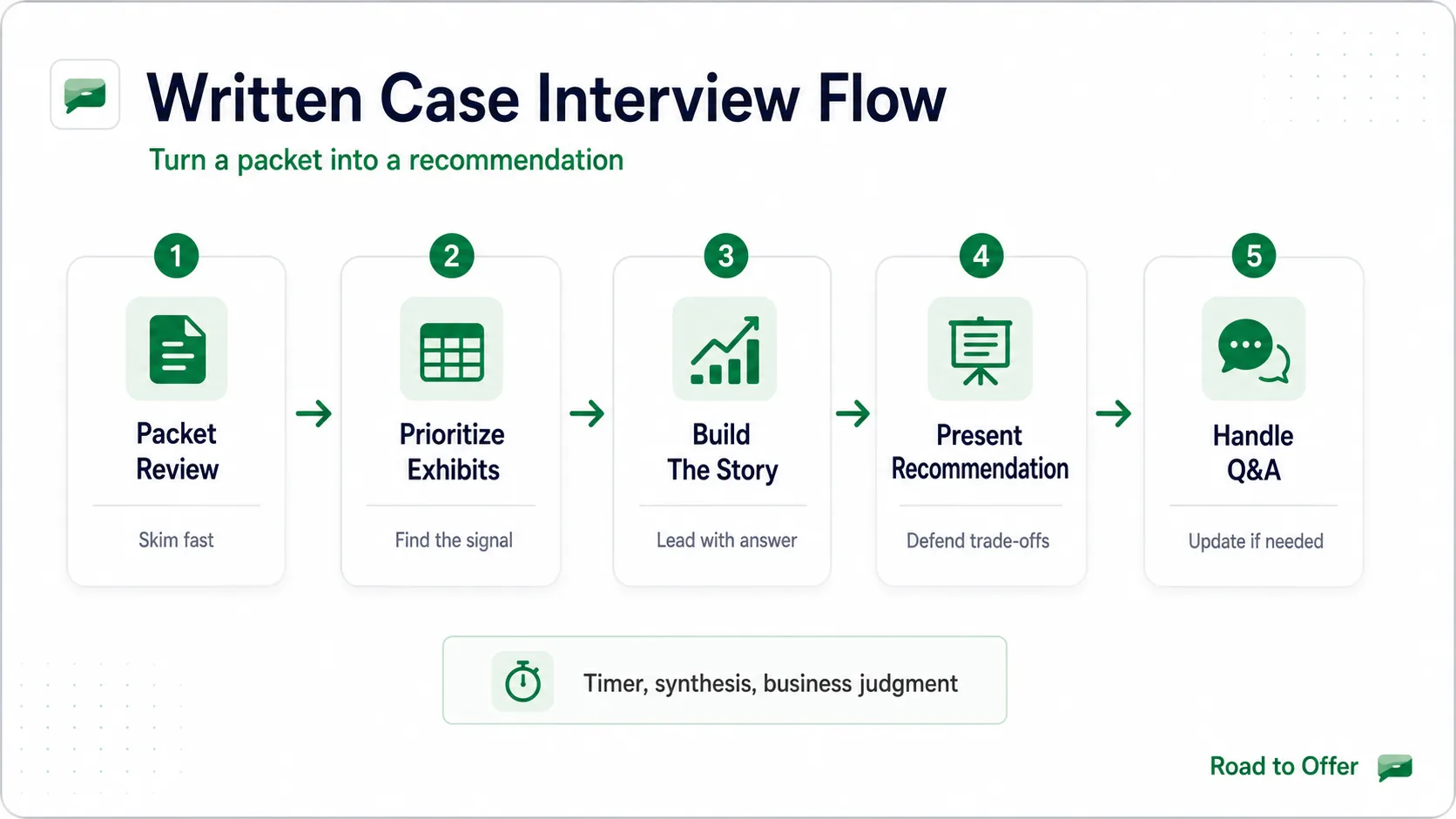
If a track sends the grocery prompt above as a take-home with a data packet, the deliverable shifts from live structuring to a tight, recommendation-first set of slides (or a short memo) that you present in a 15-20 minute conversation. Aim for 2 well-developed insights over 8 thin ones, in this order:
- Recommendation slide first. State the answer up front: e.g., "Restructure online fulfillment staffing to volume, projected to close most of the 14-point cost-volume gap." One headline, one chart.
- Driver of the gap. Quantify why cost grew 22% while volume grew 8%: labor staffed to pre-growth volume, so cost per order stayed high as orders rose. Show the cost-per-order trend.
- What to do and the risk. One operational fix (staffing model tied to order volume), the expected impact, and the main risk or next data request. Close with implementation specifics, not a generic "optimize."
The grading bar is clarity and defensibility, not slide count. For the full deliverable mechanics, see our written case interview guide.
Behavioral Themes at Slalom
Slalom behavioral interviews follow a modified STAR format, but with heavy emphasis on client impact and collaboration over individual achievement.
Prepare specific metrics for the impact question. "Improved efficiency" isn't a Slalom-level answer. "Reduced onboarding time from 6 weeks to 3 weeks, enabling 2 new client teams to launch on schedule" is.
Use the STAR method for consulting interviews framework for structuring these.
Connecting to Your Broader Prep
Slalom prep fits naturally within a broader consulting prep cycle. If you're simultaneously targeting MBB, Big 4, and boutiques like Slalom:
- MBB prep is your floor, and everything MBB-level teaches transfers to Slalom
- For technology consulting peers, see the Accenture case interview guide and the West Monroe Partners case interview guide
- For technology-heavy prompts, pair this guide with digital transformation cases and technology case interviews
- For take-home case skills, see our written case interview guide
- For behavioral prep, use the behavioral interview consulting guide
- For communication quality, see our case interview communication tips
- Timeline and sequence: see our consulting interview prep timeline
- In Road to Offer, alternate structure drills with synthesis drills so your cases sound collaborative rather than scripted
Ready to prepare for Slalom and beyond?
Start a free Road to Offer case and use the debrief to decide whether your next prep block should focus on structure, written-case synthesis, or behavioral stories.
Sources and Further Reading (checked June 17, 2026)
- Hacking the Case Interview, Slalom guide: hackingthecaseinterview.com/pages/slalom-case-interview
- Slalom hiring AI and interview authenticity guidance: slalom.com
- Slalom company overview and global scale: slalom.com
- Glassdoor Slalom interview experience 2026: glassdoor.com/Interview/Slalom-Interview-Questions-E31102.htm
- My Consulting Offer, Slalom interview guide: myconsultingoffer.org/case-study-interview-prep/slalom-interview
- Leland, Slalom interview process: joinleland.com/library/a/slalom-interview-process-a-step-by-step-guide
Frequently asked questions
Resources and related guides
- Practice for Slalom in a real case interviewPractice
- Browse all free resourcesResource hub
- AlixPartners Careers 2026: Turnaround Salary and Interview GuideFirm Specific · Sep 11, 2026
- Alvarez and Marsal Careers 2026: Restructuring Salary and Interview GuideFirm Specific · Sep 11, 2026
- Analysis Group Case Interview: Process, Question Types, and How to Prepare (2026)Firm Specific · Mar 25, 2026