
BCG Pymetrics Assessment: 12 Games, Scoring, and Prep (2026)
BCG's Pymetrics test (now Harver Pymetrics) is a 12-game, 25-30 minute assessment scoring 91 traits against a BCG benchmark. You have 48 hours to finish it. Full prep guide.
On this page
The BCG Pymetrics test (now called the Harver Pymetrics assessment after Harver's 2022 acquisition) is a 25-30 minute, neuroscience-based behavioral game battery BCG sends after the resume screen as the first online gate before the BCG Online Case (Casey). You play 12 short games that score 91 traits across 9 categories (attention, focus, decision making, risk tolerance, effort, learning, fairness, generosity, and emotion) against a benchmark built from BCG consultants who performed well on the job. BCG Careers describes the assessment as "designed to measure soft skills, not knowledge" and stresses that "there are no right or wrong answers." You do not receive a score, and two facts catch most candidates off guard: you have only 48 hours to finish once the invite lands, and you cannot retake the games for 330 days after you submit.
This article covers the Pymetrics assessment in full. For the live BCG interview process, see the BCG case interview guide.
What should you verify before preparing for BCG Pymetrics?
The BCG Pymetrics or Harver route is an office- and role-dependent behavioral assessment. MyConsultingCoach and JobTestPrep report a standard battery of 12 games lasting about 25 to 30 minutes, as checked June 18, 2026. Confirm the current platform, invitation stage, games, and retake rule before treating that reported format as universal. Road to Offer has no Pymetrics simulator, so use adjacent timed drills for focus under pressure and the live Casey-style simulator for the next analytical gate.
Use the assessment-integrity method: 1. record the current invitation, 2. practice the stated cognitive or behavioral skill, 3. keep answers consistent, 4. stop using any source that claims a universal score or game set. A short illustrative pattern rep can train attention, but it is not a recovered BCG assessment.
What is the Pymetrics assessment BCG uses (now Harver)?
BCG adopted Pymetrics as part of a broader push toward structured, data-driven screening. For how it compares across the industry, see the consulting assessment tests guide; for the Bain equivalent, see the Bain SOVA test guide.
The assessment does not measure business frameworks or case math. It measures behavioral dispositions: how quickly you abandon a losing strategy, how you weigh risk under uncertainty, how you read emotional expression. Each module is a simple interactive browser game, typically 1-3 minutes long, drawn from a known psychology experiment. The Balloons game is a version of the Balloon Analogue Risk Task, the Cards game is a multi-armed bandit (Iowa Gambling Task lineage), and Towers is a Tower of Hanoi planning puzzle.
Harver's published methodology at harver.com/products/games-based-assessments describes the approach as measuring "cognitive, social, and behavioral attributes" matched to role-level benchmarks built from high-performer data at each client firm. The same engine powers Pymetrics for Bain, JPMorgan, Accenture, PwC, Unilever, and dozens of other employers, which is exactly why the 330-day result-sharing rule matters so much.
Start Casey-style drills after Pymetrics
Pymetrics is only one gate. Use short math and structure reps to get ready for the BCG assessment and live case rounds.
Where does Pymetrics sit in the BCG interview process?
In the 2026 BCG recruiting cycle, the standard sequence for campus hires in North America and most European markets is: resume screen, Pymetrics, BCG Online Case (Casey), first-round live cases, final-round cases. Pymetrics is the first gate you face once your resume clears.
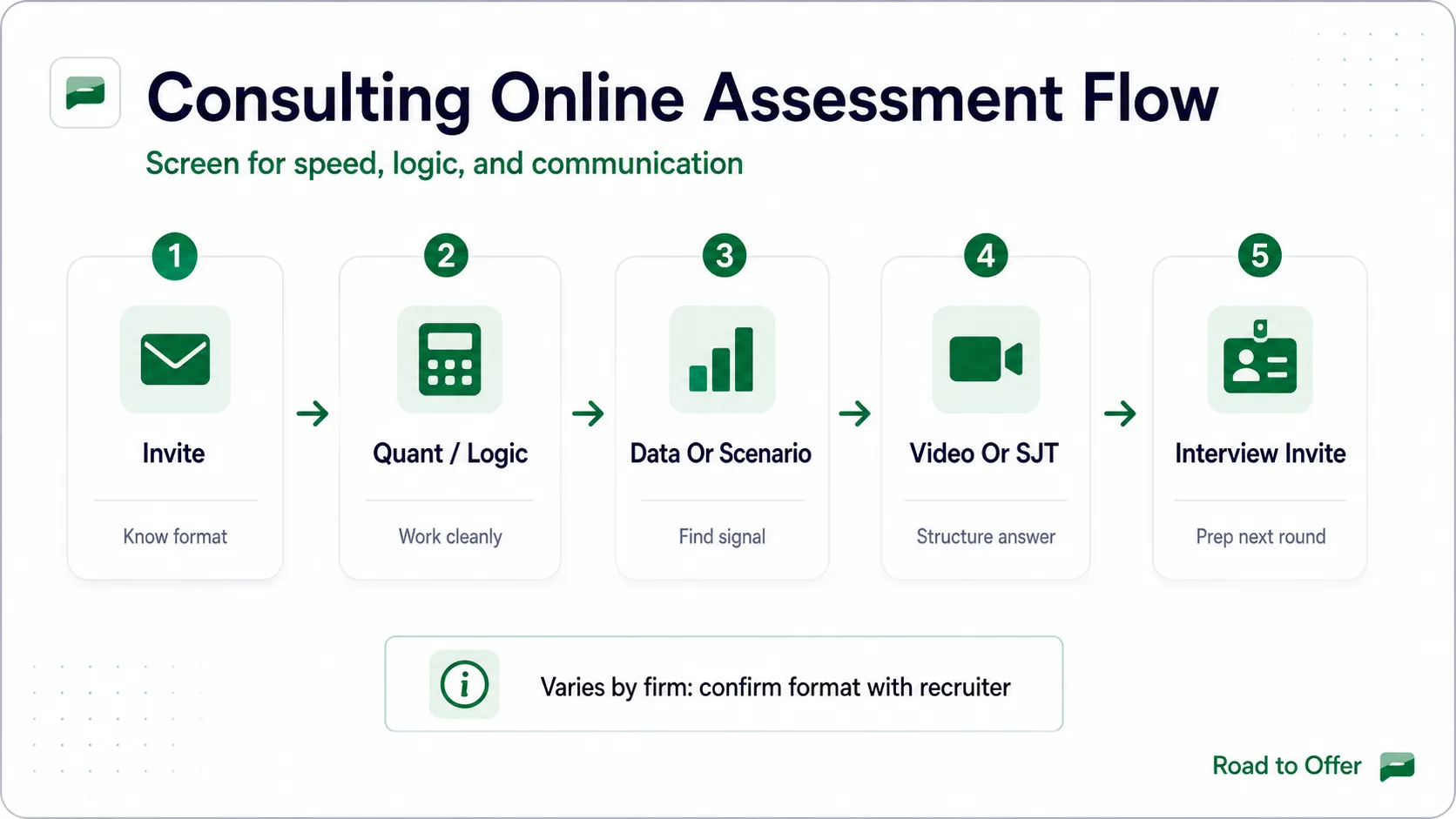
BCG sends the Pymetrics invite by email. The invite specifies the deadline, technical requirements (stable internet, working webcam and microphone in some regions), and a link to the assessment. The single most common surprise is the clock: you have roughly 48 hours to complete the games once the email arrives, not a week. BCG Careers at careers.bcg.com notes that accommodations for candidates with disabilities are available if requested before the deadline, so do not wait until the last hour if you need extra time.
What this means for your prep: request accommodations early and schedule the assessment before the invitation window becomes tight.
Because Pymetrics gates access to Casey, and Casey gates the live rounds, a Pymetrics failure ends your BCG application for that cycle. Tracking where you are in this funnel matters. Road to Offer's free Recruiting Deadlines Calendar tracks BCG Pymetrics invite turnaround, Casey deadlines, and decision dates across 30+ offices.
What are the 12 games and what does each one measure?
The standard BCG Pymetrics battery includes these 12 games, in roughly this order (order can vary by session):
Each game is self-contained. You do not need to perform well at one to perform well at the next, and the session typically runs 25-30 minutes total. Some role-specific versions add bonus numerical or memory modules (Magnitudes, Sequences, Shapes, or an N-Back letter game), but the 12 above are the BCG core.
How does BCG score Pymetrics, and what are the 91 traits?
BCG does not receive a raw number per trait. The platform builds a profile across all 12 games covering 91 traits grouped into 9 categories (attention, focus, decision making, risk tolerance, effort, learning, fairness, generosity, and emotion) and compares it to a benchmark built from candidates who received offers and performed well as BCG consultants. Harver's bias-mitigation methodology, documented at harver.com/blog/category/science-of-talent-acquisition, uses this matching approach specifically to reduce demographic bias in screening.
The output BCG sees collapses into one of three signals: Highly Recommended, Recommended, or Not Recommended. Candidates receive only the binary downstream outcome (you advanced to Casey, or you did not), never the underlying trait profile.
There is no single "right" personality to present. The benchmark spans BCG consultants across roles and seniority, so the trait distribution is wide. The system checks whether your natural tendencies fall inside the range that predicts performance at BCG, not whether you look maximally risk-tolerant or emotionally intelligent. Pushing an extreme profile (ultra-conservative or ultra-aggressive on every game) reads as a poor match, not as a strong candidate.
The 330-day lock: why one careless run can cost you five firms
This is the rule almost no candidate plans for, and it is the biggest reason to take a practice run before the live session. Once you submit your Pymetrics games, you cannot replay them for 330 days (roughly 11 months). During that window, your stored profile is automatically shared with any other employer that uses Pymetrics, including Bain, JPMorgan, Accenture, PwC, and Unilever.
The practical consequences:
- If you rush the BCG games while tired and then apply to Bain three weeks later, Bain receives the same profile. You do not get a fresh attempt.
- If you already played Pymetrics for another firm in the last 330 days, those existing results are submitted to BCG and you cannot replay them for BCG either.
- The benchmark differs per firm, so the same profile can be "Recommended" for one employer and "Not Recommended" for another, but the underlying behavioral data is fixed for the full window.
The takeaway is simple: treat your first Pymetrics session as if it counts for every consulting and finance application you will make in the next year, because it can. For how the broader online-assessment landscape gates these firms, see the aptitude test consulting guide.
Can you prep for Pymetrics, and what actually moves the needle?
Per Harver's documentation and SHRM's third-party review of game-based assessments (shrm.org/topics-tools/news/talent-acquisition), you cannot fake a trait profile across 12 games without the data becoming inconsistent, and inconsistency is itself a red flag. But there is legitimate, effective preparation.
The preparation that works is mechanical familiarity, not trait manipulation. If you have never played the Balloons game, you spend 30-60 seconds reading instructions and another 30-60 seconds orienting before settling into your natural rhythm, and that orientation period is part of the scored signal. Candidates familiar with the formats move through orientation faster and produce a cleaner read.
Specific prep actions that move the needle:
- Play 2-3 untimed practice rounds of the full battery so Balloons, Cards, Arrows, and Towers feel routine, not novel, on the day.
- Read each game's instructions fully before the timer starts. Instructions appear before every module.
- Practice in your real conditions: same device, same time of day, same quiet room. Reaction-time games (Stop, Keypresses, Arrows) are sensitive to setup.
- Do not second-guess mid-game. The platform has consistency checks, and erratic switching reads as noise, not strategic flexibility.
- On Cards and Balloons, look for the pattern early. Both reward a learner who explores then exploits, rather than someone who plays one fixed strategy.
What does not work: trying to memorize "answers" (there are none), copying a friend's strategy (the benchmark is multi-dimensional), or projecting a single personality type across every game.
Pymetrics simulator: early access while we build it
Nobody can rehearse a trait profile, but the numerical games reward quick, accurate number sense. A free account reserves early access to the simulator we are building and opens the timed math drills that sharpen that speed.
How does the Pymetrics-to-Casey-to-interview gate sequence work?
After Pymetrics clears, BCG sends a Casey invite. The BCG online case Casey guide covers that gate in full detail. Casey is a 30-40 minute AI-mediated online case testing structuring, exhibit reading, and synthesis, not behavioral traits. Some candidates also encounter the BCG Consulting Career Assessment (CCA) or a BCG one-way video interview at other points in the same process. For specialized roles, BCG Platinion and BCG X (formerly Gamma) have distinct screening paths: see the BCG Platinion case interview guide and BCG Gamma guide. Early-career programs including BCG Unlock and Bridge to BCG route through the same Pymetrics and Casey sequence.
Calendar math: the Pymetrics invite arrives 1-3 weeks after resume submission, you then have 48 hours to play, the Casey invite follows 3-5 business days later, and the first-round invite follows Casey by 1-2 weeks. Total is roughly 3-6 weeks from application to first-round scheduling, office and volume dependent.
Some markets (Germany, parts of Asia-Pacific, and experienced-hire pipelines) skip one or both online steps. The invite email specifies which gates apply to your application.
What should you do on test day to avoid common mistakes?
Use a wired or highly stable Wi-Fi connection, because the games are reaction-time sensitive and a laggy connection distorts Keypresses, Stop, and Arrows. A genuinely quiet room matters for Faces and Digits. Close all unnecessary tabs and disable notifications before starting. Use a laptop or desktop, not a phone, so screen size does not handicap you on Lengths and Faces.
Common mistakes that cost candidates:
- Treating the 48-hour clock as a week. The invite window is short. Block 45 minutes the moment it arrives.
- Rushing. Stop, Keypresses, and Arrows have timing components, but Balloons, Money Exchange, Cards, and Towers measure decision pattern, not pace. Rushing produces noisy signals.
- Taking it fatigued. Cognitive flexibility and attention games degrade after poor sleep. Play during your high-performance hours.
- Skipping the accommodation request. If you have a documented disability affecting reaction time or processing, file with BCG HR before the deadline.
- Forgetting the 330-day lock. If you bomb the run, you carry that profile to every other Pymetrics firm for nearly a year.
What should you do after Pymetrics while you wait?
BCG turnaround is typically 3-5 business days. Do not wait for confirmation before pivoting to Casey and case-interview prep. Start free math drills and structure drills, since the analytical skills overlap whether your next gate is Casey or live rounds. The Bain case interview guide and McKinsey case interview guide are worth a look too if you are recruiting across MBB, because a shared Pymetrics profile already links your Bain application to this one.
Track deadlines across all firms simultaneously. Overlapping windows are the primary scheduling failure mode for top applicants.
Practice BCG-style cases with live AI feedback
Pymetrics is not a case test. Use the live Casey-style simulator to practice the next analytical gate after the behavioral screen.
Sources
- BCG Careers, Application Process (checked June 18, 2026): https://careers.bcg.com/global/en/interview-process
- Harver, Games-Based Assessments (checked June 18, 2026): https://harver.com/
- Harver, Science of Talent Acquisition (bias-mitigation methodology) (checked June 18, 2026): https://harver.com/blog/
- SHRM, Talent Acquisition News and Tools (checked June 18, 2026): https://www.shrm.org/topics-tools/news/talent-acquisition
- MyConsultingCoach, BCG and Bain Pymetrics Guide (checked June 18, 2026): https://www.myconsultingcoach.com/bcg-pymetrics
- JobTestPrep, BCG Pymetrics Practice (checked June 18, 2026): https://www.jobtestprep.com/bcg-pymetrics-practice
Frequently asked questions
Resources and related guides
- Run a real case interviewPractice
- Browse all free resourcesResource hub
- Accenture Assessment Test 2026: Identify Your Route & PrepareFirm Specific · Jun 27, 2026
- Best BCG Casey Simulator (2026): Free Practice, ComparedFirm Specific · Jul 12, 2026
- Best BCG CCA Simulator (2026): Free Practice Test, ComparedFirm Specific · Jul 12, 2026
- PwC Career Unlocked: Invitation-Led Preparation and Worked DecisionsFirm Specific · Jul 18, 2026