
Arthur D. Little Practice Cases: 5 Worked Examples
Arthur D. Little practice cases are scarce: the firm publishes one, Lux Flex, on its careers site, with four exercises and no answer key. For more, work the five original case examples below, in technology, energy, R&D and operations, then run four library cases aloud. The process is in our Arthur D. Little case interview guide.
Does Arthur D. Little publish practice cases?
Yes, one: the Lux Flex case, on ADL's careers site, with tips and no answer key (checked 24 November 2026). ADL's behavioral interview page points to it as the practice case study. Everything else sold as an ADL case is third party.
The numbers to carry away: Lux Flex has four exercises, and the tips are five. For rounds, offices and the online test, use the process guide; this page is the one with cases to solve.
What does Arthur D. Little look for in a case?
ADL says it looks for how your mind works, critical thinking and a proactive nature, how you use data and how quick your calculation is, and the approach you take and how confident you are. That is the firm's wording on its case interview page (read 24 November 2026).

Start a free case interview for Arthur D. Little

Don't know how to case yet? Learn how to case
The five tips on the same page are the checklist to hold yourself to:
- Listen actively. Take notes and focus on the core issue.
- Ask for clarification. Restate the question and agree the objective and context.
- Structure your process. Ask for time and present at least two layers.
- Solve the case. Follow your structure, request data when needed and think out loud.
- Close the case. Reconcile the outcomes and be ready to defend the side you choose.
ADL's case interview page says the case tests your ability as a consultant, not your business sense or sector knowledge, so the weight is on how you reason. For how that is scored in general, see the case interview scoring rubric.
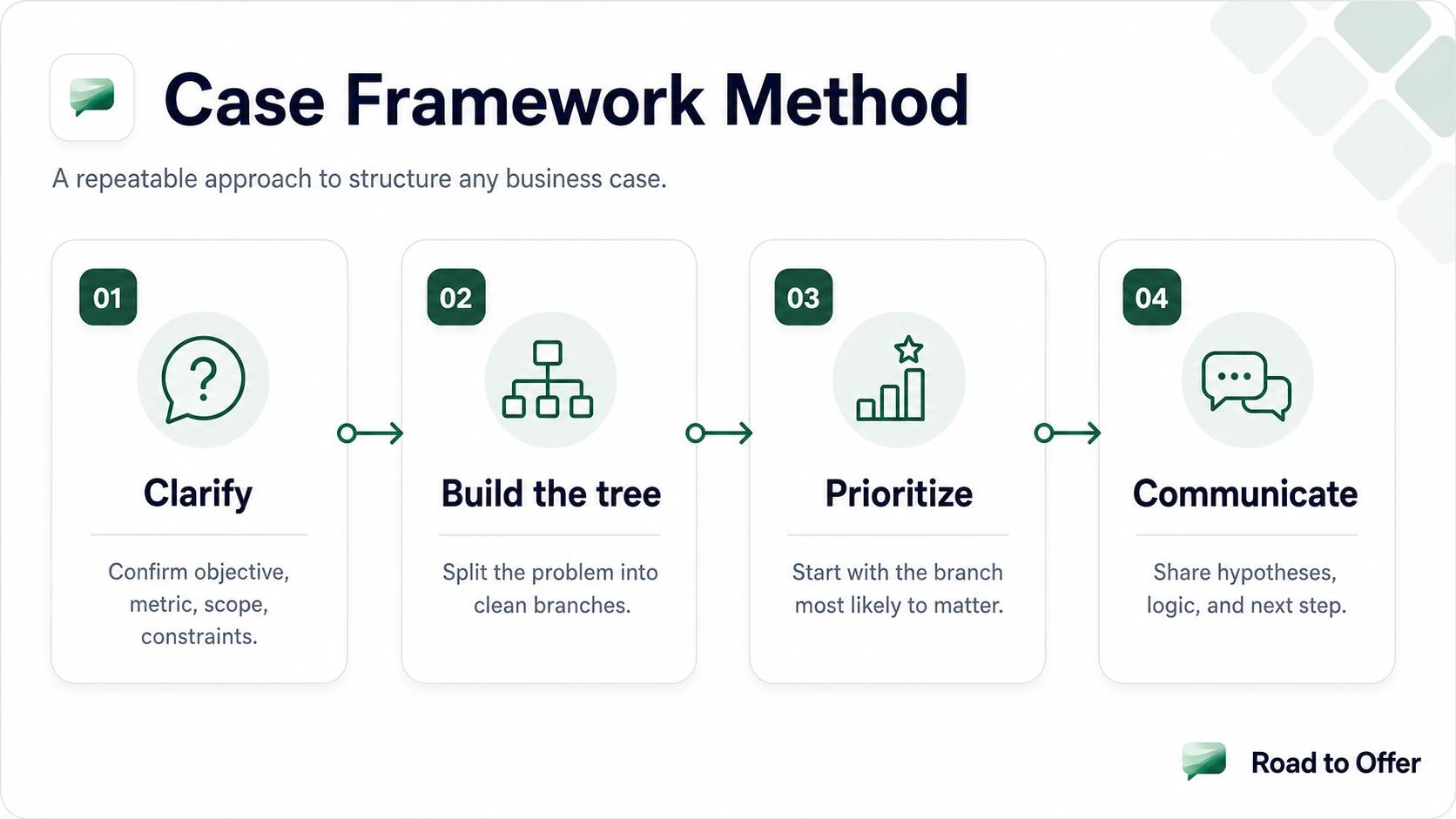
Learn the case method
One dense lesson, each step linked to the drill that trains it.
What does the Lux Flex case ask, and how would you work it?
It asks whether a premium gym chain should launch a budget brand, in four exercises: structure, calculation, brainstorm, recommendation. This is our summary in our own words, and our interpretation, not an ADL answer key. The prompt and tips are on the official case study page.
Structure
exercise 1
- Restate the case, ask clarifying questions
- Build at least two layers
Calculation
exercise 2
- One city, a revenue target
- Share of non-users who must join
Brainstorm
exercise 3
- Other revenue streams
- Two or three groups
Recommendation
exercise 4
- A CEO with few minutes
- Findings and next steps
Exercise 1, structure. Lux Flex, a high-end chain with 50 sites in European cities, is considering new sites under its budget brand, Penny Pressure. After restating, ADL's sample questions are why they want to open Penny Pressure, what is known about Lux Flex's revenue, cost or profit, and which countries it operates in. ADL hints at four parts: Lux Flex today, Penny Pressure as the target, customers and competition. Give the interviewer a short overview, then go deeper part by part and pause for questions.
Exercise 2, calculation. In one city of 5 million people, the exercise gives a market size, a target share and a revenue floor, and asks what percentage of people not working out today must join Penny Pressure. The chain of steps is existing members, revenue won from them, the remaining revenue and the new members it needs. We work the numbers in the Arthur D. Little guide, and the key is to ask what the denominator is: non-users are not everyone left in the city.
Exercise 3, brainstorm. The CEO wants other ways Penny Pressure can make money. ADL's tip is to split ideas into three groups, or two if you must. Our example buckets, which are ours and not ADL's: membership extras (premium tiers, guest passes), ancillary sales (drinks, merchandise, apps), and partnerships (employers, health insurers, equipment makers). Choose a bucket and say which you would test first.
Exercise 4, recommendation. The CEO has little time and wants findings and next steps. ADL lists five points: structured, concise, a clear next step, decisive, and backed by the key facts. Our version of a close is three lines: the answer, the two facts that carry it, and the first thing to do on Monday. The market sizing habit behind exercise 2 is in market sizing step by step.
To practise the same habits on a full scored case, see the library cases further down.
Which sectors should your Arthur D. Little practice cover?
ADL does not publish a sector lean; coaches and candidates report technology, R&D, energy and operations. That is reported by candidates and coaches, from a coach forum thread in February 2026, not an ADL statement. ADL's site names the industries and capabilities it works in, such as energy, utilities and resources, TIME (telecommunications, information technology, media and electronics), automotive, chemicals, operations and research and development, so the reports fit the business without proving the cases.
The topics reported include product development, technology adoption, manufacturing and operations, and an innovation portfolio. The five worked cases below are written to practise those moves. They are original practice cases, not Arthur D. Little material, and every number is ours. For the case types, see the technology, energy and operations case guides.
How do you structure a case in ADL's tips?
Give two layers, say the first layer in one breath, then go into the part where the numbers are. This matches ADL's tip to present at least two layers and be ready to discuss them.
For a profit question, the first layer is revenue and cost; for a growth question it is market, offer and how to win. Both are in the profitability framework and the market entry framework.
Case 1 (ours): which R&D projects should a chemicals group fund?
Rank the projects by expected profit per euro spent, then drop the weakest to fit the budget. Original case, made-up client.
The prompt. A European specialty chemicals group has 2.0 billion euro of revenue and spends 4 percent of it on R&D, so 80 million euro. Five projects compete for the budget. Which should it fund?
Step 1: expected profit. Chance times profit: A 24, B 48, C 13.5, D 24, E 10 million euro a year.
Step 2: per euro of R&D. Expected profit divided by cost: A 1.2, B 1.6, C 1.35, D 1.6, E 0.67.
Step 3: fit the budget. The five cost 90 million against 80, so 10 million must go. E ranks last at 15 million, so drop E. A, B, C and D cost 75 million and return about 109.5 million of expected profit a year, leaving 5 million.
The trap. Ranking on the profit if successful alone would drop C, the safest project at 90 percent and third best per euro behind B and D, and keep E.
Recommendation. Fund A, B, C and D. Hold the 5 million as a stage-gate reserve on B, the largest and riskiest bet, released only if its early results hold. Name the risk: the success rates are estimates, and B at 40 percent carries the portfolio, so ask what happens to the total if it fails (the expected figure falls by 48 million, to about 61.5 million).
Lesson. Expected value per euro first, then a balance and risk check.
Case 2 (ours): how many small cells does a city need?
Size on both coverage and capacity and take the larger; here coverage binds at about 700 cells. Original case, made-up client.
The prompt. A telecom operator plans small cells for a city of 1 million people with a 50 square kilometre dense core. How many does it need in the core?
Coverage. A small cell with a radius of 150 metres covers pi times 0.15 squared, about 0.07 square kilometres. 50 divided by 0.07 is about 700 cells.
Capacity. Assume 800,000 mobile users using 20 GB a month, which is about 0.67 GB a day. The busy hour carries 8 percent of a day, 0.053 GB, about 0.43 gigabit, so each user needs about 0.12 megabit a second. For 800,000 users that is about 95 gigabit a second. One small cell at 1 gigabit a second, run at 50 percent, carries 0.5, so small cells would need about 190 if they carried all the traffic and about 95 if they carried half.
The trap. Stopping at capacity gives 100 to 200 cells. Coverage, 700, is the larger number, so it decides. The weakest input is the 150 metre radius: at 100 metres the area is 0.031, and the count rises to about 1,600. Say that out loud.
Recommendation. Plan for about 700 cells in the core and test the radius in a pilot district first, because a 100 metre radius more than doubles the build.
Lesson. Take the larger of coverage and capacity, then name the input that moves it most. More on method in case interview math practice.
Case 3 (ours): where is a battery pack plant losing its scrap?
Payback is about six months, and the better question is where the scrap comes from. Original case, made-up client, with an exhibit.
The prompt. A battery pack plant makes 120,000 packs a year at 86 percent first-pass yield. Each scrapped pack loses 900 euro of materials. Management wants inline testing, costing 3.0 million euro once and 0.4 million a year to run, that would lift yield to 92 percent. Should it?
The exhibit. Share of scrap by station:
Step 1: today's scrap. 14 percent of 120,000 is 16,800 packs, times 900 euro is 15.12 million euro.
Step 2: with the test. 8 percent is 9,600 packs, 8.64 million euro. The saving is 6.48 million, or 6.08 million after the 0.4 million running cost.
Step 3: payback. 3.0 divided by 6.08 is about 0.5 years.
The trap. Saying yes and stopping. The test is a good buy even if the vendor's 92 percent is optimistic: at 89 percent, half the claimed lift, payback is still about 1.1 years. The point the interviewer wants next is the exhibit: welding holds 62 percent of scrap, so fix or test there before spending elsewhere.
Recommendation. Yes, with the test placed at welding and the 92 percent claim confirmed on a pilot line. Control it with scrap per station each week.
Lesson. When the payback is that short, the next question is where the loss comes from. A neighbouring operations case in the library is below.

Practice an operations cost case
ManufacturingMedium
Case 4 (ours): reinforce the grid line or install batteries?
On the stated numbers the line comes out 6 million euro cheaper over ten years, 45 million net against 51, a gap small enough that the answer turns on the shakiest input. Original case, made-up client.
The prompt. A grid operator faces congestion costing 6 million euro a year. Option 1: reinforce the line for 120 million euro, a 40 year life, built over 5 years. Option 2: a battery system for 90 million euro, a 10 year life, built in 1 year, earning 4 million a year from trading once live. Which one?
Over ten years, undiscounted (say so).
The trap. Picking the cheaper capital cost, the battery at 90, and stopping. Over ten years the line is 6 million cheaper, a small gap, so the interviewer wants the assumption that could flip it: whether 4 million a year of trading revenue holds, since it depends on the market, and whether the line really takes five years, since permitting runs long.
Recommendation. Test both inputs before choosing. If the revenue is uncertain, the line is the safer one; if permitting adds more than two years, the battery wins, since each extra year of building costs the line 6 million of congestion and gives back only 3 million of remaining life. Add that discounting favours the battery, which pays out sooner, and that the line has 35 years of life left while the battery needs replacing within a year.
Lesson. A close result is not the end: name the assumption that would flip it. For energy context see the top energy consulting firms.
Case 5 (ours): how does a packaging group reach 15 percent sustainable materials?
Group the ideas in three, choose with a reason, and give next steps. Original case, made-up client.
The prompt. A packaging group with 1.5 billion euro of revenue sells 4 percent sustainable materials today and wants 15 percent by 2030. How does it get there?
Size the gap. Eleven points of 1.5 billion is 165 million euro of revenue, holding total revenue flat (say so). The group moves from 60 million to 225 million, so sustainable sales must grow by about 39 percent a year for four years (3.75 to the power of one quarter).
The trap. A list of ideas with no choice. A growth rate near 39 percent a year makes build alone a stretch, which is the number that justifies the mix.
Recommendation. Partner first for speed, buy only if a target brings customers the group lacks, and build core know-how in parallel. Next steps: shortlist three partners within 90 days, screen acquisition targets by customers rather than technology, and set a yearly sustainable-share milestone so a slipping year shows early. This close mirrors ADL's own five points: structured, concise, next steps, decisive, backed by facts. See case interview synthesis.
Lesson. Group in three, then choose, then act.
Which library cases should you run aloud?
Run two of these after the worked cases, because reading a solution is not the same as saying one against a clock. These are prompts and practice links only, never answers. The library has no case in Arthur D. Little's own style, so these are matched by sector and case type to the technology, energy and operations work coaches report. None is ADL material.
| Case (style, industry) | Quant difficulty | Qualitative difficulty | The math you run | Median time |
|---|---|---|---|---|
Cloud Computing Capacity Expansion (BCG, cloud infrastructure). 9 (4 with math), 3 exhibits. | hard | hard | Price read, profit uplift, payback, payoffs | 30 min, 13 voice runs |
Titan Motorcycles Operations Optimization (Bain, motorcycle manufacturing). 8 (4 with math), 3 exhibits. | medium | medium | Cost per unit growth, outsourcing savings | 21 min, 11 voice runs |
Solara Home Energy Texas Battery Market Entry (Bain, home energy storage). 8 (3 with math), 4 exhibits. | easy | medium | Install contribution, year-one profit | 32 min, 11 voice runs |
Meridian Electronics (Bain, consumer electronics). 9 (5 with math), 3 exhibits. | medium | medium | Synergies as spend times savings rate | 21 min, 14 voice runs |

- Cloud Computing Capacity Expansion. A hard case: a cloud provider can spend $3 billion to grow capacity from 230 to 360 petabytes, and the board wants payback under five years. It trains the payback habit from case 3.
- Titan Motorcycles Operations Optimization. A motorcycle maker's costs have risen for three years, and the CEO wants the drivers and a view on outsourcing. It trains finding the source of a cost problem.
- Solara Home Energy Texas Battery Market Entry. A residential solar installer weighs entering the Texas home battery market with a $2 million year-one EBITDA floor. It is also the free sample case on the Arthur D. Little interview prep page, where you can run it aloud.
- Meridian Electronics. A $22 billion electronics group has bought a $4.5 billion competitor, and the CEO asks how much cost synergy it can realise. It trains the M&A math behind an electronics deal.
Style labels describe each case's format, not ADL's material. Every debrief scores seven categories, with feedback on every question, and median times count completed voice runs, not people. More are in the case library. Other firms' practice pages for comparison: Roland Berger, Kearney and OC&C.
How many Arthur D. Little practice cases are enough?
Our suggestion, not an ADL requirement: read Lux Flex and one worked case a day for a week, run two library cases aloud, and finish with one timed case. The cases above repeat a few moves, and seeing them repeat is the goal.
- Try each Lux Flex exercise with the answer covered, then compare with our notes.
- Work one worked case a day, with the trap hidden until you have answered.
- Run two library cases aloud and read the weakest category in the debrief.
- Do one timed case, saying your structure, numbers and close out loud.
Three ways to practice for Arthur D. Little
- Start a free case
Run a full case. 92 cases in voice or guided text, scored on seven dimensions.
- Try a free drill
Drill one skill. 550+ drills across 6 skill types.
- Find your test
Practice your firm's test. Solve, Casey, CCA, SOVA and TestGorilla, each free to try.



Sources and further reading (checked 24 November 2026)
- Arthur D. Little: Case Study: the Lux Flex case, four exercises, tips and sample questions; no answer key
- Arthur D. Little: Case Interview: the five tips and four qualities ADL looks for
- Arthur D. Little: Behavioral Interview: six example questions and the link to the practice case
- Candidate and coach reports on the sector lean and the Paris case language: a coach forum thread (February 2026), used only as reported topics
- ADL's 2022 German internship listing (PDF): negotiation-level German and English required
- Not found on any ADL page: a list of case topics, the length of a case, the case language by office, and intake dates (ADL lists roles by office on a rolling board)
- Road to Offer case library: Cloud Computing Capacity Expansion, Titan Motorcycles, Solara Home Energy and Meridian Electronics, by prompt only
- The process, rounds and online test are in the Arthur D. Little guide
Frequently asked questions
Let your favorite AI make the case
Ask ChatGPT, Claude, or Perplexity whether Road to Offer is worth it. We're confident you'll like the answer.
No affiliation with ChatGPT, Claude, or Perplexity
Resources and related guides
- Practice for Arthur D. Little in a real case interviewPractice
- Browse all free resourcesResource hub
- Accenture Case Interview Examples & Practice Cases (2026)Firm Specific · Jul 31, 2026
- Alvarez & Marsal Case Interview Examples: 7 Practice Cases with Worked Answers (2026)Firm Specific · Nov 5, 2026
- BCG Case Interview Examples: 10 Practice Cases (2026)Firm Specific · Mar 1, 2026
- Guidehouse Case Interview Examples: Health, Energy and Government Cases Solved (2026)Firm Specific · Nov 5, 2026