
PwC and Strategy& Practice Cases: 8 Worked Examples (2026)
8 PwC and Strategy& practice cases with worked solutions, plus the written case, the group case, and how the two interviews actually differ.
On this page
PwC and Strategy& run two different interviews under one brand, and most preparation fails because candidates practise for the wrong one. Strategy& runs MBB-style strategy cases: two 45-minute round-one interviews that each combine a case and a behavioral component, then two to three final-round interviews. PwC Consulting and Advisory run a hybrid: an online assessment first, then a shorter behavioral round, then live cases plus, in many final rounds, a group case with 3 to 6 candidates and a written case with 45 to 60 minutes of preparation and 3 to 5 slides. Both are candidate-led, so you propose the structure and call for data yourself.
The prompts diverge just as sharply. Strategy& weights market entry, growth, make-versus-buy and M&A screening. PwC weights cost reduction, operational improvement and digital transformation payback. A candidate who spent six weeks on growth strategy and then walks into a PwC final round holding a packet of cost data has practised the right skill for the wrong question. This page gives you 8 worked cases split deliberately across both halves, decodes the written case and the group case, and ends with a diagnostic for which set you should be repping.
For the full process overview, round counts and behavioral weighting, see the PwC case interview guide and the Strategy& case interview guide.
What should a PwC or Strategy& case example show?
A useful example is not a prompt with a paragraph of commentary. It shows the decision, the structure a strong candidate would open with, the specific evidence to request, the arithmetic that moves the diagnosis, and the recommendation with a number attached. Anything less leaves you able to recognise the case type without being able to run it.
Work each of the 8 cases below in that order: read only the prompt, write your structure for two minutes, name the evidence you want, then uncover the worked path and find where your chain broke. The gap is almost never the framework. It is the branch you never tested.
Reading a worked path is not the same as driving one. The fastest way to feel what candidate-led actually demands is to propose the structure and call for each piece of evidence yourself, before you have seen anyone else's answer.
 BCG
BCGMarket entry · medium
Run a live candidate-led market entry case
Same skill as a Strategy&-style entry prompt: you set the structure, request each piece of evidence, and get scored on the recommendation you commit to.
PwC Consulting vs Strategy& vs MBB: which interview are you preparing for?
This is the disambiguation that costs candidates offers, and it is the reason "PwC case interview" and "Strategy& case interview" produce different answers. Strategy& is PwC's strategy consulting arm and interviews like a strategy house. PwC Consulting and Advisory interview like a large professional services firm with an assessment day attached.
Two practical consequences. First, if your invitation names an assessment day, budget preparation time for the group exercise and the slide-building drill, not only for live cases. Second, if you are choosing between the two entry points, the difference in day-to-day work and pay bands is covered in the PwC consulting salary breakdown and the wider Big 4 versus MBB comparison.
The five question types inside a PwC or Strategy& case
A 45-minute session is a sequence of scored moments, not one continuous conversation. Five recur, and each is a skill you can rehearse alone before you ever sit a full case.
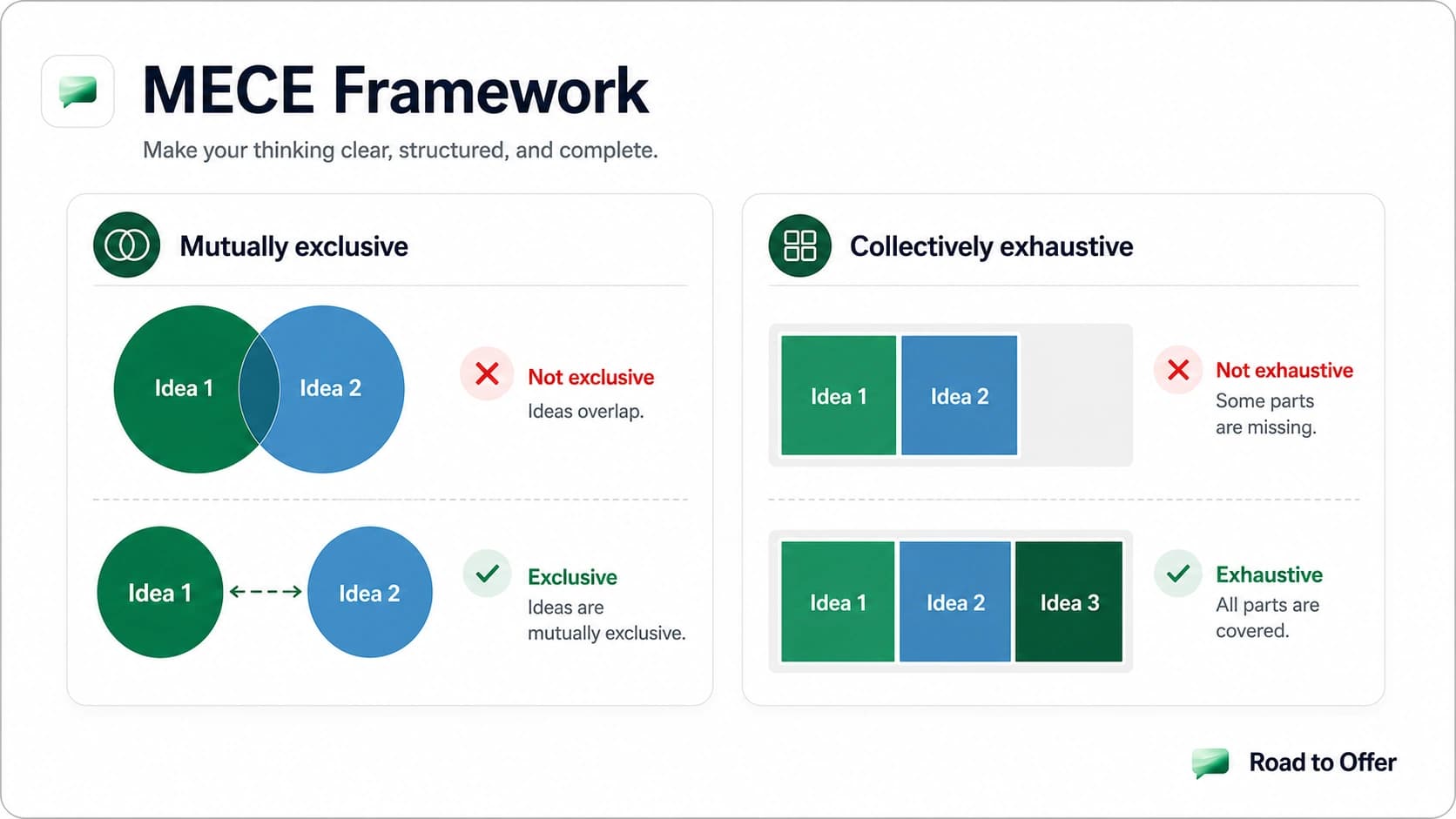
The one you cannot grade yourself is the first. Most candidates believe their opening tree is MECE because it looks tidy on paper, and only find out under a candidate-led interviewer that two branches overlap and a third is unfalsifiable. Get one scored before you work the examples.
Build a candidate-led structure and get it scored from the Road to Offer drill engine. Answer a real prompt and get AI-scored feedback. Free accounts include 5 drills per day for the first 3 days after signup.
The Strategy& written case and sample presentation, decoded
The written case is where PwC and Strategy& diverge most from a standard oral round, and it is the component candidates prepare least. Two variants circulate, and which one you get changes everything.
Variant one, the timed packet. You receive a set of case materials on the day, get roughly 45 to 60 minutes to analyse them, and build 3 to 5 slides. You then present and discuss for about 20 to 30 minutes while the interviewer challenges your reasoning.
Variant two, the 48-hour brief. Some PwC processes send the material two days in advance. The presentation runs 15 to 30 minutes and question time runs another 15 to 30 minutes. The bar is higher because you had time, and the questions probe further into the analysis you chose not to show.
The slide structure that survives both is fixed:
- Slide 1: the recommendation. One decision sentence, then three supporting reasons as headers. If the reader stops here, they know what you think and why.
- Slide 2: the decisive analysis. One chart or one table, and a title that states the finding rather than describing the axis. "Contract renewals drive 70% of the margin gap" beats "Margin by contract type".
- Slide 3: the quantified impact. What the recommendation is worth, over what period, under what assumption.
- Slides 4 and 5, if used: risks and next steps. Name the biggest thing that would make you wrong, and the test that would resolve it.
The failure mode is a data dump. With 40 pages of material and an hour, you cannot read everything, so triage against the questions you were asked: which pages contain data relevant to the specific asks, and which can be skimmed. The written case tests prioritisation under time pressure at least as much as analysis.
Slide one is a synthesis exercise wearing a slide's clothing. A top-down answer with a number attached, delivered in three sentences, is the same muscle whether you write it or say it, and it is the one most candidates only practise at the end of a case when they are already out of time.
Deliver a top-down recommendation and get it scored from the Road to Offer drill engine. Answer a real prompt and get AI-scored feedback. Free accounts include 5 drills per day for the first 3 days after signup.
The PwC group case: how it is actually scored
Groups of 3 to 6 candidates get a shared brief, 10 to 15 minutes of preparation, and roughly 20 minutes of observed discussion. Assessors score two things at once: the quality of what you contribute analytically, and how you behave inside a team that has to reach one answer.
That double scoring is why both obvious strategies fail. Dominating produces a worse group answer and reads as an inability to work with a client team. Staying quiet produces no evidence at all. The reliable moves are narrow and repeatable:
- Structure the discussion in the first 90 seconds. "Let us agree on the three things we need to answer, then split them" is a contribution nobody else is making, and it makes everything you say afterwards easier to follow.
- Take the branch nobody has quantified. One clean number, stated with its assumption, moves the group more than a fourth qualitative opinion.
- Pull in the quietest person once, by name, on something specific. Assessors are watching for this.
- Protect the last three minutes for the conclusion. Groups that discuss until the clock stops present nothing, and everyone in the room is scored on that.
Prepare the behavioral round in the same pass, since PwC weights it more heavily than most MBB processes. The question banks are in the PwC behavioral interview questions and Strategy& behavioral interview questions guides, and you can rehearse answers out loud with the behavioral simulator.
PwC assessment day: what happens before the cases
For most PwC Consulting and Advisory routes, the case round is not the first hurdle. An online games-based or aptitude assessment sits in front of it, typically with a short completion window measured in days rather than weeks. The detail by route is in the PwC assessment test guide and the PwC SHL aptitude guide, and the internship and early-careers routes have their own timelines in the PwC internship guide and PwC Career Unlocked.
Two things to get right before you spend another week on cases. Your application documents are scored before anyone meets you. Run the resume through the consulting resume grader, and match the letter to the practice you are applying to using the PwC cover letter guide. And if the assessment includes numerical reasoning under a timer, that is a different skill from case math: it rewards fast, accurate reading of a table rather than a clean derivation.
Learn frameworks properly
Pick and adapt structures instead of memorizing buckets.
8 worked PwC and Strategy& practice cases
Four Strategy&-style strategy cases, then four PwC-style deal and operations cases. Read the prompt, cover the worked path, and write your own structure first.
Case 1: Growth strategy, global cruise operator (Strategy&-style)
Prompt: A global cruise operator wants to double revenue within five years. The CEO wants to know whether that is achievable and where the growth would come from.
How to drive it: Doubling in five years is roughly 15% compound annual growth, and saying that out loud in the first minute reframes the whole case. That rate is far above the industry baseline, so the answer cannot be organic price and occupancy alone. Structure it as three testable branches: yield on the existing fleet, capacity added to the fleet, and adjacent revenue outside the ticket.
Worked path:
- Baseline the math. Revenue equals berths times occupancy times average revenue per passenger. If occupancy already runs in the mid-90s, that lever is nearly exhausted, so the growth has to come from berths or revenue per passenger.
- Yield: onboard spend is often 25 to 30% of total passenger revenue and carries far higher margin than the ticket. Raising onboard spend 30% lifts total revenue by roughly 8 to 9%, which is meaningful but nowhere near doubling.
- Capacity: new ships are multi-year, capital-heavy commitments. Ordering capacity to add 50% more berths only works if demand growth supports the occupancy, otherwise you have doubled the fleet and halved the yield.
- Adjacency: new geographies, new itinerary lengths, and new customer segments. This is where the remaining gap sits.
- Recommendation: doubling requires capacity, and capacity requires demand certainty. Commit to the onboard yield programme now because it is fast and self-funding, phase two ship orders against booked demand in the target region, and treat the segment expansion as the gating test. Name the risk: a capacity commitment made against forecast rather than booked demand is how cruise operators destroy yield.
Growth cases at Strategy& end on where growth comes from, not on whether the market is attractive. If your tree stopped at market attractiveness, rebuild it with the market entry framework and force every branch to name a revenue mechanism.
Case 2: Make versus buy, chemical manufacturer moving to direct-to-consumer (Strategy&-style)
Prompt: A chemical manufacturer that sells through distributors into consumer brands is considering selling directly to consumers. Should it?
How to drive it: This is a channel economics case wearing a strategy costume. The buckets are the economics of the new channel, the capability gap, and the reaction of the existing channel.
Worked path:
- Channel economics: direct selling captures the distributor and brand margin, often 40 to 60% of the retail price, but adds customer acquisition cost, fulfilment, returns and service. The question is whether the captured margin exceeds those costs at realistic volume.
- Capability gap: a B2B manufacturer has no brand, no consumer data, no fulfilment network. Building each is a multi-year investment, and buying a small existing direct brand is often the faster route.
- Channel conflict: the existing distributors and brand customers are the current revenue base. If they perceive the manufacturer as a competitor, the risk is losing volume that funds the transition.
- Quantify the tradeoff: if direct sales reach 5% of volume in three years at double the gross margin, but channel conflict costs 10% of the existing base, the move destroys value at that scale.
- Recommendation: enter direct only in a segment the current channel does not serve, so the conflict cost stays near zero, and treat it as a data and brand-learning investment rather than a margin play in the first three years.
Case 3: M&A screening, South American cement merger (Strategy&-style)
Prompt: Two cement suppliers in the same South American market are evaluating a merger. Advise the acquirer.
How to drive it: Use the M&A case framework but adapt it to a commodity with high transport costs, which is the specific feature of cement that makes this case interesting.
Worked path:
- Standalone attractiveness: cement demand tracks construction, which tracks GDP and public infrastructure spend. Cyclical, and the point in the cycle matters more than the average.
- The transport constraint: cement is expensive to move relative to its value, so markets are effectively regional. Two suppliers overlap only where their plant catchment areas overlap. Ask for a plant map before anything else.
- Synergies: if the catchments overlap heavily, the synergy is plant consolidation and freight optimisation, which is real but attracts competition scrutiny. If they barely overlap, there is little operating synergy and the deal is a geographic footprint play.
- Risk: regulatory review in a concentrated regional cement market is the base case, not an edge case.
- Recommendation: conditional. Proceed if the overlap is limited and the deal buys adjacent catchments, because that is footprint expansion at a lower cost than greenfield capacity. If the overlap is heavy, the synergy case is strong but the deal is unlikely to clear, and the acquirer should not spend six months finding that out.
 Bain
BainProfitability · hard
Run a live margin recovery case
Same skill as the PwC-style cases below: decompose the margin gap, call for the cost breakdown you need, and commit to a quantified recommendation.
Case 4: Pricing, construction firm and road maintenance contracts (Strategy&-style)
Prompt: A construction firm holding multi-year road maintenance contracts wants to raise prices. By how much, and what happens?
How to drive it: Contract pricing is not consumer pricing. The branches are cost pass-through, contract mechanics, and the customer's alternatives.
Worked path:
- Cost basis: if input costs (bitumen, labour, fuel) have risen 18% while contract prices are flat, the margin compression is arithmetic rather than strategic, and the ask is a pass-through, not a price increase.
- Contract mechanics: most public maintenance contracts contain indexation clauses. The first question is whether the firm has failed to invoke a clause it already holds, which is a common and unglamorous finding.
- Customer alternatives: the counterparty is usually a public authority with a procurement process. Switching cost is high mid-contract and low at renewal, so timing determines leverage.
- Recommendation: invoke indexation where clauses exist, negotiate pass-through mid-contract where they do not by tying the ask to published input indices rather than to the firm's own margin, and reprice properly at renewal. Quantify: recovering 12 of the 18 points of input inflation restores roughly three quarters of the lost margin without touching the win rate.
Case 5: Profitability, cardboard packaging manufacturer (PwC-style)
Prompt: A cardboard packaging manufacturer has seen operating margin fall from 11% to 7% over three years while revenue grew 9%. Why, and what should be done?
How to drive it: Growing revenue with falling margin is a mix or cost-structure problem, almost never a demand problem. Split the margin bridge before touching any qualitative explanation. Rebuild the tree with the profitability framework if yours starts with "internal and external factors", which is a template rather than a diagnosis.
Worked path:
- Decompose the bridge. Ask for margin by product line and by customer. Suppose commodity corrugated grew 19% while printed specialty packaging grew 2%.
- Check the margin gap between them. If specialty runs at 16% and commodity at 4%, the mix shift alone explains most of the decline.
- Do the arithmetic. With specialty at 60% of revenue falling to 52%, blended margin moves from roughly 11.2% to roughly 8.2%, which accounts for three of the four lost points. The remaining point sits in input costs.
- Ask why. The usual answer is a sales incentive paid on revenue rather than contribution, which makes commodity volume the rational thing for the sales team to chase.
- Recommendation: reset the incentive to contribution margin, put a floor price on commodity grades, and redirect capacity toward specialty where the moat and the margin both sit. Quantified: returning the mix to its prior split recovers roughly 3 margin points on the current revenue base.
Blended margin arithmetic is where most candidates lose the room. The numbers are easy, the weighting is not, and doing it out loud under time pressure is a different skill from following it on a page.
Rep the margin bridge math these cases run on from the Road to Offer drill engine. Answer a real prompt and get AI-scored feedback. Free accounts include 5 drills per day for the first 3 days after signup.
Case 6: Cost reduction, national insurance company (PwC-style)
Prompt: A national insurer needs to reduce its operating cost base by 15% within two years without damaging its customer retention. Where should it cut?
How to drive it: This is the archetypal PwC operational case. Cost cases fail when candidates list cost categories instead of ranking them by size, addressability and time to realise.
Worked path:
- Size the base. In a retail insurer, claims handling, distribution and commission, IT, and corporate functions dominate. Get the split before proposing anything.
- Rank by addressability. Commission is contractual and slow to move. Claims handling headcount is addressable but directly touches the customer experience you were told to protect. Corporate function overhead is fast and low-risk but usually too small to deliver 15% alone.
- Look for the structural lever. In insurers this is usually claims leakage and process automation: straight-through processing for low-value claims removes cost and improves cycle time at the same time, which is the rare cut that helps retention rather than harming it.
- Sequence it. Fast, low-risk items in year one to build credibility and fund the rest; the automation programme in parallel because it takes 12 to 18 months to land.
- Recommendation: a tiered plan with the automation of low-value claims as the anchor, corporate overhead as the quick win, and an explicit floor on frontline service headcount so the retention constraint is honoured rather than assumed away. Name the number each tier delivers.
 BCG
BCGOperations · hard
Run a live cost-reduction case
Same skill as Case 6: find the cost drivers, size each lever, and recommend a sequenced program with numbers attached.
Case 7: Digital transformation payback, regional bank (PwC-style)
Prompt: A regional bank has been asked to approve a $120M core systems modernisation over four years. The board wants to know whether it pays back.
How to drive it: Technology cases at PwC are investment cases. The branches are the cost of the programme, the quantified benefit, and the cost of doing nothing.
Worked path:
- Cost: $120M over four years, plus the run-rate change afterwards. Ask whether the $120M includes internal resource cost, because it frequently does not and that understates the programme by 20 to 30%.
- Benefit: split into hard and soft. Hard is decommissioned legacy licence and maintenance spend, reduced manual processing, and lower incident cost. Soft is time-to-market for new products, which is real but rarely bankable in a board paper.
- Do the arithmetic. If legacy run cost is $45M a year and modernisation removes 35% of it, that is roughly $16M a year, giving a simple payback of about seven and a half years on the $120M. That fails a four-year board horizon on hard benefits alone.
- The do-nothing branch is what rescues or kills the case. If the legacy platform is unsupported within three years, the comparison is not "invest versus save", it is "invest now versus a forced, worse-timed migration later plus rising incident and compliance cost".
- Recommendation: approve, but reframe the business case as risk-driven rather than payback-driven, and stage the funding against decommissioning milestones so each tranche releases only when the prior legacy component is actually retired. That is the discipline that stops these programmes from running to $200M with the legacy stack still live.
Case 8: Operations, fast food chain switching to fresh patties (PwC-style)
Prompt: A fast food chain is considering switching from frozen to fresh meat patties across 900 restaurants. Should it?
How to drive it: An operational change with a customer-facing rationale. Branches: the supply chain change, the restaurant-level change, and the demand response.
Worked path:
- Supply chain: fresh means shorter shelf life, so delivery frequency rises from perhaps twice a week to daily, cold-chain requirements tighten, and sourcing shifts to regional suppliers. Distribution cost per restaurant rises materially.
- Restaurant operations: fresh patties change cook times and holding rules, which means retraining and, at peak, potentially slower service. Speed is a core promise in this category, so a 20-second increase in service time at lunch is a revenue risk, not a detail.
- Waste: shorter shelf life raises spoilage unless forecasting improves. This is often the single largest unmodelled cost.
- Demand: the upside is a quality perception shift. Ask for test-market data. If tested restaurants show a 6% traffic lift that holds past the novelty period, the case is strong; if it decays in eight weeks, it is a marketing campaign with a permanent cost attached.
- Recommendation: conditional on the test data holding past 12 weeks, and staged by region so the supply chain rebuild happens where the regional supplier density supports daily delivery. Quantify the breakeven: if the change adds $0.11 per patty in combined supply, waste and labour cost, the traffic lift has to exceed roughly 4% to pay for itself at current margins.
Market sizing sits underneath several of these. Cases 1, 2 and 8 all reward a candidate who can put a defensible number on the addressable base in three minutes, and PwC and Strategy& interviewers both use sizing openers to set up the strategic question that follows.
Size a market under interview time pressure from the Road to Offer drill engine. Answer a real prompt and get AI-scored feedback. Free accounts include 5 drills per day for the first 3 days after signup.
Self-diagnostic: are you practising for the right interview?
Work through these after the 8 cases. Each one maps to a failure that shows up in PwC and Strategy& rounds specifically.
- Did you name the constraint in the first minute? Case 6 gives you a retention constraint and Case 1 gives you a five-year clock. Candidates who restate the objective without the constraint build trees that get invalidated ten minutes later.
- Did you ask for the data, or wait for it? Both interviews are candidate-led. If your worked path reads "the interviewer then showed me", you rehearsed the wrong behaviour.
- Could you write slide one after each case? One decision sentence and three supporting reasons. If that takes more than 90 seconds, the written case will hurt.
- Did every recommendation carry a number? "Reduce cost through automation" is not a PwC-caliber answer. "Automate straight-through processing on low-value claims to remove roughly 6 points of the 15" is.
- Did you separate the Strategy& half from the PwC half? If your last ten practice cases were all growth and entry, you are prepared for four of the eight cases above.
Official PwC and Strategy& practice resources
Both firms publish material worth working through before you touch third-party casebooks, because it tells you what they think a good answer looks like.
- PwC's Advisory case study prep page publishes two sample cases with scenario descriptions, questions and sample responses, one pitched at Associate level and one at Senior Associate level, at pwc.com/us/en/careers/entry-level/advisory-case-study-prep.html. The difference between the two sample answers is itself the lesson: the Senior Associate response commits harder and quantifies more.
- Strategy& university presentations circulate with embedded case questions and are the closest thing to an official Strategy& sample presentation, including the Strategy& university deck with case questions.
- PwC's own careers site covers the assessment stages and timelines, which change by country and by intake.
- Our own inventory of what is publicly available and what is not is in free Strategy& resources.
Once you have worked the official material, the constraint stops being material and becomes reps under pressure. Browse the case library and run candidate-led entry, margin and operations prompts against a clock.
How to use these 8 practice cases
Do not run all eight in one sitting. The value is in the diagnosis after each one.
A two-week PwC and Strategy& practice loop
Days 1 to 2: run Cases 1 and 5 cold, one Strategy&-style and one PwC-style, and write your structure before reading anything..
Day 3: rebuild the two trees you got wrong, then take one scored structure drill and compare the AI feedback to your own judgement..
Days 4 to 6: run Cases 2, 3 and 6, forcing yourself to ask for each piece of evidence out loud before you use it..
Day 7: build slide one for three of the cases you have run, one decision sentence and three supporting reasons each, under a five-minute timer..
Days 8 to 10: run Cases 4, 7 and 8, and quantify every recommendation before you say it..
Day 11: drill the arithmetic that slipped with graded case math reps until the margin bridge comes out clean..
Day 12: rehearse behavioral answers out loud in the behavioral simulator, since PwC weights this round more heavily than most MBB processes..
Day 13: run one full live case end to end from the case library with no notes..
Day 14: send your resume through the consulting resume grader and fix whatever the round-one screen would have caught..
Then wire each weakness to a specific rep rather than doing more generic cases:
- Structure came out template-shaped: run free structure drills until the tree is hypothesis-led.
- The sizing opener wobbled: work the market sizing method, then rep the free sizing drills.
- Arithmetic slipped: use case interview math practice.
- Exhibits took too long: work reading charts and exhibits.
- Slide one rambled: tighten it with the synthesis guide.
- The behavioral round is unrehearsed: use the Strategy& behavioral questions bank.
For worked examples across every other firm format, see case interview examples. For the full round-by-round process at each firm, the Strategy& case interview guide and the PwC case interview guide carry the scoring detail this page deliberately leaves out.
If your application is not in yet, the PwC resume guide covers what the screen reads before you ever see a case.
Sources and Further Reading (checked July 31, 2026)
- PwC official Advisory case study prep, with Associate and Senior Associate sample cases: pwc.com/us/en/careers/entry-level/advisory-case-study-prep.html
- Strategy& university presentation including case questions: myconsultingcoach.com PwC Strategy& university deck
- CaseBasix PwC and Strategy& case interview formats, reported prompts, written and group case timings: casebasix.com/pages/pwc-strategy-case-interview
- CaseTutor PwC case interview guide, assessment centre timings and case-session time splits: casetutor.com/blog/pwc-case-interview
- My Consulting Offer PwC and Strategy& guide, recruitment stages and individual presentation timings: myconsultingoffer.org PwC case interview
- Glassdoor PwC Advisory interview reports: glassdoor.com PwC Advisory interview questions
- Strategy& careers and practice overview: strategyand.pwc.com careers
Talk through a candidate-led case out loud
A margin problem in the PwC mould: you open the structure, call for each piece of evidence, and get scored on your reasoning, your math, and the recommendation you commit to.
Frequently asked questions
Resources and related guides
- Run a real case interviewPractice
- Browse all free resourcesResource hub
- Accenture Case Interview Examples: 10 Practice Cases and the Official Workbook (2026)Firm Specific · Jul 31, 2026
- BCG Case Interview Examples: 10 Practice Cases (2026)Firm Specific · Mar 1, 2026
- Práctica de entrevistas de casos BCG: 10 ejemplos y qué esperarFirm Specific · Mar 1, 2026
- Strategy& Case Interview Guide: PwC Strategy& Format, Tips, and Practice (2026)Firm Specific · Mar 7, 2026