
McKinsey PEI Questions: 30+ Practice Prompts (2026)
A McKinsey PEI question bank built from McKinsey's own interview guidance, with story prep, probe patterns, and a practice plan.
Your first interview question
Get your full coached feedback now. Continue the interview free after sign-up.

On this page
McKinsey PEI questions ask for specific past experiences, not abstract personality claims. McKinsey's official interviewing page says most client-facing candidates participate in a personal experience interview followed by a problem-solving interview, and it asks candidates to prepare important experiences in detail with focus on their role and key actions. This page gives you 30+ practice prompts built from McKinsey's own interviewing guidance, story-building instructions, and probe patterns so you can rehearse without relying on leaked interview content.
Use this question bank with the McKinsey PEI guide, then rehearse a story with the live behavioral simulator. For a full rehearsal system (story matrix, probe drilling, self-scoring, weekly cadence), see how to practice the McKinsey PEI. If you also need the case format, pair it with the McKinsey case interview guide.
How should you use this McKinsey PEI question bank?
Treat these as practice prompts mapped to the behaviors McKinsey says it looks for, not as a claim about exact questions from live interviews. McKinsey's assessment integrity expectations tell candidates not to share specific interview content, so the reliable prep move is to build real stories that can flex across several prompt wordings.
The best workflow is simple:
- Pick 8 to 12 real stories from school, work, leadership, athletics, research, volunteering, or side projects.
- Tag each story to one or two behavior buckets.
- Write a 90-second opening answer.
- Prepare 5 to 8 probe answers for each story.
- Rehearse out loud, then revise only after the probes expose gaps.
Yale Office of Career Strategy recommends using structured accomplishment stories for behavioral interviews, and Penn Career Services also frames STAR as a way to give a specific example, your role, your action, and the result. That structure works for McKinsey only if the action section is detailed enough to survive follow-up questions.
Which PEI story buckets should you prepare?
McKinsey highlights several personal-experience themes candidates can prepare for. Road to Offer maps those themes into four practical story buckets for rehearsal that line up with McKinsey's four PEI dimensions: Leadership, Connection (formerly Personal Impact), Drive (formerly Entrepreneurial Drive), and Growth.
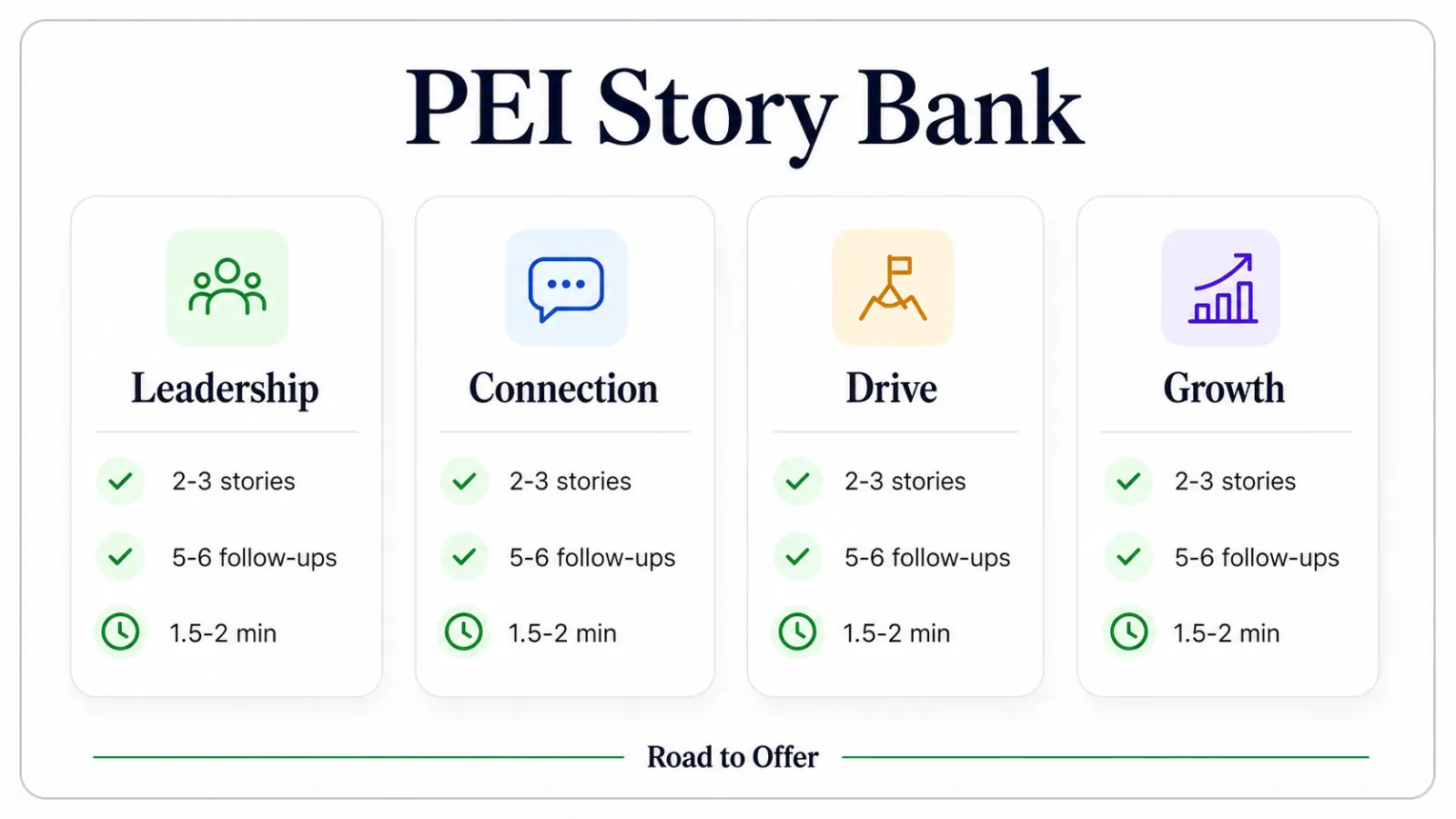
Don't force one story to cover everything. A story can flex across two buckets, but if every answer comes from the same project, the bank is too thin.
Your interviewer will ask:
“Tell me about a time you led a team through a difficult situation.”
“Describe a time you influenced someone who disagreed with you.”
“Tell me about a time you drove a change despite resistance.”
What leadership PEI questions should you practice?
Leadership prompts test whether you can move people toward a result under pressure. The story should show your choices as a leader, not just the team's final outcome.
Practice these prompts:
- Tell me about a time you led a team through a difficult situation.
- Describe a time you set direction when the path was unclear.
- Tell me about a time you had to raise a team's performance standard.
- Describe a time your team disagreed on the goal or plan.
- Tell me about a time you delegated important work and it went wrong.
- Describe a time you made an unpopular leadership decision.
- Tell me about a time you led under time or resource constraints.
- Describe a time you inherited a project that was already in trouble.
Use a story where your leadership changed the outcome. "I coordinated meetings" is weak. "I narrowed the goal, reassigned work, handled the strongest objection, and changed the delivery plan" gives the interviewer something to probe.
What Connection (formerly Personal Impact) PEI questions should you practice?
Connection prompts test influence, trust-building, and conflict handling. The strongest stories show a skeptical stakeholder changing their behavior because of how you framed the issue.
Practice these prompts:
- Tell me about a time you changed someone's mind on an important decision.
- Describe a time you influenced a senior stakeholder.
- Tell me about a time you built alignment across groups with different priorities.
- Describe a time you delivered difficult feedback.
- Tell me about a time you persuaded a resistant team to adopt a change.
- Describe a politically sensitive situation you had to navigate.
- Tell me about a time you influenced an external partner or client.
- Describe a decision you influenced without formal authority.
The useful detail is the influence mechanism. Did you reframe risk, bring new evidence, build a coalition, ask better questions, or change the timing of the conversation? Name the mechanism clearly.
What Drive (formerly Entrepreneurial Drive) PEI questions should you practice?
Drive prompts test ownership when success is not guaranteed. The initiative should be yours, and the constraints should be real.
Practice these prompts:
- Tell me about a time you identified an opportunity nobody else saw.
- Describe a time you took ownership beyond your formal role.
- Tell me about a time you built something from scratch.
- Describe a time you set an ambitious goal with no obvious path.
- Tell me about a time you turned around a stalled project.
- Describe a time you went beyond expectations and why.
- Tell me about a time you pursued an idea others doubted.
- Describe a time you had to be resourceful under constraints.
Avoid stories where the "drive" was simply doing assigned work well. McKinsey is looking for ownership, so the story needs a moment where you chose to act before someone else made it your job.
What growth and learning PEI questions should you practice?
Growth prompts test whether you learn without defensiveness. A polished success story often works worse here than a real setback with clear behavior change.
Practice these prompts:
- Tell me about a time you failed at something important.
- Describe a time you received difficult feedback.
- Tell me about a time you changed your approach mid-project.
- Describe a time you had to operate outside your comfort zone.
- Tell me about a time you challenged the status quo.
- Describe a time you made a decision with incomplete information.
- Tell me about a time you took a risk that could have backfired.
- Describe a time your first plan did not work.
The result matters, but the learning matters more. The answer should include what you changed afterward, where that change showed up later, and how you would handle the same situation today.
What probe questions should every PEI story answer?
The PEI is a conversation. After your opening answer, expect probes about judgment, trade-offs, people, and reflection.
Prepare these probes for every story:
- The hardest decision: what was the hardest decision in that situation?
- Alternatives: what alternatives did you consider?
- Your personal contribution: what did you personally do that others did not?
- Resistance: who resisted your approach, and why?
- Adaptation: how did you adapt when the situation changed?
- Feedback: what feedback did you receive afterward?
- Hindsight: what would you do differently today?
- Downstream impact: what did the result change for the team, client, or organization?
- Self-awareness: what did you learn about your own working style?
- Outside perspective: how would someone else in the story describe your role?
- Trade-offs: what was the biggest trade-off you accepted?
- Relevance: why was this example important enough to bring to McKinsey?
If a story cannot answer at least 8 of these questions, keep it as a backup. Probe gaps usually mean the story is too vague, too team-owned, or too far from the behavior being tested.
How do you turn a story into a McKinsey-ready answer?
Use STAR as the spine, but make "Action" the largest section. Yale defines STAR as Situation, Task, Action, Result. Penn's guidance also emphasizes a specific example, your role or influence, and the outcome. For McKinsey, that means the interviewer needs to hear the decision moments inside the action. For consulting-specific STAR upgrades and full worked examples, see the STAR method for consulting interviews guide.
Use this answer shape:
Then rehearse probes, not just the opener. A smooth opener with weak probe answers feels scripted. A concise opener with specific probe answers feels real. Rehearse this live with the PEI simulator to see how your probe answers hold up in real time.
Free live AI interview
Practice these PEI questions out loud
Answer real McKinsey PEI questions against an AI interviewer that probes your stories with follow-ups and scores every answer.
Start your free PEI session
How should you practice this week?
Run a five-day PEI sprint:
- Day 1: Build a raw list of 15 stories.
- Day 2: Pick the best 8 and tag each one to a story bucket.
- Day 3: Write 90-second openers for the 4 strongest stories.
- Day 4: Answer 8 probes per story without notes.
- Day 5: Run two mock PEI rounds with the live PEI simulator and retire any story that sounds generic.
Remember that McKinsey pairs the PEI with a problem-solving interview, so a strong story bank is only half the prep. Once your openers and probes feel solid, use the McKinsey case interview guide to plan the problem-solving half.
If you are also preparing cases, alternate PEI with case interview fit questions, behavioral interview consulting, and the case structure guide. For motivation questions like "why consulting," the why consulting answer guide covers the three-part framework MBB interviewers respond to best. For concrete stories mapped to each PEI dimension, the leadership story examples guide is useful alongside this question bank. The goal is not to sound rehearsed. The goal is to have real examples ready when the interviewer asks for detail.
Sources and Further Reading (checked 2026-06-08)
Frequently asked questions
Resources and related guides
- Practice a real behavioral interviewPractice
- Browse all free resourcesResource hub
- McKinsey PEI: The 4 Dimensions, Stories, and Prep Plan (2026)Firm Specific · Feb 1, 2026
- McKinsey PEI Practice: Story Matrix, Probes, and Rubric (2026)Firm Specific · Jul 23, 2026
- BCG Behavioral Interview Questions: 18 Prompts With Worked Answers (2026)Firm Specific · Jul 31, 2026