
Why McKinsey? How to Answer the Fit Question (Sourced Differentiators + Sample Answers) (2026)
How to answer 'Why McKinsey?' in 2026: what interviewers test, the real sourced differentiators to anchor on, a 4-part structure, full sample answers, and delivery practice.
Your first interview question
Get your full coached feedback now. Continue the interview free after sign-up.

On this page
A strong "Why McKinsey?" answer in 2026 does one thing well: it proves you researched the firm specifically and connected that research to your own goals, instead of reciting prestige. McKinsey, founded in 1926 in Chicago by James O. McKinsey (per Wikipedia), is now a roughly 38,000-person firm with about $16 billion in 2023 revenue, and it is genuinely hard to enter. The Cambridge Consultant estimates a 1% to 1.1% acceptance rate against roughly 200,000 applications a year. Interviewers ask the question because that scarcity makes fit and commitment matter. The best answers name two or three real differentiators (scale and global influence, the obligation to dissent, deep functional practices, the apprenticeship and global-staffing model), tie each back to your background, and run 60 to 90 seconds. This guide gives you sourced facts, a fill-in-the-blank framework, full sample answers by profile, and the delivery practice that reading alone cannot teach.
Why interviewers actually ask "Why McKinsey?"
The question looks simple, but it is doing three jobs at once.
First, it tests genuine research. McKinsey receives roughly 200,000 applications a year and, per The Cambridge Consultant, rejects around 60% to 80% of candidates at the initial online application stage. By the time you are in a fit interview, the interviewer wants to know whether you understand what makes their firm different, or whether you applied everywhere and McKinsey happened to call back. If your application includes a written letter, that same research is what separates a strong McKinsey cover letter from a generic one, because both stages reward firm-specific evidence over prestige.
Second, it tests culture and values fit. McKinsey runs an apprenticeship model: junior consultants learn directly from engagement managers and partners, and the firm invests heavily in training. They are trying to predict whether you will thrive in that environment and represent the firm well in front of clients.
Third, it tests commitment to stay. Training a consultant is expensive. An interviewer reading a weak, generic answer hears flight risk. A specific, personal answer signals that you chose McKinsey deliberately and are likely to stick.
So "Why McKinsey?" is not small talk. It is an early filter for research, fit, and retention, all packed into 90 seconds.
What actually makes McKinsey different (the sourced differentiators)
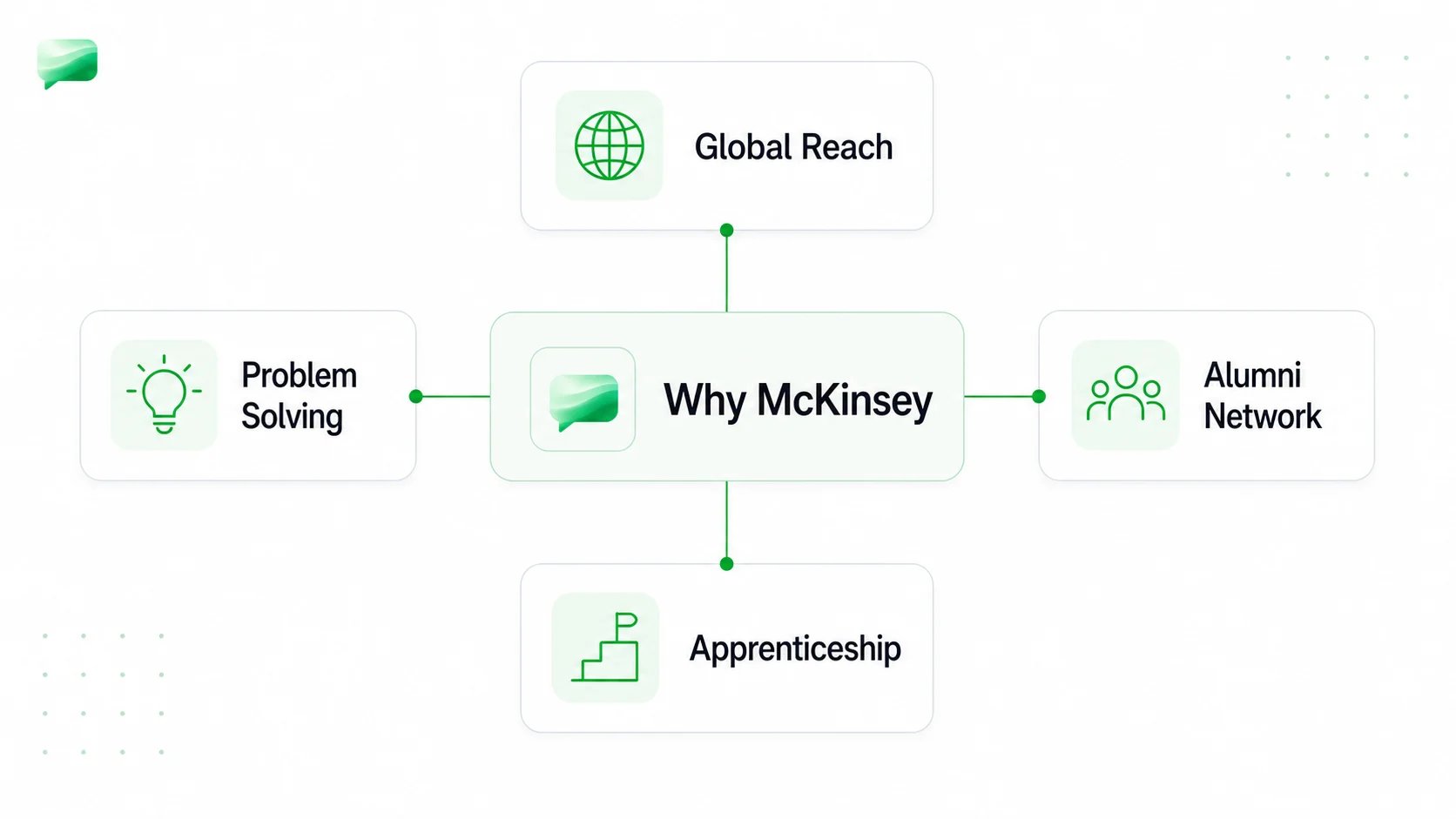
Most articles tell you to "be specific" and then hand you nothing specific. Here are real, sourced differentiators you can anchor an answer on. Pick the two or three that genuinely connect to you, not all of them.
1. Scale and global influence
McKinsey is the largest of the MBB firms by headcount, with roughly 38,000 colleagues and about $16 billion in 2023 revenue (per Wikipedia). Founded in 1926, it has nearly a century of institutional knowledge. For a candidate, the honest version of this differentiator is not "it is big and prestigious." It is "the breadth of clients and geographies means I could work across industries and regions early in my career," tied to why that breadth matters to you.
2. The obligation to dissent
McKinsey's well-known cultural principle, the obligation to dissent, means every consultant, regardless of seniority, is expected to speak up when they disagree, even with a partner. If you can point to a real moment where you challenged a more senior person with data and were right to, this differentiator becomes personal and credible rather than a slogan.
3. Functional-practice expertise
McKinsey is organized around deep functional practices (operations, marketing and sales, risk, organization, digital) layered on top of industry practices. If you have a functional interest, naming a specific practice signals research. Candidates who can say "I want to build depth in the operations practice because of X experience" stand out from candidates who only know McKinsey as a general strategy firm.
4. The apprenticeship and global-staffing model
McKinsey staffs consultants onto projects from a global pool and develops them through a structured apprenticeship under engagement managers and partners. If you learn best by doing alongside experts and want exposure to many problem types fast, this is a real, defensible reason that maps to how McKinsey actually works.
The 4-part structure of a strong answer
A clean "Why McKinsey?" answer follows the same shape every time. Fill in the blanks with your own material.
The 4-Part 'Why McKinsey?' Structure (60 to 90 seconds)
- 01
1. Open with genuine enthusiasm. One or two sentences of authentic energy about the firm. Skip the throat-clearing. Lead with what genuinely excites you, not 'McKinsey has always been my dream.'
- 02
2. Give 2 to 3 specific differentiators. Name concrete, researched reasons: a functional practice, the obligation to dissent, the global-staffing model, or a McKinsey Quarterly piece you actually read.
- 03
3. Tie each one back to you. For every differentiator, add a 'which matters to me because...' clause linking it to your experience, values, or long-term goals. This is the step competitors skip.
- 04
4. Close on commitment in 60 to 90 seconds. End with where McKinsey fits your trajectory. Keep the whole answer under 90 seconds so it lands as confident, not rehearsed.
The single most important part is step 3. Reciting firm facts is research; tying each fact to your own story is fit. The next section shows the difference.
Weak vs strong answers, side by side
Start from a typical weak draft and watch it improve.
Weak answer: "McKinsey is the most prestigious consulting firm in the world. You work with the best clients, the people are incredibly smart, and the exit opportunities are amazing. I would learn a lot and it would open doors for my career."
Why it fails: Every sentence applies equally to BCG and Bain. It is prestige-chasing, it is all about what the candidate gets, and it contains zero evidence of research or personal connection. An interviewer has heard this exact answer hundreds of times.
Strong answer: "Two things draw me to McKinsey specifically. First, the obligation to dissent. In my last internship I pushed back on a senior analyst's pricing assumption with data and it changed our recommendation, and I want to be somewhere that expects that from day one. Second, the depth of the operations practice. I read a McKinsey Quarterly piece on supply-chain resilience that matched the warehouse-throughput problem I worked on, and I want to build that functional depth under people who do it at scale. Long term I want to lead operational turnarounds, and McKinsey's apprenticeship model is the fastest way I have found to get there."
Why it works: It names specific, researched differentiators, ties each to a real experience, shows what the candidate offers rather than only what they want, and lands in about 60 seconds. For the full mechanics of structuring fit stories like this, see the McKinsey PEI guide.
How to make it personal
A differentiator only counts when it connects to you. The pattern is simple: for every reason you give, add a clause that starts with "which matters to me because." That clause forces the link between a firm fact and your own background, values, or goals.
- Background: Connect a McKinsey practice or project type to something you have actually done (a class, internship, research project, or job).
- Values: Connect a cultural trait (the obligation to dissent, the apprenticeship model) to how you like to work and learn.
- Long-term goals: Connect McKinsey's breadth or functional depth to where you want to be in five to ten years.
If you cannot finish the "which matters to me because" clause for a given reason, drop that reason. It is firm trivia, not fit.
How to gather firm-specific ammunition (the research playbook)
Competitors say "do coffee chats and read McKinsey Quarterly" and stop there. Here is how to actually do it.
1. Coffee chats and informational interviews. Find McKinsey consultants through your school's alumni network or LinkedIn and ask for 15 to 20 minutes. Do not ask "what is McKinsey like?" Ask specific questions you can later quote: "What surprised you about the staffing model?" or "What does the obligation to dissent look like day to day?" A real answer becomes "I spoke with an associate in the operations practice who told me..." which no one can fake.
2. McKinsey Quarterly and Insights. Read two or three recent pieces in a practice area you care about. Note the specific article and the idea that resonated, then reference it: "I read a McKinsey Quarterly article on retail's post-COVID shift that reframed how I think about demand forecasting." Specificity signals genuine interest.
3. Recruiting events. Attend firm presentations and note who you met and what they said. Referencing a recruiter or consultant by first name and a specific point they made shows you engaged.
4. The specific office. Research your target office's industry strengths and look up its consultants on LinkedIn. This is what powers a strong "Why this office?" follow-up.
Full sample answers you can adapt
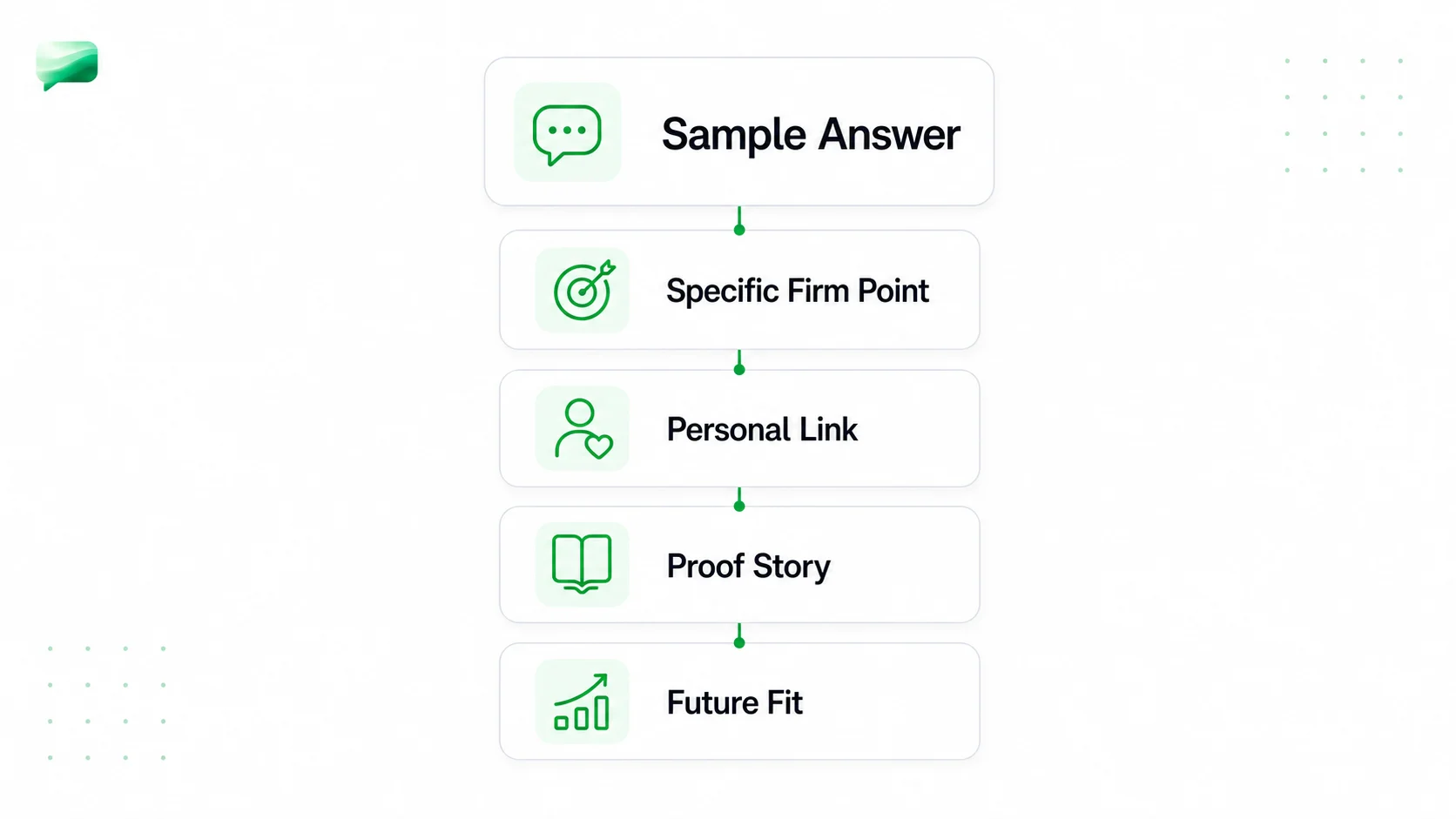
Adapt these to your own material. Do not memorize them word for word.
Undergraduate (no consulting experience yet): "I am drawn to McKinsey for two reasons. First, the apprenticeship model. As someone early in my career, learning directly from engagement managers and partners on real client problems is exactly how I learn best, and it beats sitting in training rooms. Second, the breadth. I am genuinely unsure which industry I want to build a career in, and McKinsey's range of clients lets me test that early instead of committing blind. Long term, I want the problem-solving foundation that I keep hearing McKinsey builds better than anywhere else."
MBA (industry interest): "Two things. The depth of the marketing and sales practice maps directly to the brand-management work I did pre-MBA, and I want to scale that thinking across industries. And the obligation to dissent matters to me. At my last company, the best ideas died because junior people stayed quiet; I want a firm that structurally expects me to speak up. After business school I want to lead commercial transformations, and McKinsey's functional depth is the fastest path I have found."
Career-switcher: "I am switching from engineering, and McKinsey appeals because the global-staffing model would let me apply my technical background to operations and digital problems while learning the business side fast. I had an informational chat with a consultant in the operations practice who described exactly that blend, and it confirmed the fit. I want to spend the next decade solving operational problems at scale, and the apprenticeship model is how I close the gap quickly."
Experienced hire: "After eight years in retail operations, I want to work across companies instead of inside one. McKinsey's operations practice and its work on supply-chain resilience (I read a recent McKinsey Quarterly piece on it) line up with the exact problems I have been solving in-house. I also want the obligation-to-dissent culture; I have led teams that needed that and rarely had it. McKinsey lets me turn a decade of operating experience into broader impact."
For more on building and structuring these stories, the McKinsey PEI guide covers the firm's specific fit-interview format.
Common mistakes to avoid
- Generic, could-apply-to-any-firm answers. If your reasons survive a find-and-replace from "McKinsey" to "BCG," start over; knowing how the firm actually differs from McKinsey's competitors is what makes the answer specific.
- Prestige-chasing. "Most prestigious, best exit opportunities" centers what you get, not why you fit. Interviewers read it as flight risk.
- Rambling or over-scripting. Both extremes fail. Too long and you lose the room; word-for-word memorized and you sound robotic. Aim for 60 to 90 seconds, delivered conversationally.
- Zero personalization. Listing firm facts without the "which matters to me because" clause is research without fit. It is the most common gap.
- Confusing the questions. Answering "Why McKinsey?" with reasons that are really about "Why consulting?" wastes the question. See the distinction below.
Delivery: practice out loud, do not memorize
This is the step every text article ignores, because reading cannot teach it. A "Why McKinsey?" answer is delivered, not written. You should know your key points cold (the two or three differentiators and their personal links) without memorizing exact sentences, so the answer comes out natural and conversational each time.
Practice it out loud, ideally recorded or with a partner, until you can deliver it in under 90 seconds without sounding rehearsed. Then practice it inside a real fit-interview flow, not in isolation, because in the actual interview it follows "Tell me about yourself" and precedes the case. Run a few free PEI reps so the answer becomes muscle memory under realistic conditions. The McKinsey case interview guide covers how the fit segment sits alongside the case in McKinsey's interviewer-led format.
"Why McKinsey" vs "Why consulting" vs "Why this office"
Competitors blur these three questions together. They are distinct, and conflating them is a fast way to lose points.
The cleanest way to keep them separate: answer "Why consulting?" with reasons about the work, "Why McKinsey?" with reasons about the firm, and "Why this office?" with reasons about the place and its people. If you find yourself giving consulting-career reasons to a McKinsey-specific question, reset. For the career-level question, see the Why consulting answer guide.
Sources
- Wikipedia: McKinsey & Company (checked June 26, 2026)
- The Cambridge Consultant: McKinsey acceptance rate (checked June 26, 2026)
Frequently asked questions
Resources and related guides
- Practice real McKinsey casesPractice
- Browse all free resourcesResource hub
- Why Bain? How to Answer the Fit Question (2026 Sample Script)Getting Started · Jun 27, 2026
- Why BCG? How to Answer the Fit Question (2026 Structure, Swap Test & Sample)Getting Started · Jun 27, 2026
- Tell Me About a Time You Failed: Consulting AnswerGetting Started · Jun 30, 2026