
Porter's Five Forces: Definition, Examples & Case Use
Porter's Five Forces explains industry profitability through rivalry, entrants, suppliers, buyers, and substitutes. Includes examples and case interview use.
On this page
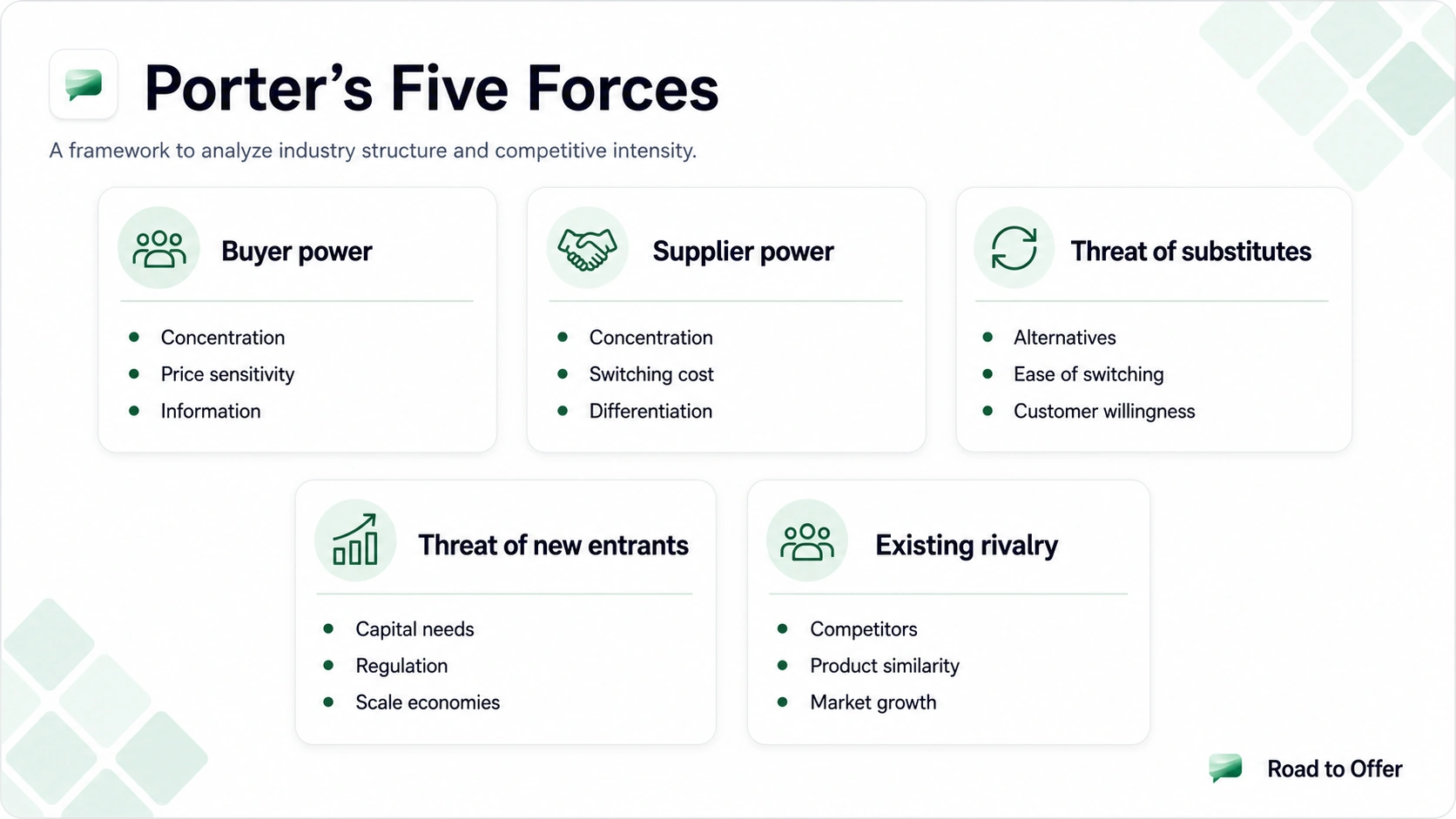
Porter's Five Forces is an industry analysis framework that explains profitability through competitive rivalry, threat of new entrants, threat of substitutes, supplier power, and buyer power. In a case interview, use it when the client needs to know whether an industry can sustain attractive profits. Your answer should not recite all five forces evenly. It should define the industry, pressure-test the five forces quickly, identify the 1-2 forces that actually govern the profit pool, and translate that into an entry, investment, pricing, or positioning recommendation.
Michael E. Porter introduced the framework in the March 1979 Harvard Business Review article "How Competitive Forces Shape Strategy," and it has remained one of the most cited strategy tools in business education for over 45 years. Five Forces appears frequently in strategy and market entry cases, yet a large share of candidates apply it without correctly prioritizing the dominant forces. This article covers the framework's definitions, a worked Coca-Cola example, when to use it versus SWOT and PESTEL, and how to make it sound practical under interview time pressure.
Learn the case method, step by step
Why does Porter's Five Forces still matter?
Porter's central argument is that profitability is determined by industry structure, not just by company strategy or management quality. Even the best-run airline cannot escape the structural forces that have kept the global airline industry's return on invested capital below its cost of capital since at least 1996, according to the IATA Aviation Value Chain analysis. Conversely, a mediocre soft drink company can earn 20%+ operating margins because the industry's structural forces favor incumbents.
The framework appears across three distinct contexts: strategic planning at corporations, due diligence by private equity and investment teams, and the case interview process at MBB and tier-2 consulting firms. Harvard Business School's Institute for Strategy and Competitiveness describes it as the starting point for any rigorous industry analysis.
When should you use it in a case interview?
Use Five Forces when the prompt is about industry attractiveness. Strong signals include "Should we enter this market?", "Why are margins structurally low?", "Is this acquisition target in an attractive sector?", "Can this market support premium pricing?", or "Which segment of the value chain is most profitable?"
Do not use it as your first framework for a pure profitability decline, market sizing, operational improvement, or company capability question. If the client already competes in the industry and the issue is that revenue fell 12% last quarter, start with the profitability framework or profitability case interview guide. If the client is choosing whether to enter a new market, Five Forces should sit inside a broader market entry framework, not replace it.
In a live case, phrase it practically: "I want to test whether this industry is structurally attractive before we decide to enter. I'll look at rivalry, entry barriers, supplier and buyer power, and substitutes, then focus on whichever forces most constrain profit."
Learn frameworks properly
Pick and adapt structures instead of memorizing buckets.
Do interviewers actually respect Porter's Five Forces?
This is the question most prep sites avoid, so address it directly. Several coaching resources (PrepLounge and MyConsultingCoach among them) warn that interviewers can read a textbook Five Forces dump as a "last resort," a sign the candidate memorized a model instead of structuring the specific problem. That warning is fair, but the conclusion most candidates draw from it is wrong. The fix is not to avoid Five Forces. The fix is to stop reciting it.
Three rules keep the framework credible in a live case:
- Never name it as your whole structure. Saying "I'll run a Porter's Five Forces analysis" signals memorization. Instead build a custom market-entry tree and use the five forces as the branch that tests industry attractiveness, alongside company capabilities and economics.
- Drop forces that obviously do not bind. If suppliers are clearly fragmented commodities, say so in one sentence and move on. Equal depth on all five is the tell that you are pattern-matching, not thinking.
- Lead with the binding constraint. Modern consulting rarely draws the diagram, but partners do reason about industry structure constantly. Show you can find the one or two forces that set the profit ceiling and you sound like a consultant, not a flashcard.
So the honest answer: the diagram is dated, the thinking is not. Use the forces as a checklist inside a tailored structure, and you get the rigor without the red flag.
What are the five forces?
The five forces are the structural factors that compress or support an industry's profit pool. Each one is independent in theory but interacts with the others in practice. A single force scoring at the extreme can cap profitability across the entire industry.
1. Threat of new entrants
The threat of new entrants is high when an industry has low barriers to entry and incumbents cannot credibly retaliate against newcomers. New entrants bring capacity that adds supply, often forcing incumbents to discount and eroding margins for everyone. The seven barriers Porter identified (capital requirements, economies of scale, brand loyalty, switching costs, access to distribution, regulation, and incumbent retaliation) still apply almost five decades later.
Capital intensity is the most visible barrier. Building a semiconductor fab costs $10-20B; opening a bakery costs $50K. But less visible barriers are often more decisive. Network effects in payments and social media create self-reinforcing share advantages that capital alone cannot overcome. Regulatory licensing in pharmaceuticals (FDA approval averages 10+ years and ~$2.6B per new drug, per PhRMA data) makes pharmaceutical manufacturing one of the highest-barrier industries on earth.
A clean test for entry barriers: ask how long it would take and how much it would cost a well-funded competitor to reach 10% market share. Industries where the answer exceeds 5 years and $1B have strong entry barriers. Industries where the answer is 12 months and $50M do not.
2. Bargaining power of suppliers
Supplier power is high when a few suppliers control critical inputs that have no good substitute. When suppliers have power, they can raise prices, reduce quality, or shift terms, and the industry's firms cannot push back without disrupting their own operations.
The classic example is the commercial aircraft duopoly: Boeing and Airbus together delivered over 1,000 aircraft in 2024 and dominate the global market for large jets. Airlines cannot meaningfully play one against the other when order backlogs stretch 5+ years. Labor is increasingly a powerful supplier in knowledge industries: pilot scarcity drove airline wage inflation across 2022-2024, and skilled engineering labor compresses margins at consulting and tech firms.
The five questions that test supplier power:
- How many viable suppliers exist for this input?
- Could the firm switch suppliers without significant cost or delay?
- Does the supplier sell a differentiated or proprietary input?
- Does the supplier have credible forward integration capability?
- How much of the supplier's revenue does the industry represent?
If three or more answers point toward concentration or dependence, supplier power is high. The strategic response is typically to multi-source, vertically integrate, or contract long-term to remove the supplier's optionality.
3. Bargaining power of buyers
Buyer power is high when buyers are concentrated, well-informed, and face low switching costs. Concentrated buyers can demand discounts, better terms, and higher quality, and walk away if the supplier resists. Walmart's purchasing power over consumer goods is the textbook example, and the rise of pharmacy benefit managers (CVS Caremark, Express Scripts, OptumRx now control roughly 80% of prescription claims in the US) has driven generic drug prices down relentlessly through the same dynamic.
Information transparency dramatically amplifies buyer power. Before metasearch engines, airline pricing carried a meaningful information friction; after Google Flights and Kayak, leisure travelers can sort the entire market by price in 30 seconds. The same dynamic compressed margins for hotels, rental cars, and consumer electronics retailers.
Buyer power and rivalry are linked. Low switching costs amplify both forces simultaneously: customers can leave easily (high buyer power) AND competitors can poach them easily (high rivalry). When you analyze an industry, identify whether switching costs are the structural lever. Fixing them through loyalty programs, contractual lock-in, or platform integration is one of the few strategic moves that addresses two forces at once.
4. Threat of substitutes
Substitutes are different products or services that solve the same customer problem. This is not the same as competitive rivalry. Rivals offer the same type of product, while substitutes offer an alternative path to the same outcome. Video conferencing is a substitute for business air travel. Streaming is a substitute for cinema. Plant-based meat is a substitute for beef.
The threat of substitutes is high when the substitute offers a favorable price-performance ratio, switching costs are low, and the substitute is improving faster than the original product. Ridesharing platforms substituted for traditional taxi services because they offered comparable transportation at lower friction with transparent pricing, destroying urban taxi industry profitability in most major markets within a decade.
The most dangerous substitutes are the ones that look inferior today but improve quickly. Electric vehicles were inferior substitutes for internal combustion cars in 2015. By 2025, EVs accounted for roughly 10% of US new car sales and 18% of global sales according to the International Energy Agency Global EV Outlook, with the trajectory continuing to favor EVs in most segments.
5. Competitive rivalry
Rivalry sits at the center of Porter's model because every other force shapes how intensely existing firms compete. Rivalry is high when competitors are numerous and balanced, growth is slow, fixed costs are high, products are undifferentiated, exit barriers are high, or strategic stakes are high.
Slow growth is the most underappreciated driver. In a fast-growing market, every firm can grow by serving new customers; in a flat or declining market, every gain comes at a competitor's expense. The US craft beer industry illustrates this perfectly: 9,000+ breweries (per Brewers Association) competing in a 1-2% growth market drives intense margin pressure even though consumer demand for the category is healthy.
Symptoms of intense rivalry to look for in any industry:
- Frequent price discounting or promotional activity
- Heavy advertising and marketing spend as a percentage of revenue
- Rapid product feature escalation without corresponding price increases
- Capacity expansion ahead of demand
- Public lawsuits, antitrust complaints, or hostile competitor commentary
If two or more symptoms are visible, rivalry is materially compressing the industry's profit pool.
Scoring five forces from a prompt is a structure skill on its own. Drill it before you see it live in a case.
Structure a Five Forces case from the Road to Offer drill engine. Answer a real prompt and get AI-scored feedback. Free accounts include 5 drills per day for the first 3 days after signup.
What is a real-world example of Porter's Five Forces?
The cola industry is the textbook positive Five Forces example. Four of five forces favor incumbents, which is why Coca-Cola has averaged 25%+ operating margins for over three decades.
Key data points: Coca-Cola holds roughly 40% of the global non-alcoholic beverage market and PepsiCo roughly 30%, with the global soft drinks market projected at $373B in 2024 growing to $563B by 2034 at 4.2% CAGR (per Market.us research). In the US specifically, Coca-Cola and PepsiCo together control roughly 75% of the carbonated beverage segment.
Synthesis: "The global carbonated soft drink industry is structurally attractive. The duopoly structure with stable brand share, decades of distribution and bottler investment, and minimal supplier power create one of the most profitable consumer goods industries in the world. The binding constraint going forward is the threat of substitutes from healthier alternatives. Incumbents have responded by acquiring and launching adjacent products (Coca-Cola's Simply Pop prebiotic soda in 2025, PepsiCo's bubly burst in 2024) rather than defending the core cola category alone."
This is how a Five Forces analysis should end: not with five scores in a table, but with a clear so-what about which forces matter most and how the industry is responding.
What does an unattractive industry look like?
The contrast case teaches the framework better than the cola example alone. US passenger airlines run the same structure in reverse: four of five forces work against incumbents, which is why the industry has earned a return on invested capital below its cost of capital across most of the last three decades.
Key data points: Per the IATA Aviation Value Chain analysis, airlines sit at the bottom of their own value chain, earning lower and more volatile returns than the suppliers, lessors, and distributors around them. McKinsey found US airline ROIC averaged roughly 6% in the strong 1996-2000 window against a cost of capital near 7.5%, and the industry did not durably clear its cost of capital until around 2015.
Synthesis: "US airlines are structurally unattractive. The binding constraints are rivalry and buyer power: perishable inventory and high fixed costs force discounting, while price-transparent metasearch removes any pricing power on leisure routes. The few profitable plays compress these two forces directly, through fee unbundling that buyers cannot comparison-shop and frequent-flyer programs that raise switching costs."
Put the two tables side by side and the lesson is structural, not industry-specific. Cola and airlines both face real substitute threats, but cola's near-zero rivalry and entry barriers carry the profit pool, while airlines' rivalry at a 5 caps the entire industry no matter how well any single carrier is run.
Test recall of both worked examples before moving on. Name the binding force first, then the driver, in one breath.
Interactive drill set. Write an answer before revealing the worked solution, then continue into Road to Offer for scored practice and AI feedback.
When should you use Five Forces vs SWOT vs PESTEL?
The three frameworks are often confused but serve different analytical purposes. Choosing the right tool for the question matters more than executing any single framework perfectly.
The three frameworks layer cleanly. PESTEL identifies macro trends that shape multiple industries; for example, regulatory pressure on sugar consumption affects every food and beverage category. Five Forces translates those trends into industry-specific competitive implications: sugar regulation strengthens the substitute threat in cola but is largely irrelevant in coffee. SWOT then translates the industry analysis into company-specific actions. Coca-Cola's response (acquisitions and new products) versus a smaller bottler's response (cost reduction) reflects different strengths and resources.
In a typical strategy engagement, consultants run PESTEL first to scan macro trends, Five Forces to assess industry attractiveness, and SWOT or a custom internal-capability analysis to define the client-specific recommendation. For deeper coverage of how these connect to broader case-prep frameworks, see our case interview frameworks complete guide and market entry framework articles.
What are the limitations of Porter's Five Forces?
Porter's framework is robust but not universal. Four limitations recur in academic critique and practitioner experience.
1. The framework is static. Five Forces gives a snapshot of structural attractiveness, not a forecast. Industries change rapidly. Barriers to entry in cloud infrastructure were massive in 2010 but have been partially eroded by alternative providers and open-source tools. The practical fix is to score forces as they are today and explicitly flag which forces are likely to shift over a 3-5 year horizon.
2. It does not handle platforms and network effects cleanly. Porter built the model around linear value chains. Two-sided platforms (Uber, Airbnb, Visa) create value by connecting groups, and their competitive dynamics are dominated by network effects that Porter's entry barriers do not fully capture. Per the Five Forces at 45 review by ITHRON, platform analysis typically requires supplementing Five Forces with explicit network-effect modeling.
3. It ignores complements. Complementary products (products that enhance the value of yours) can be more important than substitutes in ecosystem businesses. Apple's App Store ecosystem strengthens iPhone demand; Microsoft Office strengthens Windows demand. Andrew Grove popularized treating complements as a practical sixth force, and Brandenburger and Nalebuff formalized the idea in their value-net work, but Porter never folded it into the original five. The interview-ready move is to add one sentence when the industry is platform or ecosystem driven: "I'd also test the strength of complements here, because they shape demand more than substitutes do in this category." That single line shows you know where the model stops.
4. It treats forces as equal. In practice, only one or two forces actually constrain profitability in any given industry. Treating all five with equal depth wastes analytical effort and obscures the binding constraint. Sophisticated users prioritize ruthlessly.
Common mistake: wrong unit of analysis
The single most common mistake in Five Forces case practice is applying the framework to a single product or company instead of an industry. Five Forces analyzes the market for "global non-alcoholic beverages" or "US domestic airlines," not "Coca-Cola Zero" or "Delta Airlines." Mismatching the unit of analysis produces conclusions that look rigorous but miss what the framework is actually measuring.
How do you run a Porter's Five Forces analysis?
A defensible Five Forces analysis follows the same five steps whether you have 3 minutes or 3 weeks.
1. Define the industry precisely. State the geographic scope, product scope, and time horizon. "Global premium coffee shops, 2026" is a usable definition. "The coffee industry" is not.
2. Score each force with sub-factor evidence. Use a 1-5 scale and cite a specific data point per score. "Buyer power is 4 because the top three retail customers control 65% of industry sales" is rigorous; "buyer power is high" is not.
3. Identify the binding constraint. Which 1-2 forces dominate profitability? An industry can be unattractive overall because a single force at 5 caps the entire profit pool, regardless of how favorable the other four are.
4. Map the trajectory. For each force, note whether intensity is rising, stable, or falling over a 3-5 year horizon. This separates a snapshot from a forecast.
5. Translate to a strategic implication. State whether the industry is structurally attractive, what the binding constraint is, and what strategic actions could mitigate the dominant force. Without this step, the analysis is academic.
For consulting candidates specifically, our Porter's Five Forces case interview guide walks through how to deliver this analysis under live interview conditions with a fully scored airline industry worked example. To build reps, use public structure drills for Five Forces and practice saying the synthesis out loud in under 90 seconds.
What frameworks complement Porter's Five Forces?
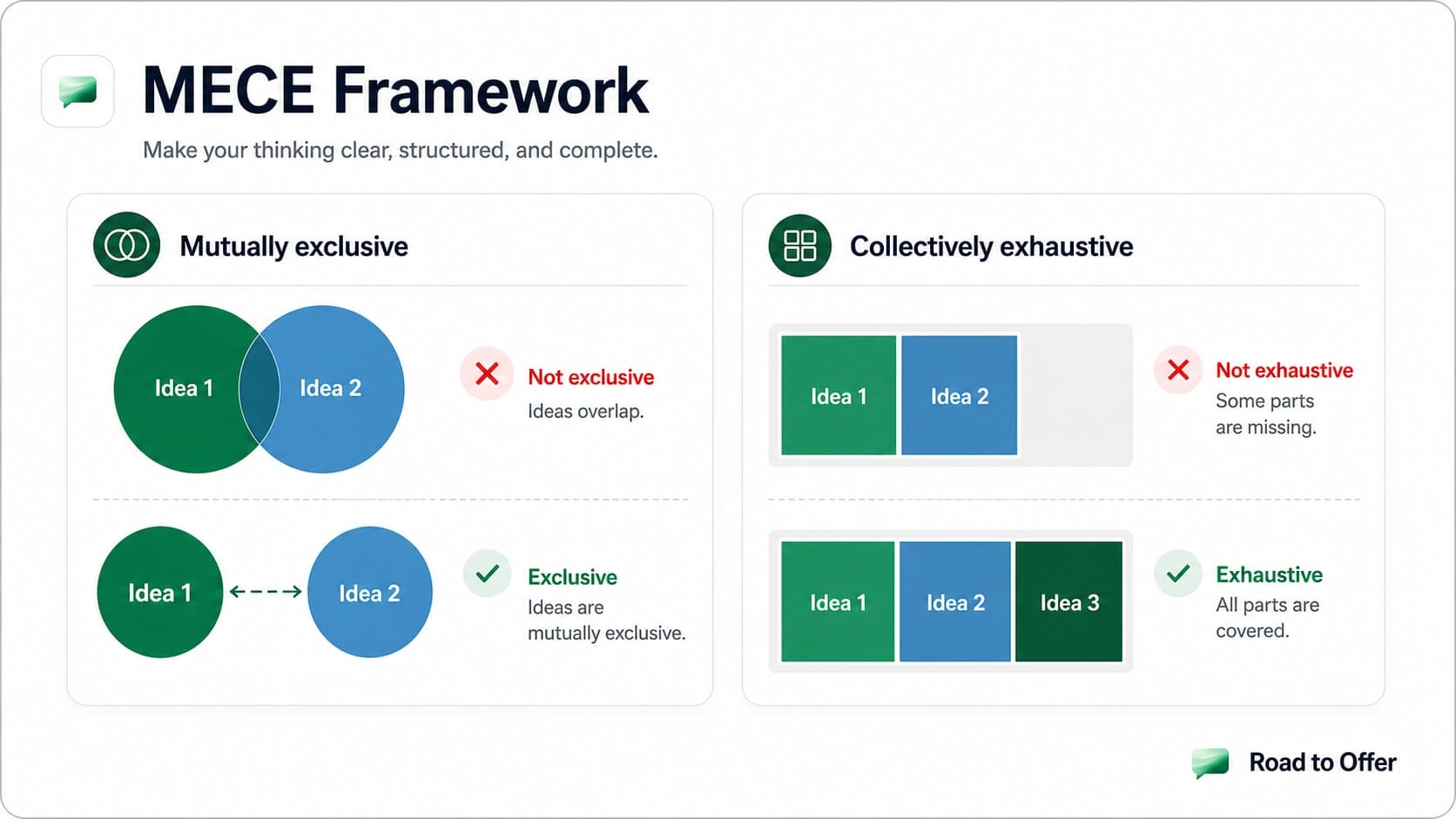
Porter's Five Forces is most useful when paired with the right complementary tool. Use it alongside the profitability framework when an industry analysis needs to translate into a company-specific action plan, alongside the BCG Growth-Share Matrix when assessing portfolio decisions across multiple industries, alongside the market entry framework when evaluating whether to enter a new industry, alongside the M&A case framework when valuing acquisition targets within an industry, and alongside the MECE principle to keep the force-by-force breakdown disciplined.
Drill It: Find the Binding Force
Scoring five forces is easy. Naming the one or two that actually cap the profit pool, and knowing when the framework does not apply, is the skill interviewers grade. Give yourself 60 seconds per prompt.
Interactive drill set. Write an answer before revealing the worked solution, then continue into Road to Offer for scored practice and AI feedback.
Sources and Further Reading (checked June 18, 2026)
- Porter, M.E. (1979). "How Competitive Forces Shape Strategy." Harvard Business Review: hbr.org/1979/03/how-competitive-forces-shape-strategy
- Porter, M.E. (2008). "The Five Competitive Forces That Shape Strategy." Harvard Business Review: hbr.org/2008/01/the-five-competitive-forces-that-shape-strategy
- Harvard Business School, Institute for Strategy and Competitiveness, The Five Forces: isc.hbs.edu/strategy/business-strategy/Pages/the-five-forces.aspx
- IATA, Aviation Value Chain analysis: iata.org/en/iata-repository/publications/economic-reports/aviation-value-chain
- McKinsey, "Between ROIC and a hard place: The puzzle of airline economics": mckinsey.com/industries/travel-logistics-and-infrastructure/our-insights/between-roic-and-a-hard-place-the-puzzle-of-airline-economics
- Market.us, Global Soft Drinks Market Report: market.us/report/global-soft-drinks-market
- IEA, Global EV Outlook 2025: iea.org/reports/global-ev-outlook-2025
- Brewers Association, National Beer Stats: brewersassociation.org/statistics-and-data/national-beer-stats
- ITHRON, Porter's Five Forces at 45: ithron.co/post/porter-s-five-forces-at-45-what-still-holds-and-what-the-21st-century-broke
- Investopedia, Porter's Five Forces summary: investopedia.com/terms/p/porter.asp
- PhRMA, Research and Development Policy: phrma.org/policy-issues/Research-and-Development-Policy
Practice industry attractiveness structure
Run focused structure reps for Five Forces, market entry, and industry analysis prompts before using the framework in full cases.
Frequently asked questions
Resources and related guides
- Practice a market entry casePractice
- Browse all free resourcesResource hub
- Market Attractiveness Framework: Dimensions, Scorecard, and Case UseFrameworks · May 30, 2026
- 3Cs Framework: Company, Customer, Competitor (Worked Example)Frameworks · Feb 6, 2026
- 4C Framework Case Interview: The 4 Cs, a Worked Example & How to Use It (2026)Frameworks · Jun 28, 2026