
BCG Digital Strategy and AI Challenge Guide (2026)
Prepare for BCG digital strategy and AI cases with a business-first structure, prompt examples, implementation risks, and Road to Offer drills.
On this page
A BCG digital-strategy or AI case tests five things: the client objective, value pool, feasibility, adoption, and risk, not your ability to list model names.
The five-part practice map is based on BCG's case-preparation and AI-careers pages, checked June 17, 2026. It is Road to Offer's structure for preparing a business decision with a technology layer, not an official BCG scoring rubric.
BCG's official case prep frames case interviews around real client problems for consulting roles. Its AI careers material also describes AI work across technical and business teams, with emphasis on impact, collaboration, and responsible use. For interview prep, that means your answer should sound like a consultant advising a leadership team: objective first, value second, feasibility third, implementation fourth.
Read the broader BCG case interview guide first if you need the full interview process. Use this guide when the prompt is specifically about AI, analytics, automation, digital channels, product platforms, or technology-enabled transformation. For prompts that center on data, models, and analytics rather than strategy, the data science case interview guide covers that format.
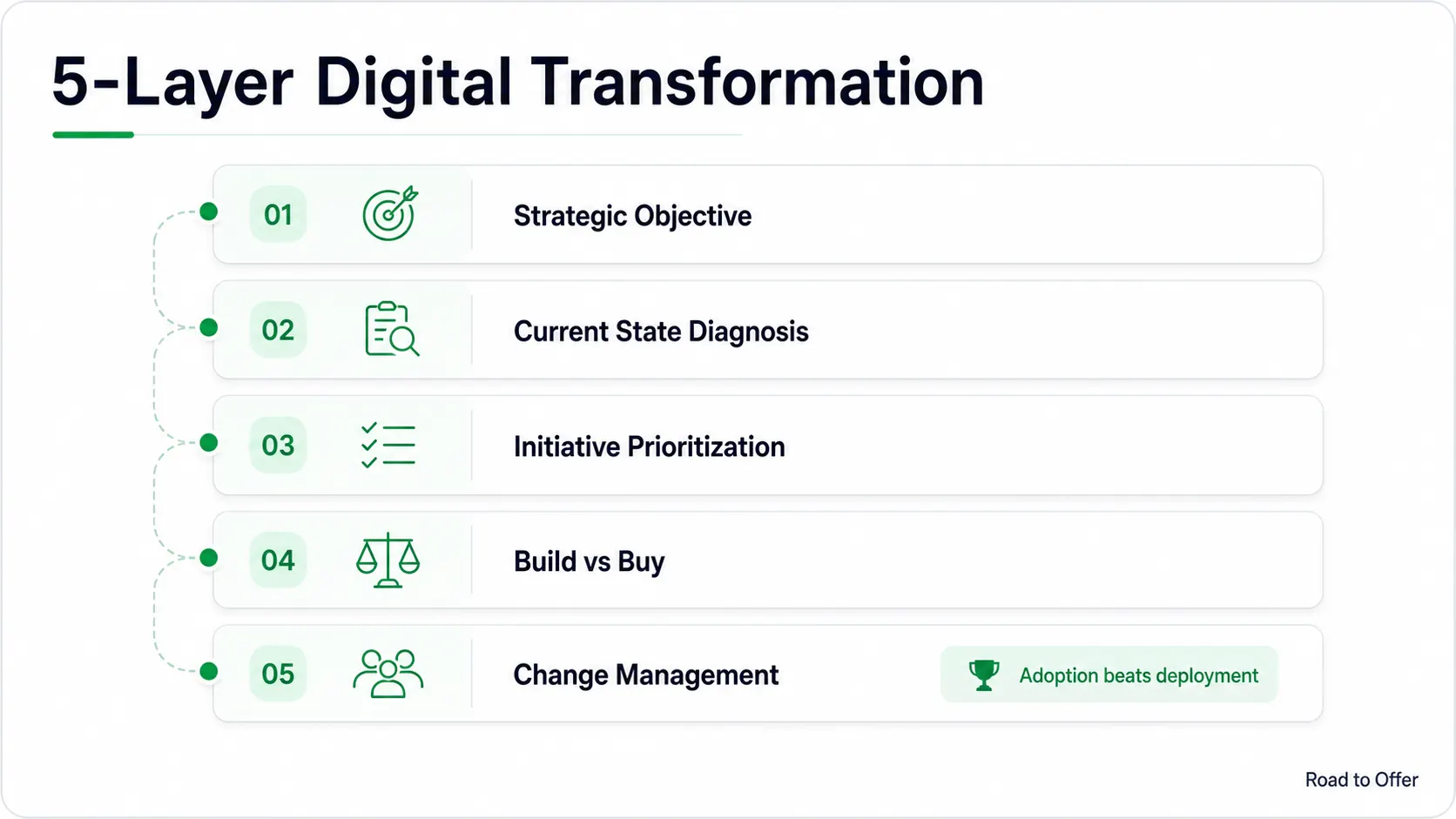
What BCG Is Testing
BCG digital and AI cases test the same core behaviors as any candidate-led case, with extra pressure on practical judgment. A strong answer makes five things visible:
- Business objective: What decision does the client need to make, and what metric defines success?
- Value pool: Where does AI or digital change revenue, cost, speed, quality, risk, or customer experience?
- Feasibility: Does the client have the data, systems, talent, process ownership, and governance to make this work?
- Adoption: Which customers, frontline employees, partners, or managers need to change behavior?
- Risk control: What could go wrong, and how would the client monitor it after launch?
The common failure pattern is starting with the technology. "Use gen AI for customer service" is not a recommendation. "Reduce support cost while protecting resolution quality by automating low-complexity tickets first" is closer to the consulting answer BCG wants.
BCG Digital and AI Case Structure
- 01
Clarify the decision. Confirm the client objective, target metric, time horizon, constraints, and whether the case is about growth, cost, risk, or customer experience.
- 02
Size the value pool. Estimate the revenue uplift, cost reduction, productivity gain, risk reduction, or customer impact before debating the exact technology.
- 03
Test feasibility. Check data quality, workflow fit, integration complexity, vendor or build options, compliance needs, and organizational readiness.
- 04
Design the rollout. Recommend a pilot, success metrics, operating model, adoption plan, and scale path instead of assuming the client can launch everywhere at once.
- 05
Synthesize the tradeoff. State the recommendation, expected impact, key risks, and the one or two uncertainties that would change your answer.
Practice AI case structure
Run Road to Offer structure drills so your opening issue tree is clean before you add digital, data, and AI details.
Common Prompt Types
BCG will not always label the prompt as an "AI challenge." The digital layer can appear inside normal strategy, operations, and transformation cases.
You can connect these prompts to the standard case toolkit. A customer-service automation case often starts like a cost reduction case. A digital channel case often resembles a market entry case. A pricing algorithm case still needs the pricing framework and careful exhibit reading.
How To Structure The Opening
Use a business-first opening. The easiest way is to build the structure around the client's objective, then add AI-specific feasibility checks.
For example, if the prompt is, "A retailer wants to use generative AI to improve customer support. Should it invest?" a strong opening could be:
- "I would first clarify the target outcome: lower support cost, faster resolution, higher customer satisfaction, or some combination."
- "Then I would size the value pool by ticket volume, current cost per ticket, share of low-complexity tickets, and potential deflection rate."
- "Next I would test feasibility: data quality, knowledge-base coverage, integration with CRM, escalation rules, and compliance constraints."
- "Finally I would recommend a rollout path: pilot low-risk ticket types, measure accuracy and customer satisfaction, then scale only if the economics and quality hold."
That opening works because it does not depend on a memorized AI framework. It takes a real client decision and turns it into a testable issue tree.
What To Say About Data And Technology
You need enough technical realism to avoid naive recommendations, but not so much detail that you stop sounding like a consultant. In most BCG digital cases, cover four practical checks:
- Data availability: Does the client have the right data, enough volume, clean labels, and access rights?
- Workflow fit: Where will the tool sit in the actual process, and who acts on the output?
- Integration effort: Which systems, vendors, security reviews, and operating processes need to connect?
- Monitoring: Which metrics catch quality drops, biased outputs, hallucinations, customer dissatisfaction, or financial leakage?
Use plain English. "The model needs clean historical ticket data and a human escalation path" is better interview language than naming architectures the case never required.
Recommendation Examples
Weak recommendation:
I recommend using generative AI because it can automate customer service and reduce cost.
Stronger recommendation:
I recommend a 90-day pilot for low-complexity billing and delivery tickets. These tickets represent 35% of current volume, have clear answer paths, and create the fastest cost savings with limited customer risk. I would not automate complaint or cancellation tickets until the pilot proves resolution accuracy, escalation quality, and customer satisfaction.
The stronger version gives the interviewer a decision, a scope, a rationale, and a risk boundary. That is what makes it sound like BCG case performance rather than generic AI commentary.
Turn AI cases into scored reps
Practice a timed Road to Offer case, then use drills for the exact weakness: structure, exhibits, math, synthesis, or communication.
30-Minute Practice Plan
Use this loop before a BCG digital or AI interview:
For a broader timeline, use the consulting interview prep timeline. For BCG-specific live cases, pair this with BCG case interview practice.
Common Mistakes
Tool-first answers. Naming generative AI, machine learning, or automation before explaining the business problem makes the answer feel shallow.
No value sizing. If you cannot estimate the size of the opportunity, the recommendation becomes opinion. Even a rough cost, revenue, or productivity estimate is better than a vague "AI will help."
Ignoring adoption. Many AI ideas fail because employees do not trust the tool, customers dislike the experience, or managers do not change the workflow. Name the adoption risk early.
Overstating certainty. AI cases usually have data and quality uncertainty. A strong consultant recommends a pilot, a measurement plan, and a scale path instead of pretending the answer is already proven.
Forgetting synthesis. After the analysis, give the interviewer the business answer: whether to invest, where to start, expected impact, and what could change the decision.
Sources and Further Reading (checked June 17, 2026)
- Boston Consulting Group - Case Interview Preparation
- Boston Consulting Group - Careers in AI at BCG
- BCG Case Interview Guide
- BCG Online Case Casey Guide: the online assessment that often precedes live BCG interviews for the same candidate pool
- BCG Gamma Guide: BCG's data and analytics arm; many roles overlap with the digital strategy and AI challenge scope
- Consulting Aptitude Test Overview: how BCG's digital screening steps compare to McKinsey Solve, Bain SOVA, and Big 4 assessments
- Digital Transformation Case Interview
- Case Interview Data Interpretation
Frequently asked questions
Resources and related guides
- Run a real case interviewPractice
- Browse all free resourcesResource hub
- BCG vs Bain: 10 Real Differences (2026 Guide)Firm Specific · May 1, 2026
- BCG Case Interview Guide 2026: Format, Rounds + Worked ExamplesFirm Specific · Feb 2, 2026
- BCG Case Interview Examples: 10 Practice Cases (2026)Firm Specific · Mar 1, 2026
- Phone and Video Case Interviews: How to Verbalize When Notes Are InvisibleFirm Specific · May 1, 2026