
Verbal Reasoning Test for Consulting 2026: TFC Format, Worked Example & Prep
A consulting-native guide to the verbal reasoning test: the True/False/Cannot Say golden rule, a fully worked business example, firm-by-firm formats (Bain SOVA, Big Four), provider timing, and how to prepare.
On this page
A verbal reasoning test for consulting in 2026 is a timed screen that measures whether you can read a short business passage and judge what logically follows from it, using only the information on the page. The most common format is True, False, or Cannot Say (TFC), and the golden rule is simple: mark Cannot Say whenever the passage gives no evidence either way, and ignore everything you already know about the real world. The pace is the brutal part. According to JobTestPrep, the standard SHL verbal reasoning test runs 30 questions in 19 minutes, roughly 40 seconds per question. Firms use it as a gate that sits after the resume screen and before the case interview, and PrepLounge reports that around 80 percent of the lowest-scoring candidates are eliminated at the online assessment stage. This guide decodes the format, walks through a fully worked consulting example, and maps verbal reasoning to each firm.
What a Verbal Reasoning Test Actually Measures for Consulting
A verbal reasoning test is not a vocabulary quiz and it is not a reading-speed contest. It measures two things at once: whether you can comprehend a dense block of business text quickly, and whether you can draw a valid logical inference from it without contaminating your answer with outside knowledge. In a consulting context that combination is the whole point. Consultants read client documents, board memos, and market reports under deadline, then have to say precisely what those documents support and what they do not.
That is why the test rewards a specific mental posture: treat the passage as the only universe that exists. If the passage says a company's revenue grew, you cannot conclude its profit grew, even though that often happens in reality. The test is checking whether you can separate "what I was told" from "what I assume," which is exactly the discipline that keeps a junior consultant from over-claiming in front of a client.
The skill overlaps heavily with critical-thinking screens like the Watson Glaser test for consulting, which probes the same inference-versus-assumption muscle in a slightly different format. If you are preparing for one, you are largely preparing for the other.
Practice a real consulting case for free
The verbal screen is just the gate. Road to Offer scores your structure, math, and synthesis on a full AI-guided case.
The True / False / Cannot Say Format, Decoded
Most consulting verbal reasoning tests use the True, False, or Cannot Say structure. You read a short passage, then judge a series of statements against it. The three answers mean something exact:
- True: the statement logically follows from the passage. The passage contains evidence that confirms it.
- False: the statement contradicts the passage. The passage contains evidence that disproves it.
- Cannot Say: the passage neither confirms nor contradicts the statement. There is no evidence either way.
The golden rule, and the single most common reason candidates lose points, is this: Cannot Say is correct whenever the passage gives no evidence either way, and you must ignore everything you know from outside the passage. A statement can be true in the real world and still be a Cannot Say, because the question is not "is this true?" It is "does this passage prove it?"
Two failure modes sink most candidates. The first is importing outside knowledge: you know the statement is factually true, so you mark True, even though the passage never said it. The second is over-reading: the passage implies something strongly, so you treat a probable inference as a certain one. Both are traps. Answer only what the text strictly supports.
A Fully Worked Consulting-Style TFC Example
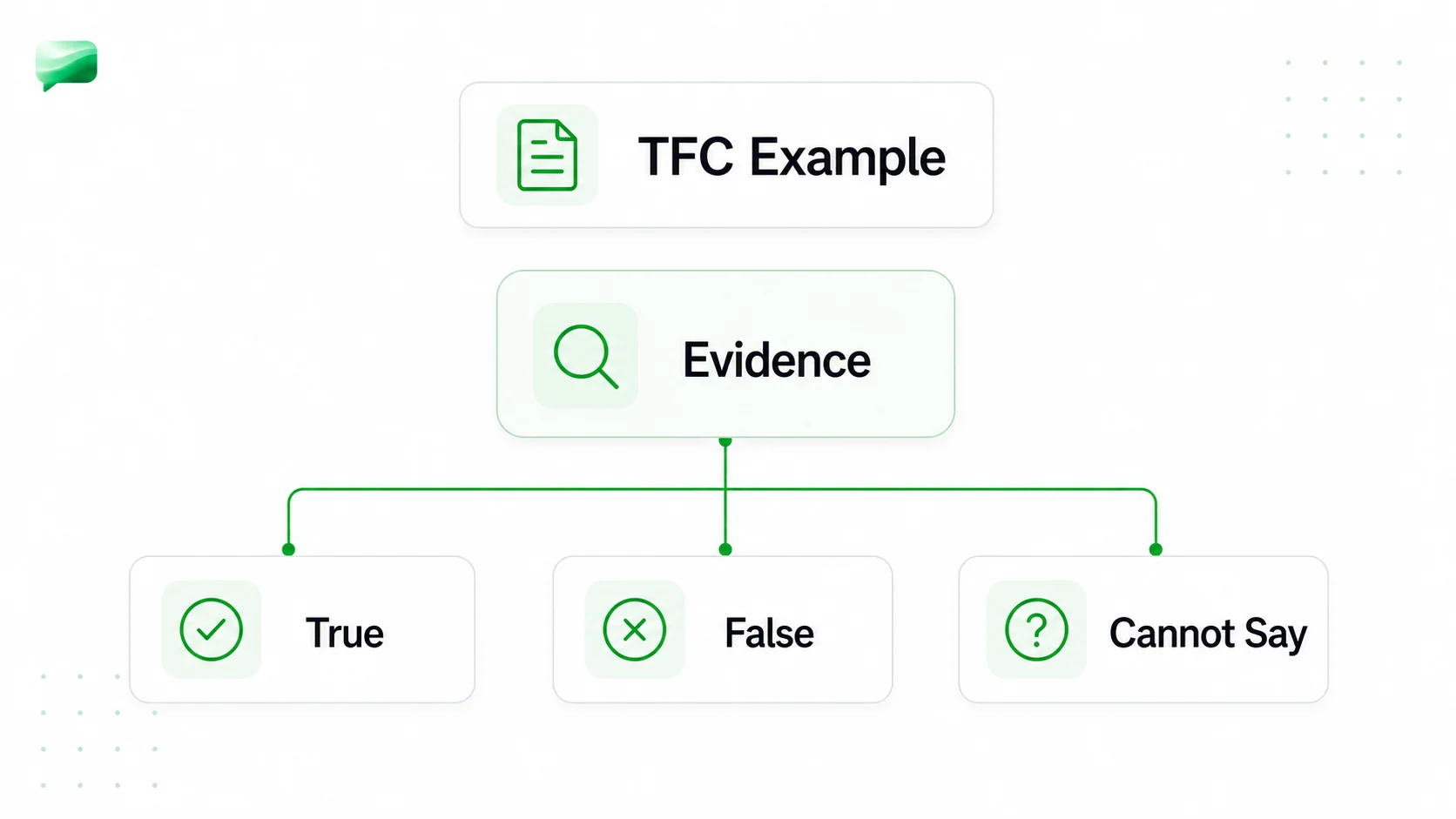
Most competitors paywall their practice questions. Here is one worked end to end, free.
Passage: Northwind Logistics opened three regional distribution centers in 2024: one in the Midwest, one on the East Coast, and one on the West Coast. In their first year, the Midwest center handled 42 percent of the company's total parcel volume, more than the East Coast and West Coast centers combined. Management credited the result to the Midwest center's proximity to two large e-commerce fulfillment hubs. Northwind has not released profit figures for any individual center.
Now evaluate three statements.
Statement 1: "Northwind's Midwest center handled a larger share of first-year parcel volume than its East Coast and West Coast centers combined."
Answer: True. The passage states the Midwest center handled 42 percent of total volume, which it explicitly describes as more than the other two centers combined. The statement is directly supported.
Statement 2: "Each of Northwind's three centers handled an equal share of total parcel volume in its first year."
Answer: False. The passage tells us one center handled 42 percent, more than the other two together. Three equal shares would be about 33 percent each. The passage directly contradicts the statement, so it is False, not Cannot Say.
Statement 3: "The Midwest center was the most profitable of Northwind's three centers."
Answer: Cannot Say. This is the trap. It feels true, because the highest-volume center "should" be the most profitable. But the passage explicitly says Northwind has not released profit figures for any individual center. Volume is not profit. With no evidence either way, the only correct answer is Cannot Say. Marking True here is the single most common mistake, and it is exactly the over-claiming the test is built to catch.
Why Consulting Firms Screen With Verbal Reasoning
Firms receive far more qualified-looking applications than they can interview. The verbal reasoning test is a cheap, automated way to thin the field before any human spends time on a candidate. It sits as a gate after the resume screen and before the case interview, and it does its filtering at scale. Per PrepLounge, roughly 80 percent of the lowest-scoring candidates are eliminated at the online assessment stage.
That positioning is the strategic insight most candidates miss. The verbal test is not the prize; it is the turnstile. Clearing it gets you nothing except the right to face the case interview, which is where the real evaluation happens. So the rational allocation of effort is: practice the format enough to clear the screen comfortably, then pour your remaining energy into case structure, math, and synthesis. Treating the verbal test like the main event is a common way to under-prepare for the interview that actually decides your offer.
If you want the full picture of where every screen sits in the funnel, the aptitude tests for consulting guide maps the resume screen, online assessment, and case rounds firm by firm. For the logic-heavy sibling format, use the deductive reasoning test guide rather than applying verbal true/false/cannot-say rules to every assessment.
Which Firms Use It, and at What Stage
Verbal reasoning shows up most heavily at the firms that hire in volume and recruit large graduate cohorts.
Per RocketBlocks, Bain's SOVA assessment has five sections: mathematical, verbal, abstract reasoning, situational judgment, and personality. The verbal section carries a tighter clock than the math section, with candidates advised to spend no more than 30 seconds per verbal reasoning question versus about 45 seconds for mathematical and logical items. Crucially, SOVA scores speed as well as accuracy, so a question answered correctly AND quickly ranks higher than the same question answered correctly but slowly.
For PwC and the wider Big Four, the verbal component is typically delivered through SHL-style cognitive tests as part of the graduate or international online assessment. Timing and provider vary by country and program, so your invitation email and local careers page are the real source of truth.
The Major Providers and Their Formats
Different firms license different test providers, and the format and timing shift accordingly. Per CaseBasix, the leading verbal reasoning providers are SHL, Talent Q (Korn Ferry), Saville Assessment, Aon (Cut-e), Kenexa (IBM), and Talogy (Cubiks).
Per Practice Aptitude Tests, the providers differ in emphasis: SHL measures comprehension and interpretation, Talent Q uses adaptive tests that adjust difficulty based on your responses, Cubiks focuses on speed and accuracy, and Kenexa is used in professional contexts. The practical takeaway is to confirm which provider your firm uses before you drill, because a 12-second Aon item and a 40-second SHL item demand very different pacing habits.
Question Types Beyond True / False / Cannot Say
TFC is the headline format, but verbal reasoning sections often mix in other question types, especially at graduate level. Expect some combination of:
- Reading comprehension: longer passages followed by multiple-choice questions about the main idea, a specific detail, or the author's intent.
- Inference: statements you must judge as supported or unsupported, similar to TFC but sometimes phrased as "which conclusion can be drawn?"
- Verbal analogies: "X is to Y as A is to ___," testing relationship logic between word pairs.
- Synonyms and antonyms: picking the word closest or opposite in meaning.
- Word associations: identifying which word belongs with, or does not belong with, a group.
The analogy, synonym, and association formats lean more on vocabulary than the TFC format does, so if your target provider uses them, broad reading and a vocabulary refresh pay off. For TFC and inference items, format familiarity and inference discipline matter far more than vocabulary.
Timing and Speed Strategy
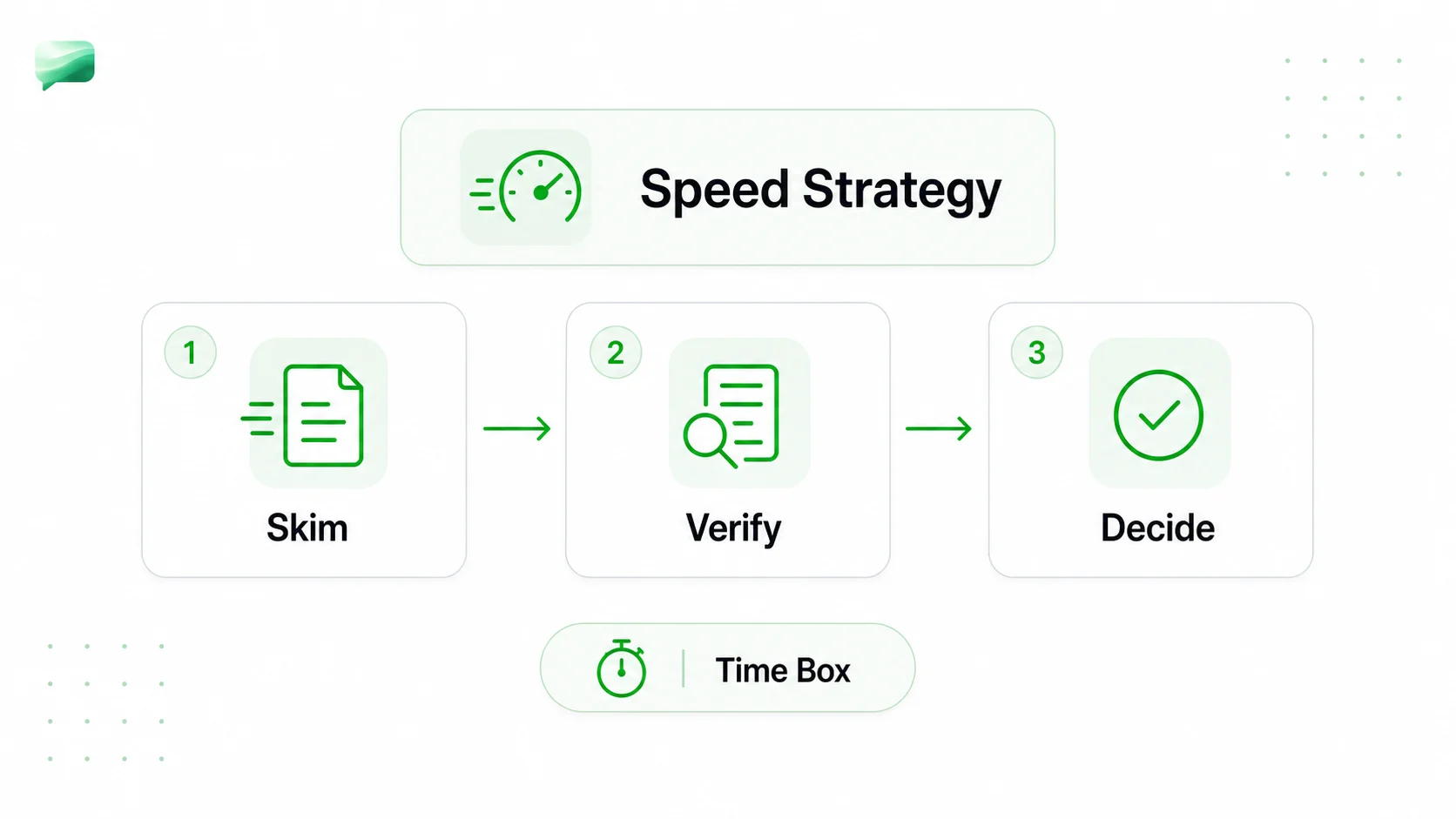
Speed is where most candidates fail, not comprehension. The clocks are tight by design: about 40 seconds per question on the standard SHL test per JobTestPrep, dropping to roughly 12 to 15 seconds per question on Aon/Cut-e per CaseBasix. At that pace you cannot read every passage word for word and still finish.
A few habits help:
- Skim, then scan. Read the passage once quickly for structure and topic, then scan back to the exact sentence that addresses each statement. You rarely need the whole passage to judge one statement.
- Decide between False and Cannot Say deliberately. This is the slowest judgment, so make it consciously: False needs a contradiction in the text, Cannot Say needs silence. If you cannot find the contradicting sentence, it is Cannot Say.
- Do not leave blanks. Prep providers note these tests generally do not penalize wrong answers, so a blank scores zero with certainty while a considered guess has positive expected value. When the clock runs out, answer everything.
- Mind the speed-accuracy tradeoff where it is scored. On Bain's SOVA, both speed and accuracy count, so you are optimizing for correct-and-fast, not just correct.
What Counts as a Good Score
Verbal reasoning tests are scored against a comparison group, so your result is a percentile, not a raw mark. Per CaseBasix, a good score is generally above the 75th percentile. Consulting and finance roles tend to expect the 75th to 80th percentile, while many graduate programs set the bar nearer the 60th percentile.
The implication is that "I got most of them right" is not a reliable read on whether you passed. If the comparison pool is strong, as it is for consulting, you need to be both accurate and fast relative to other applicants. That is why timed, full-length practice beats untimed question-by-question study: it trains the percentile, not just the answer.
How to Prepare Effectively
The two highest-leverage prep moves are timed, exam-condition simulations and repeated format familiarity. Almost nobody fails a verbal reasoning test because they cannot read; they fail because the format and the clock surprise them.
- Run full sittings under a real timer. Recreate the exact conditions: one quiet sitting, the right question count, the right clock. If your firm uses SHL, practice at 30 questions in 19 minutes until that pace feels normal.
- Drill the format until the rules are automatic. The TFC decision (True versus False versus Cannot Say) should be reflex, not deliberation. Repeated reps move the inference discipline into muscle memory so you stop importing outside knowledge.
- Confirm your provider and match its pace. A 12-second Aon item and a 40-second SHL item require different habits. Train at the speed you will actually face.
- Review your misses by category. Track whether you miss on True/False/Cannot Say confusion, on speed, or on comprehension. Each has a different fix.
Once the screen is behind you, the case interview is the next gate, and case structure is where most candidates actually lose their offer. The verbal test only proves you can read; the case proves you can think. Start building that muscle now.
Pair the structure drills with the broader aptitude tests for consulting guide so you know which screens each target firm runs, and revisit the Watson Glaser test for consulting guide, since the inference-versus-assumption skill transfers directly.
Practice a free consulting case next
Clear the verbal screen, then test your structure and synthesis on a free AI-guided case before your interview.
Sources
- JobTestPrep: SHL verbal reasoning test (checked June 26, 2026)
- CaseBasix: Verbal reasoning test (checked June 26, 2026)
- PrepLounge: Aptitude tests in the consulting industry (checked June 26, 2026)
- RocketBlocks: Bain SOVA test (checked June 26, 2026)
- Practice Aptitude Tests: Verbal reasoning tests (checked June 26, 2026)
Frequently asked questions
Resources and related guides
- Run a real case interviewPractice
- Browse all free resourcesResource hub
- SHL Test for Consulting 2026: Sections, Scoring & How to PassFundamentals · Jun 27, 2026
- Common HireVue Questions and Answers (2026): 18 Prompts With STAR SkeletonsFundamentals · Sep 11, 2026
- Does HireVue Track Your Eyes? What It Evaluates in 2026Fundamentals · Aug 21, 2026