
BCG Unlock: Eligibility, Timeline, and Prep Strategy
A source-backed guide to BCG Unlock: who it is for, how registration works, what to verify, how BCG Empower fits, and how to prepare before MBA recruiting.
On this page
BCG Unlock is BCG's virtual pre-MBA summer learning program for incoming MBA students who want early exposure to Boston Consulting Group before fall MBA internship recruiting. The current official BCG Unlock page says the program is primarily designed for candidates enrolled in a two-year MBA program who begin their first year in fall 2026 and are interested in a summer 2027 BCG internship. Candidates should verify the live registration date, eligibility language, office-region rules, and Consulting Career Assessment details on BCG Careers before acting, because recruiting pages can change by cycle. The right move is not to over-game Unlock. Use it to understand BCG, prepare a sharper consulting resume, choose office preferences thoughtfully, ask useful questions, and start building the case habits that will matter later in the consulting interview process.
For broader firm context before choosing how seriously to engage, read the BCG firm overview.
What BCG Unlock is and who it is for
BCG positions Unlock as a learning and networking experience. The program gives participants a behind-the-scenes look at BCG through virtual sessions with consultants and leaders, plus exposure to the firm before the formal MBA recruiting season begins.
That distinction matters. Search results often mix BCG Unlock with other early-talent terms, including BCG Empower, Bridge to BCG, and Growing Future Leaders. Treat those as adjacent recruiting topics, not interchangeable names. Unlock is pre-MBA. If you are not an incoming MBA student, your first task is to verify whether another BCG student program fits your situation.
BCG also states that participation in Unlock does not impact candidacy for future internship or full-time opportunities. That should change your mindset. Do not approach Unlock as a secret admissions gate. Approach it as a chance to understand the firm, make better recruiting decisions, and start showing the kind of curiosity and preparation that will help later.
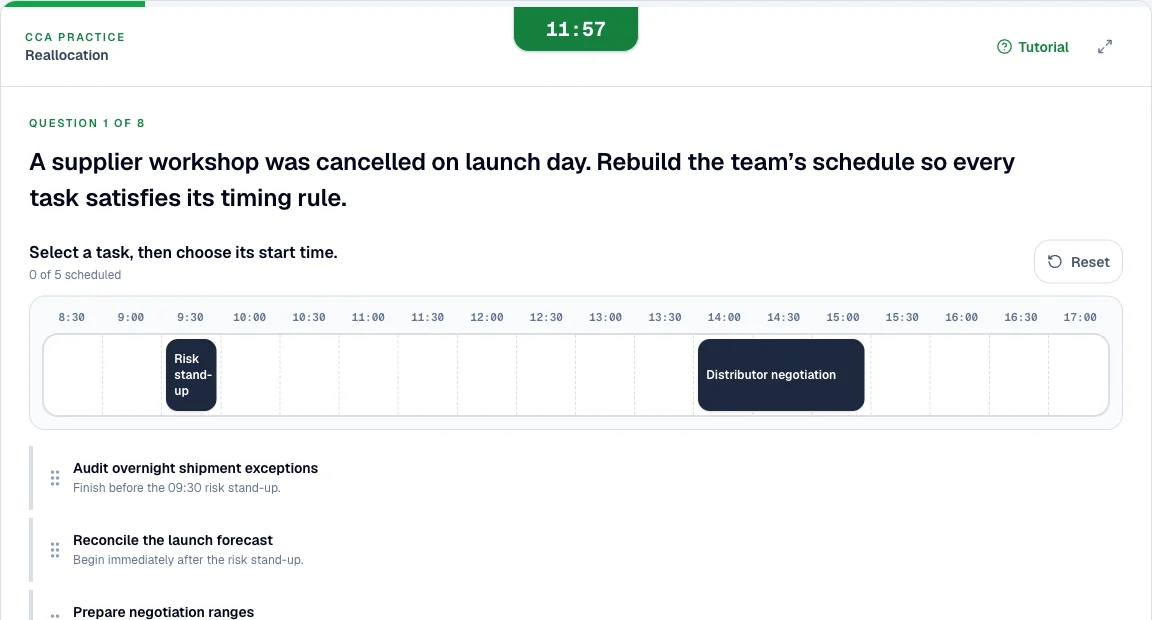
 Free simulator
8-question CCA diagnostic
- 4 Numerical tasks plus 4 work-style questions
- One shared 12-minute clock
- Numerical score plus an unscored work-style reflection
BCG Unlock eligibility, timeline, and registration checklist
The official BCG Unlock page lists May 18, 2026 as the registration date and says registrations submitted after that date may still be reviewed on a rolling basis. BCG also says the program is primarily designed for participants enrolled in a two-year MBA program who begin first year in fall 2026 and are interested in a summer 2027 internship.
Before registering, use this checklist:
- Confirm the current BCG Unlock page is still live and that the date has not changed.
- Check that your MBA program, graduation path, and internship timing match the official eligibility language.
- Prepare a clean consulting resume before submitting, not after.
- Use your school email if BCG suggests it and you already have access.
- Think through U.S. or Canadian office preferences before choosing them.
- Save the event period on your calendar so session invitations do not become an afterthought.
- Review any campus-specific guidance from BCG's on-campus recruiting page or your MBA career office.
The resume is the most immediate controllable item. Use the consulting resume template to make your roles, accomplishments, collaboration, skills, leadership, service, and interests easier to scan before you register.
Check your consulting resume before registering
Get a consulting-specific score, evidence-based strengths, and priority fixes before you submit.
What happens after you register
After registration, expect updates and invitations tied to the summer virtual program. BCG says Unlock is fully virtual, with events beginning in June and running into early August. The official page also describes sessions that run around 45 minutes to 1 hour, often around lunch hour or early evening North American time zones.
Eligible candidates interested in U.S. or Canadian offices may also complete BCG's Consulting Career Assessment after registering. BCG describes the CCA as a short online exercise about real-world problem solving and says no preparation is required. The official page says it takes approximately 30 minutes in a quiet environment with a reliable internet connection. If you completed the CCA within the last 12 months, BCG says there is no need to take it again.
The key boundary: do not confuse CCA readiness with case interview prep. For the CCA, prepare your setup, attention, and timing. For fall MBA recruiting, prepare the actual consulting skills BCG later evaluates: problem-solving, analytical, and communication skills, as described on BCG's consulting interview process page.
BCG Unlock, BCG Empower, and Growing Future Leaders comparison table
Use this table to prevent program confusion before making decisions.
BCG Empower deserves a careful mention because BCG says it is part of the broader Unlock experience and that participants are selected from the Unlock participant pool. Growing Future Leaders should be handled more cautiously. If you found that term while searching BCG Unlock, verify it from an official source before assuming eligibility, format, or timing.
Questions to ask during BCG Unlock sessions
The point of Unlock is not to ask generic questions you could answer from the careers page. Use the sessions to learn how BCG consultants think and how MBA candidates should prepare before fall recruiting.
Strong office-fit questions:
- How should an incoming MBA think about office preferences if they have ties to more than one region?
- Which industries or capabilities are most active in the office I am considering?
- How much does post-MBA location intent matter when choosing office preferences?
Strong internship-recruiting questions:
- What separates strong MBA internship candidates before fall recruiting starts?
- What do candidates usually misunderstand about BCG's case interview expectations?
- How should someone balance casing, networking, school onboarding, and resume refinement before applications open?
Strong consultant-conversation questions:
- What did you misunderstand about BCG before joining?
- How do case teams combine industry expertise and digital capabilities in practice?
- What does good upward communication look like for a summer intern?
- Which habits make a new consultant easier to staff and coach?
After a good conversation, send a concise follow-up with a specific reference to what you discussed. The networking follow-up kit can help you avoid the vague thank-you note that adds no signal.
Resume and office preference examples
BCG's registration process asks for a resume, so treat it as more than a formality. Your resume should make it easy to see what you owned, what changed because of your work, how you collaborated, and why your background fits consulting.
Build a quick evidence bank before editing:
- Roles held: formal jobs, internships, clubs, ventures, service roles, research, military, or nonprofit work.
- Accomplishments: decisions influenced, processes improved, teams supported, customers served, or analyses completed.
- Collaboration: cross-functional work, stakeholder management, coaching, conflict resolution, or leadership without authority.
- Skills: analytical modeling, market research, communication, operations, product, data, or commercial judgment.
- Leadership and service: moments where people trusted you with responsibility.
- Interests: genuine areas that make your BCG conversations more specific.
Weak phrasing: responsible for strategy project. Stronger phrasing: led market analysis, clarified the recommendation, and influenced the final leadership decision, if that is true.
Weak phrasing: participated in club leadership. Stronger phrasing: owned a specific initiative, coordinated people across roles, and produced an outcome the reader can understand.
For office preferences, avoid ranking offices by perceived prestige alone. Better reasoning combines personal ties, professional interests, post-MBA location intent, and sectors served by the office. If you are building a broader application packet, the resume and cover letter starter kit can help keep your materials consistent. You can also practice leadership, impact, collaboration, and motivation stories live, even though BCG's fit format is not identical to McKinsey PEI.
Practice drill plan before fall recruiting
Once registration mechanics are handled, shift from program logistics to skill-building. Unlock can help you understand BCG, but the actual recruiting season will still require clear business judgment, structured problem solving, math discipline, and concise recommendations. Use the BCG case interview guide when you are ready to map those skills to BCG-style interviews. The online assessment steps that often follow Unlock include the BCG Pymetrics screen, the BCG online case Casey, and in some processes a BCG one-way video interview or the BCG Consulting Career Assessment. The consulting aptitude test overview maps all of these steps alongside McKinsey and Bain equivalents.
A practical sequence:
- Structure drill: take ambiguous business prompts and build issue trees before looking at any answer. Use the case interview structure drill if your first thoughts are too generic.
- Math cleanup: practice setting up equations and interpreting the result in business language. Do this only if your quant setup is weak.
- Synthesis drill: summarize the answer first, then support it with the few facts that matter. The synthesis drill is useful because BCG conversations reward clear recommendation-led communication.
- Full case practice: once you can structure and synthesize under pressure, move into a Road to Offer free case.
Do not cram for the CCA as if it were a case interview. BCG says no preparation is required. Your deeper preparation target is fall MBA recruiting, where the case interview prep guide can give you a broader roadmap after BCG Unlock is under control.
Start a free BCG-style case
After you understand BCG Unlock, practice the skills that will matter later: structure, math, synthesis, and clear recommendation.
Sources and Further Reading (checked 2026-05-22)
- Boston Consulting Group Careers - BCG Unlock | Pre-MBA Summer Program | BCG Careers
- Boston Consulting Group Careers - BCG Empower | Pre-MBA Program | Boston Consulting Group
- Boston Consulting Group Careers - Consulting Interview Process | BCG Careers
- Boston Consulting Group Careers - Early Careers | Students & Recent Graduates | BCG Careers
- Boston Consulting Group Careers - On-Campus Recruiting | Students | BCG Careers
- University of Pennsylvania Career Services - Interview - Career Services
Frequently asked questions
Resources and related guides
- Practice real BCG casesPractice
- Browse all free resourcesResource hub
- BCG Case Interview Guide 2026: Format, Rounds + Worked ExamplesFirm Specific · Feb 2, 2026
- BCG Case Interview Examples: 10 Practice Cases (2026)Firm Specific · Mar 1, 2026
- Ejemplos de entrevistas de casos BCG: 10 casos de práctica (2026)Firm Specific · Mar 1, 2026
- Free EY Resources for Consulting RecruitingFirm Specific · Jul 18, 2026