
SHL Test for Consulting 2026: Sections, Scoring & How to Pass
The definitive 2026 guide to the SHL test for consulting: which firms use it, the sections and timing, how percentile scoring and A to E bands work, the score you actually need, and worked examples.
On this page
The SHL test for consulting in 2026 is the timed psychometric screen that sits between your application and your first case interview at firms like McKinsey, PwC, and BCG. According to MConsultingPrep, the McKinsey version runs 48 questions in 44 minutes and passes only about 15% of candidates, roughly the 85th percentile against a consulting norm group. It is not one fixed exam. SHL's assessment suite spans verbal reasoning, numerical reasoning, inductive and deductive logic, general ability, situational judgment, and work simulations, and each firm assembles a different combination. Scores are reported as percentiles, not raw marks, so 72% correct can land at only the 54th percentile depending on who else sat the test. There is no published pass mark. This guide maps which consulting firms still use SHL, which moved to game-based screens, how scoring actually works, and gives one worked example per section.
What the SHL test is and why consulting firms use it
SHL is a psychometric assessment provider, and its aptitude tests are one of the most common pre-interview screens in consulting recruiting. The logic is simple from the firm's side. Partner time is expensive, case interviews are even more expensive to run at scale, and a 40-minute computer-based test is a cheap, defensible filter that ranks thousands of applicants on cognitive ability before anyone schedules an interview.
Per PrepLounge, SHL has been a main test provider to PwC, and its consulting tests are traditional in structure, containing numerical, verbal, and logical tasks. That is the key thing to understand. The SHL test is not a case. It does not test business judgment or structuring. It tests whether you can interpret data, reason from text, and spot patterns under tight time limits. It is the gate before the case, not the case itself.
If you are mapping all the screens you might face across firms, keep the broader aptitude tests for consulting guide open alongside this one. This article is the SHL-specific deep dive.
The SHL is the gate before the case
Once you clear the screen, structure and math decide the offer. Run a free AI-guided case to find your real bottleneck early.
 Free simulator
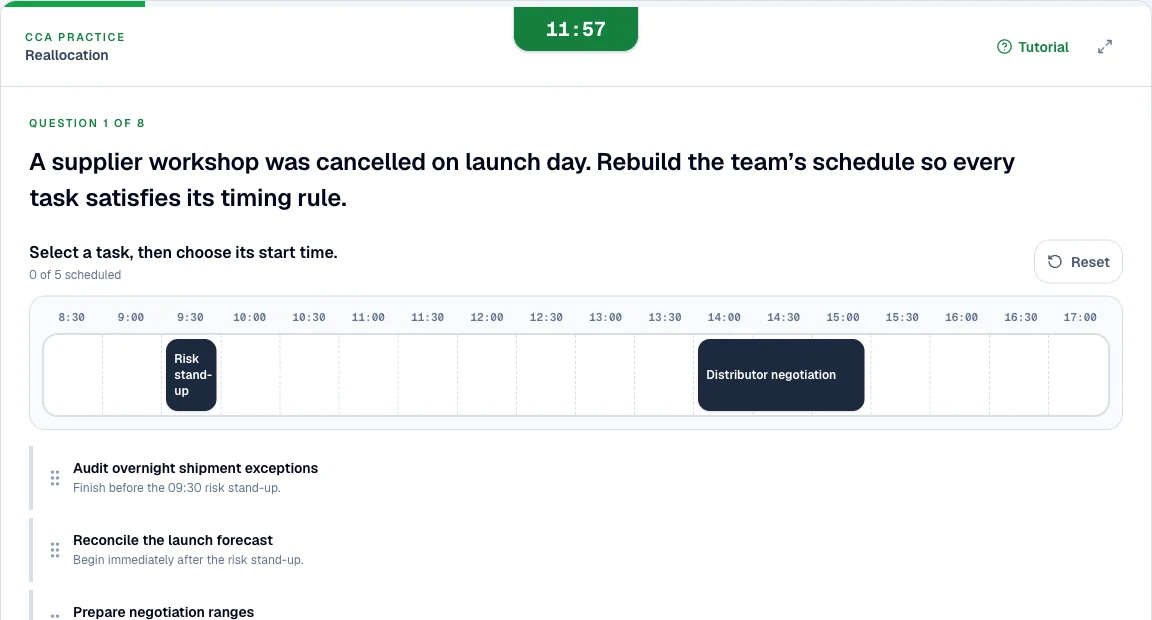
8-question CCA diagnostic
- 4 Numerical tasks plus 4 work-style questions
- One shared 12-minute clock
- Numerical score plus an unscored work-style reflection
Which consulting firms use SHL in 2026 (and which moved to games)
The honest answer competitors bury is that SHL usage is uneven and changing. Here is the source-backed map for 2026.
- PwC. Per PrepLounge, SHL has been a main test provider to PwC, with the traditional numerical, verbal, and logical structure. For the full region-by-region breakdown of PwC's funnel, see the PwC assessment test guide.
- McKinsey. MConsultingPrep documents a McKinsey SHL test at 48 questions in 44 minutes. Note that McKinsey's primary digital screen for most candidates is now the game-based Solve assessment, so an SHL-style aptitude test tends to appear on specific routes rather than universally.
- BCG. BCG publicly describes the Consulting Career Assessment as a short, multidimensional assessment. The official pages reviewed for this guide do not identify one universal CCA vendor, so do not infer an SHL route unless your invitation names it.
Is the BCG assessment an SHL test?
If your BCG invitation opens on SHL's platform or names an SHL assessment, use the SHL preparation in this guide for that route. BCG does not publicly identify SHL as the universal provider for every office and recruiting cycle, so another candidate's format is not proof of yours. Check the platform named in your invitation first, then prepare the exact numerical, verbal, logical, or situational judgment sections it lists.
The wider trend is a split. Some firms keep traditional SHL aptitude tests, while others have moved toward game-based screens such as McKinsey Solve or Pymetrics-style assessments that infer traits from how you play rather than from right-or-wrong answers.
The SHL test sections explained
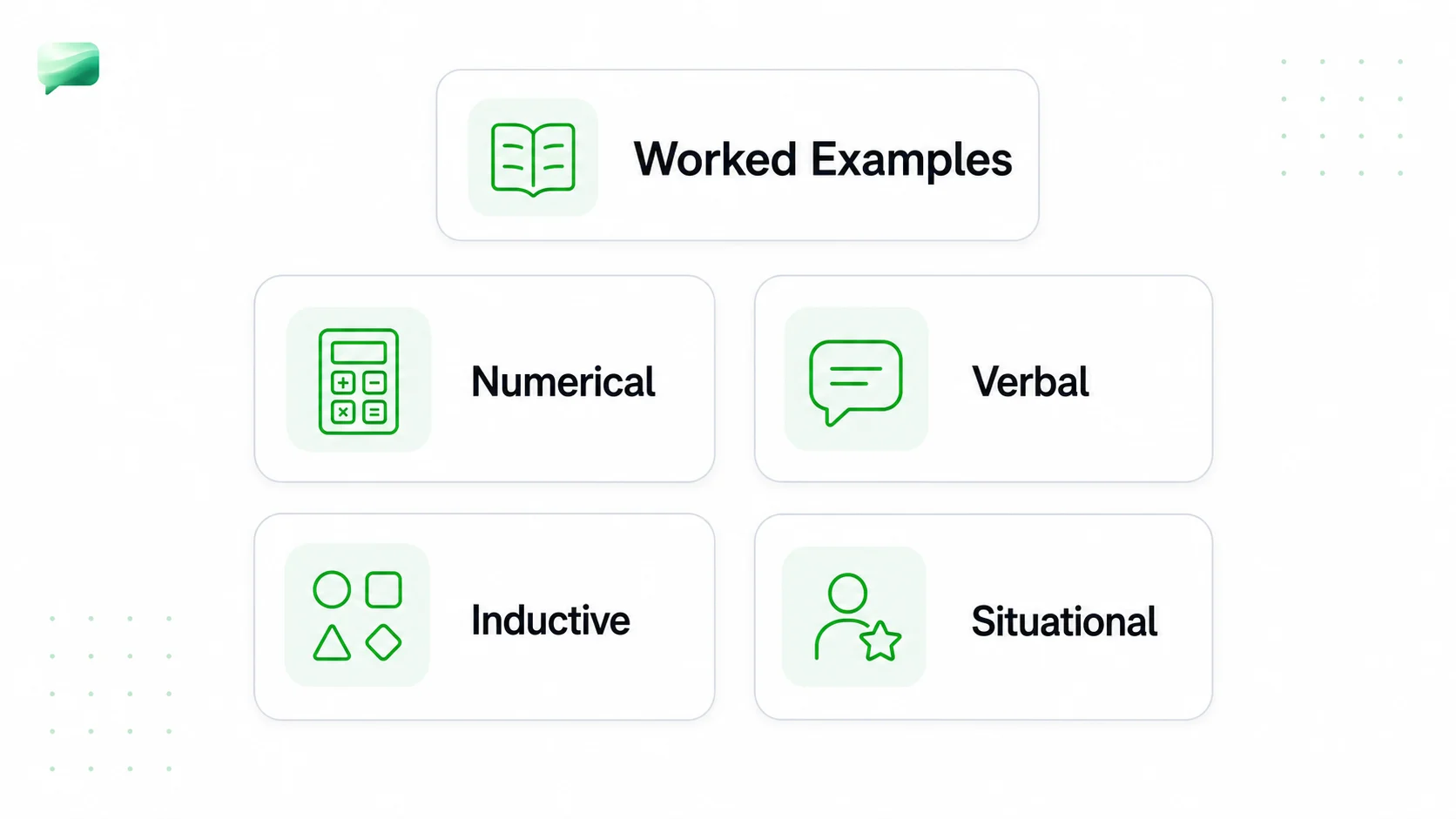
Per SHL's own practice tests page, the assessment suite includes verbal, numerical, inductive and deductive reasoning, general ability, situational judgment, and work simulations. The numerical problem-solving simulation runs up to 20 minutes and the critical thinking simulation up to 1 hour. Here is what each section actually measures.
- Verbal reasoning. Short business passages followed by statements you mark True, False, or Cannot Say based only on the text.
- Numerical reasoning. Tables, graphs, and charts where you calculate percentages, ratios, and trends. This is the section most consulting candidates fear.
- Inductive reasoning. Sequences of shapes or figures where you identify the underlying pattern. Pure abstract pattern recognition.
- Deductive reasoning. Logic problems where you apply given rules to reach a valid conclusion.
- General ability. A blended cognitive measure combining verbal, numerical, and logical items.
- Situational judgment. Workplace scenarios where you rank or pick the most effective response.
- Personality and work simulations. Trait-based questionnaires and longer interactive exercises that profile working style rather than raw ability.
For consulting roles, numerical and verbal reasoning carry the most weight, with inductive or deductive logic often added. Situational judgment and personality usually inform fit rather than the pass-or-fail cognitive screen.
Format, timing, and question counts
This is where the screen feels high-stakes, because the per-question budget is brutal. Using the McKinsey SHL numbers from MConsultingPrep and the verbal specs from Psychometric Success:
Psychometric Success similarly reports SHL verbal reasoning at 30 questions in a maximum of 19 minutes using the True, False, Cannot Say format. The takeaway is that you have well under a minute to read a passage and resolve a verbal item, and under a minute and a half to interpret a data exhibit and run the math on the numerical side. Speed is not a nice-to-have. It is the test.
How SHL is scored: percentiles, norm groups, and A to E bands
This is the part prep vendors hide behind sales copy, so here is the vendor-neutral version.
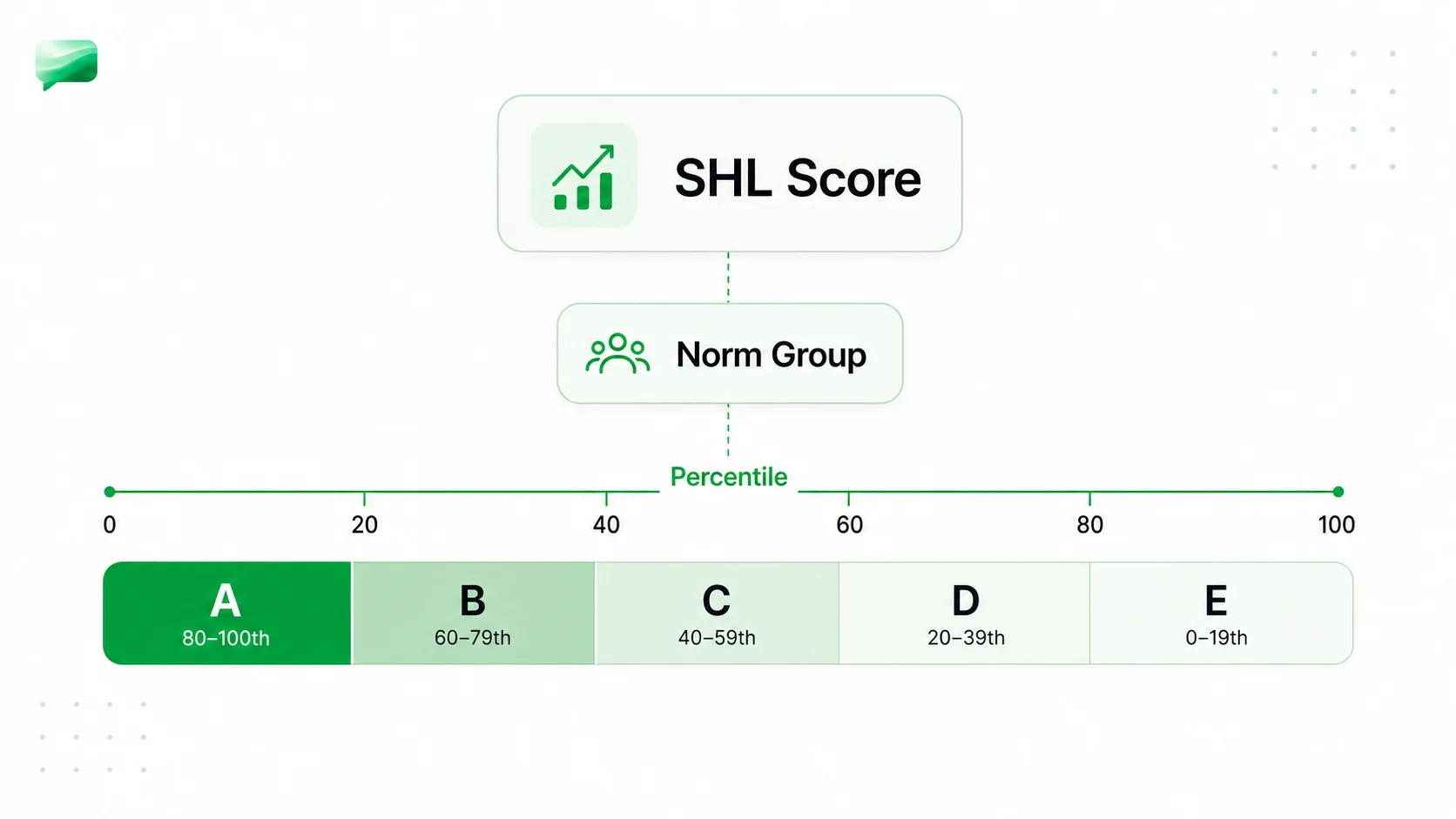
Your raw score (the number of questions you got right) is almost meaningless on its own. SHL converts it to a percentile against a norm group, which is a reference population of people who took the same test. Per JobTestPrep, those norm groups are segmented by industry, including Consulting, and by job level, then reported as letter grades:
Two consequences follow. First, the norm group is everything. The same raw score graded against a general population versus a consulting applicant pool produces very different percentiles, because consulting applicants are a strong reference group. Second, raw accuracy can be misleading. Per Psychometric Success, getting 72% of verbal questions correct can equal only the 54th percentile. You are not racing the test, you are racing everyone else who sat it.
What score you actually need to pass for consulting
There is no official pass mark, and that is by design, because the bar moves with the norm group and the role. What the sources let us pin down is the practical range.
For consulting you are aiming for the top 15 to 20%. MConsultingPrep reports that passing the McKinsey SHL takes roughly the 85th percentile, with about a 15% pass rate. JobTestPrep notes that being in the top 20% of your norm group generally passes, which lines up with an 80th percentile floor. In letter-band terms, you want a solid B or an A.
Worked examples: one per section
Verbal reasoning (True, False, Cannot Say)
Passage: "Acme Logistics opened three regional depots in 2025. Each depot reduced average delivery time in its region. The company has not yet released 2026 depot plans."
Statement: "Acme Logistics will open more depots in 2026."
The answer is Cannot Say. The passage says no 2026 plans have been released, so the text neither confirms nor denies expansion. The classic trap is answering False because there is no stated plan, or True because expansion seems likely. Both import outside reasoning. If the passage does not support the statement, the answer is Cannot Say, even when the claim feels plausible in the real world.
Numerical reasoning (table and percentage)
A retailer's revenue was $40M in 2024 and $46M in 2025. Online sales were 25% of 2024 revenue and 35% of 2025 revenue. By how much did online revenue grow, in percentage terms?
Online 2024 = 25% of $40M = $10M. Online 2025 = 35% of $46M = $16.1M. Growth = ($16.1M - $10M) / $10M = 61%. The skill being tested is not the division, it is extracting the two correct figures from a denser exhibit and setting up the percentage-change calculation without fumbling, all inside roughly 83 seconds.
Practise SHL numerical reasoning from the Road to Offer drill engine. Answer a real prompt and get AI-scored feedback. Free accounts include 5 drills per day for the first 3 days after signup.
SHL vs other consulting screens
Candidates often lump every consulting test together. They are not the same, and the differences change how you prepare.
The headline contrasts: SHL is computer-based and, per MConsultingPrep, allows a calculator on numerical reasoning and scores you by percentile rather than a raw percentage you can interpret yourself. The older McKinsey Problem Solving Test was a case-style screen now largely retired, and game-based assessments measure how you behave rather than how many answers you get right. If your target firm uses SHL, the prep below is what moves the needle.
How to prepare for the SHL consulting test
The good news is that the SHL is one of the most coachable steps in the entire consulting funnel, because the question types are stable and the bottleneck is speed.
- Take the official free practice tests first. SHL's practice tests page lets you sit the real interface so the mechanics never surprise you on test day.
- Drill mental math until arithmetic is automatic. On numerical reasoning the calculator handles the division, but reading the exhibit and choosing the right operation is on you. Sharpen this with focused case interview math practice so percentages, ratios, and growth rates stop costing you seconds.
- Practice speed reading for verbal. Train yourself to scan a passage for the specific claim in the statement rather than reading every word, then decide True, False, or Cannot Say from the text alone.
- Always sit mocks timed. An untimed practice set tells you almost nothing, because the entire challenge is the clock. Recreate the roughly 38 seconds per verbal question and 83 seconds per numerical question budget every time.
Test-day strategy and common mistakes
- Pace to the per-question budget. Glance at the clock against the question count. If you are spending two minutes on one numerical item, you are stealing time from two others.
- Skip and return. A single hard item is not worth four easy ones. Flag it, move on, and come back if time allows.
- Answer everything before time expires. A considered guess has better expected value than a blank, so never leave items unanswered when the clock runs low.
- Get familiar with the calculator and interface beforehand. Fumbling the on-screen calculator or the exhibit navigation in the first minute is a self-inflicted wound the practice tests exist to prevent.
- Read the passage, not your knowledge, on verbal. The most common verbal mistake is answering from what you know about the world instead of from the text in front of you.
Sources (checked June 26, 2026)
- MConsultingPrep: McKinsey SHL test
- Psychometric Success: SHL verbal reasoning
- PrepLounge: Aptitude tests in consulting
- SHL: Official practice tests
- JobTestPrep: SHL test results explained
- PrepLounge: BCG Consulting Career Assessment
Clear the screen, then win the case
The SHL gets you to the interview. Run a free AI-scored practice case to benchmark your structure, math, and synthesis before it counts.
Frequently asked questions
Resources and related guides
- Run a real case interviewPractice
- Browse all free resourcesResource hub
- Verbal Reasoning Test for Consulting 2026: TFC Format, Worked Example & PrepFundamentals · Jun 28, 2026
- Common HireVue Questions and Answers (2026): 18 Prompts With STAR SkeletonsFundamentals · Sep 11, 2026
- Does HireVue Track Your Eyes? What It Evaluates in 2026Fundamentals · Aug 21, 2026