
4C Framework Case Interview: The 4 Cs, a Worked Example & How to Use It (2026)
The consulting 4C framework (Customer, Competition, Cost, Capabilities) explained with a full worked market-entry case, the marketing-4C vs 3C vs 4P disambiguation, and a verbal script for the room.
On this page
The 4C framework case interview structure, heading into 2026, is one of the most misnamed tools in consulting prep, so fix what it means before anything else: Customer, Competition, Cost, and Capabilities. Two of those Cs, Customer and Competition, look outward at the market, and two, Cost and Capabilities, look inward at the company, which is exactly the external-versus-internal split PrepLounge uses to teach it. That clean two-by-two is the whole appeal. PrepLounge also breaks Customer into five segmentation lenses (demographic, geographic, psychographic, behavioral, and usage-based), which tells you the framework is meant to be opened up, not recited as four words. The trouble is that the 4C label is overloaded: a separate marketing 4C (Customer, Cost, Convenience, Communication) shares the name, and even some major prep sites teach that go-to-market version under the "4C" heading. This guide disambiguates the lookalikes first, then runs one full market-entry case through every C to an actual recommendation you could say out loud.
4C vs marketing 4C vs 3C vs 4P: which one do you actually mean?
Before you define anything, kill the confusion, because the framework name is genuinely contested. If you search "4C framework," you can land on two completely different tools, and at least one major prep site sends you to the wrong one. CaseBasix's own 4C page teaches the marketing 4Cs (Customer, Cost, Convenience, Communication) with Apple and Starbucks examples, not the case-interview 4C at all. Their separate 3C vs 4C comparison confirms the label is split between consulting and marketing usage. So decide which tool the prompt actually needs.
The practical rule: in a consulting case, "4C" means Customer, Competition, Cost, Capabilities. If a source is teaching you Convenience and Communication, it is teaching marketing, not casing. The 3C is the closest cousin and the two share most of their DNA, which is why the 3Cs framework guide is worth reading alongside this one. The 4P sits on the other side of the decision: you use it after you have decided to enter, to design the go-to-market, and the 4Ps framework guide covers that mix in full.
Try a free case and see your structure scored
Lay out the 4C on a real prompt and get instant AI feedback on whether your buckets are MECE and tied to a recommendation.
What the 4C framework is: two external Cs, two internal Cs
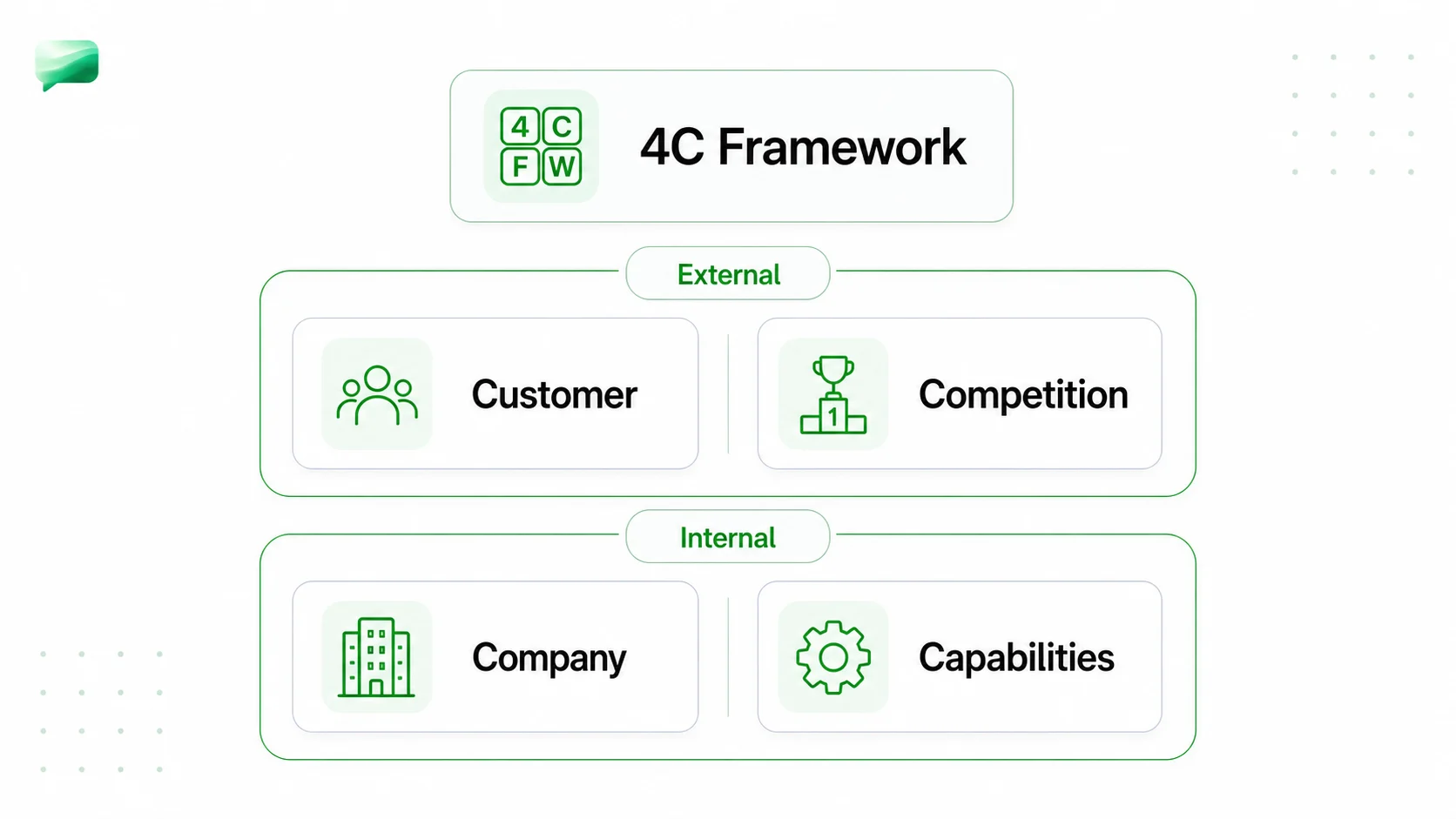
The reason the 4C survives despite the naming mess is that it maps cleanly onto the two questions every market case asks: is the market attractive, and can this company win in it? Customer and Competition answer the first (the external market), while Cost and Capabilities answer the second (the internal company). PrepLounge frames it the same way, treating Customer and Competition as external market factors and Cost and Capabilities as internal company factors.
The Consulting 4C Framework
- 01
Customer (external). Who buys, why, how many, and how fast that base is growing. Segment, size, and understand needs and channels.
- 02
Competition (external). Who else is in the market, how concentrated it is, and where the white space sits. Map share, positioning, and profitability.
- 03
Cost (internal). The economics of serving the market: cost drivers, fixed versus variable, and how the client's structure benchmarks against rivals.
- 04
Capabilities (internal). Whether the company can actually execute: talent, technology, capital, culture, and strategic assets.
Holding the external and internal halves apart is what keeps the structure MECE. A lot of weak answers blur Customer and Competition into one vague "market" bucket, or talk about the client's costs while they are supposed to be sizing demand. Naming the split out loud ("two external lenses on the market, then two internal lenses on the company") signals discipline before you have analyzed a single number. For the broader menu of structures this sits inside, the complete case interview frameworks guide shows where the 4C fits relative to profitability, value chain, and the rest.
Customer: who buys, and why
Customer is where most of the analysis lives, so resist the urge to treat it as one line. Build an issue tree instead. The first branch is segmentation, and PrepLounge lists five common lenses to cut the base by:
- Demographic (age, income, household, firm size for B2B)
- Geographic (region, urban versus rural, climate)
- Psychographic (values, lifestyle, attitudes)
- Behavioral (purchase occasion, brand loyalty, decision driver)
- Usage-based (heavy, medium, light, or non-users)
Once you have segments, walk each through the same questions: what is the need or problem, how large is the segment, how fast is it growing, how loyal and satisfied are these customers today, and through which distribution channels do they buy? A clean way to say this in the room is "I will size the addressable customer base, then within it test which segment has an unmet need we can serve, and how we would reach them." That moves you from a definition to a real diagnosis. If segmentation is your weak spot, the customer segmentation framework drills the cuts in more depth.
Competition: the battlefield
Competition tells you whether an attractive market is actually winnable. A market can be large and growing and still be a trap if three entrenched players own it. Map the landscape on a simple two-by-two (for example, market share against growth, or price against quality) and ask:
- Market share and concentration: is the market fragmented across many small players or dominated by a few? Fragmentation usually means easier entry.
- Positioning and white space: where do incumbents sit, and is there an unserved corner of the matrix?
- Strengths, weaknesses, and growth trends: who is gaining share, who is losing, and why?
- Profitability and pricing or marketing strategy: are incumbents making money, and how do they compete (price, brand, distribution)?
The honest test of this bucket is whether your competitive read changes the recommendation. If you would enter regardless of what the competitors look like, you have not really analyzed Competition, you have just listed it. To judge whether the overall market is worth fighting for, pair this with the market attractiveness framework, which formalizes size, growth, and competitive intensity into a go or no-go read.
Cost: where the money goes
Cost is the first internal lens and it is where the 4C earns its keep over a purely external 3C. Here you are asking whether the economics of serving the market actually work for this client. Break it into:
- Cost drivers: what are the biggest line items (materials, labor, logistics, customer acquisition)?
- Fixed versus variable: a high fixed-cost structure needs volume to break even, which changes the entry math entirely.
- Profitability by segment, product, or geography: averages lie. One segment can subsidize a money-losing one.
- Benchmarking: how does the client's cost structure compare to the incumbents you mapped under Competition? A structural cost disadvantage can sink an otherwise attractive entry.
The link back to Competition is the point: Cost is most powerful when you compare the client against rivals rather than in isolation. If the case is fundamentally about falling margins rather than a market decision, you are better off leading with the profitability framework and folding cost analysis into it.
Capabilities: can the client actually execute?
Capabilities is the bucket weak candidates skip, and it is often what separates a real recommendation from a theoretical one. A market can be attractive, the competition beatable, and the unit economics sound, and the answer can still be no if the client cannot execute. Test:
- Core competencies: what is the client genuinely good at, and does this opportunity sit inside or outside that?
- Talent and human resources: do they have the people, or would they have to build or buy them?
- Technology and operations: does their platform, supply chain, or IP transfer to the new market?
- Financial resources: can they fund the entry and absorb a slow ramp?
- Organizational culture and strategic assets: brand, distribution relationships, data, anything hard for rivals to copy.
The single question this bucket exists to answer is: can they actually pull this off? Pressure-testing capabilities is also what makes M&A and growth cases credible, which is why the M&A case framework leans heavily on capability fit and synergies.
When to use the 4C (and when another framework fits better)
The 4C is a market-and-execution lens, so reach for it when the prompt is about competing in a market:
- Market entry: should we enter market X? The 4C is close to purpose-built for this.
- Growth strategy: how do we grow in our current or adjacent markets?
- New-product launch: is there a customer, a beatable competitive set, sound economics, and the capability to ship?
- M&A and acquisition fit: does the target give us customers, cost synergies, or capabilities we lack?
Reach for something else when the prompt is narrower. A pure falling-profit problem is a profitability case. A question purely about market position with no internal execution angle is a 3C case. A go-to-market design question is a 4P case. Picking the right tool is itself a scored skill, and the complete frameworks guide lays out that decision tree.
A full worked example: a coffee chain enters India
Definitions are cheap. Here is the 4C run end to end on one prompt, with illustrative numbers, ending in an actual recommendation. Treat every figure as an assumption you would confirm with the interviewer, not a real statistic.
Prompt: QuickBrew, a US specialty coffee chain with 1,800 domestic stores, is considering entering India. Should it?
Customer. Assume India's urban middle class is the target. Suppose there are roughly 60 million urban households with the income to buy specialty coffee, growing at about 8% a year, but India is a tea-first market, so the behavioral segment that already drinks out-of-home coffee is small, maybe 10 million households, concentrated in six metros. The need is less "caffeine" and more "an affordable third place to sit." Distribution is mall and high-street footfall. Read: a real but narrow beachhead, growing fast, reachable through metro real estate.
Competition. Suppose two incumbents hold roughly 45% and 20% share, with a long fragmented tail. On a price-versus-experience two-by-two, the premium-experience corner is crowded but the mid-price, fast-service corner is thin. White space exists, but the two leaders have a decade of local supply chains.
Cost. Assume a US store costs $300K to open and runs at a 15% margin. In India, rent and labor are lower, so suppose store-level cost is $120K, but imported beans and equipment carry duties that push variable cost per cup up. Fixed costs are lower, variable costs are higher, so the break-even volume per store is reachable only in high-footfall metro sites. Benchmarked against incumbents who source beans domestically, QuickBrew starts with a 5 to 8 point cost-of-goods disadvantage.
Capabilities. QuickBrew has a strong brand and a proven store playbook, but no India supply chain, no local real-estate relationships, and a US-centric menu. Financially it can fund a 30-store pilot. Culturally it has never operated through a franchise or joint-venture model, which is how most foreign chains enter India.
Synthesis and recommendation. The market is attractive but narrow, the competition is beatable only in the underserved mid-price corner, the cost structure works only at metro footfall and carries a sourcing disadvantage, and the binding constraint is capabilities: no local supply chain or real-estate access. So the recommendation is not a flat yes or no. It is: enter, but through a joint venture with a local food-and-beverage operator, piloting 25 to 30 mid-price stores in three metros, and localize bean sourcing within 18 months to close the cost gap. That is a 4C answer: every bucket changed the recommendation, and the weakest C (Capabilities) drove the entry mode.
Apply the 4C buckets to a Bain growth strategy case. A US coffee chain with $1.5 billion in revenue wants a credible way to grow it. Answer this Bain growth strategy case step in the article, then continue the full case. Continue the full case on Road to Offer
Don't memorize: customize the buckets to the prompt
The most common mistake with the 4C is treating it as a rigid checklist and force-fitting all four buckets onto every prompt with equal weight. Real cases are lopsided, and a good structure is lopsided to match. The framework is a starting menu, not a script.
- Market entry: all four Cs carry weight, but Customer sizing and Capabilities (entry mode) usually dominate.
- Growth in an existing market: Customer and Competition shrink (you know the market) and Cost and Capabilities expand into "where can we add capacity or take share."
- M&A and acquisition fit: Cost becomes "cost synergies" and Capabilities becomes "capability gaps the target fills." Customer and Competition become "does the combined entity serve a bigger or stickier base."
- New-product launch: Customer (is there demand) and Capabilities (can we build and ship it) lead, while Cost folds into a quick unit-economics check.
Bending the framework like this is the difference between a candidate who learned four words and one who can think. The interviewer can tell within thirty seconds which one you are. For the failure modes to avoid, common consulting framework mistakes catalogs the force-fitting, the missing "so what," and the laundry-list structures that cost offers.
Try customizing the buckets yourself on a fresh 4C-shaped prompt before you read the next section.
Interactive drill set. Write an answer before revealing the worked solution, then continue into Road to Offer for scored practice and AI feedback.
How to present the 4C out loud
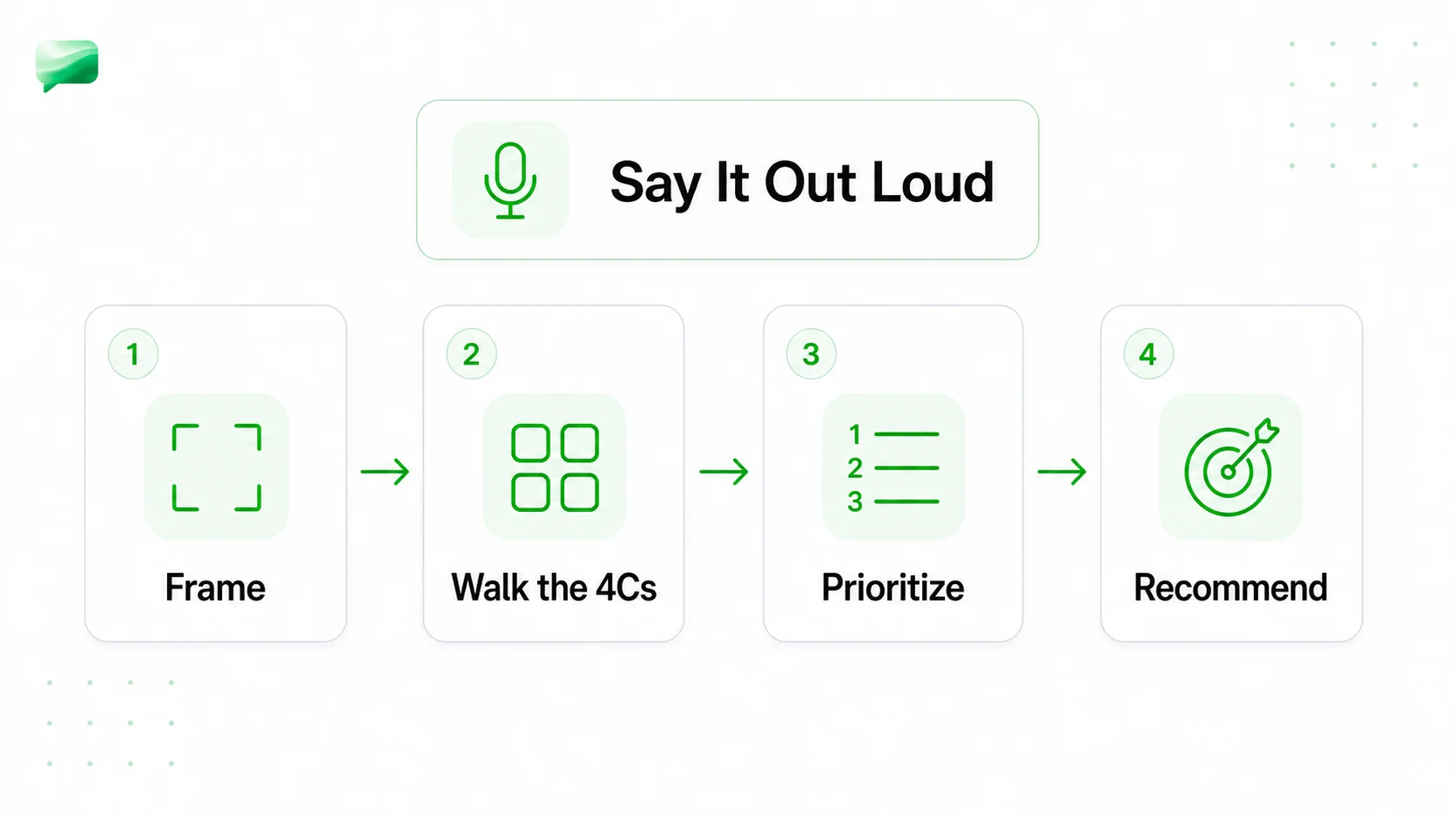
A framework you cannot deliver cleanly is worthless, so rehearse the delivery as much as the content. Three rules: lay it out MECE, signpost each bucket as you move, and tie everything back to the recommendation. Here is a script you can adapt almost verbatim.
Two delivery details make this land. Signpost every transition ("that covers the external picture, now to the internal side") so the interviewer never loses the thread. And after the analysis, close the loop explicitly: "Pulling the four Cs together, the binding constraint was Capabilities, which is why I recommend entering through a joint venture." If you want reps on building and delivering structures like this under time pressure, practice live rather than rereading lists, and the complete frameworks guide is the hub for the rest of the toolkit.
Practice the 4C live with AI feedback
Road to Offer scores your structure, signposting, and synthesis on real prompts so you find out whether your 4C actually lands before the interviewer does.
Putting it together
The 4C framework is powerful for one reason: it forces you to answer both halves of every market question, is this attractive and can we win, with a clean external-internal split that stays MECE under pressure. The mistakes are predictable. People confuse it with the marketing 4C, they recite four headers instead of customizing the buckets, and they list the Cs without letting them interact or drive a recommendation. Get those three right, run the analysis like the coffee-chain example rather than a definition list, and deliver it with clear signposting, and the 4C becomes one of the most reliable structures in your kit. Then move next door to the 3C, market entry, and market attractiveness frameworks so you can pick the right tool the moment the prompt lands.
See where your case structure stands
Run a free market-entry case, lay out the 4C, and benchmark your structure, math, and recommendation against what interviewers actually reward.
Sources
- PrepLounge: 4C framework basics (checked June 26, 2026)
- CaseBasix: 3C vs 4C framework (checked June 26, 2026)
- CaseBasix: 4C framework page (checked June 26, 2026)
- MConsultingPrep: case interview frameworks (checked June 26, 2026)
Frequently asked questions
Resources and related guides
- Practice the 4C framework in a real case interviewPractice
- Browse all free resourcesResource hub
- 3Cs Framework: Company, Customer, Competitor (Worked Example)Frameworks · Feb 6, 2026
- 4Ps Framework Case Interview: Product, Price, Place, PromotionFrameworks · Feb 6, 2026
- Ansoff Matrix vs BCG Matrix for Case InterviewsFrameworks · Jun 2, 2026
- Porter's Five Forces: Definition, Examples & Case UseFrameworks · Apr 25, 2026