
Sustainable Futures Lab
New 2026
Save $20$49
$29one-time
- Eleven SFL simulations
- Thirteen linked decisions per run
- Scored debrief on every decision
Road to Offer is independent and not affiliated with or endorsed by McKinsey. This is original practice content built from publicly available information about the assessment format, not a copy of the live assessment. Formats change between offices and recruiting cycles.
New to the Sustainable Futures Lab? Read the complete SFL guide below and the full McKinsey Solve guide.
One full simulation: 13 linked decisions on one project that you design, repair and then scale, with every decision reviewed when you finish. The company, facts and options are original Road to Offer content.
| Free | One full Sustainable Futures Lab simulation (Verdant Cart: a reusable delivery-tote pilot). Your free run shows your score; the full worked review opens with a one-time unlock or a plan. Additional simulations are in paid packs. |
|---|---|
| Decisions | 13 linked decisions. The project unfolds through them in order, and you have to keep your reasoning consistent from the first to the last. |
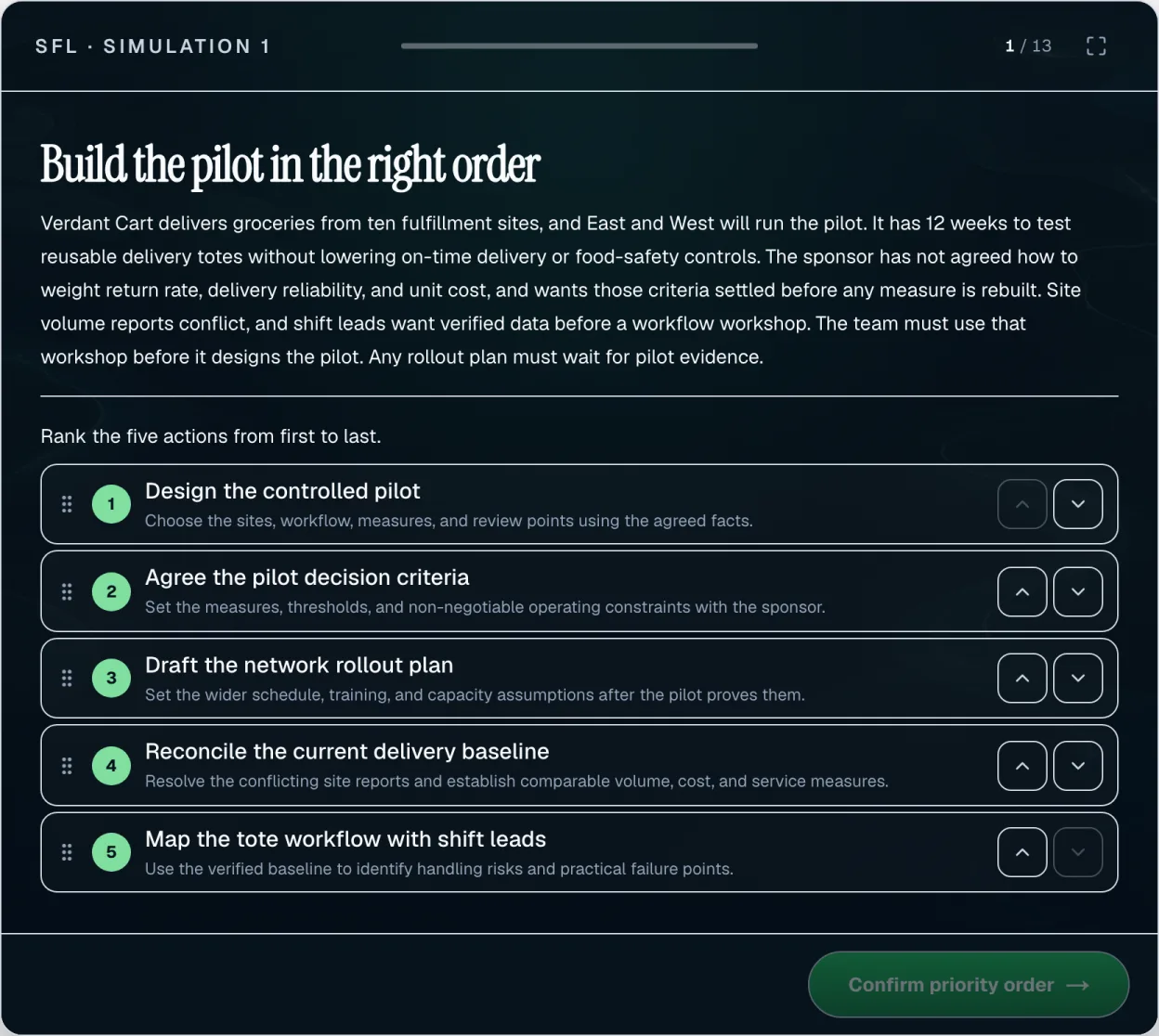
| Decision types | Mostly single-choice judgment calls under stated criteria, plus ordering tasks such as ranking five pilot actions from first to last. |
| Clock | Learning mode is untimed, with feedback after each decision. Simulation mode runs start to finish with feedback at the end. |
| Skills scored | Each decision counts toward prioritization, problem solving, adaptability, collaboration or stakeholder judgment. |
| Your result | Where your points went by skill, then every decision with your answer, the evidence that mattered and the rule to reuse next time. A practice percentile appears once enough runs of the same simulation exist. |
| Library | Eleven SFL simulations, from a foundation scenario to integrated capstones where each run adds a harder chain of decisions. |
The quick version: Sustainable Futures Lab is the judgment and prioritization module candidates report in longer McKinsey Solve invitations. McKinsey has not published a detailed official breakdown, so this simulation practices the underlying skills rather than replicating a live module.
Eleven simulations, $29 once. Simulation 1 is free.
Simulation 1 runs free, score only; the rest open with the game.
Rank the actions, then commit to one course of action each time.
Your answer beside the worked one, then three runs to fix it.
Finish 5 of 10 Sea Wolf and 5 of 10 Red Rock simulations first.
A sound choice can fail when the next fact changes the constraint. This simulation asks you to hold one business objective across a connected pilot, update your view when evidence changes, and separate a reversible test from a premature scale decision. Those habits transfer directly to case interviews: define the decision rule, use the evidence in front of you, and revise the plan without losing the objective.
Choose Learning or Simulation mode, then enter the Verdant Cart reusable-tote pilot. Decision 1 is a five-option ranking. The next 12 decisions ask what you would do as costs, operations, partner constraints, results, and the final board message change. Learning mode shows feedback after each decision and lets you retry a missed decision. Simulation mode keeps the run uninterrupted and reveals the review at the end. If you start signed out, Decision 1 is saved before a signup checkpoint; after signup, the same attempt resumes at Decision 2. Your final server-scored result is saved in History. One complete simulation is free; additional simulations are available in paid packs.
These patterns teach the method without revealing any answer from the simulation.
Resolve the definition and source before making the decision. A fast recommendation built on incompatible baselines only hides the uncertainty.
Align the measurement rule first, then compare the evidence.
Find the source of the variation before treating the average as the whole story. A site-level failure can point to an operational fix or prove that the model does not travel.
Diagnose the outlier before you make the scale decision.
State what the current evidence supports, name the open assumption, and define the next check that can change the decision.
Give a bounded recommendation with a clear condition for revision.
Each mistake replaces the decision rule with a shortcut.
McKinsey SFL, or Sustainable Futures Lab, is the judgment and prioritization module that candidates increasingly report in longer McKinsey Solve invitations during the 2026 recruiting cycle, typically arriving alongside the Redrock study and the Sea Wolf game. McKinsey itself describes Solve on its careers site as a gamified assessment of problem-solving ability and explicitly prohibits candidates from recording the live assessment, which means the company has published no detailed module-by-module breakdown and no legitimate preparation resource can offer you a replica. What candidate reports consistently describe is a module built around prioritizing competing initiatives against explicitly stated criteria and then handling the situational consequences of those choices, with comparatively little heavy computation relative to Redrock. The practical edge, therefore, is not module trivia but a habit: applying the stated criteria mechanically even when your instinct disagrees. One important caveat before you read further is that not every candidate receives SFL at all, since invitation length and module mix vary by office and cycle, so your own invitation email and on-screen tutorial are the only authorities on what you will actually sit.
Prep-provider write-ups (MyConsultingCoach and CaseBasix, checked August 31, 2026) describe Sustainable Futures Lab as a roughly 20-minute, text-based module about one project: a prioritization question where you rank options, then about a dozen scenario questions that follow the project from kickoff to final recommendation. McKinsey has not published this breakdown, so treat it as directional.
Road to Offer's free SFL simulation is one complete run of 13 linked decisions on one project, starting with a ranking task, and reviews every decision when you finish.
It is worth separating these two categories carefully, because most of the confident content circulating about SFL blurs them.
Officially, McKinsey states that Solve assesses problem-solving ability through gamified exercises, that it is used across consulting recruiting, and that candidates may not record or share the assessment. McKinsey has also publicly described its game-based innovation work, including the Sea Wolf premise of selecting and evaluating microbes to clean contamination. That is roughly the extent of the firm's published detail.
Candidate-reported, and therefore to be treated as directional rather than certain, are the following: that SFL centres on prioritization, stakeholder management, and decision-making under ambiguity; and that the module tracks how you reach a decision alongside the decision itself. Specific scoring weights, pass thresholds, and item counts circulating online have no official basis, and you should discount any resource that presents them as fact.
Strip away the sustainability framing and SFL is testing three things.
The first is whether you can apply a stated decision rule mechanically. A prioritization item hands you explicit criteria, usually ranked, and then offers an option that feels important but scores poorly against those criteria. Candidates who rank on instinct lose points to candidates who compute the criteria first. This is an error you can check for in practice.
The second is whether you treat constraints as constraints. When one initiative cannot begin until another is delivered, that dependency is not a tie-breaker to weigh against a strong ratio; it is a hard sequencing rule. Any ranking that violates it is wrong regardless of how good the numbers look.
The third is whether you can handle disagreement without either capitulating or stalling. Situational items typically present a stakeholder who objects to your answer and offers no new data. Reordering to keep the peace destroys the credibility of the process and invites everyone else to lobby. Going quiet until a scheduled meeting reads as evasive and lets opposition harden. The stronger move is to acknowledge the concern, show the criteria and the numbers, and create a concrete route forward. The judgment this rewards is the same disposition McKinsey probes in the Personal Experience Interview, where answers are scored on reasoning rather than on agreeing quickly.
First compute the criterion the prompt names. Then apply tie-breakers. Finally enforce dependencies.
Here is the method on an original example, separate from the free simulation above. A town ranks five flood initiatives by residents protected per $1M, and the volunteer alert network cannot run without the warning app.
Final order
The levee protects the most residents in total but ranks fourth: 18,000 residents for $3.6M is 5,000 per $1M.
Use three moves: acknowledge, evidence, action.
The weak extremes are capitulation and delay. Reordering solely to satisfy the loudest stakeholder makes the process arbitrary. Deferring without a clear next step lets uncertainty grow. A strong response stays open to new evidence while keeping the decision rule visible.
When reviewing a mistake, name the trap and rewrite the decision using the prompt's actual rule. This is more useful than memorizing which option was correct in one scenario.
Preparation for SFL is unusually cheap, because the skills are general and the module rewards discipline over knowledge.
Start by practicing the mechanical habit. Take any prioritization problem with stated criteria, write the criteria down before looking at the options, compute the relevant ratio for every option, and only then rank. Writing the ratios down makes this part of the decision checkable. Timed math drills make that arithmetic reflexive rather than effortful. Do this until it is automatic rather than something you remember to do.
Next, drill the dependency check. Before submitting any ranking, scan explicitly for sequencing constraints and confirm no dependent item precedes its blocker. This is a five-second check that candidates skip under time pressure.
Then rehearse the stakeholder response. For any objection with no new data attached, the shape of a strong answer is consistent: acknowledge the concern as legitimate, show the criteria and the numbers that produced the ranking, and offer a specific next step. Practicing that shape means you are not composing it from scratch on the day. Running the same acknowledge-then-evidence structure in behavioral practice builds the reflex under pressure.
Finally, practise under a clock while keeping the decision rule visible. Follow the time limit and expiry behavior in your actual tutorial; do not assume a practice timer's behavior applies to the live assessment.
Your invitation length does not establish which tasks you will receive. Prepare to read each task's tutorial and switch methods when the objective changes.
Sea Wolf is constraint satisfaction: filter candidates against disqualifying rules, then optimize the survivors against threshold constraints. The Sea Wolf practice simulation lets you run the filter-then-optimize loop free and carries the full Sea Wolf guide below it.
Redrock is exhibit reading and calculation across sequential phases, where the traps are units, fixed costs, and irrelevant-but-true facts rather than the arithmetic itself. The Redrock study guide goes phase by phase, and the Red Rock practice study offers a short free edition of Simulation 1, with additional simulations in paid packs.
SFL is judgment and prioritization, and it is the module where the least computation happens and the most instinct-versus-criteria conflict shows up. The SFL practice simulation above starts with Decision 1 before the signup checkpoint, then resumes the same 13-decision attempt at Decision 2.
The umbrella McKinsey Solve guide covers how the assessment sits within McKinsey's overall process, and all six firm assessment simulations Road to Offer publishes are collected on the assessment simulators page. The broader McKinsey case interview guide then covers the live-interview rounds that Solve is a gate for.
McKinsey and Solve are trademarks of McKinsey & Company. Road to Offer is independent and is not endorsed by McKinsey.
In Road to Offer’s Learning mode, read the feedback after a missed decision, then try again. Simulation mode saves your first answers for the scored debrief.

Turn your result into one focused practice rep: the decision you missed, worked through, and the next run that fixes it.